ponytug
Super Member
Thanks for the update, and congratulations on finding a few problems. Hopefully, it won't take much to make it right.
All the best,
Peter
All the best,
Peter

I’m still holding out hope I’m “getting off easy/cheap”…LOLConsidering what could have been wrong here you're getting off easy/cheap.
If by "relapping the edge" you mean spinning the valve against the valve seat with lapping compound, I would consider that a bare minimum for repair (in addition to a head gasket). I would eval your valve guides very carefully -why did the valve stick in the first place? Varnish? Guides shifted or oblong? Why did your pushrod bend? Was it indeed your hydraulic lifter and if so why did that happen when it's designed not to?
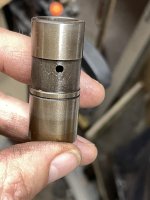
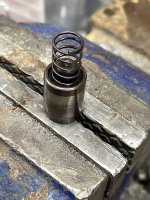
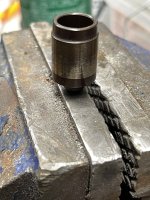
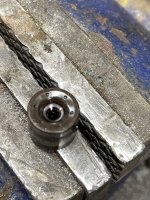
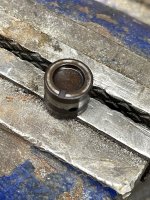
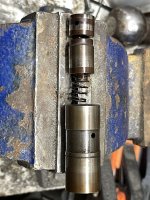
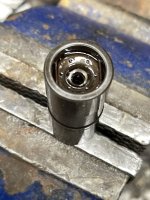
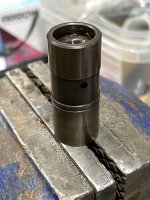
I would consider replacing the lifters as well as they seem to be varnished internally.I’m still holding out hope I’m “getting off easy/cheap”…LOL
Yes, that’s what I meant by “relapping”.
The guides—my thinking is the valve was sticking because of the buildup of crud, varnish, etc. I mean, it made a believer out of me to see how bad things can look with bad or wrong oils, lack of maintenance, etc.
The more I’ve learned about these lifters and then seeing the actual results before and after bleeding I could see how the rods would bend. (I cut off an end of an old rod and chucked it into a drill press, then tried to compress the lifter—I ended up having to use about as much pressure as my arms could do, to slowly push out/bleed the oil from inside. After a little while of doing that, they operated just fine, with finger pressure.)
Hope that helps explain a little better.
There are a variety of sludge / varnish remover products out there, e.g. SeaFoam in the oil, etc. I think any of them would help, and be a prudent course of action. I have used them to clean up various engines, and they all work, at least to some degree. My advice would be use one of them, run the engine hard for ten hours or so, change the oil and filter, add some more detergent / or Tuffoil, and do some accelerated oil changes for awhile.I would consider replacing the lifters as well as they seem to be varnished internally.
Seems like this engine has seen crappy oil, prolonged oil change periods, extended operation at borderline high temps, or a combination of the above.
I don't have any personal experience with detergent oils but from the pics and what you're describing I'm wondering if running with one for the first 10 or 20 hours before changing the oil with a good synthetic might be a good idea to reduce some of the deposits/varnish. Maybe others with experience can chime in here

Marvel mystery oil seems to work for me?
Have an Excursion with over 100k and a little valve train noise. Used the MMO and it runs like a sewing machine now-can hardly tell the engine is running.
I put MMO in everything now-including the PT1460.
Good luck.
LOL my wife laughs at me—I can’t let it go, like so many other things I’ve fixed…it might take a little time to dig into as much info/how-tos/videos as I can, but it always feels good to finally fix things. (Along with plenty of frustration and aggravation/4 letter wordsI admire your persistence.
 )
) Yes I’m going to replace them as well.I would also pull the other head and disassemble/clean the valve assemblies, lap the valves, and replace the lifters on the other cylinder as well. A sticky/intermittently closing valve on the other cylinder would explain the no compression one day then compression another day as you described

Wow! Yes, all very true and good, deeper thought. Replacing them and I believe “priming” them is in order as well.There are a variety of sludge / varnish remover products out there, e.g. SeaFoam in the oil, etc. I think any of them would help, and be a prudent course of action. I have used them to clean up various engines, and they all work, at least to some degree. My advice would be use one of them, run the engine hard for ten hours or so, change the oil and filter, add some more detergent / or Tuffoil, and do some accelerated oil changes for awhile.
It isn't my money, but having owned a number of engines with hydraulic lifters, I would change the hydraulic lifters. It is tough to get them clean without disassembly, and not all versions disassemble easily. They need oil to operate, and they really should not go in and out with finger pressure. I suspect that having forced the oil out of the lifter, where it was doing its job, you now have some air inside, allowing the motion with finger pressure. I think of the concept of a hydraulic lifter as using engine oil to expand the lifter to just the right height, keeping the valve clearance at the optimal height. If they are super springy, they won't keep the height up. (They need pressure to overcome the resistance of the valve springs after all.)
I think from the damage that your engine, @Modrob, has apparently had, there was probably a loss of lubrication, probably due to fuel in the oil, and you are working through the after effects.
I think that the good news is what you have found is all readily fixable.
All the best,
Peter

(To be fair and honest, this was from Sunday evening depart to Friday evening return, 2 trains, 2 busses each way, but we spent our FL time visiting the new 18 month-old granddaughter and daughter, and even squeezed in building a heavy/duty swing/play set for them.We’re FINALLY (hopefully) about to return home this evening after this Florida Amtrak train/bus round trip fiasco, and I’m now “recharged” and ready to tackle this motor with a renewed vigor!
(One more hour on this bus transfer, then board our last train for another 6 hours—let’s hope all goes as it should LOL)
 )
)2manyrocks and…her nice and polished stainless steel French door fridge ice maker went on the fritz awhile back. Ended up a couple of problems compounded the problem—after a couple weeks of hit-and-miss episodes of working on it, she was ready to just go buy a new fridge! What? I said…no way— it until I’ve given up…LOL (meanwhile I had bought a small countertop ice maker to get by withLOL my wife laughs at me—I can’t let it go, like so many other things I’ve fixed…it might take a little time to dig into as much info/how-tos/videos as I can, but it always feels good to finally fix things. (Along with plenty of frustration and aggravation/4 letter words
Wife says “just buy a new one” on about everything, (we are mid 60s and only married 3+ years) and I have to explain my brain can’t fathom paying the amounts of money to simply “buy” the new fixes…LOL
) I continued on, and with more great forum members’ help and guidance, learned how the whole ice maker system worked, and I finally got it fixed. Yep, it only took about a month, but that was having to mix in with other fix-it projects that seem to keep popping up…but another success!
I completely agree.LOL my wife laughs at me—I can’t let it go, like so many other things I’ve fixed…it might take a little time to dig into as much info/how-tos/videos as I can, but it always feels good to finally fix things. (Along with plenty of frustration and aggravation/4 letter words
Wife says “just buy a new one” on about everything, (we are mid 60s and only married 3+ years) and I have to explain my brain can’t fathom paying the amounts of money to simply “buy” the new fixes…LOL
I would. If there are no major deposits, no harm would be done. If there are deposits, the detergents/ degumming compounds will help get them off. I wouldn't worry about them removing something important.IF after replacing lifters, gaskets, etc…
Would trying to run some “cleaning” options to lessen the varnish, gumming, sludge, etc., cause some possible ring leaking??