You are using an out of date browser. It may not display this or other websites correctly.
You should upgrade or use an alternative browser.
You should upgrade or use an alternative browser.
Kubota B2710HSD front axel sheared off.
- Thread starter PETDOC
- Start date
- Views: 13439
More options
Who Replied?
/ Kubota B2710HSD front axel sheared off.
#41

5030
Rest in Peace
- Joined
- Feb 21, 2003
- Messages
- 28,967
- Location
- SE Michigan in the middle of nowhere
- Tractor
- Kubota M9000 HDCC3 M9000 HDC
In my opinion, overloading a front AXLE is very commonplace not only with smaller units but large ones as well. I've 'overloaded' the front axle on my M9's many times but I am also aware of the ramifications of doing just that and I don't ever have a 'counterweight on the back either which, in my opinion contributes to the eventual failure which in my case was the outboards on my open station M9 at 5500 hours. Could it have went longer without failing? Maybe, maybe not. Mechanical assemblies do wear out after all. Some sooner, some later but all of them do at some point. The insert bearings on mine got sloppy and contributed to the failure and I replaced everything before the issue got so bad that it destroyed the gears.
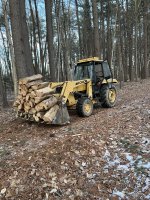
The bearings on my right front axel were fine. Actually my theory on why the axel sheared off may be tested in a few days. Replacement for left front axel arrives tomorrow. If the original left front axel has no cracks or indications of wear then M59’s posts will be spot on—need more data. When seeing my FEL's weight limit of 880 lbs I had a queasy feeling of 'did I ever overload my FEL?' Not really sure a full load of wet shag bark hickory (probably the heaviest wood I transported) would exceed 880 lbs.In my opinion, overloading a front AXLE is very commonplace not only with smaller units but large ones as well. I've 'overloaded' the front axle on my M9's many times but I am also aware of the ramifications of doing just that and I don't ever have a 'counterweight on the back either which, in my opinion contributes to the eventual failure which in my case was the outboards on my open station M9 at 5500 hours. Could it have went longer without failing? Maybe, maybe not. Mechanical assemblies do wear out after all. Some sooner, some later but all of them do at some point. The insert bearings on mine got sloppy and contributed to the failure and I replaced everything before the issue got so bad that it destroyed the gears.

rScotty
Super Member
- Joined
- Apr 21, 2001
- Messages
- 9,701
- Location
- Rural mountains - Colorado
- Tractor
- Kubota M59, JD530, JD310SG. Restoring Yanmar YM165D
In your original post you said,The bearings on my right front axel were fine. Actually my theory on why the axel sheared off may be tested in a few days. Replacement for left front axel arrives tomorrow. If the original left front axel has no cracks or indications of wear then M59’s posts will be spot on—need more data. When seeing my FEL's weight limit of 880 lbs I had a queasy feeling of 'did I ever overload my FEL?' Not really sure a full load of wet shag bark hickory (probably the heaviest wood I transported) would exceed 880 lbs.
" Over the years, I’ve hauled a lot of very heavy sections of trees from the site of a fallen tree to my log splitter. This is often been a trip of one to 2 miles on a gravel road. My assumption is that when cruising back to my place with a full load, every time I hit a bump the loaded bucket would transmit a sudden tremendous force on a narrow point of the axle....."
I'd say you nailed it with the bump theory. Those dynamic forces are far larger than the FEL load limit.
rScotty

ruffdog
Super Star Member
- Joined
- Dec 31, 2011
- Messages
- 12,492
- Location
- cowville, banana republic
- Tractor
- Bobcat Toolcat 5610G, Deere X744, Cub Cadet IH 982
^^Exactly! Speeding across rough terrain will greatly increase the loads induced to the equipment. With no suspension to dampen those shocks, it will be the weak links that fail, like an axle.In your original post you said,
" Over the years, I’ve hauled a lot of very heavy sections of trees from the site of a fallen tree to my log splitter. This is often been a trip of one to 2 miles on a gravel road. My assumption is that when cruising back to my place with a full load, every time I hit a bump the loaded bucket would transmit a sudden tremendous force on a narrow point of the axle....."
I'd say you nailed it with the bump theory. Those dynamic forces are far larger than the FEL load limit.
rScotty

old and tired
Veteran Member
- Joined
- Jan 15, 2019
- Messages
- 1,924
- Location
- Raleigh, NC/Hillsville, VA
- Tractor
- L2800 HST, 2005, R4 tires
Reported as a spammer!!!! All their posts are....Sounds like the front axle took a lot of stress over time, especially with hauling heavy loads on rough roads. ....
5030
Rest in Peace
- Joined
- Feb 21, 2003
- Messages
- 28,967
- Location
- SE Michigan in the middle of nowhere
- Tractor
- Kubota M9000 HDCC3 M9000 HDC
Time to add an hydraulic accumulator to the loader circuit. Actually any hydraulic line the feeds the loader will work but the ideal location would be the line that feeds the valve block.

DarkBlack
Elite Member
When it comes to determining force on the front spindles, the attachment point of the loader arms to the tractor frame is irrelevant, assuming the tractor is ridged. The force on the spindles is most directly impacted by the weight in the bucket, and that weight’s distance ahead of the spindles.Even if the manufacturer provides a written limit for front axle load how are you going to know when you have reached it given the mounting points of the FEL and their relationship to load transmission to both front and back end of the machine. That is exactly why, after Kubota America's engineer refused to provide me with a hard number, I realized knowing the number would not tell me what I needed to know, which is "What is the weakest link between the load carried by the bucket of FEL and the rest of machine. This is a FEA problem. Is it the loader arms, is it the loader arm pins, the bushings, etc, etc, etc.
You found a weak link ( the spindle to hub attachment ) but why must be answered if you are trying to craft a solution that assures a non repeat of this failure and there are many reasons for metallurgical failures.
Last edited:
DarkBlack
Elite Member
There may be no visible physical changes, but they might have changed/improved the steel type, heat treatment and tempering.You are correct on the newer version of the front axels (see pictures); however, the older B series can't use the newer version of the front axel. Axel type is based on tractor serial number. You've got to dance with the one that brung you.View attachment 2307203View attachment 2307206
DarkBlack
Elite Member
I’ll say, with my Massy, it’s easy to know if I have a light or heavy load on the front axle, by the ease of steering with the power assist. If I have a heavy implement on the 3ph, I can steer it with a finger. If I have a load in the bucket and nothing on the 3ph, it takes some effort to turn the steering wheel, and it gives a good reminder, that I should have a counterweight

Sawyer Rob
Super Member
That's called wishful thinking..There may be no visible physical changes, but they might have changed/improved the steel type, heat treatment and tempering.
I'll bet you, Kubota figures the steel ect.. is good enough, IF you aren't overloading the front end!
You don't have to read long on this forum to find people trying to make a "farm tractor" out of a tinkertoy tractor.
SR
We have replaced ours a couple times along with many bearings in the housing .
The tractor has had very little loader use as well so they are a weak point without overloading I have broken them pulling bush hog loader not even being used but if you do heavy loader work be warned they will break but not hard to replace
The tractor has had very little loader use as well so they are a weak point without overloading I have broken them pulling bush hog loader not even being used but if you do heavy loader work be warned they will break but not hard to replace
AnotherBueller
Gold Member
Think about 2 kids on a teeter totter, one heavy and close to the privet point, the other lighter but further away. If you try to lit the heavy end with no one on the other end you are lifting the entire weight, but as soon as there is some weight on the other side, no matter how much the amount you lift is less.The thing about counter weights is that they don't lower the load on the front axle until you get enough weight on them that you're pivoting on the rear axle and actually lifting the front wheels. You can actually increase the weight on the front axle even more if you have a counter weight and then lift enough in the loader to lighten the rear. It takes a tremendous amount of weight to counter that, to the point where, in many cases, you have to overload the rear axle in order to get enough weight to lessen the load on the front. Counter weight is still a good idea, of course, but it's not going to significantly lessen the load on the front axle, in most cases.
Think of a pry bar that lets you move a big rock. It's the same kind of idea.

ptsg
Super Member
Pretty sure the same people could break the so called "farm tractors" just as easily.That's called wishful thinking..
I'll bet you, Kubota figures the steel ect.. is good enough, IF you aren't overloading the front end!
You don't have to read long on this forum to find people trying to make a "farm tractor" out of a tinkertoy tractor.
SR
The more time I spend on forums, the more I realize that people just seem to have this desire to constantly max the loader capacities on their tractors for really no good reason.
On the other hand, they seem completely afraid of pulling a good loaded trailer as if a tractor wasn't designed to do just that.
M59
Platinum Member
- Joined
- Oct 27, 2014
- Messages
- 565
- Location
- Fairview NC
- Tractor
- Kubota M59 TLB/ Mahindra Max 24 TLB/ KX-080-5
There is a simple solution to see the actual static load on the front end of the tractor however is requires money and effort. Once the "heavy" load is in place then jack up tractor's front end so each of the front wheels are off the ground and place a unyielding metal plate ( 1/2" steel ) onto ground and add a scale to each plate and lower tractor back onto scales. You now have direct reading of static load on front axle and load per each front bearing/ wheel. For grins and giggles then add the load a number of contributors have suggested to the 3 pt hitch and see how much load comes off the front end.
The above is the simplest way to understand and grasp the actual static front axle load. Dynamic load could be somewhat quantified by suspending the load in the bucket from a scale. What is the static load when suspended but not moving? What is the highest displayed load on scale when moving as this implied load would be transferred to the front axle in roughly the same proportion as the static load per scale and the scales under each front wheel.
Not a simple solution but the easiest means to better understand the forces you are dealing with.
The above is the simplest way to understand and grasp the actual static front axle load. Dynamic load could be somewhat quantified by suspending the load in the bucket from a scale. What is the static load when suspended but not moving? What is the highest displayed load on scale when moving as this implied load would be transferred to the front axle in roughly the same proportion as the static load per scale and the scales under each front wheel.
Not a simple solution but the easiest means to better understand the forces you are dealing with.
Sort of like what Messick's did in linked YouTube on post #3. Clearly demonstrated counterweight helps reduce front axel load.There is a simple solution to see the actual static load on the front end of the tractor however is requires money and effort. Once the "heavy" load is in place then jack up tractor's front end so each of the front wheels are off the ground and place a unyielding metal plate ( 1/2" steel ) onto ground and add a scale to each plate and lower tractor back onto scales. You now have direct reading of static load on front axle and load per each front bearing/ wheel. For grins and giggles then add the load a number of contributors have suggested to the 3 pt hitch and see how much load comes off the front end.
The above is the simplest way to understand and grasp the actual static front axle load. Dynamic load could be somewhat quantified by suspending the load in the bucket from a scale. What is the static load when suspended but not moving? What is the highest displayed load on scale when moving as this implied load would be transferred to the front axle in roughly the same proportion as the static load per scale and the scales under each front wheel.
Not a simple solution but the easiest means to better understand the forces you are dealing with.
IndyIan
Veteran Member

Free Beam Calculator | ClearCalcs
The most powerful online free beam calculator. Easily model shear, moment, and deflection, with unlimited supports, interactive diagrams, and instant results.
 app.clearcalcs.com
When I have time and if I remember, I might measure my tractor for and enter it in. Weights will be estimated, but the main idea is to find out if a rear counter weight does significantly reduce the load on the front axle. I assume it does, but I've never done the math.



