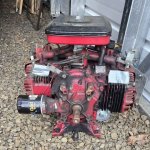
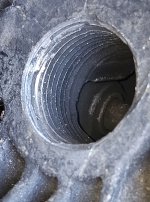
I'm hoping I can get some help identifying the size of these threads on this engine. I picked up a replacement engine for my garden tractor and all is good except for the threads in the exhaust ports. This is a Briggs opposed twin flathead, model 422447. The previous owner tried to thread 3/4" NPT pipe fittings in and mangled the threads. I'm hoping I can clean these up with a tap but I need to identify what they are first. If all else fails, I can use the tapped holes on either side of the port to mount a flange but I'd rather not deal with gaskets. One side isn't too bad but the other is looking pretty taxed. Are these normally 3/4" NPT and the previous owner just overtightened or could these be 3/4" NPS? Any advice is much appreciated.
You are using an out of date browser. It may not display this or other websites correctly.
You should upgrade or use an alternative browser.
You should upgrade or use an alternative browser.
More options
Who Replied?
/ Briggs exhaust port thread ID
#1

DJ54
Elite Member
- Joined
- Jan 20, 2009
- Messages
- 4,629
- Location
- Carroll, Ohio
- Tractor
- IH Farmall 656 gas/ IH 240 Utility/ 2, Super C Farmalls/ 2, Farmall A's/ Farmall BN/McCormick-Deering OS-6/McCormick-Deering O-4/ '36 Farmall F-12/ 480 Case hoe. '65 Ford 2000 3 cyl., 4 spd. w/3 spd Aux. Trans
Looking up the model number engine, then finding an online parts manual showing exhaust parts, it appears that an adapter was used picture below. L&R have different P/N's and different prices.

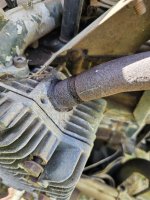
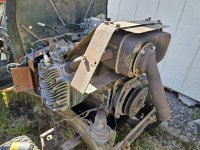
Right, that is a last resort option that is not original to the tractor. I'll have to take a pic of the exhaust setup and post it later today. The exhaust setup appears to be original and is threaded directly into the ports on the original engine then straight into muffler mounted high and to the front. These engines were used in a lot of different applications so I'm sure there are different setups. If I can keep something close to the original setup I can keep the original heat shielding in place as well.
mrmikey
Elite Member
I believe it 3/4" NPT
I've read many threads on this trying to figure out what exactly these threads are. I can confirm mrmikey, the threads of at least the stock nipple on the briggs opposed twin engine I have are in fact 3/4" NPT. I removed the original threaded fittings today and they are definitely tapered 3/4"-14 NPT threads. I can also say that the depth of the threaded hole in the block is well past the max engagement. Once the fitting/pipe is as tight as it should get, there is still a good 1/2" of threaded hole left. If you try and tighten any further you will start stripping out the block. Notice in the attached pics that you can get only about 4-5 turns. On a standard pipe fitting that still leaves a lot of exposed thread left. The previous owner of this block kept going and damaged the threads. I'm not a pro at NPT fittings and not familiar with what would be considered normal. Also in my ignorance, I can't confirm what the threads in the block actually are, only what the original fitting was.
Attachments
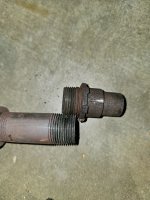
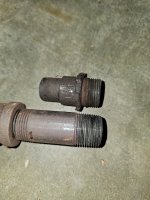

RandyT
Elite Member
You do realize that the ring around the fitting with the spikes sticking out is a separate piece and is actually a lock ring that you tighten to hold the fitting in place after installing the threaded portion by hand.I've read many threads on this trying to figure out what exactly these threads are. I can confirm mrmikey, the threads of at least the stock nipple on the briggs opposed twin engine I have are in fact 3/4" NPT. I removed the original threaded fittings today and they are definitely tapered 3/4"-14 NPT threads. I can also say that the depth of the threaded hole in the block is well past the max engagement. Once the fitting/pipe is as tight as it should get, there is still a good 1/2" of threaded hole left. If you try and tighten any further you will start stripping out the block. Notice in the attached pics that you can get only about 4-5 turns. On a standard pipe fitting that still leaves a lot of exposed thread left. The previous owner of this block kept going and damaged the threads. I'm not a pro at NPT fittings and not familiar with what would be considered normal. Also in my ignorance, I can't confirm what the threads in the block actually are, only what the original fitting was.

jigs_n_fixtures
Veteran Member
The first photo of his cylinder head has threaded holes adjacent to the exhaust port. Which might be for the adapter in post #2.You do realize that the ring around the fitting with the spikes sticking out is a separate piece and is actually a lock ring that you tighten to hold the fitting in place after installing the threaded portion by hand.
RandyT
Elite Member
I am sure it is. And I have seen both styles used on engines over the years. A lot of that choice is whatever the mower manufacturer wanted to use. So either the threaded insert or the bolt on could of been used depending on the exact engine type code.The first photo of his cylinder head has threaded holes adjacent to the exhaust port. Which might be for the adapter in post #2.

5030
Rest in Peace
- Joined
- Feb 21, 2003
- Messages
- 28,967
- Location
- SE Michigan in the middle of nowhere
- Tractor
- Kubota M9000 HDCC3 M9000 HDC
If it was mine, I'd use the 2 bolt external flange and a suitable exhaust gasket. Reason being is the exhaust port will flow better minus the restriction of the threaded pipe inserted in the port. and..
I'd clean up the buggered threads already in the port as they could cause hot spots while the motor is running. Have a similar engine sitting in the shop and mine is threaded 3/4" NPT. Iy has no exhaust system on it presently and it appears in the application it came out of, the internal threads were never used. Instead an external 2 bolt flange was.
Keep in mind that a 3/4" NPT tap will be an expensive date. I could loan you one if you want to go that route however.
Threaded engagement on any NPT threaded hole will entirely depend on how deep the tap was inserted initially. Usually, engagement of 2 or 3 complete revolutions of whatever you install is enough. It's a tapered engagement so sealing is always dependent on the taper, not the actual physical insertion. Works the same way when threading pipe.
I'd clean up the buggered threads already in the port as they could cause hot spots while the motor is running. Have a similar engine sitting in the shop and mine is threaded 3/4" NPT. Iy has no exhaust system on it presently and it appears in the application it came out of, the internal threads were never used. Instead an external 2 bolt flange was.
Keep in mind that a 3/4" NPT tap will be an expensive date. I could loan you one if you want to go that route however.
Threaded engagement on any NPT threaded hole will entirely depend on how deep the tap was inserted initially. Usually, engagement of 2 or 3 complete revolutions of whatever you install is enough. It's a tapered engagement so sealing is always dependent on the taper, not the actual physical insertion. Works the same way when threading pipe.
Thanks all for the input on this. My original thinking was keeping the original setup so the muffler ends up in the same place and I can keep all the original heat shielding and brackets. The muffler has bolts in the back of it for mounting to an existing bracket. I would need to keep the same spacing on everything for it all to fit, which means the engagement of the muffler on the exhaust fitting would need to be the same distance off the block. The 3/4" NPT tap was only 15 bucks but thank you 5030 for the offer, I appreciate it. The right port appears to be cross threaded and some chunks busted out of the threads, lining up the tap properly is going to be tricky if even possible. The left port looks usable as is. Or, I ditch all that and just throw on some generic muffler. The threaded holes on either side of the ports are in great shape so either way it looks like I have options. My boys are having fun working on it so it's all a win for them.
mrmikey
Elite Member
Watch when you run the tap in you don't go too deep. Yours could be different I can't tell but on the smaller BS engine the intake valve stem is right there, go too deep and you're into the valve. Ask me how I know  .
.
.
5030
Rest in Peace
- Joined
- Feb 21, 2003
- Messages
- 28,967
- Location
- SE Michigan in the middle of nowhere
- Tractor
- Kubota M9000 HDCC3 M9000 HDC
The depth will entirely depend on if the tap is a bottoming tap or not, but in any case with NPT threads, you don't need to run the tap in far as the tapered design of the tap only needs 3-4 full threads. Bottoming taps will have thread profiles to almost the end of the tap whereas other taps (through taps) won't have thread profiles to the very end and pipe taps are only supposed to cut 3-4 full threads anyway. If I was doing it, I'd remove the head and do it on the bench with the head secured in a vise anyway.
mrmikey
Elite Member
Didn't think there was such a thing as a bottoming pipe tap it being a tapered thread?
5030
Rest in Peace
- Joined
- Feb 21, 2003
- Messages
- 28,967
- Location
- SE Michigan in the middle of nowhere
- Tractor
- Kubota M9000 HDCC3 M9000 HDC
There is sort of... If you run the tap in too deep all you do is defeat the purpose of the tapered tap.Didn't think there was such a thing as a bottoming pipe tap it being a tapered thread?
ultrarunner
Epic Contributor
- Joined
- Apr 6, 2004
- Messages
- 28,906
- Tractor
- Cat D3, Deere 110 TLB, Kubota BX23 and L3800 and RTV900 with restored 1948 Deere M, 1949 Farmall Cub, 1953 Ford Jubliee and 1957 Ford 740 Row Crop, Craftsman Mower, Deere 350C Dozer 50 assorted vehicles from 1905 to 2006
Early on rehabbing old houses one of the first expensive purchase was a set of pipe taps to 1.5” size starting at 1/8 th
Can’t tell you how many times being able to clean up buggered pipe treads proved to be a real time saver… and more than a few times this included small engine muffler work.
A tap loaded with grease will capture a lot of the threading chips…
Can’t tell you how many times being able to clean up buggered pipe treads proved to be a real time saver… and more than a few times this included small engine muffler work.
A tap loaded with grease will capture a lot of the threading chips…
etpm
Veteran Member
- Joined
- Jun 30, 2021
- Messages
- 2,338
- Location
- Whidbey Island, WA
- Tractor
- Yanmar YM2310, Honda H5013, Case 580 CK, Ford 9N
Yeah, bottoming pipe taps are common in machine shops. Oftentimes there is not enough material to use a regular pipe tap so either a bottoming tap is used or a regular tap is used and then a bottoming tap is used to get full threads. With CNC machines so common now pipe threads are milled instead of a tap being used, especially when larger pipe threads are needed. The torque requIred for larger diameter pipe threads is quite high so thread milling is the preferred method now. In my shop any pipe thread larger than 1/4 was usually milled. Faster to mill than tap too.Didn't think there was such a thing as a bottoming pipe tap it being a tapered thread?
Eric

Here are some similar links:


- Replies
- 14
- Views
- 13K