JD4300 -- Catastrophic Failure of the Shift Shaft

/ JD4300 -- Catastrophic Failure of the Shift Shaft #1  

reasley

Silver Member
Joined
Jun 26, 2007
Messages
109
Good evening, fellow JD owners --

I have a 4300 CUT with 4WD and HST. The range shift lever has always been stiff going into the 3 different ranges but this is always aided by hitting the right RPMs -- right off of idle.

Anyway, today I was doing some fork lift to trailer work and tried to shift from "C" range to "B" range. When I felt the range lever give, I knew exactly what had happened -- the shift rod had broken somewhere along its length.

My initial reaction was "I seem to remember this problem being discussed on TractorByNet and I remember splitting the tractor was necessary." Hopefully, my memory is faulty and I'm thinking of something else.

When I looked under the tractor, sure enough, the rod had snapped about 1/8" or so into the case. After removing the shift linkage coupler down there, I looked at the stubby piece of the shaft that was hanging out of it. Evidently, there is a portion of the shaft near that lever (maybe right inside the case) that is smaller in circumference than the rest of the shaft. That is where the shaft broke and it certainly appears that rust was a contributing factor to the failure.

Anyway, I immediately came home and looked carefully through the factory technical manual and the on-line parts catalog and it *seems* that there may be a possibility that the rockshaft cover can be removed to access the shaft inside (which is attached by a spring pin) -- and, if that is correct, then I should be able to slide the shaft out of the case once the left wheel is removed.

My questions to those familiar with the part:

1) Can the shaft indeed be replaced w/o splitting the tractor?
2) If so, how much time for the job? If not, how much time for the split and subsequent replacement?
3) If this failure possibly indicative of a shifting problem internally? [Note: I don't *think* so, because it has always shifted fine (albeit a little stiffly at times) prior to the shaft breakage.]

Finally, I know what I am certainly going to do when the repair is complete -- I will heavily coat that shaft area on the outside of the case with a heavy duty grease so that there is no way that moisture can penetrate it -- and I will check that area regularly.

In advance, thanks for any advice/assistance provided.

Richard Easley
 
/ JD4300 -- Catastrophic Failure of the Shift Shaft #2  
I have a 4200 HST and I always have trouble finding "B" range; but other than that no problems to date. How many hours on your 4300? I have 450+/- hours on mine.

Keep us apprised of what you experience getting your rig back online.
 
/ JD4300 -- Catastrophic Failure of the Shift Shaft #3  
reasley said:
Good evening, fellow JD owners --

I have a 4300 CUT with 4WD and HST. The range shift lever has always been stiff going into the 3 different ranges but this is always aided by hitting the right RPMs -- right off of idle.

Anyway, today I was doing some fork lift to trailer work and tried to shift from "C" range to "B" range. When I felt the range lever give, I knew exactly what had happened -- the shift rod had broken somewhere along its length.

My initial reaction was "I seem to remember this problem being discussed on TractorByNet and I remember splitting the tractor was necessary." Hopefully, my memory is faulty and I'm thinking of something else.

When I looked under the tractor, sure enough, the rod had snapped about 1/8" or so into the case. After removing the shift linkage coupler down there, I looked at the stubby piece of the shaft that was hanging out of it. Evidently, there is a portion of the shaft near that lever (maybe right inside the case) that is smaller in circumference than the rest of the shaft. That is where the shaft broke and it certainly appears that rust was a contributing factor to the failure.

Anyway, I immediately came home and looked carefully through the factory technical manual and the on-line parts catalog and it *seems* that there may be a possibility that the rockshaft cover can be removed to access the shaft inside (which is attached by a spring pin) -- and, if that is correct, then I should be able to slide the shaft out of the case once the left wheel is removed.

My questions to those familiar with the part:

1) Can the shaft indeed be replaced w/o splitting the tractor?
2) If so, how much time for the job? If not, how much time for the split and subsequent replacement?
3) If this failure possibly indicative of a shifting problem internally? [Note: I don't *think* so, because it has always shifted fine (albeit a little stiffly at times) prior to the shaft breakage.]

Finally, I know what I am certainly going to do when the repair is complete -- I will heavily coat that shaft area on the outside of the case with a heavy duty grease so that there is no way that moisture can penetrate it -- and I will check that area regularly.

In advance, thanks for any advice/assistance provided.

Richard Easley

Richard,

Not sure what year your 4300 is but there was an in line change to the range shifting in early 2000. An improved range shifter was made available to retro fit earlier tractors.

You might want to enter your serial number in the Deere product improvement web page and see what comes up. Product Improvement Process : : John Deere
 
/ JD4300 -- Catastrophic Failure of the Shift Shaft
  • Thread Starter
#4  
Thanks for the feedback Jim and mjncad --

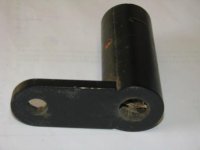
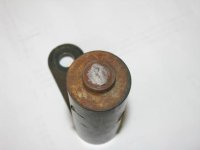
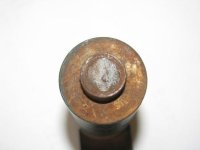
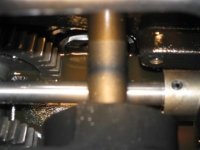
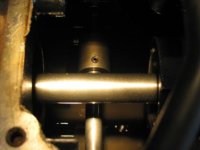
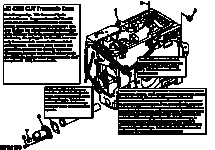
I just edited a jpg file (attached) that describes the scenario that I face and also some pictures of the lever with the broken shaft shown. I am pretty confident that I can do this repair by removing the rockshaft cover but I will probably wait for a day or two to begin in case I get contradictory info.

There is another possible alternative that is up for consideration. It could be either a permanent solution or, at least, a temporary solution until I allocate time to do the major repair at a more convenient time. It appears that I could drill and thread the remaining portion of the shaft (remember, it is nestled very securely in the sleeve bearing in the transaxle case and is about 1/8" inside that sleeve bearing), locktite it, and attach a shaft extension to that thread part. Short-term, I could then shift the tractor to the "B" range and leave it there until the full repair or possible even longer term, but quite judiciously, of course. Again, the shaft is 5/8", so I feel confident that this could be done.

Jim, I went to jdparts.com and found the update that you mention. I think that this provides a stronger bolt combination up at the range selector pivot point, which is about a foot or so away from the actual shift lever on the transaxle case.

Again, note the attachments and feedback on my thinking about the repair encouraged and welcome!

Richard Easley
 

Attachments

  • Transaxle Housing Diagram.gif
    Transaxle Housing Diagram.gif
    26.8 KB · Views: 1,218
  • leverasviewed goingintotransaxlecase.jpg
    leverasviewed goingintotransaxlecase.jpg
    12.8 KB · Views: 697
  • Notebrokenshinycenterofshaft.jpg
    Notebrokenshinycenterofshaft.jpg
    12.7 KB · Views: 767
  • Noterustyringaroundperimeter ofshaft.jpg
    Noterustyringaroundperimeter ofshaft.jpg
    14.7 KB · Views: 660
/ JD4300 -- Catastrophic Failure of the Shift Shaft #5  
reasley said:
Thanks for the feedback Jim and mjncad --

I just edited a jpg file (attached) that describes the scenario that I face and also some pictures of the lever with the broken shaft shown. I am pretty confident that I can do this repair by removing the rockshaft cover but I will probably wait for a day or two to begin in case I get contradictory info.

There is another possible alternative that is up for consideration. It could be either a permanent solution or, at least, a temporary solution until I allocate time to do the major repair at a more convenient time. It appears that I could drill and thread the remaining portion of the shaft (remember, it is nestled very securely in the sleeve bearing in the transaxle case and is about 1/8" inside that sleeve bearing), locktite it, and attach a shaft extension to that thread part. Short-term, I could then shift the tractor to the "B" range and leave it there until the full repair or possible even longer term, but quite judiciously, of course. Again, the shaft is 5/8", so I feel confident that this could be done.

Jim, I went to jdparts.com and found the update that you mention. I think that this provides a stronger bolt combination up at the range selector pivot point, which is about a foot or so away from the actual shift lever on the transaxle case.

Again, note the attachments and feedback on my thinking about the repair encouraged and welcome!

Richard Easley


Richard,

The update is a moot point. The pictures that you posted confirm that you either have the update or your tractor was manufactured after the in line change. The original setup was simply a shift lever welded to the lever that is pinned to the end of the shaft. I owned a first year 4200, and from your description of the difficulty changing ranges on your tractor, I suspected that you might have an early tractor.

Your idea of drilling and tapping the shaft is a good one. I don't think that loctite will be sufficient, though. You might be better served to use a bolt with lots of thread and a jam nut. You may have to craft a sleeve that is a smaller od than the transmission hole to prevent the jam nut from contacting the outside of the transmission housing.

There is one thing that I noticed when I was looking at my manual of which you need to be aware. Step 3 of "Range Transmission Removal and Installation" Remove spring pin (C) from shift lever arm. Push shift shaft into the case as far as it will go.

It sounds as though the shaft may retreat a bit when you drill it and it appears that the position of the shift shaft may also serve to retain engagement of the internal lever to the shifter block. You'll probably need to measure and get it fairly close to the original position prior to attempting shifting. The exploded illustration in my manual (labeled M95029) shows the lever (2) to be quite narrow where it engages the shifter block and I suspect that there isn't much margin for error.

Is the hole on the other side of the transmission case blind? If not, you might be able to tap the shaft out far enough to weld a bolt to the end where it twisted off. It would probably be a lot easier than drilling and tapping and more likely be a candidate for a more or less permanent repair. Take a look at illustration M94864 - step 13 in the installation section. I'm not sure if the shaft will come out that far with the internal shift lever installed - might have been removed for the purposes of illustration - but it is worthy of some thought.


Hope this helps.
 
/ JD4300 -- Catastrophic Failure of the Shift Shaft
  • Thread Starter
#6  
Jim_Fisher said:
Richard,

The update is a moot point. The pictures that you posted confirm that you either have the update or your tractor was manufactured after the in line change. The original setup was simply a shift lever welded to the lever that is pinned to the end of the shaft. I owned a first year 4200, and from your description of the difficulty changing ranges on your tractor, I suspected that you might have an early tractor.

Your idea of drilling and tapping the shaft is a good one. I don't think that loctite will be sufficient, though. You might be better served to use a bolt with lots of thread and a jam nut. You may have to craft a sleeve that is a smaller od than the transmission hole to prevent the jam nut from contacting the outside of the transmission housing.

There is one thing that I noticed when I was looking at my manual of which you need to be aware. Step 3 of "Range Transmission Removal and Installation" Remove spring pin (C) from shift lever arm. Push shift shaft into the case as far as it will go.

It sounds as though the shaft may retreat a bit when you drill it and it appears that the position of the shift shaft may also serve to retain engagement of the internal lever to the shifter block. You'll probably need to measure and get it fairly close to the original position prior to attempting shifting. The exploded illustration in my manual (labeled M95029) shows the lever (2) to be quite narrow where it engages the shifter block and I suspect that there isn't much margin for error.

Is the hole on the other side of the transmission case blind? If not, you might be able to tap the shaft out far enough to weld a bolt to the end where it twisted off. It would probably be a lot easier than drilling and tapping and more likely be a candidate for a more or less permanent repair. Take a look at illustration M94864 - step 13 in the installation section. I'm not sure if the shaft will come out that far with the internal shift lever installed - might have been removed for the purposes of illustration - but it is worthy of some thought.


Hope this helps.

Jim, thanks so much for reviewing the manual and my post. You and I are on the same page on this thing.

One major thing that I discovered this afternoon: the lever was installed backwards at the factory. Yes, that is correct -- it is installed backwards -- look again at M94864. Note how the lever butts against the transmission case? Mine doesn't -- it was installed with the lever about 2" out from the case, and that explains the continued angular strain on the shaft (keep in mind the built-in ridge on the shaft, too, right inside the case). Really ticks me off -- this thing has had undue stress on it since new because of an assembly error. [Note: the only other thing that would explain its incorrect attachment is maybe this was the original attachment method and the factory changed it over time, but I doubt it, because the picture in the manual shows the "correct" way and there is no reference to earlier differences.]

You make a great point about checking the other side for an attachment point -- I had already looked over the manual and parts diagrams extensively and had concluded that it was "free floating" though I knew that didn't make sense. Note that I've sat on looking at it closer physically for 24 hours because I was so frustrated that this happened, but I'm on my way up to the stable now to check it out, and the first thing that I'll do is look for te shaft protruding out the other side -- if that is the case, then I think that we can definitely work with the weldable solution.

Again, thanks so much for the reply. I'll post later on tonight on what I find . . .

Richard Easley
 
/ JD4300 -- Catastrophic Failure of the Shift Shaft #7  
reasley said:
Jim, thanks so much for reviewing the manual and my post. You and I are on the same page on this thing.

One major thing that I discovered this afternoon: the lever was installed backwards at the factory. Yes, that is correct -- it is installed backwards -- look again at M94864. Note how the lever butts against the transmission case? Mine doesn't -- it was installed with the lever about 2" out from the case, and that explains the continued angular strain on the shaft (keep in mind the built-in ridge on the shaft, too, right inside the case). Really ticks me off -- this thing has had undue stress on it since new because of an assembly error. [Note: the only other thing that would explain its incorrect attachment is maybe this was the original attachment method and the factory changed it over time, but I doubt it, because the picture in the manual shows the "correct" way and there is no reference to earlier differences.]

You make a great point about checking the other side for an attachment point -- I had already looked over the manual and parts diagrams extensively and had concluded that it was "free floating" though I knew that didn't make sense. Note that I've sat on looking at it closer physically for 24 hours because I was so frustrated that this happened, but I'm on my way up to the stable now to check it out, and the first thing that I'll do is look for te shaft protruding out the other side -- if that is the case, then I think that we can definitely work with the weldable solution.

Again, thanks so much for the reply. I'll post later on tonight on what I find . . .

Richard Easley


Richard,

This is getting interesting. The illustration on JDParts (2692 | Grid: 2E10 | Section: 52 | Page: 16) shows it with the lever to the outside. The exploded drawing in my printed manual (Apr 01) is consistent with the photographic illustrations as is the manual on CD (Sept 02) that I have. Both manuals show the lever on the inside, close to the transmission case.

I just went out to the shed and crawled under my tractor. Mine is installed with the lever to the outside, the same as yours. The linkage seems to be in perfect alignment and I can change ranges with my fingertips. I suspect that the manual may have been illustrated prior to the system being put into production or that another change was made.

A 9/16 shaft is not something that twists off easily. It may be that the problem stems from the binding of the shaft caused by the rust that you discovered or there may be another factor that we're not yet aware of.

Maybe someone else with a 4200, 4300, or 4400 will take a look at their tractor and let us know if the lever is mounted to the inside or the outside.
 
/ JD4300 -- Catastrophic Failure of the Shift Shaft
  • Thread Starter
#8  
Jim_Fisher said:
Richard,

This is getting interesting. The illustration on JDParts (2692 | Grid: 2E10 | Section: 52 | Page: 16) shows it with the lever to the outside. The exploded drawing in my printed manual (Apr 01) is consistent with the photographic illustrations as is the manual on CD (Sept 02) that I have. Both manuals show the lever on the inside, close to the transmission case.

I just went out to the shed and crawled under my tractor. Mine is installed with the lever to the outside, the same as yours. The linkage seems to be in perfect alignment and I can change ranges with my fingertips. I suspect that the manual may have been illustrated prior to the system being put into production or that another change was made.

A 9/16 shaft is not something that twists off easily. It may be that the problem stems from the binding of the shaft caused by the rust that you discovered or there may be another factor that we're not yet aware of.

Maybe someone else with a 4200, 4300, or 4400 will take a look at their tractor and let us know if the lever is mounted to the inside or the outside.

Good morning, Jim --

I didn't get a chance to post my findings last night. What I found was interesting. The lever was not installed incorrectly; clearly, the factory made a revision to the shift lever somewhere in production. I measured the distances of the shaft installed both ways and there is no way that the lever that I have can be installed the other way around with the shaft that I have -- the length is simply not there to "turn it around."

Also, I checked the other side and you are correct: there is a bore where the shaft must reside; unfortunately, it is covered with a freeze-plug type cap. So, it was bored through the case on both sides and then capped on the side opposite the lever.

Further inspection of the lever-side bore revealed a very thick O-ring, which I removed. Upon removal, the shaft receded a bit further into the case -- still in the bore, though. After removal of the O-ring, I was able to grab the shaft ever so slightly with an ultra-thin, small set of needle-nose pliers with 4" noses, but the leverage was very minute -- enough to determine that the shaft moves crossways very freely and has spring tension on it (which explains its receding into the case).

About the O-ring: very poor design. Remember, the shaft (5/8") is reduced to 9/16" to make the groove for the O-ring -- a reduction of 10% but well over that in reduced leverage, particularly considering the angular stress caused by the lever being mounted about 2" away from the side of the case.

The O-ring is for oil seepage only (there should be no pressure at that point on the case) and, instead of reducing the shaft size, the lever should have had a recess chamfered into it so that an O-ring could press against the case, with no reduction in shaft size.

Here's what I have concluded after last night: I have five options at this point, and I seriously doubt that I will do the first because I don't know the distance of the shaft from the freeze-plug type cover:

1. Drill a 1/8" hole in the freeze-plug type cover and remove it with a slide hammer. This would enable me to push the shaft out the other side to weld it. However, the ability to do this may be further limited by the fact that the shift rod is attached to the shift forks and it may not move far enough.

2. Carefully clean the broken shaft end with acetone. Put a thin layer of grease around the shaft bore. Epoxy a rod to the broken shaft which would then be used to pull the shaft out as far as possible. Clamp the shaft in place when it is extended as far as possible. Either re-weld the original shaft to it or, more likely, weld a section of fine-thread rod to it and set lengths.

3. Pull the rockshaft cover to enable me to either 1) physically move the rod over to weld as in Step 2 above or 2) replace the rod if possible.

4. If Step 3 does not work, split the tractor and remove the rod and replace.

I have a great machine shop a mile from my home. If it comes down to the point where the rod does have to be removed and replaced, then I am going to have the shop make me a very, very hard, durable rod to replace the factory rod. Also, I will either chamfer the shift lever for an O-ring as described above or I will let it seep, which reminds me:

Another limitation of the O-ring as spec'd is that it is about 3/8" into the shaft bore, meaning that the 3/8" area of the bore is not lubricated.

Again, any thoughts/ideas are welcome!

Richard Easley
 
/ JD4300 -- Catastrophic Failure of the Shift Shaft
  • Thread Starter
#9  
Couple of more data points on the replacement. If the job requires splitting the tractor, I have the technical proficiency to do the task but am 50/50 on whether or not I want to do it. And -- if the rockshaft cover removal is sufficient to do the task, I definitely want to do it myself. Therein lies the dilemma: what if I conclude that rockshaft cover removal will work, I do it, it doesn't work, and I didn't want to split myself?

I guess at that point I would be resigned to do the split myself.

I called two Texas dealers this morning for estimates. One said split, one studied the factory workshop manual and said that he thinks that rockshaft cover R&R will do it, but not 100% certain. Split guy says $800 labor only (@$75 hour = 11 hours). Rockshaft cover guy says $400-450 for cover only or $900 to split. I pointed out the note in the manual that I discussed on-line yesterday and he agrees that cover *must* be removed to remove shaft and he thinks this will do it. In other words, necessary, but maybe not sufficient.

The saga continues . . .

Richard Easley
 
/ JD4300 -- Catastrophic Failure of the Shift Shaft
  • Thread Starter
#10  
I went ahead and ordered the parts to do the repair -- should be in Wednesday (parts below if interested):

YZ80993 BELL CRANK, RANGE 26.50 F37020111 O-RING 0.85 USD 2.55 USD YZ80859 SHAFT 32.25 YZ80858 LEVER, INT.30.75 F7125020HBK PIN,SPIRAL 1.25 USD 7.50 F21008SC PLUG, EXPANSION 1.65 USD 4.95 USD LVU11633 KNOB, CAP RANGE 9.50 M134678 BASE, SHIFT KNOB 2.65 24M7040 WASHER, METALLIC, ROUND HOLE 0.24 19M7774 SCREW, FLANGED, METRIC 0.41 11M7012 PIN, COTTER 0.15 USD

I ordered the shift shaft to either use as a replacement or as a model for my machine shop.

Hopefully, the procedure will go well and only the rockshaft cover will need to be removed.

Interesting finding while on the phone with the parts person: there has been an improvement to the shift forks for this series of tractors. I am assuming for smoother, safer, less-wearing, more durable shifting of the 3 ranges. I did not order the kit (assuming that the rockshaft cover will take care of my repair), but if I do end up splitting the tractor, I will certainly get that kit . . .

Richard Easley
 
/ JD4300 -- Catastrophic Failure of the Shift Shaft #11  
reasley said:
I went ahead and ordered the parts to do the repair -- should be in Wednesday (parts below if interested):

YZ80993 BELL CRANK, RANGE 26.50 F37020111 O-RING 0.85 USD 2.55 USD YZ80859 SHAFT 32.25 YZ80858 LEVER, INT.30.75 F7125020HBK PIN,SPIRAL 1.25 USD 7.50 F21008SC PLUG, EXPANSION 1.65 USD 4.95 USD LVU11633 KNOB, CAP RANGE 9.50 M134678 BASE, SHIFT KNOB 2.65 24M7040 WASHER, METALLIC, ROUND HOLE 0.24 19M7774 SCREW, FLANGED, METRIC 0.41 11M7012 PIN, COTTER 0.15 USD

I ordered the shift shaft to either use as a replacement or as a model for my machine shop.

Hopefully, the procedure will go well and only the rockshaft cover will need to be removed.

Interesting finding while on the phone with the parts person: there has been an improvement to the shift forks for this series of tractors. I am assuming for smoother, safer, less-wearing, more durable shifting of the 3 ranges. I did not order the kit (assuming that the rockshaft cover will take care of my repair), but if I do end up splitting the tractor, I will certainly get that kit . . .

Richard Easley


Richard,


If you end up removing the rockshaft cover, you should probably make sure that you have a hydraulic filter and sufficient fluid on hand to for a complete change as well as a gasket for the housing that holds the suction screen.

Also make sure that you have a good magnet in case you can't catch the roll pin that holds the internal shift lever in place.

While you are under the tractor, make sure that the brake shafts are free. I had a brake hang this weekend and ended up having to loosen the adjustments on both sides and apply some kroil to the shafts to get them to work freely. The tractor was delivered with the brake adjustments a little bit on the tight side and after 1800+ hours of use, they have never needed adjustment. I left them a half turn looser on the turnbuckles in the hope that the extra travel will prevent them from hanging in the future.
 
/ JD4300 -- Catastrophic Failure of the Shift Shaft
  • Thread Starter
#12  
Jim_Fisher said:
Richard,


If you end up removing the rockshaft cover, you should probably make sure that you have a hydraulic filter and sufficient fluid on hand to for a complete change as well as a gasket for the housing that holds the suction screen.

Also make sure that you have a good magnet in case you can't catch the roll pin that holds the internal shift lever in place.

While you are under the tractor, make sure that the brake shafts are free. I had a brake hang this weekend and ended up having to loosen the adjustments on both sides and apply some kroil to the shafts to get them to work freely. The tractor was delivered with the brake adjustments a little bit on the tight side and after 1800+ hours of use, they have never needed adjustment. I left them a half turn looser on the turnbuckles in the hope that the extra travel will prevent them from hanging in the future.

Thanks for the reply, Jim -- good tips, all. Interesting what you say about the brakes. My technical experience has been primarily automobiles and it's interesting to see these things happen to a heavier-duty, simpler piece of machinery. Just goes to show that, because of the harsher operating environment (chemicals, grasses, manure, etc.), proper greasing and lubrication becomes even more critical.

Isn't that interesting about the improved fork kit? I'll jump all over that if I have to split the tractor, but I'm not going to split it just for that reason.

I talked to my machine shop friends today and they are going to look at the metal part tomorrow that is broken to determine if they can make a longer-lasting shaft. Also, I don't know what I'm getting in from John Deere -- the older, lever-on-the-outside setup or the newer lever-on-the-inside. If I get the older style as replacement, then I will hope that they can take that shaft, look at the diagrams and the lever, and make a new super-duper hard shaft that enables a reverse hook-up for the lever, making it face the case.

But -- first thing tomorrow, I will attempt the "epoxy-the-shaft-to pull-it-out-far-enough-to-weld" scenario. But -- I doubt that I will get enough of the shaft outside to both lock it in place and then weld an extension to it. But -- I will try!

Any other words of wisdom before I begin surgery appreciated!

Richard Easley
 
/ JD4300 -- Catastrophic Failure of the Shift Shaft #13  
I'm finding this thread quite interesting and I hope to take a look at my shift lever in the next few days.

I forgot to ask Richard earlier if he bought his 4300 new or used. If used, I'm wondering if the previous owner failed to inspect and maintain the tractor. Otherwise I'm wondering if this is a design defect that is covered under a "Fix as Found" recall like the battery leakage problem that caused HST oil coolers to fail. I know all too well about that one.

If it is a design defect, then it brings up a concern I have with all manufacturers introducing new models on a frequent basis as if tractors are like cars subject to styling whims. I'd much rather have the manufacturer take the time to design it right and evolve a tractor over time instead of introducing a new model series every 2 to 4 years just to make the marketing boys happy.
 
/ JD4300 -- Catastrophic Failure of the Shift Shaft #14  
reasley said:
Thanks for the reply, Jim -- good tips, all. Interesting what you say about the brakes. My technical experience has been primarily automobiles and it's interesting to see these things happen to a heavier-duty, simpler piece of machinery. Just goes to show that, because of the harsher operating environment (chemicals, grasses, manure, etc.), proper greasing and lubrication becomes even more critical.

Isn't that interesting about the improved fork kit? I'll jump all over that if I have to split the tractor, but I'm not going to split it just for that reason.

I talked to my machine shop friends today and they are going to look at the metal part tomorrow that is broken to determine if they can make a longer-lasting shaft. Also, I don't know what I'm getting in from John Deere -- the older, lever-on-the-outside setup or the newer lever-on-the-inside. If I get the older style as replacement, then I will hope that they can take that shaft, look at the diagrams and the lever, and make a new super-duper hard shaft that enables a reverse hook-up for the lever, making it face the case.

But -- first thing tomorrow, I will attempt the "epoxy-the-shaft-to pull-it-out-far-enough-to-weld" scenario. But -- I doubt that I will get enough of the shaft outside to both lock it in place and then weld an extension to it. But -- I will try!

Any other words of wisdom before I begin surgery appreciated!

Richard Easley


Richard,

I doubt that the lever on the inside design was ever put into production. It would require changes to the linkage in order to maintain alignment. I also suspect that there might be a close clearance issue with the linkage and the housing if the design were to be implemented. The photographs in the manual were probably made using an early prototype.

The improved internal shifting design may address the root cause of the problem. Why don't you ask the dealer if there is a TSB (I think that the Deere terminology is DTAC) that describes the problem and solution?

The only words of wisdom that I can offer at this point are to apply a good penetrating lubricant to the shaft where it goes through the case and try your luck with with a magnet prior to attempting the epoxy strategy. It has been my experience that lucky beats smart ten times out of ten.

Good luck with the repair.
 
/ JD4300 -- Catastrophic Failure of the Shift Shaft
  • Thread Starter
#15  
quote=mjncad]I'm finding this thread quite interesting and I hope to take a look at my shift lever in the next few days.

I forgot to ask Richard earlier if he bought his 4300 new or used. If used, I'm wondering if the previous owner failed to inspect and maintain the tractor. Otherwise I'm wondering if this is a design defect that is covered under a "Fix as Found" recall like the battery leakage problem that caused HST oil coolers to fail. I know all too well about that one.

If it is a design defect, then it brings up a concern I have with all manufacturers introducing new models on a frequent basis as if tractors are like cars subject to styling whims. I'd much rather have the manufacturer take the time to design it right and evolve a tractor over time instead of introducing a new model series every 2 to 4 years just to make the marketing boys happy.[/quote]


Good morning, mjncad (is that really your name? :) --

When I ordered the parts yesterday morning, the lady who ordered them for me took the initiative on her own to look up any potential warranty stuff. She said that it ran out in 2001. Still (and I did not press it at all with her), JD *should* replace this part as a goodwill gesture because it is clearly a defective design -- the leverage that the shift lever puts on the O-ring grooved area combined with a lack of lubrication of the outside area of the case bore (note: not from faulty maintenance but a design flaw) virtually guarantees that this part will fail at some point in time.

On the new model intros, hey, I'm a marketing guy, so be careful!!!

Speaking of that, check out the latest issue of Fortune magazine -- there's a great article about JD addressing a neglected segment of the market (hobby farmers who are bargain hunters) -- the article describes JD as basically stumbling onto this market in a backwards sort of fashion as opposed to doing market research to determine potentials. Interesting article.

Richard Easley
 
/ JD4300 -- Catastrophic Failure of the Shift Shaft
  • Thread Starter
#16  
Jim_Fisher said:
Richard,

I doubt that the lever on the inside design was ever put into production. It would require changes to the linkage in order to maintain alignment. I also suspect that there might be a close clearance issue with the linkage and the housing if the design were to be implemented. The photographs in the manual were probably made using an early prototype.

The improved internal shifting design may address the root cause of the problem. Why don't you ask the dealer if there is a TSB (I think that the Deere terminology is DTAC) that describes the problem and solution?

The only words of wisdom that I can offer at this point are to apply a good penetrating lubricant to the shaft where it goes through the case and try your luck with with a magnet prior to attempting the epoxy strategy. It has been my experience that lucky beats smart ten times out of ten.

Good luck with the repair.


Good morning, Jim --

Thanks again for your thoughts on the repair.

After reflecting on your first paragraph, I think that you are right that the pictures are based on an early prototype because I, too, had wondered about the alignment after looking at it closer night before last. It's a shame they didn't stick with that prototype!

I will check on the DTAC today and post what I find out.

On the last paragraph, BTDT on the pentrating lubricant and magnet -- there's too much spring tension and not enough "grab area" to do much with either the magnet (I had a perfectly-sized very strong one) or a pair of needle nose pliers. Bluntly, I don't expect the epoxy possibility to work because it is basically a butt weld, but with epoxy. If the shaft had a small bore through the middle, one could get a small easy-out and pull it out that way but it doesn't have one. Still, I have to spend 20 minutes trying the "epoxy pull" just to satisfy my curiosity.

Thanks again.

Richard Easley
 
/ JD4300 -- Catastrophic Failure of the Shift Shaft
  • Thread Starter
#17  
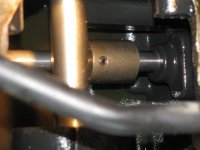
innershiftleverandrodhorizontal.jpg

outershiftlevertoleftofpictureborder.jpg

shiftrodverticalasviewed fromleftsideoftractor.jpgR&R FOLLOW-UP


Early this morning, I took the shift lever with broken shift shaft to my machinist friend. He concurred with me that the O-ring groove, in conjunction with its location, the leverage exerted on it, and the weight of the shift lever all contributed to the breakage of the shaft. He quickly concluded that attempting to weld it would be futile, so I did not bother doing anything but R&R after that.

He is going to take the factory shaft that I should get in tomorrow and make a duplicate out of 4140 stainless for me without the problematic O-ring groove. This, along with the greater strength of the 4140 should solve the breakage problem.

After spending about 15 minutes there, I came home and began removal of the rockshaft cover hoping that this would be sufficient to do the job. Start-to-finish on R&R was, surprisingly, only 1.5 hours, and this included removal of the left fender which enables you to sit on a rolling seat right next to the transaxle case.

It was a great result: there is absolutely no need to split the tractor to replace this shaft. Indeed, the only reason that one would split the tractor relative to replacing this shaft is if you installed the updated shift fork kit which must come out the front. This is somewhat surprising since one of the dealers that I called for an estimate (out of town) said that the tractor must be split to replace the shaft. Either he is referring to installing the shift fork kit at the same time, or, I don稚 want to think of the alternative.

Once the rockshaft cover is off, it is wide open to get to the shaft. I've enclosed some pictures of the area as attachments.

About the shift kit: I had to drain the hydraulic fluid in order to inspect that area, because the oil level is above the shift forks. [Note for discussion in a minute that the shift shaft is well above the oil line.]

I could find no problems whatsoever with the shift forks and I looked hard for problems. No bits of anything in the suction filter area and nothing on the magnetic drain plug except for the normal amount of very, very fine, dark friction material from the 3 pt. arm unit.

I was pleasantly surprised regarding how simple this job was; it requires no special tools and accessibility is great.

I'm certain what I will do about oil seepage from this area w/o the O-ring. The use of an O-ring here is very, very poor design because of all that we have discussed. As mentioned previously, I will probably have the shift lever chamfered and put an O-ring in that will engage the side of the case which will serve the triple advantage of 1) keeping oil from seeping to the outside, 2) removing the weakened area of the shaft and, significantly, it will keep the entire bore lubricated (which the original doesn't) and that will prevent rust (and binding) in that area.

Another thing that I plan on doing is making up some type of locking device for the range shift lever so that I can lock it in "B" should I let someone borrow it. Indeed, the machinist has a Kubota which broke its shift forks a number of years ago. He lets a number of people borrow the tractor, so, after the repair, he literally cut the shift range lever off about 1 from the bottom. He feels the same way that I do about them: They have to be so long to reach the operator, that it is easy for anyone no matter how small to exert way too much leverage on those parts.

Richard Easley
 
/ JD4300 -- Catastrophic Failure of the Shift Shaft #18  
reasley said:
[Another thing that I plan on doing is making up some type of locking device for the range shift lever so that I can lock it in "B" should I let someone borrow it. Indeed, the machinist has a Kubota which broke its shift forks a number of years ago. He lets a number of people borrow the tractor, so, after the repair, he literally cut the shift range lever off about 1 from the bottom. He feels the same way that I do about them: They have to be so long to reach the operator, that it is easy for anyone no matter how small to exert way too much leverage on those parts.

The rental yard I bought my first tractors from locks out all but the LOW
range on all its tractors. This is due to renter abuse. On the Kubotas,
they hacked off the lever near the gearbox case. On the JDs, they welded
some sheet metal over the slot that the lever went into when shifted.

Interesting thread, Richard. Great you were able to get at that rod without
cracking the tractor.
 
/ JD4300 -- Catastrophic Failure of the Shift Shaft #19  
reasley said:
Good morning, mjncad (is that really your name? :) --

On the new model intros, hey, I'm a marketing guy, so be careful!!!

Speaking of that, check out the latest issue of Fortune magazine -- there's a great article about JD addressing a neglected segment of the market (hobby farmers who are bargain hunters) -- the article describes JD as basically stumbling onto this market in a backwards sort of fashion as opposed to doing market research to determine potentials. Interesting article.

Richard Easley

MJN are my initials and CAD comes from my former life as a CADD Dweeb for 24-years in the engineering world. Engineering and Marketing...sounds like something out of Dilbert. :rolleyes:

I'll have to see if that Fortune article is online. The only paper magazine I subscribe to anymore is Fine Homebuilding.

Matt
 
/ JD4300 -- Catastrophic Failure of the Shift Shaft #20  
reasley said:
View attachment 100428

View attachment 100429

View attachment 100430R&R FOLLOW-UP


Early this morning, I took the shift lever with broken shift shaft to my machinist friend. He concurred with me that the O-ring groove, in conjunction with its location, the leverage exerted on it, and the weight of the shift lever all contributed to the breakage of the shaft. He quickly concluded that attempting to weld it would be futile, so I did not bother doing anything but R&R after that.

He is going to take the factory shaft that I should get in tomorrow and make a duplicate out of 4140 stainless for me without the problematic O-ring groove. This, along with the greater strength of the 4140 should solve the breakage problem.

After spending about 15 minutes there, I came home and began removal of the rockshaft cover hoping that this would be sufficient to do the job. Start-to-finish on R&R was, surprisingly, only 1.5 hours, and this included removal of the left fender which enables you to sit on a rolling seat right next to the transaxle case.

It was a great result: there is absolutely no need to split the tractor to replace this shaft. Indeed, the only reason that one would split the tractor relative to replacing this shaft is if you installed the updated shift fork kit which must come out the front. This is somewhat surprising since one of the dealers that I called for an estimate (out of town) said that the tractor must be split to replace the shaft. Either he is referring to installing the shift fork kit at the same time, or, I don稚 want to think of the alternative.

Once the rockshaft cover is off, it is wide open to get to the shaft. I've enclosed some pictures of the area as attachments.

About the shift kit: I had to drain the hydraulic fluid in order to inspect that area, because the oil level is above the shift forks. [Note for discussion in a minute that the shift shaft is well above the oil line.]

I could find no problems whatsoever with the shift forks and I looked hard for problems. No bits of anything in the suction filter area and nothing on the magnetic drain plug except for the normal amount of very, very fine, dark friction material from the 3 pt. arm unit.

I was pleasantly surprised regarding how simple this job was; it requires no special tools and accessibility is great.

I'm certain what I will do about oil seepage from this area w/o the O-ring. The use of an O-ring here is very, very poor design because of all that we have discussed. As mentioned previously, I will probably have the shift lever chamfered and put an O-ring in that will engage the side of the case which will serve the triple advantage of 1) keeping oil from seeping to the outside, 2) removing the weakened area of the shaft and, significantly, it will keep the entire bore lubricated (which the original doesn't) and that will prevent rust (and binding) in that area.

Another thing that I plan on doing is making up some type of locking device for the range shift lever so that I can lock it in "B" should I let someone borrow it. Indeed, the machinist has a Kubota which broke its shift forks a number of years ago. He lets a number of people borrow the tractor, so, after the repair, he literally cut the shift range lever off about 1 from the bottom. He feels the same way that I do about them: They have to be so long to reach the operator, that it is easy for anyone no matter how small to exert way too much leverage on those parts.

Richard Easley


Richard,


Can your machinist cut a circular recess in the bell crank (YZ80993) where it contacts the housing? I'm thinking a quad ring that resides in the bell crank and protrudes slightly so that it is in constant contact with the housing. Keeps the oil in and the moisture and dirt out. Since this is a common sump tractor, keeping foreign matter out is quite important.

At one time, Deere offered a rental yard upgrade kit that locked out the C range. I suspect that the purpose was to limit travel speed. On my tractor, the shift between A and B is usually quite easy, It appears that the cogs on the shift collars are always aligned between the low and mid ranges. Shifting between B and C almost always involves a touch to a hydro pedal to bring the collars into alignment and is probably where the most potential for failure occurs. I'm not sure that I'd want the tractor locked in B. If it is doing a job in the B range that really should be done in the A range, there is potential to overload the hydrostatic transmission and build heat. Locking out C, which could be done top side, at the lever mount, would probably be a better choice.

Thanks for taking the time to document the repair. Hopefully, this thread will make all of us more alert for any changes in the way that the range shift operates and any failures can be avoided with a little bit of lubrication.
 
Last edited:

Marketplace Items

WHIRLPOOL REFRIGERATOR/FREEZER W/ICEMAKER (A60432)
WHIRLPOOL...
2005 GMC Canyon (A57148)
2005 GMC Canyon...
Patterson water pump (A59230)
Patterson water...
2001 Dorsey 48ft Flatbed T/A Trailer (A56857)
2001 Dorsey 48ft...
UNUSED FUTURE EQUIPMENT SEAT (A60432)
UNUSED FUTURE...
2020 Freightliner M2 106 AWD Altec DC47TR Digger Derrick Truck (A60460)
2020 Freightliner...
 
Top