Retaining walls-suggestions???

/ Retaining walls-suggestions??? #1  

Anonymous Poster

Epic Contributor
Joined
Sep 27, 2005
Messages
29,678
Hi all: Will be putting in several hundred feet of retaining walls next year toward the goal of leveling some property that currently has a 1:10 - 1:12 (more or less) slope. Max height of wall probably 6' - 7' down to 2' or so above current grade. Current plan is to use telephone poles (which I can get free for the hauling) buried vertically 2' - 3' deep against which the ground (upper side) is pressing. Because the poles are not a solid piece wall (as a concrete/block, etc. would be) I don't believe drains would be needed running behind the wall (although I might need to dump some gravel for drainage through the poles making up the wall. Simple and relatively painless. Dig a trench, place poles cut to length, pack (and compact) lower side of wall to hold poles in place, then dump dirt (etc) on the "upper" side of the wall. So . . . what do you folks think? Am I missing something? Any experienced suggestions most appreciated. John
 
/ Retaining walls-suggestions??? #2  
The depth should be more like 4'+ because of
pressure on posts and since they are round
and not tied together they could push into
down slope side of trench.
Putting an angle on the trench back toward
slope will help to.
In the midwest the get below the frost
level need to go 3' .
 
/ Retaining walls-suggestions??? #3  
The last retaining wall I built was 30' long and 10' at the highest point. All the posts were 6X6x16. We tried to get all our holes 5' deep. If I had to do it again I would have used a larger auger. I used a 9 and then a 12 but it seemed that after we dug out all the rocks the holes were about 18-24 inches wide. By the way we put 8X8 railroad ties in for the actual wall and used the PT 6x6's for the post.

Steve
 
/ Retaining walls-suggestions??? #4  
I recommend tieing the poles together with half inch rebar or half inch threaded rod every 4 feet, with a few pole spikes between the rod.

Also don't forget to add a deadman every 8 - 12 feet linear feet and every 3 - 5 courses of poles.
 
/ Retaining walls-suggestions???
  • Thread Starter
#5  
Definitely deeper on the foundation, at least 4 feet. All of the pole tops will need to be tied together, poles do not stay straight by themselves, the wires hold them straingt.
You need to provide drainage, both behind the wall and at the base of the poles for maximum life. Frost behind a retaining wall exerts tremendous pressure against the wall.
Most Important, you need to anchor the top of the wall back into the fill every few feet, or the wall won't withstand the pressure.
 
/ Retaining walls-suggestions??? #6  
For sure on using drain rock for the full lingth of the wall with drain pipe, Also use a filter fabric against the dirt wall on the uphill side to keep the drain from becoming contaminated, you won't be sorry.
 
/ Retaining walls-suggestions???
  • Thread Starter
#7  
Hi,

Are you going to put up some kind of rail to help prevent the possibility of someone walking off the wall and breaking their neck?

I have a short section [80 feet maybe] of what used to be a drop off above my pond, and I ended up tapering it at about a 45 degree angle, thinking it better to have something to roll/slide down rather than the sudden drop off...that is on foot, not on the tractor! /w3tcompact/icons/smile.gif...I did not have any rail or other warning that it was there, and while in daytime it was easily seen, at night is was not.

That taper ends about 15 feet from the pond, and there is a flat area around the pond where I can drive the tractor, or walk/whatever.

Just bringing this up as an alternative...if you actually need a wall that is one thing. If you can get by without a wall, you might be better off in the long run without one.

I hope to get something growing on that slope that I don't have to cut or maintain much...

Just a couple alternative thoughts.../w3tcompact/icons/smile.gif

Bill in Pgh, PA
 
/ Retaining walls-suggestions??? #8  
I was going to initially suggest that you hire a engineer for an hours worth of advice. However, the suggestions in the responses do cover most of what one would tell you. I would reitirate a few things. Drainage is paramount. Increase your depth for posts. Use the deadmans back into the hill. Read some books on the subject. Get the advice of an engineer. Several hundred feet of retaining wall is obviously a big project and costly. Professional advice will be only a small cost of a successful project.

BTW, I am real impressed with the advice by responders. Sounds like people who are used to doing major projects with tractors and stuff.
 
/ Retaining walls-suggestions??? #9  
Maybe Think about the fiber barrier you can put between the poles and the backfill inorder to prevent any dirt from washing through the wall when it rains. I got some at LOWES and it works great. My project was nowhere close to your size but it might prevent washout.. Jray
 
/ Retaining walls-suggestions??? #10  
Drainage helps but if you have a clay backfill, you'll have problems. Water doesn't flow easily through clay. Of all backfill materials clay will produce the highest active pressure on the wall.

The best backfill material is sand (least pressure on the wall). If you use geotextile as a wrapper for sand backfill, the fabric will prevent soil from infiltrating and blocking the sand and keep the sand in place.

The most consistent problem I've seen in retaining wall construction is the backfill.
 
/ Retaining walls-suggestions??? #11  
As everyone said, "deeper trench."

A couple of thoughts.

One, deadmen. They're easy to do. You take a telephone pole and put it six to ten feet above the retaining wall. You lay it in a trench so it's parallel to the wall. You tie the wall and the deadman together will large all thread. The reason I suggest all thread is you have the potential for later adjustment if required.

Two, I'd tie the poles together side to side. What I've done is to drill a three quarter inch hole through two poles at a time. I then drive either rebar or three quarter inch hot rolled steel rods into the hole.

You place your first two poles in the trench and then tie them together as I've suggested both high and low. Then you place the next pole in the trench and tie it to the second pole the same way but out of line with the first set. You add each additional pole the same way.

This is much easier than trying to drill all the poles so you can tie them together with one continuous rod.

I would definately find out what the local practices are for filling in behind retaining walls. I've built them and always put in drains through the wall and a french style drain parallel to the wall when possible.

If you don't put forty two inch high rails above the retaining wall then you're being very foolish. It isn't just the liability of someone getting hurt you have to worry about. It could be someone you really care about who is the injured person.
 
/ Retaining walls-suggestions??? #12  
I would also recommend hiring an engineer. You should also check into your local building code. Around here, anything over 2' tall has to be "engineered" and permit'ed. A retaining wall 6' tall is going to have some incredible stresses on it, and in the long run, it will pay to have it designed appropriately. Everybody else's suggestions are good ones, it's just a question of how often you need a deadman, and exactly what type of foundation you need, etc.

You might also want to re-consider the telephone poles. It sure sounds good and cheap now, but labor is going to be your biggest cost in doing this. I don't know how long telephone poles should last, but around here, wood is generally frowned upon for structural walls (as opposed to decorative only). Not just because they eventually rot, but freeze/thaw cycling on wood can be devastating to it.

Kevin
 
/ Retaining walls-suggestions??? #13  
I've also wondered if you are committed to telephone poles. I'm not an expert but I believe there are better materials for retaining walls.

A couple weeks ago, I was driving through Parsons WV and saw a recent retaining wall built by the city. It must be 50 or 60 feet tall and 120 or 130 feet long. It is made of solid decorative concrete blocks that are designed for retaining walls. I was very surprised, had no idea they could be stable this high. They are wedge shaped on the sides so you can make convex or concave curves and each is set back about 1/4 to 1/2 inch from the one below it. They are simply stacked. I don't know if there is a dead man built into it, and not sure how this could be done. I believe the idea is the wall can move slightly without buckling like mortored block.

Since I've been looking for them, I noticed another project in another town where three sides are built up over 20 feet and filled. There is a gravel parking lot built on top of it.

Sooo....I checked out the cost of the blocks. Over $6.00 a piece at Lowes. Ouch! The thing is I think I can build some simple plywood forms and make my own blocks for a buck or two a piece. I'm even considering stain to make them look more like cut stone. I think it could be a good winter project. Wouldn't take long mix up a batch and shovel it into a dozen forms. Couple dozen every weekend till spring would do me fine!

Anyone have any experience with these types of walls? Do they use a dead man system? Any thoughs appreciated.

Mike
 
/ Retaining walls-suggestions??? #14  
PT phone poles were used for 'mini' retaining walls at the marina. The parking area is probably 5' higher than the seawall. (Some are over 6 1/2'.) The retainers are about 100' long and as much as 5' high at the center gradually down to 3' at each end. There are at least 6 of these walls. That forms a nice walk way along the seawall of at least 6' wide. There is evidence of threaded rod through a bearing plate on some of the poles, (as WHarv suggested). The parking surface is always a minimum of 6' from the ends of the 100' span. They're holding up very well, considering the extremes of Michigan winters. No evidence of movement from any of them in almost ten years from install.
 
/ Retaining walls-suggestions???
  • Thread Starter
#15  
John
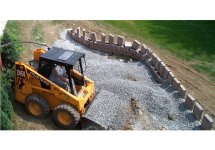
I replaced a railroad tie wall with a product called Allan Block. It is a hollow block that interlocks and you fill them with gravel. My wall if almost 6 foot high & 70 foot long. There is a place near me that has an Allan block wall that is over 12 foot high (that is where I got the idea to use Allan Block). The product is easy to install. I installed mine on a gravel footer, installed a drain behind the wall, 18inches to 24 inches of gravel behind the wall.

It has been installed for three years and there is no sign of pushing or sagging. I keep my eye on a couple of walls that were constructed before mine and they are all in good shape.

Just another option. http://www.allanblock.com/

John
 

Attachments

  • 33-220926-Wallfinished.jpg
    33-220926-Wallfinished.jpg
    67.1 KB · Views: 390
/ Retaining walls-suggestions???
  • Thread Starter
#16  
Allan wall construction picture

John
 

Attachments

  • 33-220928-Wallconstructiongravel.jpg
    33-220928-Wallconstructiongravel.jpg
    108.5 KB · Views: 945
/ Retaining walls-suggestions??? #17  
I can't remember the name of them right now, but one of the local supply places had a block system that consisted of structural foam blocks like the large Allen blocks, plastic tie clips, and geotextile fabric. The blocks were filled with stone, and the fabric was attached to the blocks every few courses and pulled back into the backfill area. This was effectively the "deadman" for the wall. The system was supposed to be designed for building large scale retaining walls. There may have also been a requirement to have somebody from the company inspect the site to recommend the design details, but I can't remember.

The blocks/clips were about $5 or $6 a piece. I didn't get pricing on the fabric because the wall I was looking to do was only 2' tall and wouldn't require it. I ended up going with the interlocking blocks you find at Home Depot/Lowes because I found somebody selling "used" ones real cheap.

Kevin
 
/ Retaining walls-suggestions??? #18  
Mike,

Check with the manufacturer of the blocks for installation details. I found 2 styles of blocks at Lowes. The ones you are talking about are designed for large structural retaining walls. The other style (about $1.90 each and much smaller) are more for decorative type stuff, not for holding back much hillside. I believe Castle was the manufacturer for these, and they explicitly say not to go over 6 courses (2') from grade. The larger ones could go higher, but I don't remember how high. If you are going to try to pour your own blocks, I would try to make them as close to the commercial ones as possible. I'm sure the type of concrete has some bearing on the specs (I know next to nothing about concrete), so you might want to see if the company specs out what they used to make theirs. If you match what they've done closely, you could probably use their construction guidelines for how high you can go with them.

Kevin
 
/ Retaining walls-suggestions??? #19  
Mike,
Retaining walls of any height above a few feet have more pressure on them that you might imagine and to answer your question about dead men … well they may not use a dead man as you might think of a dead man they use many different methods to aid in the stabilization and strength of the wall to prevent failure … check this web site and I think you will find the answers to your questions There are some very tall retaining walls and many are mortar less .. there is a lot of Engineering in the design of a retaining wall and they should not be taken lightly … improperly Engineered they can be very dangerous … yet many people get lucky .. in most places I think there may be codes covering them as well as inspections .. if you built one you must be aware of the drainage, compaction (and the kind of back fill material used), and pressures on the wall.

http://www.keystonewalls.com/

Leo
 
/ Retaining walls-suggestions??? #20  
Hi Mike,

The blocks all interlock, and usually use a row(s) of geotextile as a tie back(s) depending on height, loads, surcharges, etc.

Using solid poured concrete blocks is ok, but realize that you still need to provide an interlock detail which will engage the geotextile as well as the adjacent blocks.

Type and placement of back fill is very important. This type of wall has numerous advantages including flexibility, durability, and not requiring a foundation which needs to extend below the frost line.

Good Luck

Dave
 

Marketplace Items

02GER CHICKET HOUSER 240' (A62131)
02GER CHICKET...
2022 CORMIDI C85 STAND-ON MINI DUMPER (A62129)
2022 CORMIDI C85...
UNUSED RAYTREE RMRB72 - 72" POWER RAKE BUCKET (A62131)
UNUSED RAYTREE...
2015 Ford F750 Dump Truck (A64047)
2015 Ford F750...
2015 Ford F550 4x4 with 37' Bucket (A62613)
2015 Ford F550 4x4...
2016 Dodge Charger Sedan (A61569)
2016 Dodge Charger...
 
Top