
Root Cause
Platinum Member
Guilty as charged but in my defense, it was a blanket statement that 3D printers were useless. I did not think that was an appropriate way to leave this thread.

wasn't aimed at you, mike has posted this in another thread as well, not entirely sure why he hates them so much.Guilty as charged but in my defense, it was a blanket statement that 3D printers were useless. I did not think that was an appropriate way to leave this thread.

Paul, by now you may know this but there are thousands of free programs out there. My grands had fun with whistles, Batman logo's, etc. It really is limitless. By the time you have 4 or 5 things made, you will move on to things that specifically interest you and your kids. good luckI'm not really a tech guy, but im hoping 1) to be able to spit out some useful and neat stuff; and 2) get kids interested in the design kinda stuff. Even if its existing models, being able to see a design or model turn into a finished object.
I imagine the first dozen prints will be silly figurines;
nice steel nozzle?These were printed with an iron powder impregnated plastic.
A little forced rusting is being done now. The pieces look like weathered cast iron afterwards.
It will be a light switch when assembled. Gift for a young relative.
View attachment 724122

Marlin 1.1.9 if memory serves me correctly.You running Klipper or Marlin firmware?
Marlin 1.1.9 if memory serves me correctly.
I was unfamiliar with the term "ringing" so had to look that one up. The various references I read seemed to indicate that it is a result of mechanical vibration or resonance during the printing process. It mentioned that it is commonly the result of quickly changing direction which can cause vibrations. I'm somewhat confused because those tail pieces (I assume those are the ones you said show ringing) are hollow with no fill. As such, the wall thickness of them is quite thin and very little starting and stopping is going on. I'm not sure how new firmware would help resolve that but it looks like I need to do more reading. One thing for sure, 3D printing is a constant learning process, at least for me.You might look into Klipper it’ll help speed up the prints as well as help with the ringing that’s showing up there in those prints.
I was unfamiliar with the term "ringing" so had to look that one up. The various references I read seemed to indicate that it is a result of mechanical vibration or resonance during the printing process. It mentioned that it is commonly the result of quickly changing direction which can cause vibrations. I'm somewhat confused because those tail pieces (I assume those are the ones you said show ringing) are hollow with no fill. As such, the wall thickness of them is quite thin and very little starting and stopping is going on. I'm not sure how new firmware would help resolve that but it looks like I need to do more reading. One thing for sure, 3D printing is a constant learning process, at least for me.
Thanks for the explanation. I appreciation you taking the time to help me better understand. I'm not enough into 3D printing, at this point, to sink more money into my setup. Truthfully, it gets the things done that I need and as I said earlier, it is just a hobby that I use to support other hobbies. Thanks again.It can also be a trait of a heavy bed style machine, both of my machines run on Klipper with the CR-10 printing up around 100mm or higher with no ringing. Klipper Firmware is replaces Marlin but requires a Raspberry pi computer to run everything it does all the computing well the main board only is there for which direction the stepper motor is going. These main body pieces are PETG came off my CR-10 running at 100mm for most settings at 75mm tall take around 2 hours well the accent adapter came off my Ender 3 with a Biqu H2 direct drive they are around 20mm tall they take around 1.5 hours each at around 50mm a second. If you’ve been thinking about doing Octoprint or are running Octoprint I’d look into Klipper with one of its light weight interfaces such as Fluidd or Mainsail they’re easier to use as well as cleaner.
Thanks for the explanation. I appreciation you taking the time to help me better understand. I'm not enough into 3D printing, at this point, to sink more money into my setup. Truthfully, it gets the things done that I need and as I said earlier, it is just a hobby that I use to support other hobbies. Thanks again.
Kind of how I feel. Most stuff is printed overnight. I'm not in a huge rush. the other thing once you speed the printers up, they get ALOT louder, at least my ender does up over 100. If it was a business it would be a different story

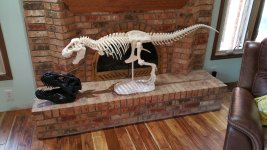
I did the same print, but mines only about 2 feet long. Took my QiDi Tech about 24 hours to print all the pieces.This is my latest print, it's a T Rex, it's about 6 1/2 feet long (about the size of a two year old.) I have two more pieces to attach, one of the legs and one arm. The black skull set is 18 inches long.
I have a Duet3D board in my HyperCube which has a pin on the expansion header that it will pull low when a M81 code is executed at the end of a print, and the hot end temp drops below 40°C. I made a circuit with a couple of relays and a small 5 volt PSU that shuts the printer off when the pin goes low. So I don't need to worry about the printer being on after the print finishes. Also, the print is usually popped loose from the build platform after it cools to ambient which is about 60°F here in the basement.Kind of how I feel. Most stuff is printed overnight. I'm not in a huge rush. the other thing once you speed the printers up, they get ALOT louder, at least my ender does up over 100. If it was a business it would be a different story
I looked at your hyperCube, seemed pricey for just a frame, but eh so far my ender is doing what I need. there are a couple different ways to kill power on the ender. haven't really gotten to that point yet, but its cool the duet3d gives you that functionality.I have a Duet3D board in my HyperCube which has a pin on the expansion header that it will pull low when a M81 code is executed at the end of a print, and the hot end temp drops below 40°C. I made a circuit with a couple of relays and a small 5 volt PSU that shuts the printer off when the pin goes low. So I don't need to worry about the printer being on after the print finishes. Also, the print is usually popped loose from the build platform after it cools to ambient which is about 60°F here in the basement.


![IMG_20180304_170807843[1].jpg](/forums/data/attachments/624/624013-f84a93a451f98e50b307b4e1eb8c8d54.jpg)


