4 Wheel Drive and Tire Ratios

/ 4 Wheel Drive and Tire Ratios #1  

rScotty

Super Member
Joined
Apr 21, 2001
Messages
9,722
Location
Rural mountains - Colorado
Tractor
Kubota M59, JD530, JD310SG. Restoring Yanmar YM165D


On 4 Wheel Drive and Tire Ratios, there has been a lot written about the advantages in matching the tire size with the internal Front/Rear gear ratios - especially for 4wd. It turns out that this Front to Rear ratio is easy to measure.

It makes sense that in 2wd, Front to Rear tire size ratio doesn't much matter. But when shifting to 4wd, matching the F/R tire rolling circumference to the tractor's internal F/R drive train gear ratio does a lot to reduce the stress on the drive train and also makes steering easier as well.

You can check this effect on any tractor by simply measuring the distance that the front and rear tires travel in one revolution and comparing the measurements in 2wd and then again in 4wd.

All that is required is a flat piece of ground or road, some way to put a mark on the tire tread that will transfer to the ground, and a tape measure. I have marked tire treads with a blob of wet paint on a dry road, and a different time by using a short lag bolt into the tread for sand and snow.

In 2wd, measuring the distance between the marks the tires leave on the ground will tell us the rolling circumference (RC) of the tires. This RC may vary from the manufacturing spec, but in 2wd without any tire slippage what we are measuring is the true rolling circumference for that tire on that tractor. We are also automatically accounting for factors like tread wear, inflation, and load.

Repeating the same measurement in 4wd on high and low traction surfaces and comparing with the 2wd numbers we got gives good insight as to what is actually happening when we shift into 4wd.

We know that a measured difference from the 2wd numbers has got to be the result of tire slippage. And we know that normally tractors are set up so that the front tires rotate about up to 5% more than the rears in order to maintain steering control. So we have some idea of what we are expecting to measure. But in spite of this I found that the first time I checked things the measurements didn't quite come out as I expected. That required some thinking.

It turns out that when we measure in 4wd the measurements are no longer simply showing independent rolling circumference for each tire. In 4wd the front and rears are coupled together, so the measurements reflect a combination of how the tractor is loaded, how much traction the tires are getting, and also the internal F/R gear ratio of the drive train. On some surfaces you may find that the front tires are dragging the rears, and on other surfaces that the rears are push-sliding the fronts. Or maybe a bit of both. It is worth thinking about for awhile; this is handy information for protecting the drive train.

BTW, you'll hear the overdriven ratio between 2wd and 4wd expressed as a percentage difference. It is often called the Front-to-Rear Overdriven Ratio, and a commonly heard figure is that you want to be 5% or less overdriven. These measurements will give you that % ratio for your tractor by comparing the 2wd F/R ratio with the 4wd F/R ratio.

Bottom line is that there is no perfect ratio. On slippery surfaces the drivetrain can protect itself pretty much regardless of any ratio difference. But when traction increases, so does drive train stress.
Good Luck,
rScotty
 
Last edited:
/ 4 Wheel Drive and Tire Ratios #2  
That's an interesting analysis of the relationship between the front and rear wheels. It would be nice if manufacturers would list the Front-to-Rear Overdriven Ratio in the tractor specifications but alas, most average SCUT & CUT buyers wouldn't know what to do with the information and dealer salesmen would have even less of a clue what it meant or how to explain it to a customer.

Another handy bit of information would be a tire chart provided by the manufacturer of compatible "mix & match" sizes for those of us who would be interested in running R1's in the rear and R4's in the front or any other combination of R1, R4 & turf tires suitable for our applications.

On a related note, does it cause undue stress on a drive train to leave the tractor in 4wd when using it on unpaved or uncompacted surfaces for extend periods of time? For instance when pasture mowing, some areas when turning on a slight grade or dip in the ground I need 4wd because the R4 tires will simply spin on the grass but the rest of the area is flat. Or is the best policy (what I call the redneck 4wd policy) to engage the 4wd after I'm stuck and hope it gets me out?
 
/ 4 Wheel Drive and Tire Ratios #3  
That's an interesting analysis of the relationship between the front and rear wheels. It would be nice if manufacturers would list the Front-to-Rear Overdriven Ratio in the tractor specifications but alas, most average SCUT & CUT buyers wouldn't know what to do with the information and dealer salesmen would have even less of a clue what it meant or how to explain it to a customer.

Another handy bit of information would be a tire chart provided by the manufacturer of compatible "mix & match" sizes for those of us who would be interested in running R1's in the rear and R4's in the front or any other combination of R1, R4 & turf tires suitable for our applications.

On a related note, does it cause undue stress on a drive train to leave the tractor in 4wd when using it on unpaved or uncompacted surfaces for extend periods of time? For instance when pasture mowing, some areas when turning on a slight grade or dip in the ground I need 4wd because the R4 tires will simply spin on the grass but the rest of the area is flat. Or is the best policy (what I call the redneck 4wd policy) to engage the 4wd after I'm stuck and hope it gets me out?

I have seen some tire charts, when looking for a match to 12x16.5 rears, that show both numbers: The actual circumference and the actual rolling circumference at rated pressure and load. This helps to determine what you are talking about.
 
/ 4 Wheel Drive and Tire Ratios #4  
It's all good information to have when considering new tires. One major item not mentioned is the loaded radius of the tires which is what determines the rolling circumference, the loaded radius will change drastically depending on the axle loading of your tractor. A tractor with no loader and only a 3 pt implement will increase the front tire load and radius while decreasing the rear tire radius while the load is being carried, the greater the load the greater the change. A tractor with a front end loader will show considerable change depending on the load in the loader, with the loader empty if you perform rScotty's test and then fill the loader with a heavy load and repeat you would find a considerable difference in the rolling circumference because the loaded radius changes with load now shorter on the front and taller on the rear. Your front end lead/lag will always change with load, so when you want it will decide the pressure you need in your tires which also changes the loaded radius. There is no end to tinkering with these thoughts :stirthepot::banghead:and :drink:
 
/ 4 Wheel Drive and Tire Ratios
  • Thread Starter
#5  
That's an interesting analysis of the relationship between the front and rear wheels. It would be nice if manufacturers would list the Front-to-Rear Overdriven Ratio in the tractor specifications but alas, most average SCUT & CUT buyers wouldn't know what to do with the information and dealer salesmen would have even less of a clue what it meant or how to explain it to a customer.

Another handy bit of information would be a tire chart provided by the manufacturer of compatible "mix & match" sizes for those of us who would be interested in running R1's in the rear and R4's in the front or any other combination of R1, R4 & turf tires suitable for our applications.

On a related note, does it cause undue stress on a drive train to leave the tractor in 4wd when using it on unpaved or uncompacted surfaces for extend periods of time? For instance when pasture mowing, some areas when turning on a slight grade or dip in the ground I need 4wd because the R4 tires will simply spin on the grass but the rest of the area is flat. Or is the best policy (what I call the redneck 4wd policy) to engage the 4wd after I'm stuck and hope it gets me out?

I believe that it is OK to leave the tractor in 4wd anytime a tire is so easy to spin - like when using R4s on grass. In fact, R4 industrials and R3 turf tires seem to spin almost too easy in the field. That's probably all to the good for protecting the drive train.

As you say, the manufacturer's Overdriven Ratio can be hard to find in the tractor specifications. But if you measure the front to rear rolling circumference (RC) on a slippery surface in 4wd - as described in the first post of this thread - and then divide the REAR RC by the FRONT RC it will give you a number very close to the manufacturer's internal gear ratio. It's close enough. The only time I checked it, the measured RC numbers were only off of the manufacturer's OverDriven Ratio by a tenth of one percent.
rScotty
 
/ 4 Wheel Drive and Tire Ratios #6  
Lift the tractor off of the ground and mark both the front and the rear tires. In 4wd turn the rear tires one full revolution. The front tire mark should be slightly past one revolution. If you measure the circumference of the front tire and then the difference you should be able to calculate the % lead of the front axle.

This is more of a question rather than a statement.
 
/ 4 Wheel Drive and Tire Ratios
  • Thread Starter
#7  
Lift the tractor off of the ground and mark both the front and the rear tires. In 4wd turn the rear tires one full revolution. The front tire mark should be slightly past one revolution. If you measure the circumference of the front tire and then the difference you should be able to calculate the % lead of the front axle.

This is more of a question rather than a statement.

It's a good question. That's the right concept....and the method that you are describing works for a 4wd car or truck or for anything where the front and rear tires are identical, inflated the same, and assuming that the loading of the front axle is the same as the rear. The problem is that none of these conditions hold true on a our tractors, so we have to use a different methods.
thanks,
rScotty
 
/ 4 Wheel Drive and Tire Ratios #8  
It's a good question. That's the right concept....and the method that you are describing works for a 4wd car or truck or for anything where the front and rear tires are identical, inflated the same, and assuming that the loading of the front axle is the same as the rear. The problem is that none of these conditions hold true on a our tractors, so we have to use a different methods.
thanks,
rScotty

I'm not 100% sure that your statement is correct. Either I didn't explain myself correctly or you didn't read what I wrote.

It might take more than one revolution of the rear tires for the marks to be close and because the front tires are smaller they would travel more than one revolution. At some point in a set number of revolutions the marks on the tires should be close as both wheels are traveling the same distance. The front tires should rotate a little more because of the built in lead.

The loading and inflation of the tires is irrelevant as the tractor is off of it's wheels. The point I'm trying to make is this would be a rough way of calculating the lead built into the drive train.
 
/ 4 Wheel Drive and Tire Ratios #9  
There already exists a tire size classification system just for this purpose; I mentioned it sometime earlier in the year when I was considering turfs for my tractor. But basically you'd get a set that was the same number of steps apart as your existing set: if you had a B and a D, and you wanted to put A size on the front, you'd need to put C size in the rear.
I've since given up on turf tires, since in very large sizes they have very large prices (plus you need the wheels upon which they are mounted.)
 
/ 4 Wheel Drive and Tire Ratios
  • Thread Starter
#10  
I'm not 100% sure that your statement is correct. Either I didn't explain myself correctly or you didn't read what I wrote.

It might take more than one revolution of the rear tires for the marks to be close and because the front tires are smaller they would travel more than one revolution. At some point in a set number of revolutions the marks on the tires should be close as both wheels are traveling the same distance. The front tires should rotate a little more because of the built in lead.

The loading and inflation of the tires is irrelevant as the tractor is off of it's wheels. The point I'm trying to make is this would be a rough way of calculating the lead built into the drive train.

And my point is that there is no "lead built into the drivetrain". The lead only appears about when you compare the difference in the internal drivetrain ratio with the difference in the rolling circumference ratio of the rear and front tires.
You need both the gear ratio and the tire ratios to calculate the lead, because it is the difference between them is the lead - often called the overdriven ratio.
good on ya,
rScotty
 
/ 4 Wheel Drive and Tire Ratios #11  
How about jacking up ONE side of the tractor just enough that the front and rear tires are just free to rotate with 4WD or FWA engaged. Will probably require a jack at front and rear.

Then, with a helper, run a rope, twine, tie strap or similar between the front and rear tires and wrapped around the outside of the tires. Mark the rope just behind the front tire also mark the floor at this point. Rotate the REAR tire while keeping the rope held in original position on the circumference of both tires.

Stop when the mark on the rope gets near the rear tire then measure the distance traveled. Then measure the slack in the rope and divide this by the the distance traveled to give and indication of percentage of front wheel lead.

The idea here is that the gear ratio should cause the front tire to "travel" faster than the rear causing the rope to go slack.

Disclaimer: I've not done this so it's subject to broad criticism, constructive or otherwise. :)
 
/ 4 Wheel Drive and Tire Ratios #12  
You can't compare drive ratios with the tires off the ground. There they are ROUND. On the ground, they are deflected by the weights on them. Because the earth is FLAT, there needs to be slippage within the tread to allow the ROUND tire carcass to have a flat spot.

All my 4wd JD tractors have tire paired size charts in them for Ag, Turf and the Industrial constructions.

Additional notes (I was a Vehicle Dynamics and Tire Engineer for almost 40 years), Cars have a viscous differential that manages front to rear drive torque distribution. Trucks can have a viscous coupling AND a lockup selector needed when the going gets tough.

Keep in mind that tractor tires are usually operated off of pavement and for dirt, they need a significant mount of slippage to generate traction. (Go check out the tractor pull videos). Naturally, the amount of slippage at optimum traction is dependent on tread design, carcass stiffness and of course SIZE. Yet SIZE is based on the weight the axle will usually carry. Tractor tires also have softer tread compounds so that the front to rear slip averaging works better. That's why you don't get 50,000 miles out of them.
 
/ 4 Wheel Drive and Tire Ratios #13  
So how would you recommend determining whether the relationship between the front and rear tires falls within the +5% lead?
 
/ 4 Wheel Drive and Tire Ratios
  • Thread Starter
#14  
So how would you recommend determining whether the relationship between the front and rear tires falls within the +5% lead?

First of all, npalen I've got to congratulate you for that crazy complicated method you proposed in message #11. That shows some real original thought and ought to work to compare the front to rear overdriven ratio based on unloaded circumference ....although the shear complexity makes it impossible to actually do it.... which is probably a good thing as xxvyb6 points out the answer you would get it isn't the same thing as loaded rolling circumference in the real world of tractor work. But congrats anyway. And BTW, a variation on your method will work for determining the internal Front to Rear gear ratio as long as there is no viscous coupling.

Getting back to your questions, here's how to do it a simpler way using wet paint spots on the tires driving on a dry slightly dusty asphalt road. All the numbers are averages of my own measurements between the paint dots we laid down on the road using our old 33hp Yanmar with OEM R1 Ag tires.

In 2WD I measured the Rolling Circumference (RC) of the front tire at 90.25", and the RC of the rear at 146". Front to rear ratio is then: 90.25/146.00 = .618

In 4WD I measured the Rolling Circumference (RC) of the front tire at 88.00", and the RC of the rear at 149". Front to rear ratio is then: 88.00/149.00 = .603

Now take a moment and look at those numbers. In 4WD, the REAR RC was longer - indicating that the rears were being dragged by the front tires. And also in 4WD we see that the FRONT RCs became slightly less, which on the road surface I used probably means that the fronts were slipping a bit as they slightly dragged the rears.
All this slight tire drag and slippage is typical of an overdriven ratio where steering control requires that the fronts turn a little faster than the rears.

How much faster? Well you can compare the ratios as a percentage of change from 2wd to 4wd by first subtracting one ratio from the other, and then dividing that answer by the original 2wd ratio, and finally multiplying by 100 to change the answer into a percentage. For the numbers above this is:

((2WD ratio - 4WD ratio) / 2WD ratio) times 100 = the overdriven percentage

((0.618 - 0.603) / 0.603) x 100 = 2.49% overdriven

And there's the answer. That Yanmar YM336D was about 2.5% overdriven as it came from the factory with Ag tires. I wanted to match that when changing to turfs.

Enjoy,
rScotty
 
/ 4 Wheel Drive and Tire Ratios #15  
So how would you recommend determining whether the relationship between the front and rear tires falls within the +5% lead?

I don't worry about F/R drive torque error on dirt, grass or gravel. It's a big deal on concrete or asphalt. And, air pressure is about the only variable available to you to change it if your axle loads are set (loader, loaded tires, sprayer tanks, full fuel tank.

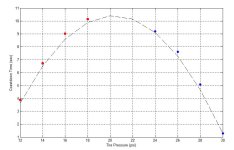
You can check it using a coast down technique if you have a manual transmission. Start with a very high front tire pressure, Run the tractor on a level surface in a gear to give you a fast walking speed. Push in the clutch and time the seconds to come to a complete stop. Lower the pressure 2 psi and do it again. If you can draw a graph on the back of an envelope, plot the pressure on the x axis and the coast down time on the y axis. After a few runs, you should notice that the curve climbs a bit, reaches a peak and then starts heading down again. The pressure at the highest coast-down time has given you the lowest front rolling resistance which has a strong drive torque component. When the drive torques are balanced (i.e. no strain in the front drive-line) you have the optimum drive ratio (theoretically). Your results will depend on the load case you choose (i'd pick the heaviest one because that's where the tire wear and the drive-line strain would be highest).

For a hydro unit, there is no clutch to disengage, so I would run the test with the same procedure, but write down the speed you attain when coasting down a decline in the road. Same strategy: The lowest rolling resistance gives you the highest speed steady state speed for the exact same throttle setting.

If I were working, we would put strain gauges on the front drive shaft and measure the minimum front drive torque and front tire pressure. But this ought to get you very close. You do need to find the peak of the time or speed curve, though. If you can't, then you might have a tire size mismatch that's causing a problem. Worn tread, wider that standard rim width, or just plain wrong front or rear tire size is the cause.
 
/ 4 Wheel Drive and Tire Ratios #16  
Here is an example of the procedure. Note that if you start with a pressure too low, it can take a while to get the optimum settings. Start with high pressure. You can bleed down the tires quickly without having to run back to the compressor. optimum pressure.JPG
 
/ 4 Wheel Drive and Tire Ratios #17  
I've not heard of a viscous coupling on a SCUT or CUT. The only thing close that I can think of is the automatic clutch on some of the New Holland's.
And, yes, I do understand the difference between rolling circumference and the actual mechanical gear ratio between the front and rear drives. And, yes, variations of the two wheels off the ground method can also yield the mechanical ratio. Your "slow-down" method of matching tires is interesting, had not heard of that but makes sense.

Edit: Link to previous discussion of this subject if anyone might be interested:

http://www.tractorbynet.com/forums/tires/371468-tires-why-rolling-circumference-loaded.html
 
Last edited:
/ 4 Wheel Drive and Tire Ratios
  • Thread Starter
#18  
I've not heard of a viscous coupling on a SCUT or CUT. The only thing close that I can think of is the automatic clutch on some of the New Holland's.
And, yes, I do understand the difference between rolling circumference and the actual mechanical gear ratio between the front and rear drives. And, yes, variations of the two wheels off the ground method can also yield the mechanical ratio. Your "slow-down" method of matching tires is interesting, had not heard of that but makes sense.

Edit: Link to previous discussion of this subject if anyone might be interested:

http://www.tractorbynet.com/forums/tires/371468-tires-why-rolling-circumference-loaded.html

I've not heard of a SCUT or CUT with a viscous coupling between front and rear either. Or for that matter any that are using a center differential on the driveshaft between the front and rear gearing. But all those things are common in offroad SUVs now, so we will probably see them in tractors someday. When that finally happens, I'm hoping that matching RC and mech. gear ratio won't be necessary. Yes, I know that you understand the various ratio matching methods, but not everyone understands it or why it needs to be considered.
Thanks for your comments,
rScotty
 
/ 4 Wheel Drive and Tire Ratios #19  
LOL, forget all about ratios (front should lead by 5%), just drive only on wet grass or snow and never on pavement.
If you are doing snow chores a good set of chains on the rears will save the front end.

I had a 3/4 ton 4 x 4 plow truck with matched tires on all 4's and the instant I hit asphalt I fractured a U joint, dang truck cost me one axle per year, usually the rt front, but then all a cost of plowing business. (but also then plow truck purchase was all of $3500 so I can't complain) also it netted me over $5K per season as a 'pastime'. I later (after 6 yrs) sold it for $4k .
Not counting inflation I think I came out ahead, LOL.
 
/ 4 Wheel Drive and Tire Ratios #20  
On a related note, does it cause undue stress on a drive train to leave the tractor in 4wd when using it on unpaved or uncompacted surfaces for extend periods of time? For instance when pasture mowing, some areas when turning on a slight grade or dip in the ground I need 4wd because the R4 tires will simply spin on the grass but the rest of the area is flat. Or is the best policy (what I call the redneck 4wd policy) to engage the 4wd after I'm stuck and hope it gets me out?

You should ask different question. When is it safe to be in 2WD? Example: You transport load of wet dirt in the FEL bucket going mild slope. You need to stop the tractor but it will skid rather long distance before it stops. Try that with 4WD. It will stop on the spot. Do not try it even with empty loader on wet grass and steeper slope. The tractor, while in 2WD, will skid to the bottom of the slope.
I had a leaky sight glass on the the HST so I decided to park the tractor nose down on about 25 deg slope to pop the glass out and replace it. Just after I drove over the top edge the tractor started to skid at increasing speed despite me pressing the brake, it made right turn on the bottom, balanced on two wheels for a second and settled back on all four. Since then I leave my tractor 90% of the time in 4WD and put it to 2WD only when bush hogging without a FEL bucket.
 

Marketplace Items

SCAN TO RECEIVE TEXT UPDATES (A60429)
SCAN TO RECEIVE...
UNUSED IRANCH MINI EXCAVATOR RAKE (A60432)
UNUSED IRANCH MINI...
UNUSED FUTURE FT-ZDQ160 110V CONCRETE VIBRATOR (A60432)
UNUSED FUTURE...
HOMEADE 8' X 22' TRI-AXLE TRAILER (A60430)
HOMEADE 8' X 22'...
2008 MAXX-D FUEL TRAILER (A58214)
2008 MAXX-D FUEL...
Kuhns AE10 Small Square Bale Accumulator - 10-Bale Efficient Handling System (A56438)
Kuhns AE10 Small...
 
Top