Adding Guages To your Yanmar

   / Adding Guages To your Yanmar #101  
THANK YOU....that made my day.

I have the adaptor for the upper radiator/temp gauge if you need it.
 
   / Adding Guages To your Yanmar #102  
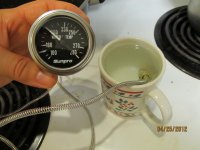
I decided to add a temperature gauge to my new YM2210. Here is what I chose:

Sunpro 2" temperature gauge CP7975
Sunpro metric adapter set CP7574

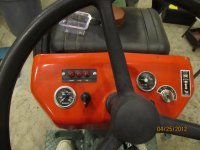
I chose this gauge because it matches the look of the stock Yanmar tachometer pretty closely.

The first thing I did was test to make sure the gauge was operating properly. I boiled some water in a mug using a microwave then put the temperature sensor in the water. The gauge read about 201 F. Obviously water boils at 212 F, but I think 201 is pretty good given that the water starts cooling as soon as you pull it out of the microwave plus the sensor itself cools the water as soon as you put it in.

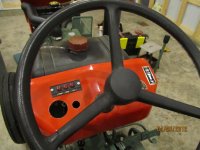
Next I punched a nice hole in the dash using a hydraulic Greenlee metal punch. I decided to put the gauge where the turn signal switch had been and move the turn signal switch to a new hole. I had to touch up the paint a bit at the edge of the holes. It was mostly hidden by the gauge overhang, but I did it anyway... :D

Next I pulled out the bolt with the old temperature light sensor and installed the new sensor line into that hole using the metric adapter. I didn't use any teflon tape on the bolts. If I find that it starts leaking, I will pull it back out and add some. Lookin good! :thumbsup:

Note that getting the old temperature sensor bolt out is a bit of a pain because it's in an awkward spot that's hard to get a wrench into. I took off the left side panel (looking from the driver's seat) and reached in with a pipe wrench -- btw, this worked well to break the bolt loose on my YM1700 too.

I ran my engine for a while just sitting in the barn, but it didn't register on the gauge. I put my hand on the engine where the temperature sensor goes, and it was warm, but not hot, so I think it just wasn't hot enough to register. I expect it will register when I'm actually working the tractor. It's pretty impressive how much better this engine cools with the water pump installed vs. my YM1700 which uses the thermosiphon approach, i.e., does not have a water pump.

I wanted to also comment on why I chose to replace the temperature light with a gauge and not the oil pressure and voltage lights with gauges (I did replace all 3 on my YM1700.) For these other 2, the lights come on once the tractor key goes to the "ON" position, and they go out once the tractor is operating properly. If there is a problem, they will come back on. With the temperature gauge, I feel more comfortable knowing if my tractor is operating at 150 F or 230 F, both of which I believe would be below the trigger temperature for the dash light.

And last but not least, my beautiful assistant is featured in the last picture. I tried to tell her that my jacket is a little big for her. :D
 

Attachments

  • IMG_0839_1.JPG
    IMG_0839_1.JPG
    194 KB · Views: 271
  • IMG_0841_1.JPG
    IMG_0841_1.JPG
    154.1 KB · Views: 292
  • IMG_0842_1.JPG
    IMG_0842_1.JPG
    172.5 KB · Views: 282
  • IMG_0847_1.JPG
    IMG_0847_1.JPG
    168.7 KB · Views: 362
  • IMG_0838_1.JPG
    IMG_0838_1.JPG
    196 KB · Views: 286
   / Adding Guages To your Yanmar #103  
Nice work G looks factory! I see you have a little future farmer there she sure looks happy to see Dad even if the jacket wont fit for a few years! :)
 
   / Adding Guages To your Yanmar #104  
BTW, I took my YM2210 out last night and ran my finish mower for about 15 minutes -- I was testing to make sure the clutch was working right -- and the temp gauge made it up to about 125 F. It was pretty cool out last night, probably around 50 degrees. According to the Fredricks dyno testing, the engine block only hit 139 F and the radiator 138 F under full load. I'm not sure how (pyrometer?) or where exactly they measured those temperatures. Those were also measured in December in Alabama, so not sure what the air temperature would have been.
 
   / Adding Guages To your Yanmar #105  
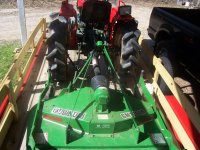
That's to hot IMHO. I would be putting a thermometer in the Radiator and get a exact reading of the Water Temp. In AL. average temp was around 50 Deg. in Dec. about the same here in Ga. I run a 5' finishing mower "alot" during the Summer months and my Radiator never gets hot. Last I checked 195 was about the hotest I ever checked it in 80-90 deg. weather. No reason to even bother with a temp. gage running that cool. Now I've had it 4 yrs. I just put my hand below the dash and can tell how hot it's running.;) here's a few pic.s of my Mower. And the JD. I use monthly. Still Big on Grn.;)
 

Attachments

  • Picture 018.jpg
    Picture 018.jpg
    88.8 KB · Views: 274
  • Picture 045.jpg
    Picture 045.jpg
    114 KB · Views: 228
Last edited:
   / Adding Guages To your Yanmar #106  
Ginormous, what did your tractor produce on the dyno? What numbers did they give you?
 
   / Adding Guages To your Yanmar #107  
That's to hot IMHO. I would be putting a thermometer in the Radiator and get a exact reading of the Water Temp. In AL. average temp was around 50 Deg. in Dec. about the same here in Ga. I run a 5' finishing mower "alot" during the Summer months and my Radiator never gets hot. Last I checked 195 was about the hotest I ever checked it in 80-90 deg. weather. No reason to even bother with a temp. gage running that cool. Now I've had it 4 yrs. I just put my hand below the dash and can tell how hot it's running.;) here's a few pic.s of my Mower. And the JD. I use monthly. Still Big on Grn.;)

It depends a lot on where the measurement was taken... The gauge I mounted has a probe that sits in the coolant inside the block just before it enters the hose to return to the radiator. This should be about the hottest point for the coolant. As soon as it reaches the radiator, it ought to start dropping in temperature.
Yanmar engineers apparently believe it's ok as long as the block stays below ~235 F, since that's when the temperature light kicks on.
 
Last edited:
   / Adding Guages To your Yanmar #108  
Ginormous, what did your tractor produce on the dyno? What numbers did they give you?

They didn't provide a HP measurement from the dyno. I asked, and they told me they don't record it. They said they just do it to stress the engine to make sure all is well as a final check after a rebuild. It seems likely they discovered that it's counter productive to tell people what the engine achieved in HP. Not recording the value gives them "plausible deniability" on the topic. Am I being cynical or realistic? You decide...
 
   / Adding Guages To your Yanmar #109  
I have yet to find a dyno that starts out low enough my local JD dealer says it takes 60 hp just to run theirs that sure leaves us out. :laughing:
 
   / Adding Guages To your Yanmar #110  
Yanmar engineers apparently believe it's ok as long as the block stays below ~135 F, since that's when the temperature light kicks on.

Hmm, that's interesting. I would have expected it to be quite a bit higher than that, though the outside of the block must not get as hot as the coolant it carries. Does anyone know at what temperature the sensor is specified to turn on the warning lamp?

The lack of horsepower numbers makes sense to me, in an unfortunate way. Most people would look at the horsepower rating on a Craftsman mower and wonder why their diesel tractor was substantially less powerful... :laughing:

It is ironic, though, that they test it to ensure it produces the correct power output, but then won't disclose it. It's probably... 22 PTO horsepower in the case of the 2210! :D I imagine it is a go/no-go test, which makes sense.
 
   / Adding Guages To your Yanmar #111  
Sears/Craftsman had Big settlement to make about the HP rating of thier engines. Not long ago. I ran into it on the Net. when i started shopping for a small compact tractor.
 
   / Adding Guages To your Yanmar #112  
Hmm, that's interesting. I would have expected it to be quite a bit higher than that, though the outside of the block must not get as hot as the coolant it carries. Does anyone know at what temperature the sensor is specified to turn on the warning lamp?
QUOTE]

SORRY! I meant to say 235 F. I believe that is the temperature the temperature warning light is supposed to kick on.
 
   / Adding Guages To your Yanmar #113  
I have a 2210BD that has a factory temp gauge included in the dash panel although I have never seen any real movement on the gauge. I did some testing with the sending unit and it looked like the gauge was questionable. I decided to add some additional gauges instead of trying to repair the original. I also decided to use an electrical temp gauge instead of one with the mechanical sensor so I could use the existing wiring and not worry about the copper tube.
I ordered a universal 2 gauge and 3 gauge pod from glowshiftdirect.com since I wasn't sure which would fit my dash better. The 3 gauge was a better fit so I did some contour sanding for a nice fit on top of my current dash. Glowshift had the pods in stock and they were delivered quickly, I would do business with them again FWIW.
I used Equus temperature, voltage and oil pressure gauges from O'Reilly Auto Parts since they were convenient and in stock. I tied onto the existing wiring connectors in the dash and used the original temp sending unit wire to the motor. The sending unit that came with the temp gauge fit in the original sending unit hole with one of the supplied adaptors and I made up a pigtail with a couple crimp-on connectors to hook onto the original wire. I had already added a tee into the oil pressure sending unit so I just had to run the plastic tubing from the gauge to my tee. I had run the plastic tubing for oil pressure on my old tractor with no problems so we'll see how this holds up.
I haven't had a chance to work it hard yet to see what type of water temp and oil pressure it develops under load.

Steve

https://picasaweb.google.com/105265...hkey=Gv1sRgCLzZntuQsLbHYg#5780664622254894066
https://picasaweb.google.com/105265...hkey=Gv1sRgCLzZntuQsLbHYg#5780664635735711970
https://picasaweb.google.com/105265...hkey=Gv1sRgCLzZntuQsLbHYg#5780664640970567954
 
   / Adding Guages To your Yanmar #114  
Since much of the stuff mentioned earlier in this thread is not available these days. What is the go to now for these gauges?
 
Last edited:
   / Adding Guages To your Yanmar #115  
Since much of the stuff mentioned is not available these days. What is the go to now for these gauges?

The one here is the best I've seen and has an original look,
Click on the Sunpro link under the image, it is still sold on Amazon.

 
   / Adding Guages To your Yanmar #117  
I had forgotten that more gauges was a major theme in this Yanmar forum back when I first started reading here. In fact I bought a gauge but never got around to installing it. Don't remember if it was Temp (likely) or Oil Pressure. At any rate I eventually gave the gauge away.

I am now of the opinion that Yanmar got it right with all of their design choices on these old classics. It's worthwhile to verify that the dash lights function properly. But that's all the attention needed. Just do a thoughtful warmup before running the engine hard.

The temp light seems to have been designed as simply a boilover warning, with different spec senders between the thermosiphon and pumped cooling systems. And anything short of boilover considered an acceptable operating temperature. Diesels are more efficient at higher temperatures. There's not even a thermostat in YM2000. They didn't overlook it, they designed a system where the warning light is all that is needed. Simplicity as a feature, as proud evidence of careful design, not simplicity as a cost savings.

It's obviously important to keep the cooling system up to spec, with the proper coolant and radiator cap, and the radiator rodded out or replaced if it doesn't cool properly. Yanmar expected thoughtful maintenance.

Some of these engines ran a lifetime of high output in semitrailer refrigeration units where nobody climbs up there between suggested maintenance intervals. Small offshore fishing boats, similar, where the owner literally owes his life to diesel engine reliability.

Now 40 +years later the fact that most of these tractors we own have only needed appearance reconditioning suggests that Yanmar got everything right, so long ago.
 
   / Adding Guages To your Yanmar #118  
I considered changing the Temp. Sensor to Gauge. In the summer I've had the Temp. light come on a few times over the Yrs.. Last time it happened and Been a few Yrs. I drained and flushed the Radiator. I also dropped the Antifreeze ratio to 20%. It's in the 90's now and I haven't tripped it yet so I'm believe in good shape. Again!
 
   / Adding Guages To your Yanmar #119  
Brand M Parts in Midland, Texas, sells a temperature gauge kit for the YM Series Yanmar tractors.
 
   / Adding Guages To your Yanmar #120  
Brand M Parts in Midland, Texas, sells a temperature gauge kit for the YM Series Yanmar tractors.
But for the other Amazon posting, you get all 3 gauges. (y)
 

Tractor & Equipment Auctions

2017 CATERPILLAR 120M2 MOTORGRADER (A52709)
2017 CATERPILLAR...
UNUSED FUTURE HYD HEDGE TRIMMER (A52706)
UNUSED FUTURE HYD...
2016 Chevrolet Tahoe SUV (A59231)
2016 Chevrolet...
Kubota SVL 97-2 (A53317)
Kubota SVL 97-2...
2022 Carry-On 5'x8' Trailer (A53316)
2022 Carry-On...
2018 Yamaha VX1050B-TA Waverunner Jet Ski (A59231)
2018 Yamaha...
 
Top