Aerator Tine

   / Aerator Tine #1  

nomad

Platinum Member
Joined
Oct 18, 2002
Messages
905
Location
TR
Tractor
MH744
I just finished making some simple toolings for a core plug curved aerator tine. See attached picture. But I just realized there is a design error in that tine. "Blue" line shows the curveness of the tine (actually, not a curve exactly, but a slightly sharp bent at the middle.) It's almost straight. "Red" and "Yellow" curves show alternative shapes to give you idea on how the curveness of the tine should have been. It should have been a spline (as the tine rotates as well as moves linearly.) Now, engineers or those who trust in their minds with mathematic-vision-in-born, tell us what path the tine follows that will determine the tine shape.
Your views will be converted, by me, to a function
which later will be discretized to inserted into CCam system
which will produce my new tine toolings
which will be produce more efficient tines for your aerators
which will reduce your oil consumption.

Or, there is no error in the original tine?
Who have core plug aerators with curved tines?
 

Attachments

  • 450042-aerotine2.jpg
    450042-aerotine2.jpg
    7.2 KB · Views: 713
   / Aerator Tine #2  
I don't know this for a fact, but I would guess that the tine you have was a compromise between what would have been ideal and what was acceptable. It's quite common for ideal designs to hit the cutting room floor due to cost, manufacturing difficulty, and/or supply chain issues. They may already have the "best" design, but have decided that the difference wasn't enough to justify the burden, whatever it may have been. Of course it's also possible that somebody looked at a straight tine and said, ya know a slight curve might be better and they just started putting a shallow bend in them. The question that really needs to answered is does the ideal tine have enough benefit to even warrant the time, effort, money, etc..? I can't answer that question.
 
   / Aerator Tine #3  
I don't think it makes any difference what shape it is. Either it is going to shear soil sideways on its way INTO the ground, or it is going to shear on its way OUT. I will give this some more thought.
 
   / Aerator Tine #4  
...Unless you can make it flexible!
 
   / Aerator Tine #5  
I'm with Jim. If you make it to go in to the soil correctly, it will not leave the soil correctly.
 
   / Aerator Tine #6  
I happen to have an aerator spoon sitting on my desk. It's 8.5" long and the curvature of the 5.25" in-soil section matches the red line. The remainder which contains the connection is straight. The spoon tapers from a tip opening with a cross sectional dia. of .625 to .875 at the section for ejection of the soil plug.
 
   / Aerator Tine
  • Thread Starter
#7  
"Ideal" tine (with proper spline shape) isn't difficult to be "machined" - Anyway, a die tool is necessary to give the shape of bent section at the middle. All that will be done is to change of the shape of this small die. No extra tooling, no extra machining, no extra cost. Probably, as you said, someone suggested "it would be better if we gave a curveness to that straight tine" and the tine manufacturer gave a simple curveness without studying much on it. If they studied a little more, the correct spline function that would determine the curveness of the tine would be obtained. This tine shape problem may seem to be a small problem, but I am estimating rougly that because of wrong tine shapes tractors are consuming about 3-5% oil more when they are pulling their aerators.
 
   / Aerator Tine
  • Thread Starter
#8  
</font><font color="blue" class="small">( I happen to have an aerator spoon sitting on my desk. It's 8.5" long and the curvature of the 5.25" in-soil section matches the red line. The remainder which contains the connection is straight. The spoon tapers from a tip opening with a cross sectional dia. of .625 to .875 at the section for ejection of the soil plug. )</font>

You have a digital camera? Could you please take picture of your tine for us? Thanks.
 
   / Aerator Tine
  • Thread Starter
#9  
</font><font color="blue" class="small">( I'm with Jim. If you make it to go in to the soil correctly, it will not leave the soil correctly. )</font>

I didn't understand Jim and you. Could you please make it clear? Thanks.
 
   / Aerator Tine #10  
If the tine enters the ground at a 10 degree tilt to the north, as you move away from North, that tine would have to rotate direction by 180 degrees pointing South, so not to come out of the ground without a "tearing" effect. To give you a demonstration of this, take a long straight bladed screwdriver and insert it into the ground at a slight angle. Then using the handle, move it forward so the handle is at the same angle going in the direction that the core aerator would be moving. You will note that there is a "slit" torn in the ground. The only way that this could be avoided is if you had a aerator that was set down on the surface like a cookie cutter and depressed into the soil. Then the "cookie cutter" would have to be pulled straight up and reinserted the same way in another location till the entire area was "cored". Nomads, hope that this explanation helps you to understand the action of a core aerator as it is rolled over the surface of the ground.
 
   / Aerator Tine #11  
Umm, first, I never mentioned any particular method to manufacture the tine. Second, you obviously are lacking in manufacturing experience if you think that changing forming dies is a no expense proposition. Third, they may not see a need to optimize the design and therefore view further study as an unneccessary expense. Other posts in this thread would seem to support that additional research is unwarranted as any special curvature of spline alone will not produce an ideal result. Besides, I can't hardly believe that 3-5% of the oil consumed while pulling aerators amounts to enough to warrant further study. There are far better subjects to study if a reduction of oil consumption is your goal.
 
   / Aerator Tine
  • Thread Starter
#12  
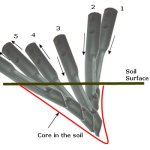
Junkman, I understand what path the tine follows. It's like in the attached picture. Yes? Does an aerator open a hole in the soil in such a shape? In this thread, I am also questioning the necessity of the curvature. Why curved tine if it's no helpful on not-tearing the soil? If a curvature is really necessary, then why such a curvature in the current tines? If the curved (core plug) tines are better than the straight (core plug) tines, why better? Whats superiority? Small thing, big questions;)
 

Attachments

  • 450666-aero.jpg
    450666-aero.jpg
    36.6 KB · Views: 419
   / Aerator Tine
  • Thread Starter
#13  
</font><font color="blue" class="small">( you obviously are lacking in manufacturing experience if you think that changing forming dies is a no expense proposition. )</font>
That you missed my point doesn't show that I lack experience in manufacturing. What I said in my previous post is "there is no cost difference between dies of two tines with two different curvatures". I mean no one is changing the die here, here is we are making the both from zero.

</font><font color="blue" class="small">( Other posts in this thread would seem to support that additional research is unwarranted as any special curvature of spline alone will not produce an ideal result. )</font>
My question is that current tine was really a product of a research or not. This isn't known yet in this thread.
 
   / Aerator Tine #14  
Villi - let's put a knuckle in the center. One that will allow it to rotate around the knuckle in only one direction...goes in straight then rotates until it is pulled from the ground by the forward motion of the machine and the rotational motion of the aerator.
 
   / Aerator Tine #15  
</font><font color="blue" class="small">( "there is no cost difference between dies of two tines with two different curvatures". I mean no one is changing the die here, here is we are making the both from zero. )</font> You assume 1) That all dies cost the same and they don't. The more complex the die the more $. and 2) that they even had a die made. Judging by the simple shape and knowing how the company I work for goes about forming metal, I would guess that they used an existing die.
</font><font color="blue" class="small">( My question is that current tine was really a product of a research or not. This isn't known yet in this thread )</font> Who cares? What bearing does it have on anything? If you are going to make a new one and whant to do real research, not just looking at other people's tines, as to what shape would work best, then do it. Why do you feel the need to keep questioning the amount of design work that went into existing products? Also, how does it pertain to supposed reason for all this: the consumption of oil?
 
   / Aerator Tine #16  
Upon quick review, while this is a valid idea that could be pursued and may accomplish a better motion for the tine, I believe that this would make the tines too expensive both on the front end (cost to manufacture/sell) and in the long term (cost to maintain/service).
 
   / Aerator Tine
  • Thread Starter
#17  
</font><font color="blue" class="small">( You assume 1) That all dies cost the same and they don't. The more complex the die the more $. )</font>
Who is saying that all dies cost the same. Complexity difference between, say, a parabolic curved tine and spline curved tine is almost zero, hence cost difference is almost zero.

</font><font color="blue" class="small">( 2) that they even had a die made. Judging by the simple shape and knowing how the company I work for goes about forming metal, I would guess that they used an existing die. )</font>
Who is using an existing die? Okay, I just made one, but without spending a $100 or two, I can change the forming/bending die easily (just a little more machining.)

Villengineer, you frequently say I lack engineering, etc.
You are an engineer working for a company. What does your company do? Specialized only in one field or two, aren't they? I am working WITH many manufacturers from metal forming to plastic forming to special casting to tool making for any materials (plastic, steel, aluminum, etc), etc etc. So, I know what I am talking about and know you aren't understanding what I am talking.

" My question is that current tine was really a product of a research or not. This isn't known yet in this thread "
</font><font color="blue" class="small">( Who cares? )</font>
I guess people on the forum care and would like to know the truths behind the screens.

</font><font color="blue" class="small">( If you are going to make a new one and want to do real research, not just looking at other people's tines, as to what shape would work best, then do it. Why do you feel the need to keep questioning the amount of design work that went into existing products? )</font>
Why shall not we question? I'm a farmer here like anyone. If another farmer had asked such questions questioning "hard design works" spend in existing products, you would probably be appreciating now. Why double-standart behaving when Nomad is questioning? Let me quess. It is easier to feel the community on your side against a foreigner like a nomad, isn't it? I understand. No problem. By the way, I am saying "there is no design work in existing tine" and you are saying "there is." Can we learn proof of the design work in it from you? Why is that tine curved?
 
   / Aerator Tine #18  
Too costly? Exactly the reason you and I should design, manufacture, and market them! /forums/images/graemlins/grin.gif Lets be the sole supplier of aerator replacement parts as well as supplier to OEM's. They break more often but if mass produced we can cut the costs...and make them out of nylon (no, not pantyhose /forums/images/graemlins/crazy.gif).

I better stop thinking while I am still able. /forums/images/graemlins/grin.gif
 
   / Aerator Tine #19  
Too costly, as in I don't want to sell them at a loss or have them setting in my yard b/c no will buy them at a profitable selling price. I simply haven't seen enough aerators running around to justify the expense.
 
   / Aerator Tine #20  
</font><font color="blueclass=small">( You are an engineer working for a company. What does your company do? Specialized only in one field or two, aren't they? )</font> We are an international company, both in manufacturing locations and sales, that designs and manufactures both standard and custom equipment for many different segments of industry and commercial use. We do make some equipment that is used in various areas in and related to farming, but most of it is not. I happen to design and oversee the manufacture of some of the custom products, including several that are farming related.
</font><font color="blueclass=small">( I am working WITH many manufacturers from metal forming to plastic forming to special casting to tool making for any materials (plastic, steel, aluminum, etc), etc etc. So, I know what I am talking about and know you aren't understanding what I am talking )</font>We cut, form, machine, and weld several different metals right here at our location. We also cut and machine several different types of plastics here. I design components out of metals, plastics, and composites. I also design and specify castings, components for power transmission, and hydraulic systems. Since I design custom equipment that is built right beside "catalog" units I often am very involved in the manufacturing process and methods of achieving the design w/out having special tooling made for each unit. I also work many outside suppliers, so I'm pretty sure I've got a pretty good grasp of what I'm talking about.
</font><font color="blueclass=small">( I guess people on the forum care and would like to know the truths behind the screens )</font>First, you are the only one questioning the design. Second, what are these screens you keep talking about?
</font><font color="blueclass=small">( . If another farmer had asked such questions questioning "hard design works" spend in existing products, you would probably be appreciating now. Why double-standart behaving when Nomad is questioning? Let me quess. It is easier to feel the community on your side against a foreigner like a nomad, isn't it? )</font> I have absolutely no problem with someone asking how a product works. I could care less about where you live. You don't ask how things work, you ask us to help you take someone elses work and use it to make yourself money by calling it your own. I take offense to your attacks on manufacturers and designs. Some of your irresponsible suggestions under the guise of an expert makes me leery of anything you post.
</font><font color="blueclass=small">( By the way, I am saying "there is no design work in existing tine" and you are saying "there is." Can we learn proof of the design work in it from you? Why is that tine curved? )</font> It exists, therefore it was the product of someone's imagination. It did not happen to show up on earth in that form by itself. It is curved b/c someone took the time and effort to specify that it should be curved. There I proved that some design work was performed.


Tractor & Equipment Auctions

Preliminary Listing / Full Catalog Coming Soon! (A53317)
Preliminary...
Adams 5T Pull-Type Fertilizer Spreader (A56438)
Adams 5T Pull-Type...
2003 Big Tex 10PI 16ft. T/A Pipe Top Utility Trailer (A55973)
2003 Big Tex 10PI...
2020 CATERPILLAR 242D3 SKID STEER (A60429)
2020 CATERPILLAR...
Caterpillar 906M (A53317)
Caterpillar 906M...
2022 Schulte 2500 Giant Rock Picker (A56436)
2022 Schulte 2500...
 
Top