All Things Livestock...

/ All Things Livestock... #81  
OK, Spivey man.. hate to disillusion you... it's all different from what you are thinking.:D.. you are in the business of RAISING GRASS. You happen to harvest it with critters.. and, then sell the grass that didn't end up being of interest to EasyEd as beef.:D

Next comment re your horn-filled beliefs... if you REALLY want a LARGE animal with LONG horns.. you are in a good situation... just steer a bunch of your young longhorn bulls and keep them for about 12 years... you will be totally amazed at their grown body size and horn length. Reason is that removing the hormones means that the animals actually continue to grow their entire life... both horns and the body height. Check out the studies by Jon Bonsma... I bet that EasyEd knows what I'm talking about.

Now, I gotta tell you.. if you breed a good Beefmaster bull to a good longhorn cow... it'll be regressing about 100 years of genetics... both breeds have their positive advantages... but I don't think that they would fit together very well.

Glad you enjoyed the BBU magazine and pictures. There will be some sales in your area... go by and check them out to see in person what a Beefmaster looks like... just remember, grain fed fat sells but those are expensive pounds! Very few cowmen (I think it's about 1% or less) can look at a grain fat animal and a range condition animal and determine which is actually the objectively better animal. The human eye will be incredibly drawn to the fat critter. I have to fight this problem in myself every time I start to purchase a bull.

EasyEd... can't wait to see how thin you once were! Hmm... I bet your dissertation has one of those long, convoluted, multi-phrased, carefully parsed and qualified titles:rolleyes: I can't wait to hear what it is:)

And, yes, I am shocked you are falling in love with an untouchable Australian mini-bovine. I guess I could believe that there would be less hoof pan, thus perhaps better water penetration and better grass growth and perhaps a little more forage per acre... but, does the breed actually result in more beef pounds per acre? I would think this would be offset by other factors such as more shots to give, etc. I know, I know... there is the commentary about how hardy they are, small birth weight, etc.... I can't think of any breed that doesn't make some sort of similar claims that, upon careful scientific record keeping, either is unprovable, or results from sample selection or variation within breed.... and this breed has only 251 females (in 1993... wonder why this hasn't been updated since it is over 10 years old)

Seems to me, if you want something small that you can handle and has horns.. get angora goats.... or "spanish goats" :eek: Just funn'in you, Ed... Thanks for pointing out this new breed.. never had heard of it. Intersting that somebody has actually gone away from the "bigger is better" cry... didn't even stop at the "moderation and balance" point, but dropped right down to the "low growth rate is good" motto. Are the Aussies stuck in the '60's where "less is more?" Was there any avowed purpose, other than to prove that an intelligent breeding design could prove Darwin right?:eek:
 
/ All Things Livestock... #82  
Texasjohn, that made for a good laugh this morning! I figured mixing Beefmaster and Longhorn would be a sacrilege, just wanted to have some fun there.

That is a good point about us raising grass and selling naturally processed grass. Actually the grocery store where we sell it is kind of a... well without offending folks let's just say it's kind of granola. About half of the clientell think we are evil for harming animals, and about 1/10 of that crowd are activists, will run over our kids with their shopping carts just to get their point across. We have tons of people tell us that they are vegetarians. I always respond with, "Great, so are our cattle!" I guess they don't go for the "you are what you eat" deal. :) I also ask them, "If we weren't supposed to eat animals, then why did God make them out of meat?" :D

We've gone back and forth on whether to use bull or steer meat. Since we slaughter around 20 months, the bulls put on so much more muscle and flesh out so much better than the steers do, however we've had some really great results using steers. Fantastic taste! They are a bit smaller and only yield about 58% of hoof weight compared to 62% for the bulls, but I think we're going with steers. It also makes life easier than having 50 bulls in a field :eek: who all go nuts every time the wind blows across the neighbor's cows. :D We bought a Calicrate bander as they are supposed to have the least impact on the animals, not supposed to impact growth... etc. compared to cutting them. Most of my family do it old school with a pocket knife because you can't get the mountain oysters if you band. :) Mmmmmmm......

That's all for the quality of the meat, not the horns. None of our beef animals will ever have great horns because they will be slaughtered before they get there. The cows have some pretty impressive horns, and our oldest bull (the brindle in my avatar) is doing pretty good. However we picked up a steer this weekend, about 8 years old, ~1600 lbs who had to turn his head sideways to get on the trailer. Massive horns, looks a lot like Bevo if we have any UT folk out there. I don't have a picture, but will get one when I get a chance. Nice lawn ornament for when we do tours. He's so gentle, just meandered up on the trailer, didn't give it a thought, and did the same thing getting off. We're going to work with him and hopefully be able to take him to promo's on a halter. He should draw some attention for sure.

Now then, back to business. Have you ever had life get in the way of perfectly good intentions? We've been so busy with the business and everything else in our lives we haven't had time to get the corral system built and here it is the end of Sept. Do you remember when summer vacation from school seemed like an eternity? Now the whole summer is gone in the blink of an eye. Wow. We're going to have to get the cattle moved to my land pronto, won't have to time do much in terms of handling. Our current plan is to load them up, we have 3 big Goosenecks ready to go, and then we were thinking about unloading them through the squeeze chute so that we can worm them, vaccinate the calves, band the bulls, and tag them all. Our hopes are that it won't be traumatic enough to imprint bad memories on them for the chute. Then build a system on my land, move the chute to that, and start conditioning them to use it the way we'd discussed. Does that raise any huge red flags to you all?
 
/ All Things Livestock... #83  
You're doing what you need to do, given the time and resources that you have... as all cowmen do.. and getting started is really tough... you need to get everything done all at once!

My son and his wife just got back from a vacation trip to China, Mongolia and Russia... celebrating her completion of medical school.. now a practicing nephrologist! In Mongolia, he rode a horse for hours across the stepps, like the Great Kahn... they eat meat there.... he has a photo of a sign saying, "meat is for men, grass is for animals!" I, too, know the granola crowd.

You will settle on steers.. bulls too hard to handle, injure themselves, etc.
I studied percentages such as you quote (for slaughter and many other things) for a long time. My conclusion is that, unless you are dealing with hundreds of animals, your management practices matter much more than the find tuning things you can do. For example, bull breeding observation, fertility testing and cow palpating will raise the % of calves raised better than any other measure... assuming that you sell the cows that are open/slow breeders.

You want mountain oysters? Raise goats... tasty tidbits!

I repeat, a BULL with amazing horns has questionable hormones working for him... a real bull's horns will be very large at the base and somewhat stubby. Steer horns are smaller at the base and thinner and grow longer/faster.

It's good you now have a gentle mascot... do your best to keep him that way... although at this point in his life, he is well accustomed to humans and unless teased, tormented and mishandled (beware, this happens much more than you think if you start taking him on "show off" trips.... dumb city folks love to do strange things when around animals) he will stay docile. Warning... learn now how to tie a lead (use nylon, not leather or fancy stuff) off very tightly... and preferably place the animal in a portable pen. Use locks! For fun, people will unsnap leads, open gates and either walk into the pen to pet the critter, or let it "fly and be free!" Make, now, a sign that explains that bad things can happen and the public is now warned... to get an idea, visit a horse event of some kind... notice the signs they have posted all around indicating that the event is dangerous and they don't have liability. Somenting like:

AN EQUINE PROFESSIONAL IS NOT LIABLE FOR AN INJUJRY TO OR THE DEATH OF A PARTICIPANT IN AN EQUINE ACTIVITY RESULTING FROM AN INHERENT RISK OF AN EQUINE ACTIVITY

I just discovered these folks make signs, know nothing about them.

Here is an intersting discussion re signage requirements from legal position, re horses

Re your plan to work stuff straight from the trailer..no problem... imprinting will not be a big problem. all gets mushed together with the experience of round up, trailering, etc...

Biggest problem is I don't understand how you are going to unload from gooseneck directly into squeeze chute. My 24 ft cattle trailer has partitions, making three 8 ft. compartments. I assume your goosenecks are somewhat similar. I see no way other than to unload one trailer segment... say 4 cows to 8 smaller animals at a time...into some sort of small holding pen from which you will press them singly into the squeeze chute. I fear if you don't have at least the rudimentary pen-to-squeeze chute setup that somebody will get hurt. Figure out how to unload the trailer without you personally having to crawl in there with those heavy bodies and horns...
 
/ All Things Livestock... #84  
Yeah, we're trying to make everything happen and not mess up too big along the way.

I didn't even know what a nephrologist is, had to look it up. Wow. Impressive. Interesting vacation too. We went to Gatlinberg. :)

I think in general you are correct about bulls & horns, however there are some producers that have managed to bring along some lines that have great weight gain and horn. I met a guy last year who has an amazing operation in OH, runs about 5,000 acres. He has either one of the only or perhaps THE only bull in the breed to go over 2,000 lbs and 70 inches of horn, named Winchester. That's an amazing beast. He's sired some awesome animals too. I guess the point is selectively breeding to over time develop animals with outstanding horn without compromising other positive traits. Perhaps you always compromise other traits, but the challenge is what we enjoy. It'll be a while before that really matters to us. For now, we sell beef, and that's what will pay the bills.

I have thought about many of those things when it comes to bringing a live animal to a grocery store parking lot. It's gonna take a whole lot of convincing before I'll agree that he's ready, and there will be serious security when we do. I don't even want to come close to a lawsuit. Good idea about the signs too.

You are right on with your comments/questions around working through the chute direct from the trailer. We have one with a sliding gate that will work fine (built into the big gate on the back of the trailer). We use this one at the slaughter house because we can slide it open and let one animal out and then slide it closed to cover its retreat so that it can't get back on the trailer. Anyway the other two are just regular Goosenecks, one about 24 ft (my papaw's), the other about 32? ish feet (my tenant farmer's). Both have double swinging gates on the rear with cut gates up in trailer. I figure we'll have to have some panels set up and let 1/3 of the cattle off the trailer at a time, then work them one at a time through the Dube chute. Certainly not ideal. We'll try it with the smaller calves and see how it works before we pull the bigger bulls through, but for sure we won't be putting ourselves in between the animals and the pen/gate/chute. We can always gather them back up and try it the right way as long as we are still breathing! :)
 
/ All Things Livestock... #85  
Yep, I found Winchester here. I recognize the management symptom from observing the same thing in other breeds.... big bull..extremes sell, high advertising budget, high semen demand/price ($50), ooops.... can't meet demand...low quality.... OK... take him to Colorado in the summer to continue collecting where it is cold and maybe quality will be OK... then maybe back to Texas when it gets too cold in CO... leave him at a vet the rest of his life and collect, collect, collect.

I know it is sacriledge, but I kinda suspect that there is a correlation between his large size, horns and lower fertility..... the only way I'd become convinced otherwise would to myself observe the quantiy and quality, via objective counting and microscope measures... and compare to moderate bulls maintained in lower lower body condition count... (which also reduces fertility)... but, that's just me...

That said, I'm sure that he's a real money maker for some folks.... such extreme, first-in-the-breed on some measure bulls always are. There was a Hereford bull that was a supreme show winner... they bred him very, very extensively... then discovered that he passed on the dwarfism gene... almost destroyed that breed. Dwarfism still haunts the hereford breed today.

Here is an interesting story you might like re an old line cowboy and his lifetime of cow experience.

And, here also is another facinating story.... well worth a read!

Now, don't be confused, I'm not saying that dwarfism in herefords and long horned/big body longhorns are necessarily related. My point is that a focus on selecting for extremes and concentrating this via use of AI, transplants, line breeding, etc. often produces short term profits at the expense of later disasterous genetic discoveries.
 
/ All Things Livestock... #86  
Yep, that's the Winchester I was talking about. Just curious, but where did you find the info about low fertility? I don't understand that one. He's been in service at DCCI for many years and has many many many progeny. I saw him this spring before they sold him, and have seen many of his sons and daughters. I guess they wouldn't advertise low fertility, but just the same there seem to be tons of animals there with his blood in them. They tend to be very good for the beef side of the business, good average daily gains and such.

Admittedly, I'm way over my head in talking about the science of this with you, especially since that's not my animal. I think you do make some really good points about breeding for freaks. Not a good long term game plan. Hadn't really thought about the affect on the breed. Longhorns developed over time into what they were for a reason, an optimal set of characteristics given the genes available to the herds. When we mess with that too much we get outside of the beauty of what nature preserved in the animals in the first place. Point well taken. Very interesting reading in those articles. I'd never heard about that. The guy who run's cattle on my place right now has one hereford cow that is really short. Kind of favors some of the ones in that one article. Kind of freaky if you ask me. I'm fine sticking to good but not extreme genes in the animals we select.
 
/ All Things Livestock... #87  
Jan Bonsma makes the point about the relationship between fertility and bull horn growth and body size in his book. I have a copy at home...

Perhaps EasyEd with his scholarly ties might be able to elucidate us on this topic from his perspective.

I also just now located this study... but it requires access beyond what I have... so I can't see the conclusions, only that horn characteristics and growth in females has been a topic of study.

This is a broad summary of beef breeding considerations although not touching this topic.
 
/ All Things Livestock... #88  
Gotcha! Yes, I have had confirmed from several breeders that there does tend to be a correlation. Most say that the momma's with the best horns typically are not their greatest milk producers. They will be sufficient, but milk production isn't as strong as others. With bulls I have not heard anything about fertility, and haven't read that book, but I can't see a breeder telling me not to buy his big horned bulls because they are less fertile. One thing we have observed though is that the bulls with more muscle tend not to have the greatest horns and vice versa. We bought some feeders from a guy who typically feeds his bulls grain for shows. They are generally pretty big animals, with less than impressive horn. We expected the feeders we bought to have similar traits, but we're feeding grass, and sadly there's not that much grass on my partners farm. We've also been giving Cargil minerals at will. Those bulls are healthy, not skinny, but certainly not fat like the bulls they came from. However these sucker's horns are growing like crazy. We figure since they aren't able to put on as much weight in our light fields these days and since they are getting a good mineral supply that they are simply putting on more horn than muscle. Not ideal for us, but we'll get our fields situated so that we aren't this low on grass in the years to come.

I'll check out those other links now...
 
/ All Things Livestock... #89  
The conclusion, clear to me although either not admitted, understood, agreed to or known by some others I have talked to, is that a focus on one extreme extracts a price elsewhere in the biological continum. And those least likely to analyze or even countenance the idea are those who are most focused on one visual, easily measured physical characteristic. I have seen this in a focus on frame score, cannon bone size, etc.

I suspect you are correct re relationship between horns and minerals... the folks seeking to get big bucks for the "big bucks" make sure that there is a proper and plentiful mineral supplement available at all times.

I have not studied longhorns, but the correlation you have personally observed between muscle (masculinity as long as it is not double muscleing) and horn growth is interesting. My opinion would be that a well balanced longhorn bull would have hormones aimed at building sufficient (not extravagant) horns sufficient for self protection and strong muscle for strength in winning the battle of the bulls for breeding rights.... according to the law of the open range.

You are already experiencing that grain fed animals/genetics will not produce such large frame animals as fast when switched to grass. This is true, regardless of breed.
 
/ All Things Livestock... #90  
texasjohn said:
You are already experiencing that grain fed animals/genetics will not produce such large frame animals as fast when switched to grass. This is true, regardless of breed.

Could you explain this a bit? Are you referring to simply the difference between grain fed & grass fed diets on the frame development, or are you talking about pulling animals from stock that has been largely developed on grain only, (i.e. several generations of show bulls that have been on feed exclusively) and then putting those calves on grass?

I never really thought about the potential effect on the genetics of pulling animals from stock that has been on grain for so many generations. :eek: Sooooo much to learn...

Early on we bought several animals from a guy who raises them for show. They are put on feed as soon as they are weaned, he works with them, shows them, and those that he doesn't sell for high dollars we'd buy for beef. Most were 1,300 - 1,700 lbs, less than two years old. We also bought a couple trailer loads of feeder calves that we dumped on our grass. His "big" bulls had tons of meat, but were pretty small as far as horn goes. This was the first commercial slaughter that we did. You know how some people frame the first dollar that the company makes, well... :D


You can see his horns were not that impressive at 2 years-ish old, 1,480 lbs when we bought him. Also, that's not exactly what he looked like, that's a steer mold, I guess they don't sell bull molds for longhorns where my taxidermist shops. :) The calves we bought from that guy are doing great, but like I mentioned the horns seem to be growing much faster on our place (grass/minerals) than on his (show feed/some grass). I wouldn't care too much since those calves will be heading for the freezer some time next year, but we did buy one registered bull calf that we have hopes to breed with. We are as thrilled as you can be with a non-proven bull at this point. Which is to say he's got everything in appearance/disposition that we want. He just has to prove himself when we get some heifers.
 
/ All Things Livestock... #91  
I'll give it a shot... my opinion based on observations.. your opinions may vary:D

There is only so much weight and size that an animal CAN express.
This expression occurs IF the animal is never stressed its entire life and ALWAYS has an optimum diet, etc. This is about the situation you are describing as related to the breeder who goes for the show ring and feeds grain lavishly. His animals will grow to their maximum ability in a minimum time.

To see this idea at work in another arena, check out your typical human family. Line 3 generations of males up. Grandpa will be the shortest. Paw will be taller than him. And, a 19+ yr old son will be the tallest of the group. Likely, same thing with the ladies. Think about it... in my case, Dad grew up literally walking behind a walking plow and his family ate popcorn one year because that was all there was to eat. Air conditioning and referigerators didn't exist for during his growth years and he had the resuilting stresses. He's the shortest. I am about 2 inches taller than him...born in WWII and I never recall being hungry, and I had vitimans growing up. Both my boys are 2 to 4 inches taller than I am... products of more enlightened dietary understanding, climate control and plenty of food and snacks at all times. I submit to you that the genetics are not ALL THAT different in the 3 human generations... but the DIET and environmental stressors are.

There is a high, but not perfect, correlation between an animal's ability to gain weight on grass versus grain. However, at every age point the grass fed animal will lag behind a grain fed animal.. on actual frame size and actual weight gain. The grass fed animal MAY be the most cost effective because it is likely that the cost of grass is less than the cost of grain, thus, the cost per lb gain can give the nod to raising animals on grass. However, time is a cost factor too.... so that can play into the equation.

Net.. your grass fed critters will NEVER look like their grain fed moms and dads... either in size or fat covering or whatever, they will be smaller... it's just not possible to achieve the optimum mix of protein, etc. from forage, as a practical matter, 24/7/365.

I love your mounted critter!

Hope your young bull works out for you... such a long time to find out... buy young bull, grow him out.. test his fertility, breed him..make sure he's interested in females, wait for a gestation period, see calves... grow them out to weaning... then on to yearlings, then breed heifers and find out their level of fertility, calving ease, etc... Takes about 5 years to prove a bull, I think.
 
/ All Things Livestock... #92  
That all makes sense. Great observations, I refer to those as wisdom once you've made enough of them, and you obviously have. I do really appreciate your thoughts on these matters.

We are OK with the time factor as we basically set a window, 20 - 30 months for slaughter. If the animal is ready in 12 months we're not going to kill them anyway. We also figured on the smaller weights and leaner meat AND lower costs of raising. We are too new to have really flushed out the cost/revenue side of grain feeding Vs. grass, but our marketing strategy is based around "natural" production of cattle. We'll see how all of that works out.

That young bull crawled under the fence last night at my partner's farm. Low spot, easy to cross, and NO grass left on his place. When he went over there tonight the bull crawled back under the fence. No major trauma, but I'm sure hoping the feller was just really hungry and not showing his stripes. He's been a great bull calf so far (as far as one can be at this stage). My partner doesn't have the time to work with them. I'm limited also but will be more deliberate at training them. We're moving one load Thursday night to try out our system.

I decided to abandon the gate panel idea, since I have a perfectly good barn right there. We set it up tonight to be able to unload about 5 at a time into the barn and then be able to cut them as we go, 3 seperate areas if we need, and a pair of gate panels to crowd them, if we need, right into the Dube chute. I feel pretty good about it. I didn't get any pictures because I forgot my camera, but will try to get some Thursday night and of course Sat. It'll be good to get the herd out on some better grass and more land.

I also went back and read through your electric fence stuff. I'm going to be going that rout to protect a pond in another field if we wind up having to graze them there anytime over the winter. I'll probably also use that to section the fields next year for rotational grazing. I figure that's the best way to manage it, cost effective and not permanent so we can change it as we learn. Once I start getting hardware I'll probably have some questions, but one thing at a time for now. :)
 
/ All Things Livestock... #93  
When you get serious about electric fencing...BEFORE you purchase wire or equipment, I offer to talk to you via phone... maybe some weekend/night when rates are cheap/free.... so much to tell, takes so long to type it all out. I think I can save you some headaches! It'll solve your roving bull problem.
 
/ All Things Livestock... #94  
That would be great! I have Vonage at home so no long distance fees for me. I would really appreciate that.

I stopped by TSC today to check out their systems. They have a solar powered deal that puts out a little over 4,000 V in a 1 mile fence. They (the literature that is) recommended 3KV - 4KV for turning a bull and 4 strands. They had poly woven wires and plain metal wires that were recommended for that system and T posts... etc. Once we get all the critters to my land I'll start figuring on a layout for the fencing that I'll want to do. Just want to keep them out of a pond and section of woods when we let them graze the back section, and want to rotate probably starting in the spring for best usage of the grass we have.

In the mean time, I think we have everything we need for working the cattle except the nose pliers. TSC didn't carry them. I'll try to get some pics when we get rolling. Should be a hoot for us to figure this out on the fly.
 
/ All Things Livestock... #95  
Fencing materials
use only charger qualified for 100 or more miles
use only 21.5 gauge high tensile wires
use only black insulators on T posts
use wrap around black insulators
use ceramic donut insulators at corners
get a bunch of insulated high tensile wire for underground, elsewhere
get a bunch of switches... you will use them often
use FEL to drive t posts in ground
use a rachet on EVERY fence wire segment
no need for springs to maintain tension
if you are able to find lots of fiberglas sucker rod, buy it rather than Tposts

VONNAGE me when you are ready.

get a pair of nose pliars from somewhere... wouldn't work cattle without them!
 
/ All Things Livestock... #96  
Texasjohn, what are the black insulators you recommend for use on t posts? I've never seen any and I'm getting ready to string some more electric. Have you got a picture and where do you get them?
I'm not far from you and have ready access to both TSC and American Fence and Supply but haven't seen any thing like that on their shelves.
 
/ All Things Livestock... #97  
Howdy weldingisfun, welcome to the Cattle thread. It's kind of been a 3-man show so far.

For everyone else (texasjohn and EasyEd :) ) the results are in on that jumpy cow. Not a dark cutter. The meat actually turned out pretty decent except the butcher's saw was too dull and they got off the spine so one whole side of ribeye's are screwed up. And, they must have dropped one side or ran over it with a fork truck or something, the pelvis was crushed and the meat was badly bruised on that side so there was lots of waste. Kind of a bummer, but now our butcher owes us big time. :)

Another interesting aside... I guess you should always be leary of a "good deal." When we bought that lot of cows that included Jupmy we were actually saving up to buy some really nice registered heifers. This deal presented itself at a decent price, 4 cows/4 heifers (5 of them bred) and a good little bull calf. That seemed like more bang for our buck, so we pulled the trigger. (foreshadowing) My business partner was talking to a lady yesterday, she said she had a neighbor who used to have longhorns and one of those cows was always jumping the fence into her field. Turns out she was the neighbor of the guy we bought them from! Ole' Jumpy had a history - not surprising - but I bet that's one of the reasons that guy was ready to sell. He was about 85 and had bad knees, so he said, and he probably did from having to chase the cow all over creation. The rest of them seem to be very well behaved, the 5 all dropped great looking calves, and all are now covered. We'll come out OK on the deal, but will be more discriminating on future purchases.
 
/ All Things Livestock... #98  
We started moving the herd last night. Everything worked perfectly! We had a handfull of volunteers, 4 bull calves about 600 lbs and a heifer about 800 lbs walked right up on the trailer. This was perfect for us to try out our make-shift system at my barn. We didn't get out there until almost dark so I only got a couple of pictures and once we started moving animals it was all business. This is the first time we've worked the herd so we were very focussed on learning what we were doing and not getting hurt. I'll get more pics Saturday when we bring the rest of them out.

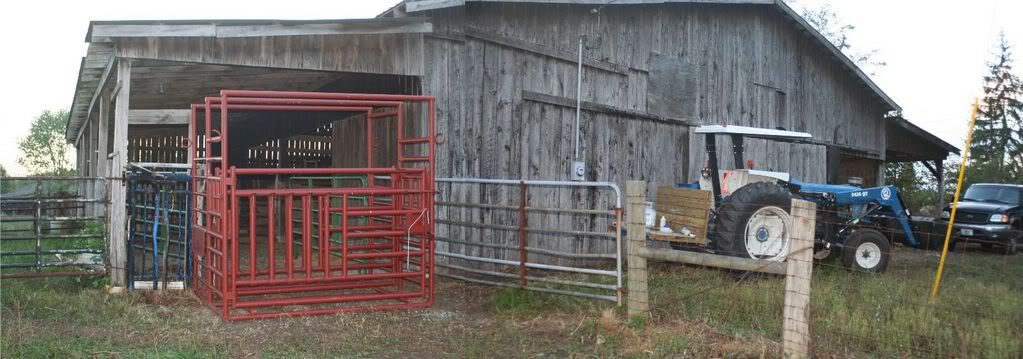
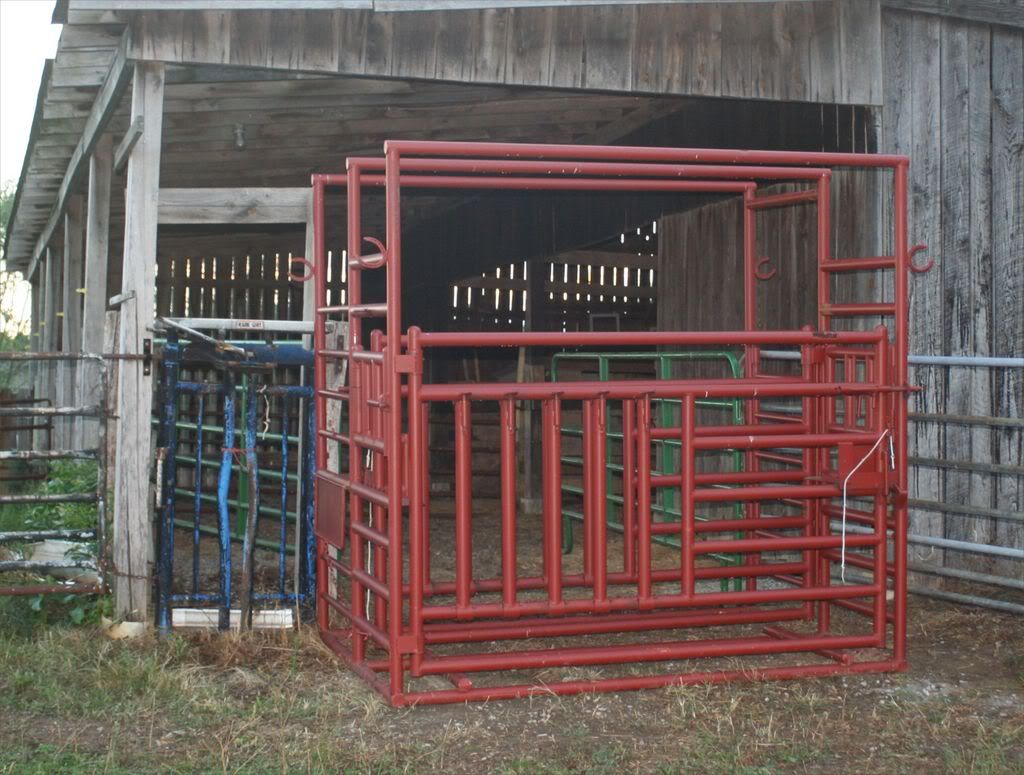
So here's a stitched shot of the back of the barn. I'm standing in the pen where we turned them out, there's another on the left and right that are all fenced in. We used my carry all as a working table for all the stuff. The Dube also has a little table that folds out, but it's not up in this picture.


We unloaded them in the front and had a zig zag kind of pattern for them to follow, straight out of the trailer, then right turn, then left turn. That thing about cattle always wanting to go back to where they've been... not sure if that's what helped here, but every one of them walked off the trailer and followed the path with little to no pressure by us. They all walked right into the Dube, again with little to no pressure from us, we closed the back ratcheting gate, squeezed them up, and got to work.

Here's a closer view (the left side of the stiched picture) so you can see the set up better. Not sure why photobucket shrinks the pictures so much.


I didn't get any shots of us branding the cattle (will try on Sat) but here's a shot before we got started of the heater with our branding irons in it:


We tagged their ears, gave them worming meds (Ivomac), and some vaccines (7 way/9 way : calves/cows - I think), we banded the bull calves with a Calicrate bander. That was awesome. I've helped my papaw and my uncle castrate before with a pocket knife, this is for sure the way to go. Those calves that were cut seemed so stressed out, but these guys, when we cranked those bands tight, they never seemed to even notice. No kicks (though we did tie their hind legs for safety sake), but there was no acknowledgement of us even being back there. Not what I expected. One even messed up and didn't crimp on the band right so we had to re-do it, that guy still didn't act like he cared. I'll be watching them over the next few days, they should drop and it's not supposed to stop the weight gain the way cutting can do. Lasty we branded them, holding brand only. We didn't do the PH numbers since these aren't being registered. Smeared the brand with Vasciline and turned them out. We had some grain for them in a bunk feeder in that lot, but most of them seemed to like the grass. Guess they read our brochure where we call them grass fed! :) Once we got the 5 of them through, we opened up the gate to the main pasture and that heifer led the bull calves right out in to the pasture to meet the cows that are already out there.

Could not have gone better as far as I'm concerned. One of the brands didn't turn out so well (my first one) but you have to learn somehow. We're excited about tomorrow. :D We'll start about 5 am. Not so crazy about that. :( I'll try to get some better shots of animals in the Dube, the banding action, and the branding. Thanks for all of the advice so far, I know that helped us have such positive results. Cooperative cattle helped too.
 
/ All Things Livestock... #99  
well.. I got my black plastic insulators at Tractor Supply... in Georgetown. Haven't looked at their stock lately.

I've used red, yellow, black.... for over 20 years... observation says that the black ones hold up MUCH better to the elements than the others. Red is worst.. yellow better, black best. I don't know why.

American Fence and Supply, my opinion, is ALWAYS overpriced.
Drop by some time (call first, PM me and I'll send you my mobile phone #) and I'll show you what I do and use...

Agreed, sometimes all you can find is another color and you have to go with that... no picture, sorry.... too busy to get one now... lots of family responsibilities at present.

Spiveyman... I CANNOT imagine what happened to crush the cow's pelvis... there is no exchuse... somehow, there is a SERIOUS novice on the cutting floor. Same for messing up ribeye...

Spiveyman... I determined that I can raise better animals than I can buy. Try as I might and selecting the very best animals I could my experience over time... and numerous outside purchases.... when I would look back on a purchase group made 3-4 years prior, the results were:

one third were GREAT cows and stayed with me a very long time

one third were kinda OK, but nothing to brag about and falling short in my opinion on one or more of the 6 essentials... thus at the bottom of my herd ranking and on the block as soon as some other animal proved themselves to be better.

one third were already gone having flunked one or more of my 6 essentials criteria

Total $ didn't seem to matter, selecting from known and reputable and honest breeders versus unknown breeders didn't seem to matter, purchasing at sales or on the ranch didn't seem to matter, using my own eye only or selecting only from previously viewed and approved animals (purebred sales) didn's seem to matter.

Net.. give it up... until you are raising and retaining your own heifers (expensive business) you will experience the one third, one third, one third results I did.... unless you have extremely good luck or have substantially more lenient retention criteria than I do. So, my opinion, you can buy as you did on the lower price end of the scale, live with the critters a little while, and expect to move 2/3 of them along when you have proven you have acquired better replacements.

Note... the above does not abdicate your need to select the very best animals you can find... if you lower your initial selection criteria, then you may have NO decent cattle left after the proving period.

I continue to believe that disposition is THE SINGLE MOST IMPORTANT selection trait... if you can't pen it, you can't even sell it!
 
/ All Things Livestock... #100  
Good to hear your first working went so well... planning, planning, planning, as you did, pays off.. Also, letting them work themselves with no to gentle pressure from you (as you did) is always best .... hollering and shouting simply confuses them when done all the time, they don't know what it means. Nevertheless, a well timed shout can be useful on occasion.

Cattle like to curve around.. thus the zig-zag gave them somewhere to move to next..
 

Marketplace Items

2017 Ford Escape SUV (A59231)
2017 Ford Escape...
UNUSED SDLANCH IRET13 ELECTRIC TRICYCLE (A60430)
UNUSED SDLANCH...
500 BBL FRAC TANK (A58214)
500 BBL FRAC TANK...
RING 2 STARTS HERE @ 9:15 AM (A60430)
RING 2 STARTS HERE...
2019 FREIGHTLINER CASCADIA TANDEM AXLE SLEEPER (A59904)
2019 FREIGHTLINER...
UNUSED KJ - K1912 - 20' X 12' LIVESTOCK METAL SHED (A60432)
UNUSED KJ - K1912...
 
Top