another led question

   / another led question #21  
I would think pretty decent. I have a 180watts bar and it draws under 9 amps. No expert here though, sure someone more knowledgeable will be along soon with a real answer
I am noticing that most led lights require 10-30vdc. Marketing wise I think the wattage and lumen ratings are based on 30 Vdc applied to the light. I do not have a light to test but I am curious how much the current draw and lumen ratings change with applied voltage?
 
   / another led question #22  
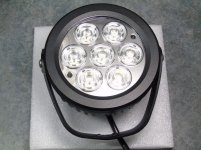
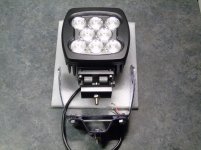
Switching my halogen work lights to LED's today. I got two Cree 70W spots (7000 Lumens each) and an 80W flood for the rear.

Found a local guy that sells any kind of LED you can think of for real good prices. (in Canada any way?) If you email him he can send a PDF catalog. He also guarantees everything for life. If you have a problem he will exchange it.
Darren at HiRev Racing. dmattalo@Hotmail.com

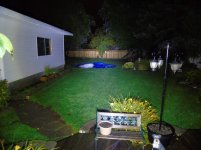
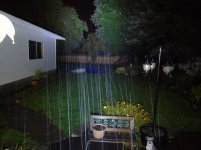
Here's some pics he sent me of one each lit up in his yard.
I can't wait to try them.

I recently switched the moose lights on my dump truck from the GE 100W aircraft landing bulbs to some LED's that are only 5400 Lumens and the difference is incredible. They may not quite have the distance of the 100W sealed beams, but they light up a huge wide area compared to them.
 

Attachments

  • spot 4.jpg
    spot 4.jpg
    333.3 KB · Views: 203
  • Spot1.jpg
    Spot1.jpg
    430.2 KB · Views: 158
  • flood2.jpg
    flood2.jpg
    356 KB · Views: 173
  • flood1.jpg
    flood1.jpg
    438.6 KB · Views: 145
   / another led question #23  
I am noticing that most led lights require 10-30vdc. Marketing wise I think the wattage and lumen ratings are based on 30 Vdc applied to the light. I do not have a light to test but I am curious how much the current draw and lumen ratings change with applied voltage?

I haven't done any testing or have any hard data either, but I bet your theory is correct.
 
   / another led question #24  
Actually, it's a little less than 15 Amps since the alternator is running at about 14.5 volts. That is your circuit voltage so 180 Watt draw becomes 12.4A. And most of the LED lights now best any halogen in whiteness and lumens. As already mentioned, they are BRIGHT!

This is a good point to keep in mind. As long as the tractor is running, and alternator output good, the applied voltage will be higher than 12V. So actual, observed current draw for accessories/devices specced at 12V will be lower than the rated amps. Even without the alternator running, a fully-charged 12V battery in good condition will measure a bit more than 12V

By the same token, if we turn off the engine and leave the work lights lit (with the ignition on accessory) for even just a short while, the applied voltage will drop, causing amp draw to increase. If we're already borderline with the fusing, that could cause a fuse to blow. It's something I'm sensitive to because I swapped the factory work lights out for LEDs on my NX4510HST cab tractor earlier this year. The factory lights were 35W halogens, two facing forward, two towards the rear. The replacements are 45W LEDs. The front and rear work lights circuits are separately switched, and fused with 7.5A mini blade fuses. At 12V applied voltage, each pair of the 45W LEDs theoretically pulls 7.5A. So if their power rating is true, I'm already borderline on fusing at 12V.
 
   / another led question #25  
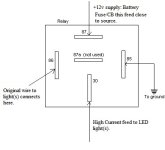
Fuses protect the wiring. It's not advisable to just put in a larger fuse for the circuit. It you need more current capacity, I would leave the original circuit wiring but use it to switch a relay. Use a larger wire to and from the relay to drive the lights with its own fuse. That would satisfy the need for more current and preserve the original wiring. (Non-destructive conversion.)

Since LEDs rely on constant current, I'm willing to bet the range of operating voltage for the lights is handled by an electronic module in the light. If so, the lights will emit the same light (lumens) no matter what voltage is applied, within the range.

Added: Also switches have a current limit. Using the original wire to switch a relay would keep the current from the switch too. 30 and 40A relays are inexpensive as well as 14 or 12 gauge wire to drive high current lighting.
 
Last edited:
   / another led question #26  
Here's a simple relay setup. The supply at the top of the relay and the LED feed should be a sufficient gauge of wire to handle the current draw or all lights connected to it.

relay-diagram.jpg
 
   / another led question #27  
My two 70w will run 3.42A each light and the 80w will run 4.86A.

The wire coming out of my 80W is only 20ga. The other two, and the wire I used throughout the tractor is 14ga, because that's what I had from my big trucks. My 20A fuse is more than enough.

Got them on tonight. My lawn is 2 acres and it's all lit.
 
   / another led question #28  
Remember also, some lights are better than others. Some draw more than others. And the cheap ones will make a high pitch squealing noise. Those are the ones you don't want.
 
   / another led question #31  
Paystar, something is amiss with you amperage... if you are running 14.2 volts, then 4.86A equals 69 watts... just the way the laws of physics compute.
 
   / another led question #32  
Paystar, something is amiss with you amperage... if you are running 14.2 volts, then 4.86A equals 69 watts... just the way the laws of physics compute.

No idea? That's what the manufacturer said? All I know is they are super bright and I am running three of them with the 20A fuse.

Here's what my dealer sent me:


the beauty about these lights being high quality they take no power compared to not so good lights of the same power. The 70w will run 3.42A each light and the 80w will run 4.86A each light. For your alternator it will be fine as long as the battery is good and the system is not overloaded. I have up to 300w light bars on Polaris and Honda side by sides plus they run a winch light bar and other stuff with no problem. The bigger 300w light bars run at 9A-10.5A so they can be used all the way down to solar power applications only requiring 9V-30VDC to opporate.
 
   / another led question #33  
It is rather obvious that apparently some of these wattage claims of these LED lamps are being overinflated. In DC circuits. Watts= volts X amps. Period, end of story. Example, 14 volts at 10 amps is 140 watts input to a device. Doesn't matter if the device is a heater coil a solenoid or a LED lamp or an incandescent lamp. Output watts is very hard to measure because we may not know the efficiency of the device. But input power measured in watts is very easy to measure. I think some of the distributors have taken a bit of "license" with their measurement's.
 
   / another led question #34  
Fuses protect the wiring. It's not advisable to just put in a larger fuse for the circuit. [snip]

True, very unwise to over-fuse a circuit rated for a specific amperage. Hopefully nobody here is doing that. :shocked:
 
   / another led question #35  
So I am not expert on this, and my background is classic cars and big stereos, but I was always told never to exceed the amperage of Alternator. Yes, a battery can provide "missing amps" but the strain on the alternator (heat) can be really great and tends to make them fail quickly. Also, when you go to idle your alternator is no longer producing anywhere near enough amps so your lights may dim and you will put a strain on your electrical system.

I was told headroom is important. give yourself a minimum of a 10 amps of headroom when putting in high amperage devices.
 
   / another led question #36  
So I am not expert on this, and my background is classic cars and big stereos, but I was always told never to exceed the amperage of Alternator. Yes, a battery can provide "missing amps" but the strain on the alternator (heat) can be really great and tends to make them fail quickly. Also, when you go to idle your alternator is no longer producing anywhere near enough amps so your lights may dim and you will put a strain on your electrical system.

I was told headroom is important. give yourself a minimum of a 10 amps of headroom when putting in high amperage devices.

I would tend to agree with this advice. Just look at the output curve on an alternator showing rpm vs current and then how heat affects the output will give you an education. When we say a tractor has a 50 amp alternator, we mean at full rpm an while it is still cool. Yes you can Rob the battery for a short period but for how long?. It still has to be made up by the alternator.
 
   / another led question #37  
Quick lesson on LEDs which will answer some of these wattage questions. :)

You can drive a LED off any voltage with a simple resistor. It will be on 100% of the time, and produce more heat.

But the most efficient way to do so is to pulse the LED, so it is only on part of the time - but still peaks at the same brightness. Above a certain hz this cannot be seen by the human eye. This allows the LED to make less heat, since it's only "on" part of the time. So, LEDs used in most applications (especially light bars/offroad lights/etc) use a LED driver to do this. They regulate to a specific "signal" (PWM) to the LED at a specific voltage themselves, so the input voltage may vary, but the output to the diodes will always be a constant voltage and current.

This is why there is a wider range of input voltages, why the output power/lumens/brightness stays the same no matter the input voltage, and the high-pitched "humming" you hear from some.

Take a 180W light. It's typically rated because it has 180 1W diodes, or 60 3W diodes, or whatever. You then have to consider the efficiency of the LED driver, which will means watts in != watts out. Then, also consider that the output could even be exactly 180W *peak*, but if it's only "on" 75% of the time, that's effectively 135W of constant current drawn.

Think about AC in your house - we call it 120v at the outlet, but it really goes between 0V and 170V! It averages out (RMS) to 120v.
 
   / another led question #38  
Thanks ishiboo, my LED guy tried explaining all that to me, but I didn't understand, LOL.

I do remember him saying that watts divided by volts equals amps isn't always cut and dry.
 
   / another led question #39  
Quick lesson on LEDs which will answer some of these wattage questions. :)

You can drive a LED off any voltage with a simple resistor. It will be on 100% of the time, and produce more heat.

But the most efficient way to do so is to pulse the LED, so it is only on part of the time - but still peaks at the same brightness. Above a certain hz this cannot be seen by the human eye. This allows the LED to make less heat, since it's only "on" part of the time. So, LEDs used in most applications (especially light bars/offroad lights/etc) use a LED driver to do this. They regulate to a specific "signal" (PWM) to the LED at a specific voltage themselves, so the input voltage may vary, but the output to the diodes will always be a constant voltage and current.

This is why there is a wider range of input voltages, why the output power/lumens/brightness stays the same no matter the input voltage, and the high-pitched "humming" you hear from some.

Take a 180W light. It's typically rated because it has 180 1W diodes, or 60 3W diodes, or whatever. You then have to consider the efficiency of the LED driver, which will means watts in != watts out. Then, also consider that the output could even be exactly 180W *peak*, but if it's only "on" 75% of the time, that's effectively 135W of constant current drawn.

Think about AC in your house - we call it 120v at the outlet, but it really goes between 0V and 170V! It averages out (RMS) to 120v.

Aha, the old Pulse Width Modulation... I should have thought of that,. I just considered a simple linear power supply. I never considered they were pulsed. Thanks for the explanation.:thumbsup:
 
   / another led question #40  
May I ask, does the switch come with a light purchase? Or does one have to shop for the appropriate switch that was also rated for outdoor usage?
 

Tractor & Equipment Auctions

2015 INTERNATIONAL PROSTAR (A59905)
2015 INTERNATIONAL...
2012 VOLVO VNL (A55745)
2012 VOLVO VNL...
2007 JCB 3CX BACKHOE (A60429)
2007 JCB 3CX...
Woods 18ft Batwing Rotary Cutter (A56438)
Woods 18ft Batwing...
MARATHON 25KW GENERATOR (A58214)
MARATHON 25KW...
Margaritaville Miniature Decorative Truck (A59231)
Margaritaville...
 
Top