Backhoe Ripper tooth - Again

   / Backhoe Ripper tooth - Again #22  
Wedge,

I think Skyco nailed it. Also, I wonder if those links are oriented properly. They look end for end and upside down from a position that would provide the most clearance. Another thing you might check to avert a new problem later is if you have enough pin length to add a washer between the cotter pin and link.

John
 
   / Backhoe Ripper tooth - Again #23  
They do look backwards- question is- they don't need to be removed to put on the tooth so how long have they been backwards or more accurately, inverted. Whether or not the square ends on the ripper will clear when new ones are oriented the right way remains to be seen.:cool:
 
   / Backhoe Ripper tooth - Again #24  
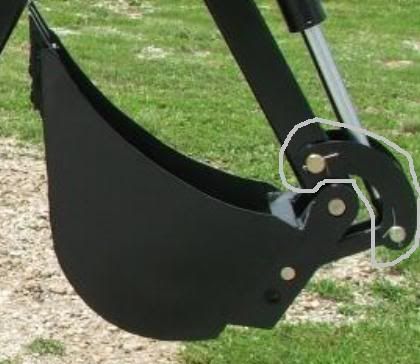
Dam... Those were on backwards. They folded like that the very first time they were curled. I bet they will clear the ripper frame top pivot corner when installed correctly, but if not, a few minutes with a grinder to radius that corner to match the profile of the bucket frame and you will be good to go.
 
   / Backhoe Ripper tooth - Again #25  
Yeah I agree. Good catch Defective.
I'll bet they clear also when on correctly. When you get your new ones, check the travel. They do seem a little skinny though. The ones on my Nardi hoe are about 5/8" or 3/4" thick.
 
   / Backhoe Ripper tooth - Again #26  
The ones on my HW-03 backhoe are .4" thick and nearly 2 3/4" across. In normal operation, digging/ripping/pulling toward the tractor, those links should always be in tension, so that much metal should be plenty strong for that application.

It is the other link that connects from the end of the cylinder ram down to the bucket lower point that is regularly under compression(second weakest mode) as it pushes the bucket around to curl. Yours looks mostly like two pieces as I can't quite tell if there is something welded between them up near the top. I was just looking at mine, and it has a 1/2" plate welded between them for nearly their full length, making it into an "I" beam like structure which is much stronger in compression than two separate straps.
 
   / Backhoe Ripper tooth - Again
  • Thread Starter
#27  
RonMar said:
The ones on my HW-03 backhoe are .4" thick and nearly 2 3/4" across. In normal operation, digging/ripping/pulling toward the tractor, those links should always be in tension, so that much metal should be plenty strong for that application.

It is the other link that connects from the end of the cylinder ram down to the bucket lower point that is regularly under compression(second weakest mode) as it pushes the bucket around to curl. Yours looks mostly like two pieces as I can't quite tell if there is something welded between them up near the top. I was just looking at mine, and it has a 1/2" plate welded between them for nearly their full length, making it into an "I" beam like structure which is much stronger in compression than two separate straps.

Ron could you post a photo of yours?
Oh and what is the hole to hole distance?


Wedge
 
   / Backhoe Ripper tooth - Again #28  
wedge40 said:
Ron could you post a photo of yours?
Oh and what is the hole to hole distance?


Wedge


Sure
Mine looks just like that first picture of the balck one you posted:) I can get you dimensions of those links when I get home this evening. I got to thinking about it, and those might not be easy to get, as I doubt it is a very high failure item. You might get them faster if you make them yourself, or have them fabbed locally.
 
   / Backhoe Ripper tooth - Again #29  
(didnt read all the responses)

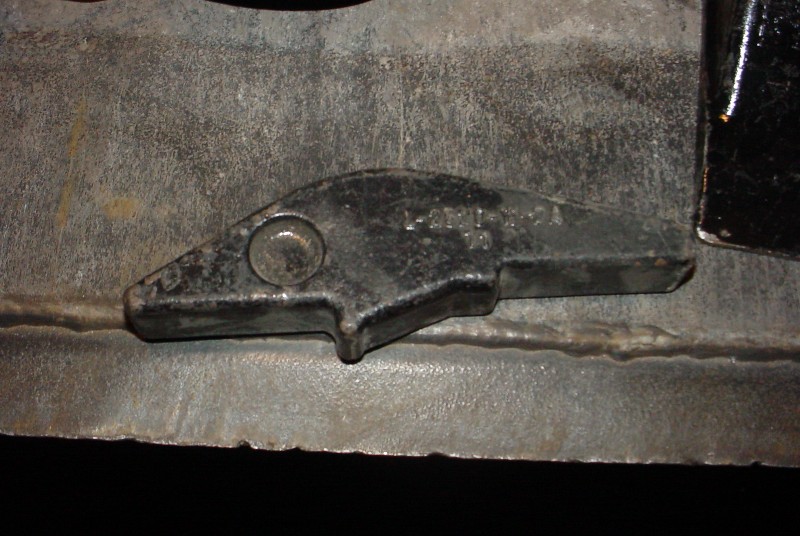
but i recommend a weld on tooth shank for replaceable tooth at the tip. For rippers and BH buckets they usually put them on upside down.

tooth_shank.jpg
 
   / Backhoe Ripper tooth - Again #30  
wedge40 said:
Ron could you post a photo of yours?
Oh and what is the hole to hole distance?


Wedge

Wedge
Here is a diagram of mine. They are made out of 0.4" plate.

 
   / Backhoe Ripper tooth - Again
  • Thread Starter
#31  
schmism - I didn't weld the ripper up and the person who did just made it so I could put new ones one if needed. He just didn't use the shank. And believe me this thing should last for ever, it weighs about 75#. Matter of fact I'm going to have to make a "holder" do I can mount and dismount the thing easier.

RonMar - Thanks for the drawing. I will keep it in my files. I lucked out because the person who I bought the backhoe from on ebay is sending some new ones for about $30.00. First thing I'm going to do when I get them is to trace them on a sheet of paper. Just in case. I'm guessing doing this alone should almost guarantee that I will never need new ones again. Murphy and I are real close friends, so over the years I've learned way to trip him up. LOL.

Wedge
 
   / Backhoe Ripper tooth - Again #32  
RonMar said:
Wedge
Here is a diagram of mine. They are made out of 0.4" plate.

Interesting b/h bkt links. That Jinma hoe must have the most curvature of
any hoe link out there. That means it will be much more prone to buckling
(bending) under compression. On some hoes, the compression link is cast
and as much as an inch thick to avoid this problem.
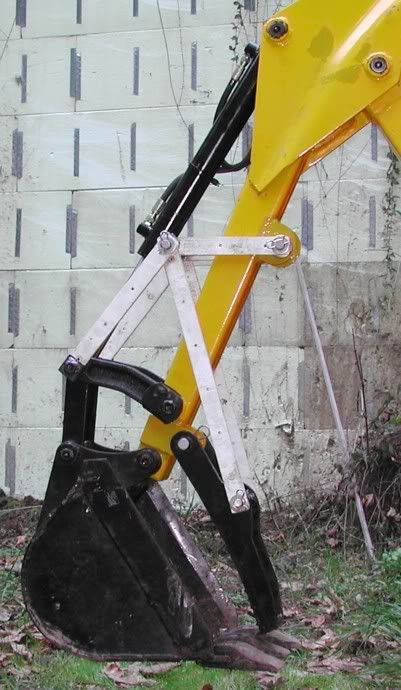
 
   / Backhoe Ripper tooth - Again #33  
schmism said:
but i recommend a weld on tooth shank for replaceable tooth at the tip. For rippers and BH buckets they usually put them on upside down.

I have bought these in the past and welded them on. They are much more
$ now and my local tractor dealer no longer carries them. So, I have ordered
some to be cut from 3/4 plate. I plan to have the tooth installed with hard
edge on top for both hoe bkt and FEL bkt. I am a bit surprised that so
many FEL and hoe bkts install the teeth with hard side down, what you call
upside down. For FEL bkts being slid along hard pavement that makes
sense, but it seems to me that most of the wear would be on top for dirt
work.
 
   / Backhoe Ripper tooth - Again
  • Thread Starter
#34  
dfkrug said:
Interesting b/h bkt links. That Jinma hoe must have the most curvature of
any hoe link out there. That means it will be much more prone to buckling
(bending) under compression. On some hoes, the compression link is cast
and as much as an inch thick to avoid this problem.

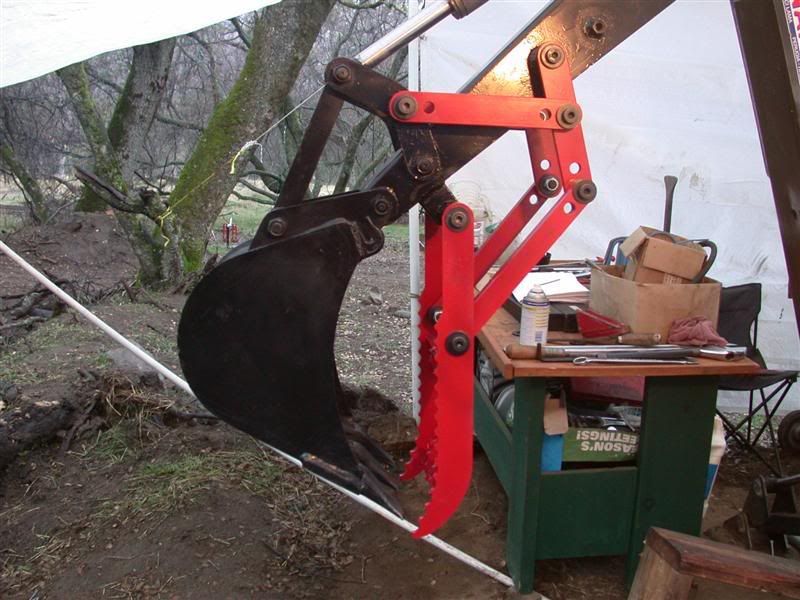
I'll post photo of mine before they get bent again. I'm pretty sure they will look the same.

What would be the problem of putting a straight link in instead of a curved one. As long as the hole to hole distance is the same. And they wont bind somewhere.

Wedge
 
   / Backhoe Ripper tooth - Again #35  
The curvature is there so that they clear the bucket pin whilst at full crowd . Installed the correct way you should not have any more trouble . I would however round the corners of the ripper hitch . Once installed go through the full travel very carefully to make sure no contact is made .
 
   / Backhoe Ripper tooth - Again #36  
Wedge,
I think you need the curve in there to avoid hitting the regular bucket pivot attachment at full curl. Most hoes have some kind of curve in there for that reason. I know mine does too.
Here's Dave's Prairie Dog hoe and one of mine on the Nardi hoe. It appears his is less curved than yours or mine.


Oops, while screwing around getting my photos, I see Iron Horse said the same thing.
 
   / Backhoe Ripper tooth - Again #37  
There wouldn't be a problem if they wouldn't bind, and some hoes and excavators use straight links. In this particular design, to get the ammount of bucket curl, the links need to be curved to reach around the pivot pin. These parts are typically in tension(strongest mode) though when under their greatest stress(ripping/curling) as there is not much call to push away significantly with the bucket. The links on mine so far have proven plenty strong up to the available push force on my curl cylinder. I can push/uncurl the bucket all day long against a stump and the only thing that happens is the safety relief on the valve opens and the hydraulic fluid gets hot:)

Wedge, I think your new ones will work just fine when installed properly.

These could also probably be re-enforced on the outer faces by welding on a piece of curved strap to form a "T" profile that would resist the tendency to buckle. The problem with this would be that what now becomes the weak point? If you inadvertently back the bucket into a stump, would you rather pretzel these relatively easy pieces to fabricate, or would the added strength lead to a more difficult to repair failure elsewhere?
 
   / Backhoe Ripper tooth - Again #38  
wedge40 said:
IT what is circled is what I bent.

Bucket_setup.jpg


I'm not sure how this happened, but when I get new ones I'll reinforce these.

Wedge

The link in your photo, WEDGE, has more curve in it than any other hoe I
have seen. The LW-7 specs I saw said that the bkt can only curl about
160-deg, as I recall....the designers were trying to maximize the curl with
the curved links and a less-than-optimum geometery to work with, IMO.
The problem I was trying to describe is curved links are subject to
buckling under tension or compression. My hoe that 3RRL posted has
one pair that is cast and slightly curved and 3/4" thick. The other is
straight and only 3/8" thick. On my B21, both pairs of links are cast and
straight, but the compression links (equivalent to your non-circled ones) are
also gussetted.
 
   / Backhoe Ripper tooth - Again #39  
Hey Wedge,

It has been a while but I was wondering if you could give us an update on your ripper tooth. I presume you got the backhoe sorted out and would like to know how effective your ripper is and if you would change anything if you were to fabricate another?

Thanks.
 
   / Backhoe Ripper tooth - Again
  • Thread Starter
#40  
Hey Wedge,

It has been a while but I was wondering if you could give us an update on your ripper tooth. I presume you got the backhoe sorted out and would like to know how effective your ripper is and if you would change anything if you were to fabricate another?

Thanks.

IslandTractor, I used it a few times then blew out the pump and haven't gotten everything back together again. But here is some insight into what I learned.
The ripper tooth would be great on a bigger backhoe, but since mine is one of the smallest out there it didn't work as planned. My vision of how it was suppose to work was I would find the root and use the tooth to "Pick" at till I had ripped through it, or just popped through the root. Here is the problem, as you curl the tooth it is being "Wedged" between the root and ground, and eventually sinks into the ground. For ripping through roots you're better off using the teeth on the bucket, or even removing all but one. Now if you have a bigger backhoe the tooth would work better because you would rip at the root without using the ground as piviot point. Or you could alway weld a plate along the back to keep it from sinking into the ground when pivioting.
if I ever get a bigger backhoe I'll have this one modified to fit and see how it works.
Wedge
 

Tractor & Equipment Auctions

UNUSED RAYTREE RMBD72-72" HYD DRUM MULCHER (A60432)
UNUSED RAYTREE...
2020 CATERPILLAR D5 LGP HIGH TRACK CRAWLER DOZER (A60429)
2020 CATERPILLAR...
KUBOTA ZG23F ZERO TURN LAWN MOWER (A60430)
KUBOTA ZG23F ZERO...
2008 Ford F-250 4x4 Ext. Cab Pickup Truck (A56859)
2008 Ford F-250...
2016 Chevrolet Tahoe SUV (A59231)
2016 Chevrolet...
54in Loader Fork Attachment (A59228)
54in Loader Fork...
 
Top