Howdy- we have finshished our pole barn and the contractor framed the inside for a shop and studio for my wife. The shop has an outside 3' man door and is framed for an inside 3' man door. After thinking about it, I'd like to adjust the inside door to a double french door so that it's easier to move bulky items in and out of the shop when needed. I haven't done any real framing in the past but was thinking I could just extend the opening by moving over the king/jack studs and adding a longer header. Two questions: Does any one know the standard opening size for a french double door? and what size header should I put in- it's currently a 2X6 on flat? The ceilings are 12 feet so there will be wall covering (proably osb) above the door. Thanks for any advice.
You are using an out of date browser. It may not display this or other websites correctly.
You should upgrade or use an alternative browser.
You should upgrade or use an alternative browser.
Basic framing question
- Thread starter anojones
- Start date
- Views: 9682
More options
Who Replied?
/ Basic framing question
#1

UpstateNYMarine
Bronze Member
The first thing that I would be worried about is whether or not it is load bearing. If it is be careful as you remove studs. Better to build the opening before you start removing the kingand jack studs that are already there. Is the wall framed with 2x4's or 2x6's. If 2x4's your header should be doubled up 2x6's if i'm not mistaken. I'm not a master framer or anything just done enough work to have a good idea. I'm sure others on here can help out with more detail. Before framing the opening I would simply go buy or measure your proposed door and frame accordingly. When we recently built our house we had a couple options for french doors. And I think the sizes varied a little. I hope this helps.

KYErik
Platinum Member
- Joined
- Dec 2, 2005
- Messages
- 909
- Location
- South central IL
- Tractor
- 1977 AC 7000, 1980 JD 2840, 1963 Case 930, 1963 Ford 4000, 1943 Case SC, Case 530CK backhoe
Call your local hardware store and ask for the rough opening size for the french doors they sell. Typically the rough opening is about 6' 10" high (or a little shorter for some units) and 5' to 5' 2" wide. It will depend on the exact unit you pick out.
If you have OSB nailed to the header, and this is a non load bearing wall (which I asume it is since its inside a pole barn), a 2 X 6 on the flat will be fine - as long as the OSB is also nalied to this header and the OSB is horizontal above the door and spans the whole distance of the door. The OSB will support the weight of the header without a problem. You may even want to stack 2 2X6 on the flat to make that section of the wall a bit more stiff so it won't vibrate as much when the door is closed.
Note- the most common french doors are made for a 2X4 wall and you will need some extra material to extend your door frame trim if you use the 2X6 header(s) on the flat. Don't ask me how I found that out (after buying a standard sized one for my house with 2 X 6 walls).
If you have OSB nailed to the header, and this is a non load bearing wall (which I asume it is since its inside a pole barn), a 2 X 6 on the flat will be fine - as long as the OSB is also nalied to this header and the OSB is horizontal above the door and spans the whole distance of the door. The OSB will support the weight of the header without a problem. You may even want to stack 2 2X6 on the flat to make that section of the wall a bit more stiff so it won't vibrate as much when the door is closed.
Note- the most common french doors are made for a 2X4 wall and you will need some extra material to extend your door frame trim if you use the 2X6 header(s) on the flat. Don't ask me how I found that out (after buying a standard sized one for my house with 2 X 6 walls).
It's not a load bearing wall, just an interior 2X6 wall inside the pole barn. That makes sense to just buy the door and then resize the opening for the purchased door. Since I'll have to remove one of the wall studs, I can probably re-use that to double up the header for good measure. Thanks for the advice on the 2X4 pre-hung door- the door will open into a garage space and that side can be left unfinished, so I'll flush it up on the shop side. Thanks again.

gotcha
Gold Member
- Joined
- Mar 4, 2007
- Messages
- 307
- Tractor
- (07) B26, (83) B7100D
Where I live one cannot do headers over windows or doors on the flat. They have to be 2X6 or larger as load requires. for a 2X4 wall it would have to be 2-2X6's or larger with a 1/2" piece of plywood between them and for a 2X6 wall it has to be built the same except it has to be 3 of the 2X stock and again with 1/2" ply between them and ALL ON EDGE.anojones said:Howdy- we have finshished our pole barn and the contractor framed the inside for a shop and studio for my wife. The shop has an outside 3' man door and is framed for an inside 3' man door. After thinking about it, I'd like to adjust the inside door to a double French door so that it's easier to move bulky items in and out of the shop when needed. I haven't done any real framing in the past but was thinking I could just extend the opening by moving over the king/jack studs and adding a longer header. Two questions: Does any one know the standard opening size for a French double door? and what size header should I put in- it's currently a 2X6 on flat? The ceilings are 12 feet so there will be wall covering (proably osb) above the door. Thanks for any advice.

EddieWalker
Epic Contributor
Funny, but I'm putting in two french doors next week. One will be six feet wide, the other will be four feet.
Be sure to buy your doors with the frames. Creating your own frame is a headache that's not worth the time or effort. Figure out what sized doors you are putting in and and 2 1/2 inches to your opening. A 36 inch door will have a 38 1/2 inch opening. 48 inch french doors will have a 50 1/2 inch opening and a 72 inch set of french doors will need 74 1/2 inches. You can squeeze it into a smaller opening, especialy if your jack and king studs are perfectly plumb. The more they are out of plumb, the more space you need to square your doors.
Headers should be two 2/6's with a piece of half inch plywood sandwiched between them for openings up to four feet. After four feet, you need to go up to 2x8's for a six foot opening. The bigger the span, the larger the lumber. And like Gotcha said, headers are on the edge. Never flat.
Eddie
Be sure to buy your doors with the frames. Creating your own frame is a headache that's not worth the time or effort. Figure out what sized doors you are putting in and and 2 1/2 inches to your opening. A 36 inch door will have a 38 1/2 inch opening. 48 inch french doors will have a 50 1/2 inch opening and a 72 inch set of french doors will need 74 1/2 inches. You can squeeze it into a smaller opening, especialy if your jack and king studs are perfectly plumb. The more they are out of plumb, the more space you need to square your doors.
Headers should be two 2/6's with a piece of half inch plywood sandwiched between them for openings up to four feet. After four feet, you need to go up to 2x8's for a six foot opening. The bigger the span, the larger the lumber. And like Gotcha said, headers are on the edge. Never flat.
Eddie
KYErik
Platinum Member
- Joined
- Dec 2, 2005
- Messages
- 909
- Location
- South central IL
- Tractor
- 1977 AC 7000, 1980 JD 2840, 1963 Case 930, 1963 Ford 4000, 1943 Case SC, Case 530CK backhoe
Well, I just learned something else I did wrong when framing my house. I only used one 2x4 on the flat as a header when I framed all the interior doors in non load bearing walls in my house. I guess I'll be on the lookout for sagging :-(
I do have a pair of beefy headers on edge above interior doors on load bearing walls and above windows and exterior doors- I guess I did that much correctly
I do have a pair of beefy headers on edge above interior doors on load bearing walls and above windows and exterior doors- I guess I did that much correctly
Looking around, it looks like it's pretty common to have 2 2X4's on flat for a header on non-weight bearing walls (for load bearing the lumber must be on edge and of the correct size for the load). I could easily go to 2 2X6's on flat in the wider door, but I've noticed the other two framed 3' doors have a single 2X6 header as well. Any thoughts on adding header hangers or hardware to add a second header without cutting up the framing? By the way, the pole barn itself has appropriate headers on edge for the windows and doors in the structural parts of the wall, this is just in the interior framing.

Spiveyman
Platinum Member
Howdy anojones, I happen to have just finished replacing a set of french doors. I wish I had taken pic's along the way, but this wasn't planned. We had some punk break in the house while everyone was gone in the middle of the day, completely busted in the door, destroyed both doors and the frame.
Anyway, the opening for the door way was 82 ¾ X 74 ¾, I bought a set at Lowe's, everything they had was exactly 80 X 72, came with the frame. All you have to do is get the whole the right size and pop it in place. It worked out perfectly so that I could simply add a 2X4 on each side, and two at the top. The thing fit like a glove and was even square/plum. I'm not that good, so I figure I just got lucky. I made certain it was solid and added a few more 4 ½ " screws around the frame to at least break the next punk's shoulder if he tries bust through it. The only problem then was covering up the extra wood. I used some 6" trim pieces and made it look real fancy on the inside, used 1X's to fill in gaps on the outside with Si caulk and also used the "Slightly" expandable foam to seal it in good. I don't know if any of that helps, but if you use the foam, get the kind that expands BEFORE it hardens, some of the stuff on the market will mess up the frame. My philosophy on it was make it solid, then cover up the ugly with trim. A real carpenter or someone who's actually "handy" might have a better way to do it. Good luck.
Anyway, the opening for the door way was 82 ¾ X 74 ¾, I bought a set at Lowe's, everything they had was exactly 80 X 72, came with the frame. All you have to do is get the whole the right size and pop it in place. It worked out perfectly so that I could simply add a 2X4 on each side, and two at the top. The thing fit like a glove and was even square/plum. I'm not that good, so I figure I just got lucky. I made certain it was solid and added a few more 4 ½ " screws around the frame to at least break the next punk's shoulder if he tries bust through it.
The only problem then was covering up the extra wood. I used some 6" trim pieces and made it look real fancy on the inside, used 1X's to fill in gaps on the outside with Si caulk and also used the "Slightly" expandable foam to seal it in good. I don't know if any of that helps, but if you use the foam, get the kind that expands BEFORE it hardens, some of the stuff on the market will mess up the frame. My philosophy on it was make it solid, then cover up the ugly with trim. A real carpenter or someone who's actually "handy" might have a better way to do it. Good luck.
hankus
Bronze Member
Exterior people doors on my shop / pole building, were all framed with 2 x 6" on the flat for headers. Having said that, for a french door of 5' plus width, I'd want something a little stiffer, even though bearing load isn't an issue
patrick_g
Elite Member
My wife and I share the second story of our shop. All doors in the entire house and connected two story shop are 3-0 except one closet door 2-6 and the upstairs shop door. That door is a fraternal twin. One side is a 3-0, normally used, and the other is a 1-0, normally not used. Opened together they give us a 4 ft door opening for ease of moving large things.
It was no difficulty for the door maker to make this in a prehung unit and there was no big price difference (solid core veneered wood doors, plain and flat and we added our own trim to dress them up. We trimmed them such that they look like a pair of 3-0 doors except for the dead giveaway of the handles.
If there is any worry about load bearing use temp studs to carry load prior to reframing for the larger header. Should be a simple job.
Don't settle for little restrictive doors in a shop. If I didn't have an overhead door in the ground floor of the shop I'd have French doors there too.
The door company had no problem supplying the prehung sized for 2x6 studs.
Pat
It was no difficulty for the door maker to make this in a prehung unit and there was no big price difference (solid core veneered wood doors, plain and flat and we added our own trim to dress them up. We trimmed them such that they look like a pair of 3-0 doors except for the dead giveaway of the handles.
If there is any worry about load bearing use temp studs to carry load prior to reframing for the larger header. Should be a simple job.
Don't settle for little restrictive doors in a shop. If I didn't have an overhead door in the ground floor of the shop I'd have French doors there too.
The door company had no problem supplying the prehung sized for 2x6 studs.
Pat
EddieWalker
Epic Contributor
When deciding whether to put in a proper header over a door, window or open area, it really doesn't matter if it's load bearing or not. Do it right and put in the proper header. It's a difference of $5 in material at the most.
Eddie
Eddie
turnkey4099
Elite Member
EddieWalker said:When deciding whether to put in a proper header over a door, window or open area, it really doesn't matter if it's load bearing or not. Do it right and put in the proper header. It's a difference of $5 in material at the most.
Eddie
Yes! Yes! and Yes again. Build it right to start with. Nothing more annoying than having to live with a "shaky" door framing. My standard construction for doors, be it a shop or a house is doubled studs each side, plus 2 doubled jack studs each side. Those doors do not 'shake' when slammed.
I would build that header (non-loadbearing) of 2 2x6 or even 2x8 and work it so it is flush on both sides. One may only plan to finish one side but who knows what comes in the future.
Harry K
Also to mention that these " non bearing rooms" inside garages soon become load bearing when people find the storage space on top quite usefull!EddieWalker said:When deciding whether to put in a proper header over a door, window or open area, it really doesn't matter if it's load bearing or not. Do it right and put in the proper header. It's a difference of $5 in material at the most.
Eddie
hankus
Bronze Member
We are talking pole buildings here, correct? I don't wish to argue the proper way to frame a doorway in stick frame construction, it has already been correctly documented here. However, in the construction of pole buildings, doorways are typically framed by placing a 4x6 timber in conjunction with one of the structural 6x6 timbers at distance equal to the rough doorway opening requirement. The girts are cut between these timbers. At the top of this opening a new girt is located with its bottom edge at the height of the rough opening, and then a second 2x6 is nailed horizotally between the timbers flush with the bottom edge of the girt.
Attachments
EddieWalker
Epic Contributor
hankus,
I agree that in pole barns, framing principles change. If it was a reguar, 3ft interior doorway, I'd agree with you. I wouldn't do it myself, but there's no problem with that type of header on a three foot span.
Flat lumber isn't going to span much more then three feet. I don't think we've heard what sized french door he plans to install, so my guess that 6 feet might be way off. I know you can get them in four feet openings, but what's the point? If you want a bigger opening, you might as well make it as big as you can!! hahaha
No way would any 2x material last on the flat over a span that wide. It will sag and rest on the door frame. It just doesn't make any sense to do it this way.
Eddie
I agree that in pole barns, framing principles change. If it was a reguar, 3ft interior doorway, I'd agree with you. I wouldn't do it myself, but there's no problem with that type of header on a three foot span.
Flat lumber isn't going to span much more then three feet. I don't think we've heard what sized french door he plans to install, so my guess that 6 feet might be way off. I know you can get them in four feet openings, but what's the point? If you want a bigger opening, you might as well make it as big as you can!! hahaha
No way would any 2x material last on the flat over a span that wide. It will sag and rest on the door frame. It just doesn't make any sense to do it this way.
Eddie
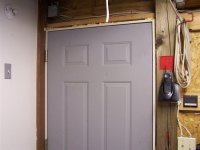
Again, thanks to all for the feedback. I will re-frame the opening for a 6' door, given the advice here I will change the headers to 2X6 on edge. The door in question is not framed between the poles of the barn as it's an inside dividing wall that doesn't line up with the poles. The outside doors are framed as Hankus has shown in the photo but with a 2X6 on edge above the flat 2X6. I have to get this done fairly soon, the electrician will be out in the next couple of weeks.
Edit: I just noticed that the picture from Hankus has the 2X6 on edge as well, same framing for the exterior doors.
Edit: I just noticed that the picture from Hankus has the 2X6 on edge as well, same framing for the exterior doors.

schmism
Super Member
EddieWalker said:Flat lumber isn't going to span much more then three feet. I don't think we've heard what sized french door he plans to install, so my guess that 6 feet might be way off.
depends on the 2x. i have span tables for purlins for AG buildings that list 4-6' on some flat orintated 2x (6-8 depends on grade)
The pole barn is likey to have 4-8' OC spaceing trusess. at 8' OC there is likely a post under each truss. meaning the wall carrries no vertical gravity load. It does however support a large horzontal wind load. (post design for AG buildings is often limited by the horzontal load, NOT the gravity load.
If trusses dont sit directly on a post, then there has to be a header at the TOP of the wall to carry the trusses that dont sit directly ontop of a post. That header is designed to carry all gravity loads.
Interior partion walls often have flat single headers, and often dont suffer any sag issues. Commonly though home owners will decide they want to add "storage" load to some truss (or celing joist) that then deflects and starts to transfer load to that interior wall. At that point you may start to see sticky doors.
as for framing your opening, from my perspective there is really no "structurally wrong" way to do it in a AG type pole barn framing. With that said, many of the points indicated (do it right the first time, why skimp on $5 worth of framing) are also good points.
patrick_g
Elite Member
EddieWalker said:Flat lumber isn't going to span much more then three feet. I don't think we've heard what sized french door he plans to install, so my guess that 6 feet might be way off. I know you can get them in four feet openings, but what's the point? If you want a bigger opening, you might as well make it as big as you can!! hahaha
No way would any 2x material last on the flat over a span that wide. It will sag and rest on the door frame. It just doesn't make any sense to do it this way.
Eddie
Well, I don't often get a chance to disagree with you Eddie so I didn't want to let this rare opportunity slip away.
I have a 4-0 French door. It is not identical twins but is fraternal twins. One side (the typically used door) is 3-0 and the "fixed" side is 1-0. This door is at the end of our upstairs hall and leads into the second floor of the attached shop (free span metal bld , red iron, I beam columns, horizontal 2x8 on 24 inch centers.) I wanted larger than 3-0 to get stuff into and out of the shop but I also wanted a swinging 3-0 for normal use.
The door handles in this instance are dummies. The doors have the recessed ball bearings on top that engage "striker plates" in the top of the door frame. This facilitates coming up to the doors carrying something and opening either or both doors with your backside as there is no cane bolt or need to twist a handle.
The doors are dead plain veneered solid core onto which I added some trim. I did the trim as if it were identical twins. I didn't use an astragal so uneven sizes are a bit less noticeable but the crack between the doors is a dead giveaway.
Pat
Attachments

"The doors have the recessed ball bearings on top that engage "striker plates" in the top of the door frame. "
I really like this idea and will look for doors with this feature, the way the area is set up it doesn't need a security latch. My plan is an inexpensive door from the local lumberyard, so won't have the option of a custom door maker.
I really like this idea and will look for doors with this feature, the way the area is set up it doesn't need a security latch. My plan is an inexpensive door from the local lumberyard, so won't have the option of a custom door maker.
Here are some similar links:


- Replies
- 10
- Views
- 3K