Generator Belt-driven vs PTO-driven generators

   / Belt-driven vs PTO-driven generators #1  

RPM

Platinum Member
Joined
Apr 10, 2001
Messages
679
OK - so I'm being super-detailed in my study of what generators are out there. I'm trying to get a grasp of what's what though.

Since they don't seem to make PTO generators with ratings around 8000W - all I really need or want to run off my BX2200 - I ended up looking at belt-driven generators. This raised a question for me. In the picture below is a 10,000W belt-driven generator (courtesy of Northern Tool). The drive shaft is on the back right ... you can figure it out.

164667_lg.gif


This costs $569.99

The next picture is of a 12000W PTO driven generator ... note the gear box and PTO coupling on the back side attached to the drive shaft of a generator otherwise the same as above.

16442_lg.gif


This costs $1899.99

So I am left scratching my head here. Allowing for a bit of a difference in price due to different power outputs, the only difference I see is a gearbox and PTO shaft coupler. Is that really a $1000+ item?

If not, does anyone know where I could get one? I'm assuming it has a couple of gears in it, some oil and then the PTO shaft coupling. I'm hoping it would make an 8kW PTO generator a possibility for under $1000.

Am I missing something? It would be great to hear back from someone with practical experience.

Patrick

 
   / Belt-driven vs PTO-driven generators #2  
Patrick -

I have no practical experience (with a lot of things), but I'm guessing the price difference has less to do with the cost of parts than it does with the ol' supply and demand concept. There must be a lot more belt-driven units on the market than their PTO-driven counterparts.

Sounds like a fun challenge to adapt the belt model to run off your PTO. Simple approach might be to rig a PTO shaft to turn a pulley.

Did I mention I have no practical experience? /w3tcompact/icons/crazy.gif

HarvSig.gif
 
   / Belt-driven vs PTO-driven generators #3  
Patrick,

I suggest you check the 'Load Factor' or Continuous Power Factor on both. A 1.0 LF means the generator can be run continuously at the rated output. 0.8 means 80% and so on. Do the units have the same type of and size of bearrings and so on... Overloading and small bearings are a bad combination. Most PTO generators are rated at a 1.0 LF with a 1.5-2.0 startup current ratting. The same may be true for the belt driven units you are looking at, but you may want to check. Also check the cost of the actual drive belt hardware verses PTO drive shaft. If you already have a PTO shaft that could narrow the $$ difference. From the pictures you showed, the 12kw generator looks like a Winco farm (continuous) duty with a oil bath gearbox (the better quality).

8kw to 12kw is a 50% bigger generator plus the bigger unit just looks better built. The better generators run at lower RPM (1800 RPM vs. 3600 RPM) and last a very long time if not overloaded. Remember 1.0 LF means you are not overloaded at the rated output at the max ambient temperature allowed. Also the rule of thumb is 2hp per 1kw or output.

You may want to check out http://www.friesen.com. They have some smaller 10kw PTO generators but I think they may be even more expensive than the Winco 12kw.

I cannot remember where, but I have seen 8kw PTO generators discussed in some old threads.


Hope this helps.
-Roger
 
   / Belt-driven vs PTO-driven generators #4  
By the way. I am not a fan of PTO generators at home or the ranch for anything other than emergency power. If you use a generator a reasonable amount, putting it on and off the tractor is a pain. You always have to drop the current implement, and attach the Generator. And then you don't have the tractor available any more. I have bottomed out on a 6500W Honda comercial generator I use all the time (6500w peak, 5000w continuous).
 
   / Belt-driven vs PTO-driven generators #5  
I looked into getting a pto generator, but after thinking about alll those extra hours I'd be putting on my tractor, I decided to go with a 10kw Natural gas/Propane generator that is connected right to my "big" propane tank. I bought it from the same dealer I bought my B7500 from.
 
   / Belt-driven vs PTO-driven generators #6  
Patrick (RPM) Glad I'm not the only voice crying in the wilderness about the various shortcomings of tractor driven gennys. If it really does fit your intended use and you have addressed future growth and expansion AND it will be a low usage item and you just want it, then go ahead but try to see the top 2-3 competitors in the "flesh" as there might be a world of difference in construction robustness and bearings.
How reliable does this need to be? What about availability? Would it matter if the tractor were out in the field with a flat tire and couldn't be brought to the genny for a few days due to rain or civil war. What if the tractor were at the dealer for some sort of work when you need power? If it is a tool then it is just an anoying inconvenience
B U T if it is to keep your freezer and frige operating or something important (not neccessarily an iron lung but important to you) operating then I think I would consider a stand alone.
I really do like multi-use tools and see the economics of them (I have some) but I suggest you do a little requirements analysis, worst case usage analysis,and risk analysis.
If you do opt for a belt driven unit be sure to select bearings rated for the side loads involved with belt tension and build a truly fool proof (child proof too) belt guard. Murphy spends extra time studying belt driven stuff.

And most importantly.... let us know what you finally decide and how it works for you (pictures too?).

Patrick (patrickg)
 
   / Belt-driven vs PTO-driven generators #7  
I had considered getting a PTO generator. After additonal thought, I realized that I needed the generator when the power goes out. Living in the Pacific Northwest means that the power goes out when 1) A wind storm knocks trees down or 2) A snow storm knocks trees down.

I realized that chances are strong that if the power is out, I will more than likely need my tractor to move trees.

Kevin
 
   / Belt-driven vs PTO-driven generators #8  
Kevin, There are lots of reasons, I'm sure, for having PTO gennys but frequently there is conflict such as you have mentioned when the genny is for emergency use. If I had two tractors I'd have a combo genny/welder with PTO drive most likely as it would be a good economical tradeoff AND I have other means of generating power or welding or both if it were an emergency situation. But then I am sometimes a belt AND suspenders kind of guy.

For example, I have installed a direct vented propane powered gas log (55,000 Btu) as back up heat in my mom's new all electric house. Last winter there were a few ice storms with one causing a 5 day electric outage (folks within a few miles of here were out for weeks, I missed that on a quick trip to SOCAL). You can get along for a while eating out of cans and making sandwiches but freezing in your own house or your pipes bursting isn't good. I have installed an auxillary propane outlet to run a BBQ unit (with no bottles for her to wrestle) that can operate an emergency cooking facility (Coleman propane fired camp stove) in the well vented sun room via a hose. This can heat water for a "sponge bath" also. She still has kerosene lamps from "way back when" so won't be in the dark. I have a small Honda genny if TV becomes important (also two 12 vdc TVs)

What I was illustrating here wasn't a "perfect" solution but was intended to show redundancy and work arounds. No reasonably probable weather phenomenon would constiute a crisis, just an inconvenience. If a generator is a requirement in this situtation it should be stand alone so the tractor can clear long driveways of snow or fallen limbs. I'm still not entirely comfortable with electric cooking and hot water but having emergency backups to replace each, albeit with loss of convenience,lessens my concern. If I had it to do over again I would have wired the place for at least one 12 vdc fluorescent per room and installed a couple Trojan golf cart batts in the garage. I don't like the smell of kerosene lamps nearly as much as the smell of diesel passed lightly through my Kubota.

Patrick
 
   / Belt-driven vs PTO-driven generators #9  
I had the same question. Does a gearbox and some bolts cost $1,000? I found the gearboxes here: http://www.bypy.it/

I have not had time to research. Please - if you find anything let me know. If all else failed I will probably get the belt driven version and use pulleys and belts. This way I can taylor the engine speed to match the generator speed. At 540RPM my L4310 is putting out much more HP than a small generator can use.
 
   / Belt-driven vs PTO-driven generators #10  
Rich,

Be careful about matching engine speed to gen speed. These generators are made to be run at 540 input rpm to produce 110/220 output volts. As the speed decreases, so does the voltage. It's like having a brownout....not a good thing for appliances, tv's etc.
 
   / Belt-driven vs PTO-driven generators #11  
I'd suggest you also look at some other generator web sites. Try nooutage.com and best-power-generators.com. There's also a genpower site but I don't know the address. My guess on the cost differential is the size as well as the gearbox both contribute. You also may want to contact your local Generac or other manufacturer dealers. Unless, you get free shipping, you'll probably spend quite a bit on shipping to buy mail-order. Let us know how you make out.
 
   / Belt-driven vs PTO-driven generators #12  
Let me clarify-
The generator would be run at the proper speed to put out 120V at 60Hz. By using pulleys I could run the tractor PTO at say 300RPM and still maintain the proper generator speed. Why run the tractor engine at 2500 RPM to get 540RPM and 40PTO HP when you may only need 20PTO HP to run a small generator?
If I buy a gearbox type PTO generator the gear ratio is fixed and can only be run at 540RPM to get the proper voltage and frequency.
 
   / Belt-driven vs PTO-driven generators #13  
Patrick,

You may also consider auctions...

This spring, I saw a PTO driven generator {about 24kw?} go for about $600. They sold the John Deere gas engine mounted to it separately for about $300! {if it was a diesel, I'd buy in a heartbeat...}The whole works was mounted on a "steel pallet-like" frame to transport around.

There is a formula you use {don't know what it is...} to convert from available PTO power to KW max. generator to drive.

You may find, it's actually cheaper to purchase a stand-alone powered generator though...

18-35197-JD5205JFMsignaturelogo.JPG
 
   / Belt-driven vs PTO-driven generators #14  
I have a 18hp 4cylinder miltary engine that I plan on using with the belt driven generator. The one mentioned earlier from northern or harbor seem to be the most econimical(sp). I had a web site at one time that gave the pulley sizes etc. to make it work correctly. This will be a awkard marriage but I need to use the engine for something.
 
   / Belt-driven vs PTO-driven generators
  • Thread Starter
#15  
Thanks to all for the different responses.

I haven't made any progress in finding specifics - I have to believe that anyone that has mated a belt-driven generator to a tractor PTO is either selling the generator/gearbox/coupling as a unit (like Northern) or just did it as a one off. Certainly for a home-brew it seems that pulleys and belts would be easier than gearboxes. The ratio of output shaft speed from the PTO to the required input shaft speed to maintain voltage would seem to be easier to tune with pulleys than gears.

I think I'll have to spend some time poking around farm auctions this fall before I make a decision. I'm kicking myself because I was at an auction this spring where a PTO generator on a trailer went for only a few hundred bucks.

In the meantime I did find some very good reference pages:

1. Standby Electric Generators for Emergency Use - Ontario Ministry of Agriculture

2. ELECTRIC GENERATORS FOR TEMPORARY USE - Iowa State Agricultural Extension

Patrick
 
   / Belt-driven vs PTO-driven generators #16  
I'd spend a lot of time thinking through how this pulley system will work and go together. You need to mount the generator to something, and be sure it doesn't hop away while running. you then need a drive shaft to some sort of support bearing and shaft with a pully somehow mounted to it and positioned and aligned with the pully somehow mounted to the gen drive shaft. You need to find out the required rotational speed for the gen. Although output voltage factors in, it's usually regulated onboard the gen. The correct rotational speed is required to get 60 HZ output. If it's off, then AC motors, including those in clocks (if they still exist these days) will turn at the wrong speed. In most cases this won't really matter, but you need to be within a few HZ of 60 or you might cause problems with the power supplies in electronic equipment. You then need to fuss with the pulley sizes and belt sizes to get the ratio right. And don't forget the tension mechanism for the belt, and be sure it doesn't alter the gen/drive shaft alignment. And how much HP will it take to drive the gen and will you need double belts. I'm not even sure how to find out the power transmission capacity of different size belts.

Starts to make that portable generator look good.

High techie, reciently founded a startup company and struggling for tractor time.
 
   / Belt-driven vs PTO-driven generators #17  
RichN, Good idea! This is the best argument I've seen for belt driving a DIY genny set. Good economy and lower wear on engine than a PTO, especially if you don't need the HP available at PTO speed. Only reason I would want a PTO genny myself is for occasional use other than for electrical outage emergencies, something like powering heavy tools and heavy welding away from my "grid" fed 50 amp 240 vac outlets. 15KW would do me fine unless I should find a bargain on a larger welder (which I probably don't really need). How many RPM does your engine need to turn to provide about 2HP/KW for however many KW you want. I think I recalled the rule of thumb correctly.

Patrick
 
   / Belt-driven vs PTO-driven generators #18  
Transfer Switch for Sale

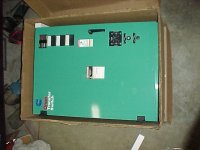
In conjunction with all this Generator discussion, I have something someone may want or need. Last winter I installed a 35kw Cummins / Onan GenSet. It is a Ford 300 cu in in line 6 cyl on propane. The guy I bought it from already had a 225 amp Cummins Automatic Transfer switch I could not use since I have 300 amp service coming into my home. The switch is NEW in the Box and fully automatic including Exercise cycle and battery charger with full meter package installed. It will work with any 3 pole 110 / 220 single phase system. It will start and run any brand generator that uses a 2 wire start system. The Cummins distributor tells me the switch costs him $2600. I am trying to get $1600 for it plus shipping. This thing is big and controls a whole house system by starting the generator when power fails and stopping the generator when the utility side returns to service. Too many features to note here. I am in Central Arkansas. Ask around, this is a steal for someone who is considering a backup generator. My e-mail is subguns@swbell.net.
 
   / Belt-driven vs PTO-driven generators #19  
Picture of Transfer Switch for Sale

Picture added for your enjoyment!
 

Attachments

  • 5-71933-MVC-011F.JPG
    5-71933-MVC-011F.JPG
    48.4 KB · Views: 317
   / Belt-driven vs PTO-driven generators #20  
Re: Transfer Switch for Sale

OOOOOOOOOOH, a tad rich for my blood but I do envy your 300 amp service, especially if it is residential.

Patrick


Tractor & Equipment Auctions

2021 CATERPILLAR D5 LGP HIGH TRACK DOZER (A60429)
2021 CATERPILLAR...
2017 Chevrolet Express 2500 Cargo Van (A59230)
2017 Chevrolet...
2020 VOLVO 760 TANDEM AXLE SLEEPER (A57880)
2020 VOLVO 760...
2012 Chevrolet Traverse LT SUV (A59231)
2012 Chevrolet...
International S1900 (A56438)
International...
2020 CATERPILLAR D5K2 LGP CRAWLER DOZER (A60429)
2020 CATERPILLAR...
 
Top