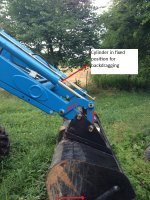
Loader bending metal on loader

   / bending metal on loader #42  
I am not worried about it. I have done a lot of things with the loader over 3 years and never push on something I know that wouldn't move.
:wink: Wheres your sense of adventure? How can you know without trying ... What about a brush pile that youre pushing and lifting to consolidsate and form it? I find often you reach your max capability and movement stops. Then you alter tactics so you can do it with whatever force you have.
...An OEM loader for a tractor customarily has a performance margin sufficient for that tractor and will often surprise you with what you can get away with. The OP seems to describe the opposite kind of surprise, and encounters it repeatedly. There just doesnt seem to be any performance margin for that loader on that tractor -- at least for that particular linkage part.
larry
 
   / bending metal on loader #43  
My NH loader book says that if you bulldoze or backdrag with the bucket in the dump position it "will impose sever shock loading on dump linkage". Both NH and Kioti books say to bulldoze or backdrag with the bucket full and level.
 
   / bending metal on loader #44  
My NH loader book says that if you bulldoze or backdrag with the bucket in the dump position it "will impose sever shock loading on dump linkage". Both NH and Kioti books say to bulldoze or backdrag with the bucket full and level.
Theres a huge amt of usable position between dump and level. The most suitable designs provide enuf of a performance margin that these orientations can be used with prudence increasing at higher angle.. Thats what makes for a useful tool. Hopefully those mfg cautions are a lot more extreme than they actually need to be.
larry
 
   / bending metal on loader #45  
This link (in the fuse theory) will either compress or stretch, I don't think it drops anything.

If in fact it is (in part) a fuse, highest forces are when the bucket is curled all the way down, precisely the condition where forces multiply, and may be a need to protect the bucket curl cylinders or other mounts. I suspect it is shaped this way to give the bucket more curl while protecting the components in this extended curl position. Seems strange that LS wouldn't state this (again, following the 'fuse' theory) so people know whats going on rather than guessing about their quality.

Ryan what was the bucket angle when you pushed on this cedar tree?

Again, I don't recall when exactly this happened but I'm guessing is was the pressing on the cedar tree. I had the bucket up high to get leverage and it was facing the tree pretty flush. I had the cutting edge of the bucket on it at first then I squared the bucket where the top and bottom where on the trunk. I think somewhere during these repetitive pushes in attempt to get the tree to lay over more is when the crumple happened. I wish I knew exactly what I did to make them kink but I don't. I found them after working the second half of that day. I recall backdragging once that day with the tractor and it was to remove old rotten logs that were about 8" in diamter and 3 ft long. All I did was lower the bucket just enough to roll them out of the bush where I was working. There's no way that did it.

I called LSusa on Wednesday to ask a few questions. Their service manager (Harvey) returned my call. I explained to him what happened and asked if he thought this could be a possible design flaw but that question wasn't clearly answered. He said he's seen the same style links fail on other brands as well. He also hinted to the idea of beefing up the links could cause the rams to bend or other issues. It was automatically assumed that I did it backdragging. The dealer I bought the tractor from and LSusa are on the same page when it comes to answering my questions. I wonder if LS actually experimented with increasing the strengths of the links to see what happened under use or if their answers are simply assumptions.
 
   / bending metal on loader #46  
:wink: Wheres your sense of adventure? How can you know without trying ... What about a brush pile that youre pushing and lifting to consolidsate and form it? I find often you reach your max capability and movement stops. Then you alter tactics so you can do it with whatever force you have.
...An OEM loader for a tractor customarily has a performance margin sufficient for that tractor and will often surprise you with what you can get away with. The OP seems to describe the opposite kind of surprise, and encounters it repeatedly. There just doesnt seem to be any performance margin for that loader on that tractor -- at least for that particular linkage part.
larry

Yup, and I was doing a lot of that brush pile pushing/moving with pallet forks and the bucket to the point of where the tractor stopped due to 4 wheel traction loss. Curling repositioning and all at the same time the equipment was moving and didn't have a problem doing that.
 
   / bending metal on loader #47  
I called LSusa on Wednesday to ask a few questions. Their service manager (Harvey) returned my call. I explained to him what happened and asked if he thought this could be a possible design flaw but that question wasn't clearly answered. He said he's seen the same style links fail on other brands as well. He also hinted to the idea of beefing up the links could cause the rams to bend or other issues. It was automatically assumed that I did it backdragging. The dealer I bought the tractor from and LSusa are on the same page when it comes to answering my questions. I wonder if LS actually experimented with increasing the strengths of the links to see what happened under use or if their answers are simply assumptions.
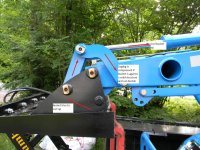
Such a compression failure cannot happen backdragging because the subject links are, at that time, being stressed in tension not compression. This fact should be stated every time someone poses that as the source of failure. Such a statement is evidence of misunderstanding or just not taking you seriously enuf to do a little critical thinking.
... Seeing such failure on other brands may be a sign of contagion. :eek: Im glad my loader hasnt caught it. More likely its due to small changes made from design to design w/o taking all the parameters into account -- a lack of critical thinking.
larry
 
   / bending metal on loader #48  
I am not a real smart fellow when it comes to hydraulics, but it seems to me that the act of squaring the loader with the trunk of the tree and pushing forward and down at the same time, would in effect put the same force on the dogs as a full lock backdrag against a stump. I would see that as a compression item against the dogs, and enough to bend the dogs versus bending the extended ram, and not a tension item at all.
 
   / bending metal on loader #49  
I am not a real smart fellow when it comes to hydraulics, but it seems to me that the act of squaring the loader with the trunk of the tree and pushing forward and down at the same time, would in effect put the same force on the dogs as a full lock backdrag against a stump. I would see that as a compression item against the dogs, and enough to bend the dogs versus bending the extended ram, and not a tension item at all.

SPYDERLK has it right. If the cylinder isn't hydraulically moved, and a dumped bucket has a force applied to it that attempts to un-dump it, the arched links will be in tension. Think of the triangle made by the links connected at the back of the bucket, the hydraulic cylinder itself, and that point at the top of the arched links where they connect to each other. As point 1 and point 2 come closer together, point 3 must move away. But point 3 is restrained by those arched links. Point 3 is trying to move up and away from the arched links, but they're holding it down. That's tension.

xtn
 
   / bending metal on loader #50  
I am not a real smart fellow when it comes to hydraulics, but it seems to me that the act of squaring the loader with the trunk of the tree and pushing forward and down at the same time, would in effect put the same force on the dogs as a full lock backdrag against a stump. I would see that as a compression item against the dogs, and enough to bend the dogs versus bending the extended ram, and not a tension item at all.
Again, backdragging/resisting curl does not compress the dogbones on the subject tractor. it pulls on them.
... And, whichever way it acts, due to leverage inherent in the geometry, the force becomes MUCH greater on the dogs when the bucket is near the uncurled/dump position.
larry
 
   / bending metal on loader #51  
This is how I could see the dogleg getting bent. See arrows in pic as to direction of force.
Please correct me if I'm wrong. It wouldn't be the first time.

1) Bucket is in dump position.
2) Tractor is moved up to a solid structure like a tree with bucket cutting edge touching tree.
3) Operator tries to curl the bucket up, bucket or tree do not move, resulting hydraulic pressure pulling piston in will bend dogleg as shown in previously posted pics.

The loader relief valve should have prevented further damage. With 1/2" thick steel its pretty tough to bend one piece let alone bending two pieces.
Is it possible the owners of the bent doglegs have boosted or turned up their loader relief pressure setting?
 

Attachments

  • LS dog leg.JPG
    LS dog leg.JPG
    281.8 KB · Views: 320
Last edited:
   / bending metal on loader #52  
This is how I could see the dogleg getting bent. See arrows in pic as to direction of force.
Please correct me if I'm wrong. It wouldn't be the first time.

1) Bucket is in dump position.
2) Tractor is moved up to a solid structure like a tree with bucket cutting edge touching tree.
3) Operator tries to curl the bucket up, bucket or tree do not move, resulting hydraulic pressure pulling piston in will bend dogleg as shown in previously posted pics.

The loader relief valve should have prevented further damage. 1/2" thick steel is pretty tough to bend.
Is it possible the owners of the bent doglegs have boosted or turned up their loader relief pressure setting?
Yes that arrow on the dog has to be in compression with the apex of the triangle being pulled by the cyl. ... And, yes that will tend to buckle the dog.

The situation is opposite when backdragging, resulting in the dog being in tension.

Are those a full 1/2" thick?
larry
 
   / bending metal on loader #53  
That arrow on the dog has to be in compression with the apex of the triangle being pulled by the cyl. ... And, yes that will tend to buckle the dog.

I agree. the cylinder is pulling on the flat bar trying to curl the bucket up, if nothing is preventing the bucket from moving the the dogleg just acts as a pivot point but if the flat bar pulling the bucket up cannot move the force is then transferred to downward force (compression) on the dogleg. This asks the question why the relief valve didn't open to prevent damage to the dogleg.
 
   / bending metal on loader #54  
Are they really 1/2" thick? Relief is not acting when the valve is centered. The tractor force or loader arm force is acting against the closed curl valve. No pressure limit.
 
   / bending metal on loader #55  
George,
Great diagram and dialogue! I love this forum! Sounds like the lesson is don't try to move an immovable object, even if you own an LS! ;)
Tom
 
   / bending metal on loader #56  
Here's another pic of a loader set to back drag. If the cylinder piston is set to this position and doesn't move while back dragging wouldn't the force be transferred to compression on the dogleg?
 

Attachments

  • LS 5030.jpg
    LS 5030.jpg
    105.6 KB · Views: 287
   / bending metal on loader #57  
Are they really 1/2" thick? Relief is not acting when the valve is centered. The tractor force or loader arm force is acting against the closed curl valve. No pressure limit.

My mistake. I just went out and measured mine and they are 3/8" thick, not 1/2" which they probably should be. Relief valve would be in play if they were trying to curl the bucket against an immovable object.
 
   / bending metal on loader #58  
No. Putting the arrow on the cyl ram would help clarify. It would be a force applied outward [to resist being pushed in]. So the dog would be in tension.
 
   / bending metal on loader #59  
My mistake. I just went out and measured mine and they are 3/8" thick, not 1/2" which they probably should be. Relief valve would be in play if they were trying to curl the bucket against an immovable object.
Yes, in play if trying to curl. But if the curl spool is centered the curl cyls are deadheaded - and what you do with the tractor or lift arms can try to change the curl. And it cant change w/o failure of some sort.

Those 3/8" doglegs and the close pin spacings on the carrier add up to an overstressed curl system. Very little performance margin.
larry
 
   / bending metal on loader #60  
Thanks for the illustrations.. I can see from the pics that the cylinder pulling (uncurl) would apply most pressure (for bending) on the dogs, while the cylinder pushing would put more pressure on the link from the top of bucket to the cylinder connection point.. thanks for the lesson on applied physics.
 

Tractor & Equipment Auctions

Caterpillar 320 (A60462)
Caterpillar 320...
BOSS MT 660 Fuel Trailer - 660 Gallon Mobile Diesel Tank, DOT-Approved (A55315)
BOSS MT 660 Fuel...
2016 CATERPILLAR 311FLRR EXCAVATOR (A60429)
2016 CATERPILLAR...
2015 VERMEER PD10 PILE DRIVER (A60429)
2015 VERMEER PD10...
KOMATSU PC490LC-10 EXCAVATOR (A60429)
KOMATSU PC490LC-10...
25 TANDEM DUAL GOOSENECK TRAILER (A55745)
25 TANDEM DUAL...
 
Top