Building our retirement home

   / Building our retirement home
  • Thread Starter
#261  
Wellllllllll ... It's like this :)

The truss designer was shown drawings that included a cross beam. He said, without the beam, he was not comfortable for the long haul.

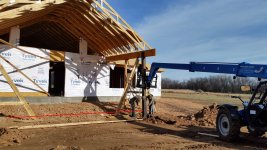
As a result, we decided to beef up the ground support. The steel posts are 8" square tube steel with 5/16" walls. They are planted in 5 feet of concrete and have 24 6" fingers extending from the 4 sides below ground level. Additionally, when we pour the decks, there will be another 2 feet of fill and 4" of concrete.

We have a "similar" design on our current home - but - it has a 3rd post in the center of the roof. After 7 or 8 years, minor cracking was starting in the mortar joints of the stone on the 2 outside posts. At that point, a cable was installed between the beams and all movement stopped. This was all a very slow progression .... yes, time and gravity.

My thoughts are to go forward with what we've done and watch closely for signs of trouble. It may take years ... or not ...
 
   / Building our retirement home #262  
My thoughts are to go forward with what we've done and watch closely for signs of trouble. It may take years ... or not ...

Sounds almost like "Hey yall watch this". My local small town lumber yard has an in-store engineer. I'm going to get up with him about a couple issues with my project. Mainly shed roof connection to a truss gable wall, and removing support from under another gable wall truss. Both simple things that I could probably easily overkill with some extra bracing, but I'd rather be safe then sorry. Because I ordered my trusses through them, he will come out free of charge!
 
   / Building our retirement home #264  
I could make a Titantic reference there lol. I have to say those post should make it pretty solid. If it does start to show problems, that means your connections are already weakened, therefore new stronger measures will have to be taken than what would have to be done now. Either way it seems to me you are putting a good amount of time, heart, and money into this home. Why take a risk? I'd call an engineer. Maybe he'll just recommend plywood as I did. I have to say if it does fail it will probably fail slowly. I have seen it happen with post and beam work. We will soon be rebuilding a 16x24 post and beam carport roof. It's still standing, probably would last quite a few more years, but the collar ties were not properly attached. It has spread 3-4". We will be looking at days of building temporary supports and bracing in order to fix it properly. We're actually gonna use an engineer to help with a repair plan. There's like 15 of these carports in this complex, job security lol.
 
   / Building our retirement home #265  
A center post would solve a lot of it, but then they are not really trusses anymore. And who wants another post after paying for trusses to avoid that?

I can certainly understand your plan to hope for the best and deal with it if it ever becomes an issue. From what you have done to address the what if's, I think you have a better then 50-50 chance of success. The real question is if it happens, how quickly will you notice it? how much additional damage will be done by the movement, such as movement in the decking, shingles and the posts?

Adding a cable, or whatever you prefer, to keep the roof together would be a very cheap, simple thing to do at this stage of everything. I've found that the older I get, the less I want to go back and fix things. Nothing worse thing fixing things in the rain, and when it fails, it will be during a storm.
 
   / Building our retirement home
  • Thread Starter
#266  
Adding a cable, or whatever you prefer, to keep the roof together would be a very cheap, simple thing to do at this stage of everything. I've found that the older I get, the less I want to go back and fix things. Nothing worse thing fixing things in the rain, and when it fails, it will be during a storm.

I was thinking a bit earlier that I'd hate to see the first snow bring it all down :)

Just for grins ... Is it possible to buy something ready-made for a specific length. Our span is about 28' to the outside of the beams. And, of course, it needs to be adjustable for tension.
 
   / Building our retirement home #267  
Maybe put up some cables and leave them slightly loose as a safety net for the first few years or until you have a good snow load or high winds. If they stay slack you'd be good to go. If they tighten up, you have time to figure out a permanent fix.
 
   / Building our retirement home #268  
I suggested several days back to use stainless steel cable and turnbuckles as used in the sailing industry but the issue was birds would rest on them and poo on the porch.

It might be fine as constructed but spread could happen. During middle ages, the Cathedral builders figured out that despite the advanced design of Gothic arch, they needed flying buttress to offset spreading forces (which are really gravitational forces).

So maybe you should at least put up some reinforcement now to which you could later attach cables and turnbuckles. Then monitor movement if any. Probably a small movement like 1/2 inch or less between the posts would indicate the need to reinforce.
 
   / Building our retirement home #269  
I suggested several days back to use stainless steel cable and turnbuckles as used in the sailing industry but the issue was birds would rest on them and poo on the porch..

IC... I must have missed that post. Myself, I'd rather deal with possible poo for a few years than a possible collapse. Just my $0.01
 
   / Building our retirement home #270  
I was thinking a bit earlier that I'd hate to see the first snow bring it all down :)

Just for grins ... Is it possible to buy something ready-made for a specific length. Our span is about 28' to the outside of the beams. And, of course, it needs to be adjustable for tension.

I would think along the lines of a metal rod, say 3/4" or 1" in diameter. If you wanted to put one between the steel posts, you could have 6" or so of each end threaded and drill holes through the posts. Nuts and washers on each end and you have an excellent tension member. Tightening the nuts will tension the rod, and of course you can adjust tension either with a torque wrench, or just by feel (what is sometimes called an "Armstrong torque wrench").

Personally, I think a slack cable is going to destroy the aesthetics of the structure even more than a proper collar tie, but a solid rod would certainly sag less than a cable.

* * * * * * *

Now there is an alternative to tieing the posts together at the top.

Looking at the pictures in post 248, it appears that there will be a deck at the height of the house floor under this roof. A very strong tension member connecting the two posts at the height of the floor will substantially change the interaction of the post footings with respect to the earth.

Either a tension rod, as described above, or a steel beam welded between the posts will greatly reduce the side forces the footers have to withstand. Also, the cantilevered portion of the posts will be shortened reducing the deflection at the top of the posts.

Best of all, the beam or the tension rod can be hidden just under the surface of the deck.

No this isn't the way to design it in the first place, but given what you already have it may be a good way to increase long-term properties at a reasonable cost.

Consult an engineer first.

Think of a tension rod where the red line is in the picture.

KiotiKowboy-1.jpg
 
   / Building our retirement home #271  
Or, if you are planning a grade-level patio, design in a railing between the two posts and hide the tension member in the top of the railing.
 
   / Building our retirement home #272  
A tension member at the top of the post would be more efficient, I think. But it would be visible.
 
   / Building our retirement home #273  
A tension member at the top of the post would be more efficient, I think. But it would be visible.

I totally agree it would be much more efficient, but I am trying to show a way to do this without any visible changes.

And without creating the possibility of a persistent line of bird poop at the edge of the deck.
 
   / Building our retirement home #274  
Personally, I think a slack cable is going to destroy the aesthetics of the structure even more than a proper collar tie, but a solid rod would certainly sag less than a cable.

True, but the idea behind the slack cable is that if it stays slack through snow and wind loads, you would REMOVE it.
 
   / Building our retirement home #275  
...the idea behind the slack cable is that if it stays slack through snow and wind loads, you would REMOVE it.

I am not certain that is really the case. I think the weak point in the as-build structure is the long-term stability of the post footers. They will want to move through the earth in the direction of the forces on them. The problem I see is that most of this motion is going to be during unusual heavy rain/wind events. Possibly snow load, but again most of the motion will be during unusual events maybe once every few years. Think about a wet, heavy spring snow with the ground thawed, but a couple feet of heavy snow on the roof.

The cables can stay slack for quite a long time but there will be no assurance of indefinite stability.

The other potential issue is that fixing the problem is not going to be easy if it ever does happen. I think part of the failure mode, if it happens, will be the posts tilting outward and the footers shifting underground. Getting everything back to plumb & true is going be be very costly. Sure, if you add a tension rod or cable at the top of the posts, and cut the posts from the trusses, you can probably pull the trusses back into shape. But the posts are now in the wrong position and the footers have shifted, how is that going to be fixed?
 
   / Building our retirement home #276  
The more I think about it I like Curly Dave'so idea of a tension rod at the deck level. Seems like that would interrupt the forces trying to splay the posts out and at least not allow the footings to move.

If any movement was only above the torsion rod, it would be easier to fix.

If you did this, the connection method of the rod at the steel posts would need assure that the wall of the tube could withstand it. So maybe beef that up considerably at that junction.
 
   / Building our retirement home #277  
When certifying new aircraft one of the ways to validate stresses and loads is thru strain gauges during flight testing.

Can you rig up some very light wire as a way to monitor any movement? You don't need to know the forces involved just if there is any movement. I would leave them slightly slack and check periodically to see if there is any change.

Might not be a bad idea regardless of what you do.
 
   / Building our retirement home #278  
Or, if you are planning a grade-level patio, design in a railing between the two posts and hide the tension member in the top of the railing.

I like this idea if the OP is dead set against using a cable or your idea of a rod that is threaded at the end. I like that idea too!!! I guess that would have to be something that would be custom built at a machine shop. Considering that the posts are metal, probably just welding the rod on by a certified welder would be a good solution too.
 
   / Building our retirement home #279  
The design of the collar ties is a concern to me. The are using tie plates under tension and that is not correct. Those plates are designed to hold wood members in place under compression, not tension as they are not designed to be used the way they are being used. I cannot imagine the truss designer being ok with the plates on the porch section, although it would be ok in the main house section. If it were me, I would add properly bolted collar ties over the existing ones, running across both the upper and lower cord of the truss. The only issue I see with the rod or cable at the bottom of the steel is a 1" movement at the bottom where the cable is would mean several inches of movement at the top, which may be enough to rip those tie plates on the collar tie out. As it is, it may be fine, those steel beams are strong but it is not the correct way to prevent the hinge at the truss/beam location and the existing collar ties do very little to prevent the outward force at the top of the trusses, a properly done collar will reduce those loads.
 
   / Building our retirement home
  • Thread Starter
#280  
The design of the collar ties is a concern to me.

The "ties" were not included for support - per se. They will add "some" strength, but that is just a side benefit.

The intent of the cross-members was solely for the look of the interior ceilings. We did not want the typical point at the top of our vault. You will notice the top of the great room window is cut flat to match the contour.

The trusses we have used were designed to ride on the support walls of the great room - and - with the expectation of a crossbeam on the front/rear porches. The engineers, and the design software, were completely satisfied at that point. Originally, the roof was to be constructed with scissor-trusses but that was going to lower our interior ceiling.

I like the idea of adding support concealed in the deck. And, I've not completely ruled out the cable - but the wife won't like it - lol.
 

Marketplace Items

2022 FREIGHTLINER M2 26FT BOX TRUCK (A59905)
2022 FREIGHTLINER...
(INOP) 2007 VOLVO A35D OFF ROAD DUMP TRUCK (A60429)
(INOP) 2007 VOLVO...
2379 (A60432)
2379 (A60432)
2006 JLG E400AJPN ELECTRIC BOOM LIFT (A60429)
2006 JLG E400AJPN...
2019 Caterpillar 239D3 Compact Track Loader Skid Steer (A59228)
2019 Caterpillar...
2018 Isuzu FTR Landscape Dump Truck (A59230)
2018 Isuzu FTR...
 
Top