Tire Selection Calculating ground contact and PSI

   / Calculating ground contact and PSI #1  

thoner7

Silver Member
Joined
Feb 26, 2019
Messages
149
Tractor
to-20 Ferguson and Kubota m5400 with Quickie loader
I'm trying to calculate out the PSI of pressure on the ground. So by taking the tire width, and multiple it by the length of the tire that actually hits the ground. What should I use for that dimension?

Like a 14.9-24 rear would be 14.9" wide x ??? =

Or a 6-16 from would be 6" wide x ??? =
 
   / Calculating ground contact and PSI #2  
Drive onto any hard surface. Make a scratch mark where the tire makes contact - front & rear. That will give you the "length" of the patch.
 
   / Calculating ground contact and PSI #3  
Yikes! This can get complicated.

Are we talking about a smooth tire (or something like a turf tire) or a tire with lugs?
Are we talking about just the downward PSI if tractor is not moving? Or if pulling a load?
Lug tire PSI will be a lot less uniform.

The length that hits surface will depend on tires internal PSI and what surface material is. Concrete, soft dirt, mud up to the axle?
Just think about the extremes: Concrete and mud to axle.
Looking at mud to axle: Calculating the (downward) PSI at any point on the tire's arc that's in contact gets complicated. ...but I guess you're just looking for what the PSI is at the maximum point.

There's probably a rule of thumb (% of circumference) if you're just spit-ballin'. :confused3:
 
Last edited:
   / Calculating ground contact and PSI #4  
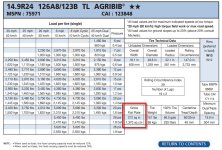
How much tire area is in contact with the ground will depend on inflation pressure and how soft the ground is, but for an average, use this resource:
http://www.ntstractortires.com/assets/uploads/pdf/tires/MichelinData.pdf

Example:

TireContactArea.jpg

When I did a "sanity check" of the 212 sq. in. number shown in that example it works out to a contact patch rectangle 16" wide by 13" long, which is longer than I would have expected. More explanation of "flat plate area" here:
Flat Plate & Flotation | AGTireTalk

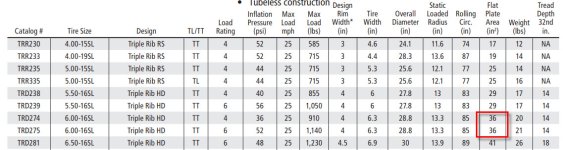
I couldn't find a 6-16 tire in that Michelin resource, so here's another one that does have that tire size:
http://www.ntstractortires.com/assets/uploads/pdf/tires/GoodyearData.pdf

GoodyearTireData.jpg

Chris
 
Last edited:
   / Calculating ground contact and PSI #5  
Agreed that this isnt a simple and straight forward calculation
 
   / Calculating ground contact and PSI
  • Thread Starter
#6  
Well, let me explain why I am asking, maybe that will simply.....

My light to-20 never gets stuck in mud. My heavy tractor with loader always gets stuck in mud.

I'm looking for a lighter loader tractor, and would like to fine a comparable one with a similar psi on the tires/ground as a to-20.
 
   / Calculating ground contact and PSI #7  
IS the loader tractor 2wd?

Takes weight off drive tires? Adds mass amounts of weight over SMALL and SKINNY non-drive tires?

Answer is simple, get a 4wd loader tractor.
 
   / Calculating ground contact and PSI
  • Thread Starter
#8  
How would a loader(empty) overhanging the front end affect the weight carried on the front tires?

My small tractor has 19 sq inches of contact per tire. A 12.5l-15 has almost 100 sq in each. On a heavy tractor like a Ford 4400 those front tires should help keep me from sinking in, right?!?!
 
   / Calculating ground contact and PSI
  • Thread Starter
#9  
IS the loader tractor 2wd?

Takes weight off drive tires? Adds mass amounts of weight over SMALL and SKINNY non-drive tires?

Answer is simple, get a 4wd loader tractor.
Yes it's 2wd. 4wd is too expensive, don't have the money. Plus my issue isn't 2wheel drive, it's sinking into the mud. I've never been stuck with my light tractor because I never sink in
 
   / Calculating ground contact and PSI #10  
You honestly cannot see why a loader (even empty) overhanging the front axle effects the weight carried by the front?

Tractors of all sizes and all makes are scaled fairly proportional. Sure there are standouts and some are the exception to the rule....

But an "average weight" 20 hp tractor, 40hp tractor, and 60hp tractor....will all share a similar ground pressure, and a similar tendency or resistance to get stuck in the mud. Because as size/weigh go up....so does tire size in a fairly proportional manner.

Meaning that if you have an average 30hp tractor with loader that has a tendency to get stuck in the mud.....going bigger or smaller isnt going to change anything.

You need to change ANOTHER variable. IE: REAR BALLAST if 2wd, going to R1 tires instead of R4, or going to a 4wd machine instead of a 2wd.
 
   / Calculating ground contact and PSI #11  
IS the loader tractor 2wd?

Takes weight off drive tires? Adds mass amounts of weight over SMALL and SKINNY non-drive tires?

Answer is simple, get a 4wd loader tractor.

...or put a whole lot more ballast on rear of heavy 2wd loader tractor.

I think what works better depends on the conditions. Is mud "bottom less"?
Sometimes you want to be light (low psi) so you can float on top of surface (mud, snow, - I know nothing about driving on sand) and as long as surface can handle the lateral/horizontal (propulsion) forces from the tire and you don't rip up the surface to where you sink, you can keep floating and going.
Other times you want a narrow tire to dig through the mud/snow and have enough weight (psi) so that there's friction for it to bite instead of spin.

You need an onboard air compressor!! Adjust Tire Inflation Pressure On the Go
 
   / Calculating ground contact and PSI
  • Thread Starter
#12  
You honestly cannot see why a loader (even empty) overhanging the front axle effects the weight carried by the front?

Tractors of all sizes and all makes are scaled fairly proportional. Sure there are standouts and some are the exception to the rule....

But an "average weight" 20 hp tractor, 40hp tractor, and 60hp tractor....will all share a similar ground pressure, and a similar tendency or resistance to get stuck in the mud. Because as size/weigh go up....so does tire size in a fairly proportional manner.

Meaning that if you have an average 30hp tractor with loader that has a tendency to get stuck in the mud.....going bigger or smaller isnt going to change anything.

You need to change ANOTHER variable. IE: REAR BALLAST if 2wd, going to R1 tires instead of R4, or going to a 4wd machine instead of a 2wd.

No, sorry, I do know how a heavy loader overhanging will add to the weight. I get there's a lot of leverage. I was asking like how should I figure the added weight of a loader, factoring in the leverage etc. Anyone know?

Far as I can tell, my mud is "bottomless" and I'm attempting to float as much as possible.
 
   / Calculating ground contact and PSI #14  
...Agreed that this isnt a simple and straight forward calculation...
Ditto that...something not mentioned (unless I missed it) is the motion factor...there is a significant difference between a static weight and a dynamic load as motion is applied...
...But on the lighter side...I've never seen a (working) tractor with spoilers...:D
 
   / Calculating ground contact and PSI #15  
Yes it's 2wd. 4wd is too expensive, don't have the money. Plus my issue isn't 2wheel drive, it's sinking into the mud. I've never been stuck with my light tractor because I never sink in

Yes your issue is 2 wheel drive. Not completely but a significant part. A driven tire will always try to pull itself out of the mud where as an idling tire like a front tire on a 2 wheel drive tractor will tend to push into the mud. Then add the weight of the loader on the front tires and you compound the problem. Now add the weight of whatever you are carrying in the bucket and you've made the problem even worse.

To attempt to solve the problem you need to either get 4 wheel drive or only drive on dry ground. Or you could add enough counter weight behind the rear tires to attempt to take weight off of the fronts or you could try to carry the load with the rear tires. IE on the three point hitch.
 
   / Calculating ground contact and PSI #16  
IMO...if you can not get even a 2wd tractor out of the mud with a front end loader you are operating in too wet of an area...know the limitations and capabilities of your machines...wait until the conditions change or change the conditions...!
 
   / Calculating ground contact and PSI #17  
Slash pine is spot on. I won't go out on my property in early spring. Just too soft and mushy. Had I needed the info - I could have obtained the weight on the rear tires. I drove the tractor in to the ADM(Archer Daniels Midland) grain scales for a TOTAL weight - a few years ago. Just park it with the rear tires only on the grain scales - wallah.
 
   / Calculating ground contact and PSI #18  
You are looking for ground force. You need to know how the weight is distributed from front to rear of you tractor, i.e. 30% over the front axle 70% over the rear? You need to measure that first. Then you take a contact patch measurement and divide the weight (pound force) by the are of the contact patch x 2 for the front, and then again for the rear. It's really not complicated, but you need to know your tractors weight distributions first. I'll help you if you do the homework that I just assigned. There are many ways to gets the weight distributions, but you'll have to know that before we can successfully make that "psi" (force per area) of the ground that you desire.
 
   / Calculating ground contact and PSI #19  
No, sorry, I do know how a heavy loader overhanging will add to the weight. I get there's a lot of leverage. I was asking like how should I figure the added weight of a loader, factoring in the leverage etc. Anyone know?

Far as I can tell, my mud is "bottomless" and I'm attempting to float as much as possible.

Are you kidding? You don’t understand how a loader adds weight to the front non drive wheels? As to how much weight driving it across a scale is the only way to find out.
 
   / Calculating ground contact and PSI
  • Thread Starter
#20  
You are looking for ground force. You need to know how the weight is distributed from front to rear of you tractor, i.e. 30% over the front axle 70% over the rear? You need to measure that first. Then you take a contact patch measurement and divide the weight (pound force) by the are of the contact patch x 2 for the front, and then again for the rear. It's really not complicated, but you need to know your tractors weight distributions first. I'll help you if you do the homework that I just assigned. There are many ways to gets the weight distributions, but you'll have to know that before we can successfully make that "psi" (force per area) of the ground that you desire.

Yes, I'm basically guessing at the weight distribution at the moment. I don't have any way of really measuring that. Especially with the loader added in over the front, makes it more difficult.
 

Tractor & Equipment Auctions

2016 CATERPILLAR 259D SKID STEER (A60429)
2016 CATERPILLAR...
HUSQVARNA RIDING MOWER 46IN DECK (A56859)
HUSQVARNA RIDING...
EZ-GO Utility Cart (A55851)
EZ-GO Utility Cart...
2021 MULTIQUIP 25 WHISPERWATT AC GENERATOR (A59823)
2021 MULTIQUIP 25...
2016 FORD F-350 XL SUPER DUTY EXT CAB TRUCK (A59823)
2016 FORD F-350 XL...
(APPROX. 20) 4' X 8' X 3/8" SHEETING (A52706)
(APPROX. 20) 4' X...
 
Top