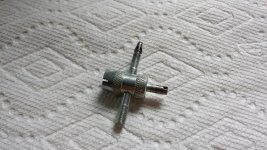
Ballast Can I do it Myself?

   / Can I do it Myself? #41  
Way easier to do it upright and on the tractor. I did enough time in a tire shop to hate seeing a tractor wheel come in on a trailer, especially larger size ones. On the tractor is best as it's all up in the air and sturdy as you work

But if the tire is on a tractor, how do you break the bead if it's stuck on?, other then that I could see why it might be easier on the tractor.
 
   / Can I do it Myself? #42  
Way easier to do it upright and on the tractor. I did enough time in a tire shop to hate seeing a tractor wheel come in on a trailer, especially larger size ones. On the tractor is best as it's all up in the air and sturdy as you work

Yep...
 
   / Can I do it Myself? #43  
But if the tire is on a tractor, how do you break the bead if it's stuck on?, other then that I could see why it might be easier on the tractor.
If it has fluid in when you let out the pressure, it usually drags it off the bead with the weight, and you don't even have to give it more than a kick. We had a tool that was about a yard long a bit like a pick that you could give it a good smack with, if it was reluctant. I never had any trouble breaking the bead unless it came in on its own, had to drive the fleet truck over a couple to get them broken off the bead ;-) we'd usually offer to come out and do it on the tractor if they rang up rather than them battle it on and off, and us battle harder with it in the shop on blocks. These dinky tractors would be a lot easier due to weight, we didn't see many under 34" at the rear, put water in them and it's just asking to scunge up threads etc etc getting them on and off.
 
   / Can I do it Myself? #44  
But if the tire is on a tractor, how do you break the bead if it's stuck on?, other then that I could see why it might be easier on the tractor.

With an air operator bead breaker if so equipped. Or with a hammer and a wedge if not. Tractor wheels do not have safety beads. So most times it don't take much to break them down.
 
   / Can I do it Myself? #45  
If it has fluid in when you let out the pressure, it usually drags it off the bead with the weight, and you don't even have to give it more than a kick. We had a tool that was about a yard long a bit like a pick that you could give it a good smack with, if it was reluctant. I never had any trouble breaking the bead unless it came in on its own, had to drive the fleet truck over a couple to get them broken off the bead ;-) we'd usually offer to come out and do it on the tractor if they rang up rather than them battle it on and off, and us battle harder with it in the shop on blocks. These dinky tractors would be a lot easier due to weight, we didn't see many under 34" at the rear, put water in them and it's just asking to scunge up threads etc etc getting them on and off.


Sorry Pete, I was posting same time you were. Oldpath05, defer to Pete's response. :)
 
   / Can I do it Myself? #46  
With an air operator bead breaker if so equipped. Or with a hammer and a wedge if not. Tractor wheels do not have safety beads. So most times it don't take much to break them down.
Most of our cowboys here have duals and run round with them flat before noticing so that does a lot of the work. Agree, they flip on and off easy as pie. Michelins and Pirellis are the tight ones if you are putting on new. It's like they think an inch is 25mm not 25.4! Even rusted old vintage tractor rims are straightforward if you give them some CRC WD40 etc and soak it in while the air comes out.
(they really need to install a 'like' button on here!!)
 
   / Can I do it Myself? #47  
So for loaded tires in cold weather, there's beet juice, windshield washer fluid and the terrible CaCl, out of these 3, which one weighs the most in the lowest volume, and which one's the cheapest, so is there anything else that can be used, like used motor oil? Been thinking of changing out the CaCl in my tires to something that's heavy and won't cause corrosion.
 
   / Can I do it Myself? #48  
So for loaded tires in cold weather, there's beet juice, windshield washer fluid and the terrible CaCl, out of these 3, which one weighs the most in the lowest volume, and which one's the cheapest, so is there anything else that can be used, like used motor oil? Been thinking of changing out the CaCl in my tires to something that's heavy and won't cause corrosion.
From what I gather, windshield fluid is what most of the guys on here are advocating as being cost effective and safe. Also the common thing they do around central otago in NZ is leave containers at the local lube shops etc, and get the old antifreeze when people get it changed out. They run it diluted in their big tractors' rears.. imagine filling 2 50" tires, it has to be cheap!! I'll let the locals give you their best advice,
 
   / Can I do it Myself?
  • Thread Starter
#49  
OK, after much delays for aquiring tools, the tire is repaired and re-filled and ready to work. (I'm glad I did it myself!)


The last question is about tire pressure with liquid filled tires.

The tire says 'Max load etc. 32 PSI cold'. The tractor manual says 28 PSI. I currently have it aired up to 20 PSI and it feels very firm.

When using liquid filled tires, do you use less pressure than with non-filled?

Thanks again for all the ideas!
 
   / Can I do it Myself? #50  
I was wondering the other night if you got your tire fixed, at some point give a list of tools you used in case I might try this.

I'd rather have tractor tires soft than hard, when I had my 11.2-24 AG tires changed three years, they inflated them to 40 psi, what was they thinking. My son brought them back home, we put them on the tractor and to myself, why do these tire feel so hard to the point they even look deformed a little, after they was on I check the pressure and went wow, spent a 1/2 hour/tire bringing them back down to 18 PSI, CaCl all over the place, my manual says 14pis. So the next time I take my tires somewhere, I'll bring a tire gauge and they will bring the PSI down.

My chart shows tires filled to 75% that's why it doesn't take much air, on your 16.9-24 R4 tires, 28psi sound plenty to me.
 
   / Can I do it Myself? #51  
From what I gather, windshield fluid is what most of the guys on here are advocating as being cost effective and safe. Also the common thing they do around central otago in NZ is leave containers at the local lube shops etc, and get the old antifreeze when people get it changed out. They run it diluted in their big tractors' rears.. imagine filling 2 50" tires, it has to be cheap!! I'll let the locals give you their best advice,

Old antifreeze (spilled/leaked) will kill animals, because it has a sweet taste, and they love it.
If there are NO farm animals/ pets/ or wild animals EVER around, then used automotive anti-freeze is an option.
"Beet juice" is the most expensive, and heaviest: non-toxic antifreeze (for water lines etc.), is next most expensive: then CaCl (heavy, but horribly corrosive): then windshield washer fluid: then used automotive anti-freeze, but deadly for animals: then water.
For obviously very different reasons, I would NEVER choose either used automotive anti-freeze, or CaCl!
 
   / Can I do it Myself? #52  
So for loaded tires in cold weather, there's beet juice, windshield washer fluid and the terrible CaCl, out of these 3, which one weighs the most in the lowest volume, and which one's the cheapest, so is there anything else that can be used, like used motor oil? Been thinking of changing out the CaCl in my tires to something that's heavy and won't cause corrosion.

Weight in increasing order WW Fluid, CaCL, RimGuard

Price in increasing order CaCL, WW Fluid, Rimguard Although if you mixed your own Methanol from a bulk 55 gallon drum, it may be as cheap or cheaper than buying CaCL and mixing it up. The active ingredient in WW fluid is Methanol. The blue dye and the water doesn't matter.

So the Rim Guard is the most expensive, weighs the most and is the least toxic.
 
   / Can I do it Myself?
  • Thread Starter
#53  
Sigh... OK... on to the next problem.

When I pressured up the repaired rear tire to 20 PSI... the tractor was tilting greatly because the other tire had a much lower pressure.

So I bled off pressure on the repaired tire to 12 PSI and the tractor was tiltling much less... but still tilting. Something didn't seem right so I decided to check the 'other' tire pressure. The 'other' tire was at 5 PSI which seemed way low. So I added pressure to the 'other' tire and got it up to about 9 PSI but then the valve core started leaking because of the corrosion. When I went to remove the valve core to put in a new one, the valve core disintegrated because of the corrosion.

The part of the valve core that the tool grips on to remove it is gone, the plunger is gone, the spring came out, etc. The valve core is still stuck in the stem with central hole open. The valve stem of the tube seems to be the type that does NOT have a separate core housing that can be removed and replaced. (The new tube I put in the repaired tire DOES have the separate, removable core housing).

So... if there is no possibility of removing the valve core and the entire tube must be replaced... I must drill out the stuck valve core in order to effectively pump out the ballast. (I have another tube on order but it's not here yet).

Any way to get the bad core out of the valve stem so that a new core could be installed?

I was thinking about drilling in with an undersized bit and hoping this would allow the stuck core bits to be dislodged. I would want to preserve the valve stem threads so the new core could be installed. But maybe with the corrosion, the valve core threads are fused with the stem threads?

Thanks for the ideas!
 
   / Can I do it Myself? #54  
Weight in increasing order WW Fluid, CaCL, RimGuard

Price in increasing order CaCL, WW Fluid, Rimguard Although if you mixed your own Methanol from a bulk 55 gallon drum, it may be as cheap or cheaper than buying CaCL and mixing it up. The active ingredient in WW fluid is Methanol. The blue dye and the water doesn't matter.

So the Rim Guard is the most expensive, weighs the most and is the least toxic.

As a comparison:
40 gal. RimGuard 10.8 lb./gal. @3.25/gal.= 432 lbs. = $130 + dealer installation.
fee ($50-$75 per tire).

40 gal. windshield washer fluid 8+ lb./gal. (water is 8.33)= 320 lbs.= $60, and you can put it in yourself.
If you choose RimGuard you are going to pay one he11 of a price to get those last 112 lbs.

CaCl .... NEVER !!!!!
 
   / Can I do it Myself? #55  
As a comparison:
40 gal. RimGuard 10.8 lb./gal. @3.25/gal.= 432 lbs. = $130 + dealer installation.
fee ($50-$75 per tire).

40 gal. windshield washer fluid 8+ lb./gal. (water is 8.33)= 320 lbs.= $60, and you can put it in yourself.
If you choose RimGuard you are going to pay one he11 of a price to get those last 112 lbs.

CaCl .... NEVER !!!!!

Well that one answer I wanted to know, Rimguard weights the most. So you saying Rimguard has to be installed by a tractor dealer and or I cant take out the CaCl and put in Rimguard myself?
 
   / Can I do it Myself? #56  
Sigh... OK... on to the next problem.

When I pressured up the repaired rear tire to 20 PSI... the tractor was tilting greatly because the other tire had a much lower pressure.

So I bled off pressure on the repaired tire to 12 PSI and the tractor was tiltling much less... but still tilting. Something didn't seem right so I decided to check the 'other' tire pressure. The 'other' tire was at 5 PSI which seemed way low. So I added pressure to the 'other' tire and got it up to about 9 PSI but then the valve core started leaking because of the corrosion. When I went to remove the valve core to put in a new one, the valve core disintegrated because of the corrosion.

The part of the valve core that the tool grips on to remove it is gone, the plunger is gone, the spring came out, etc. The valve core is still stuck in the stem with central hole open. The valve stem of the tube seems to be the type that does NOT have a separate core housing that can be removed and replaced. (The new tube I put in the repaired tire DOES have the separate, removable core housing).

So... if there is no possibility of removing the valve core and the entire tube must be replaced... I must drill out the stuck valve core in order to effectively pump out the ballast. (I have another tube on order but it's not here yet).

Any way to get the bad core out of the valve stem so that a new core could be installed?

I was thinking about drilling in with an undersized bit and hoping this would allow the stuck core bits to be dislodged. I would want to preserve the valve stem threads so the new core could be installed. But maybe with the corrosion, the valve core threads are fused with the stem threads?

Thanks for the ideas!

How long has the CaCl been that tire to corrode the valve stem like that? I'd try reversed drill bits, but I never heard of a valve stem decinercrating. 12 psi sound low to me.
 
   / Can I do it Myself? #57  
Well that one answer I wanted to know, Rimguard weights the most. So you saying Rimguard has to be installed by a tractor dealer and or I cant take out the CaCl and put in Rimguard myself?

You could take the CaCl out yourself, but it might be very messy.
You may be able to install the RimGuard yourself also ..IF..you can find a dealer willing to sell it to you in bulk.
 
   / Can I do it Myself?
  • Thread Starter
#58  
Thanks for all the ideas!, I'm sticking with the CalChlor for my particular application for now.

Thankfully, I got the problem sorted. I was able to extract the stuck valve core and installed a new one and the tractor is working again (without having to install a new tube) Currently running at 15 PSI each. Now that the fluid levels are down at the stem level, it's easy to jack up the tractor and install new valve cores to deal with the corrosion problem.

Thanks again for all the ideas!
 
   / Can I do it Myself?
  • Thread Starter
#59  
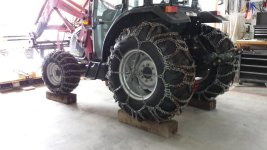
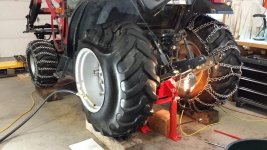
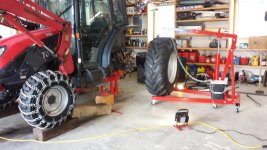
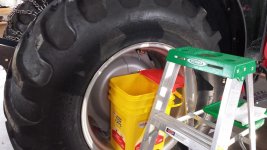
Here's some shots of the process along the way:

tractor_tire_repairs_17_small.jpgtractor_tire_repairs_02_small.jpgtractor_tire_repairs_03_small.jpgtractor_tire_repairs_12_small.jpgtractor_tire_repairs_15_small.jpgtractor_tire_repairs_16_small.jpg

Thanks again!
 
   / Can I do it Myself? #60  
Good on you for doing it yourself, glad you got the other side sorted out the easy way! I think those pressures will be right, with less air volume in there, you need to have a lower pressure to still get that 'give'.. I run 14-18 psi in rears depending.
Thank you for the update, and pictures!
 

Tractor & Equipment Auctions

2003 Komatsu WA250-3MC Articulated Wheel Loader (A56857)
2003 Komatsu...
Kubota M6 131 HP
Kubota M6 131 HP
KUBOTA U55-5 EXCAVATOR (A59823)
KUBOTA U55-5...
2005 GMC Canyon (A57148)
2005 GMC Canyon...
(APPROX. 26) 4' X 8' X 3/4" OSB SHEETS (A52706)
(APPROX. 26) 4' X...
5004 (A55851)
5004 (A55851)
 
Top