Carb problems

   / Carb problems #21  
I have a 2422, with a Robin 25HP engine--should be close enough. Your schematic shows a multiconductor cable with a white wire (this is the one you haven't been able to find) going to one terminal of the thermo-switch. Find that cable in the area near the thermoswitch and find the white wire, follow it to the end of the white wire. There should be a terminal on the end that will plug on to the thermoswitch. The other terminal on the thermoswitch is already connected to the fan.

If you have trouble finding the multiconductor cable, follow the wire from the PTO valve until it joins the multiconductor cable. You should then be able to find the white wire.

If all else fails, you can run a (fused the same as the present fan fuse) new wire directly from the battery to get you going until you can find the correct feed (white) wire.

Hope this makes sense, it does to me--but that doesn't always mean it does to anyone else. :p
 
   / Carb problems #22  
ldabe said:
Carl,
There are two wires coming from the fan, one goes to the fuse, and then continues to the relay. The other one goes to a bolt on the tractor for ground.

As for checking the relay using an ohm meter, shouldn't I go across the terminals of the relay (when cold shouldn't have anything) and then when hot I would have a change.

Does this sound anywhere close, or am I missing your point all together?


Yes, that is advanced electronics :) But, make sure you unplug the other clip or take out the fuse. You can never be too sure of where a wire came from. Some volt meters are sensitive to reading ohms and taking a voltage hit. Check the resistance cold and hot. Cold should be open circuit and hot engine should be close circuit.

OK. Now looking at your note it appears to me you do not have any HOT (+) power coming to that relay. Just to make sure you are saying the fuse wire in the picture is coming from the fan.

So, you need to get some juice from the battery to the fan. If it where me and I had the patience, I would not let the load (the amperage needed to drive the fan) run through the ignition switch. Instead, I would take the switched lead from the ignition switch and run it into a relay (These are automotive relays, cost about $2) I would then take a hot lead off the battery or starter area and run it into the relay, using the switch to activate the relay ( this does not make sense - let me draw it, scan it and post it).

Carl
 
   / Carb problems #23  
Sorry, I must have been typing while you guys were posting:). Looks as if you should have the problem under control.

BTW: "what does 'SO #14-5' mean on the wire diagram?"
The SO refers to the insulation jacket on the multiconductor cable, SO means 600volt insulation flexible; if it were SJO it would be 300volt insulation flexible. #14 refers to the wire gauge of the conductors, 5 is the number of conductors in the cable. In short, just a description of the multiconductor cable.;) Hope you are able to get going quickly.:)
Bill
 
   / Carb problems #24  
So, I am going to try and give a bit back. I feel I have gained so much and given so little.

I like relays, a lot. Switches are seldom designed to handle current much more than an amp or two, and they are generally expensive and difficult to replace, especially when it is your ignition switch.

So, here is a little drawing on how to install a relay to reduce the amps through your switch. The relays I speak of are automotive, can be found anywhere, and cost $2.00. You can get bases for them that make wiring even easier.

First, always disconnect your battery when you are doing electrical work.

Basically, find the wire running to your device that you want to put a relay on. On my 1850 I installed additional lights, and relayed them with fuses. I found the lead from my switch to the lights and I cut it. I then ran a thicker guage wire from my starter block (follow the positive batter wire to your engine and there it should connect with the starter and have lots of other connections) (or you can do it from your battery post). Anyway. You connect that new hot wire with a fuse to your relay, you connect the wire you cut from the switch to your relay, and you connect the wire to your light or fan to the relay. Then you run a ground wire off your relay and ground it to the tractor (i generally use the screw I am using to mount the relay to the body of the tractor as the ground as well).

One late note, and one not on my drawing, I always put a fuse on the wire running from the battery / starter. Just a good policy to get into. I ususally put it on next to the relay so when I have to tech a problem I know that the fuses are next to the relays...

Most auto relays have the same wiring pattern and number at the bottom. 86 is from your switch
85 is to ground
30 is from your battery
87A is left blank but protected so it does not touch anything else (it is hot when relay is in rest mode)
87 is to your device.

Many I hope this makes sense. Hope it helps someone as well. It is quite easy to do.

Here is a link with a better drawing of the bottom of the relay, and a picture of one too...

Relays, Single Pole Double Throw (SPDT), Automotive Relays
 

Attachments

  • relaywire.jpg
    relaywire.jpg
    16 KB · Views: 139
   / Carb problems #25  
bjustice said:
Sorry, I must have been typing while you guys were posting:). Looks as if you should have the problem under control.

BTW: "what does 'SO #14-5' mean on the wire diagram?"
The SO refers to the insulation jacket on the multiconductor cable, SO means 600volt insulation flexible; if it were SJO it would be 300volt insulation flexible. #14 refers to the wire gauge of the conductors, 5 is the number of conductors in the cable. In short, just a description of the multiconductor cable.;) Hope you are able to get going quickly.:)
Bill

Thanks for the SO, SJO seperation. Never knew that...
 
   / Carb problems #26  
ldabe said:
Ok guys, where are ya at?

Can anyone tell me if they have two wires (one on each side / terminal) of the "thermal relay" that tells the oil cooler fan to come on? (If you look at the wire diagram, it looks like to me that there should be two wires, one on each terminal, one that comes from the fan and then on the other side one that goes to??? ... I am guessing to a power source.)

There are other wires not connected to anything, but none has the female connector that makes connection with the terminal on the relay.

Also, if the "thermal relay" is possibly bad (I take it that it is just a heat sensor) can I take off the wire coming from the fan, and splice/connect/jumper to another source wire to get the fan running...and if so, what wire would you suggest?

Thanks in advance for all responses.

Btw, what does 'SO #14-5' mean on the wire diagram?

Yes, there should be a wire on each side of the "thermal relay"
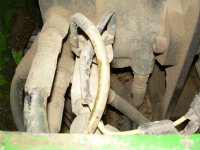
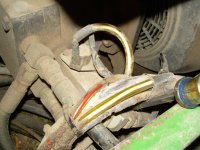
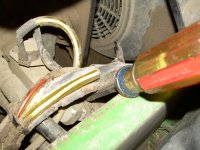
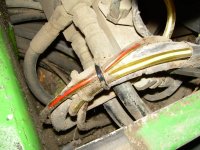
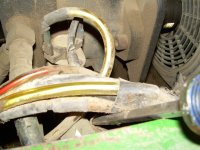
The missing wire goes into the wiring harness. See attach pictures for it's location. It comes out of the wiring harness right next to the scewdriver that I am using to hold the wiring harness in view and away from the side.

Yes, you can jumper those wires together and make the fan run whenever the key is on. You can run it from the white wire. My guess is that the lug has broken off of the white wire.

The white wire is in a clear plastic tube (which I might have installed, but I don't think so). The wire runs from where the screw driver is, forward and then undeneath the wiring harness and over to the "thermal relay".

You could run your own wire through the tunnel and up to the ignition switch if you cannot find the existing on.

If you have a meter you can check the wire. If there is voltage on it when the key is on and no voltage when the key is off, then it is probably the right one.

The "thermal relay" is a temperature switch which I belive cuts on at 130 deg F. I believe it is commonly used in clothes dryers. I have replaced mine once.
 

Attachments

  • wiring fan thermostat 001.JPG
    wiring fan thermostat 001.JPG
    229.7 KB · Views: 133
  • wiring fan thermostat 002.JPG
    wiring fan thermostat 002.JPG
    231.8 KB · Views: 135
  • wiring fan thermostat 003.JPG
    wiring fan thermostat 003.JPG
    231 KB · Views: 134
  • wiring fan thermostat 004.JPG
    wiring fan thermostat 004.JPG
    231.2 KB · Views: 142
  • wiring fan thermostat 005.JPG
    wiring fan thermostat 005.JPG
    231 KB · Views: 139
   / Carb problems
  • Thread Starter
#27  
BobRip said:
Yes, there should be a wire on each side of the "thermal relay"
The missing wire goes into the wiring harness. See attach pictures for it's location. It comes out of the wiring harness right next to the scewdriver that I am using to hold the wiring harness in view and away from the side.

Yes, you can jumper those wires together and make the fan run whenever the key is on. You can run it from the white wire. My guess is that the lug has broken off of the white wire.

The white wire is in a clear plastic tube (which I might have installed, but I don't think so). The wire runs from where the screw driver is, forward and then undeneath the wiring harness and over to the "thermal relay".

You could run your own wire through the tunnel and up to the ignition switch if you cannot find the existing on.

If you have a meter you can check the wire. If there is voltage on it when the key is on and no voltage when the key is off, then it is probably the right one.

The "thermal relay" is a temperature switch which I belive cuts on at 130 deg F. I believe it is commonly used in clothes dryers. I have replaced mine once.

Bob, Carl, and Bill,
First let me thank each of you (and any others if I missed your name) for taking the time to respond...and with so much good and valuble info.

Carl...I will have to read your post on wiring the relay a couple times, to understand it. It is not you, but me, takes awhile to sink in.

Bill...I appreciate the info on the 'SO #14-5', I thought that was the wire gauge and number of wires, but it would have taken some time to figure out or search the "SO" part.

Bob...yes, that is exactly the setup! My white wire going back to the harness is also in a clear rubber tube, but it does not have the right connector to fit on the other side of the relay. It has a different type than the push on spade that is from the fan (with the fuse).

{I am definitely going to be calling that service center I used, it almost seems deliberate. If the connector broke from the wire, the push on spade connector should still be on the male fitting of the relay, and the white wire would show a break, not a different connector.}

After talking with Carl the last time, I went out and checked the relay using the ohm meter, and it is working like it should be when hot & cold.

I then checked to see if the white wire in the clear rubber tube was hot with the ignition key on...it was.

Then I took a nail and put in the connector on the white wire and touched the push on spade from the fan with the fuse, and the fan came on...so fan is good.

So, I am thinking I will change the connect on the white wire to a push on spade and put onto the other side of the thermal relay.

-------------------------------------
Does anyone see a problem with this?
-------------------------------------
(It seems to be the way the diagram shows, and it is the set up that Bob has also, except for the fuse on the fan side.)

Carl...should I still put the relay in?

Bob...do you have a fuse on the fan side?

Let me again stress to all how much I appreciate the help, pics, suggestions, and comments. "PT guys" are...well they are "PT guys"! I think that says it all.
 
   / Carb problems #28  
I don't understand why the fan wire from the thermostat is fused? Seems to me the fuse should be located on the power wire to the thermostat. That would provide protection for a grounded fan or a grounded thermostat. I checked my PT-422 when I tucked it in for the night and mine is fused on the wire to the fan from the thermostat like your picture.

If I had your situation and could not locate the power wire for the thermostat I would run a (fused) wire from the positive battery terminal to the other thermostat connector. Be sure to fuse the wire you run as close to the battery terminal as possible for maximum protection. Note your fan will run with the ignition switch off if the thermostat is closed.


Dale
 
   / Carb problems #29  
Glad you found the power wire. We must have been typing at the same time.

Dale
 
   / Carb problems
  • Thread Starter
#30  
DHS said:
Glad you found the power wire. We must have been typing at the same time.

Dale

Dale, thanks for the input.

Why do you think Power Trac puts the fuse on the wire going to the fan?
(At least I think it is Power Trac, since yours is just like mine. In fact, I need to go back and look at Bob's pics, and see if he has a fuse on the fan side also.)
 
   / Carb problems #31  
Glad you found the wire. Just change out the spade... No need to complicate the system with a relay. You are not pulling a lot of power with this one fan. I just offered it up if you had to go do some serious wiring or went with a larger fan.

Now, the way i would be wrong is if other 425 owners said to swap go with a relay. I don't know your system so definitly ask the experts.

Carl
 
   / Carb problems #32  
ldabe said:
Dale, thanks for the input.

Why do you think Power Trac puts the fuse on the wire going to the fan?
(At least I think it is Power Trac, since yours is just like mine. In fact, I need to go back and look at Bob's pics, and see if he has a fuse on the fan side also.)


You have to decide to place the fuse somewhere. The main fuse still protects the entire electrical system. So there is not a lack of protection. Perhaps the PT engineers felt there is more of a probability of an electrical problem with the fan than the thermostat. If the fan causes a short to ground the fan fuse blows and the rest of the tractor continues to run. If the thermostat causes a short to ground the main fuse blows and everything shuts down.

It will not cause any problems as is and I don't intend to change mine.

Dale
 
   / Carb problems #33  
I suspect that the mismatch on the fastener on the white wire and the thermal relay occurs because there is a missing section of wire--that has a connector to match the white wire on one end and a connector to match the thermal relay on the other.
 
   / Carb problems #34  
ldabe said:
Bob, Carl, and Bill,


So, I am thinking I will change the connect on the white wire to a push on spade and put onto the other side of the thermal relay.

This is a good idea -BobRip
-------------------------------------
Does anyone see a problem with this? No - Go for it. -BobRip
-------------------------------------


Bob...do you have a fuse on the fan side? - Yes, I have changed the fuse holder now, but the fuse has always been there. - BobRip

all.

Sounds like you have got it figured out. I would not add a relay, but the thermal switch will probably fail eventually.
I have thought of adding a fan operating light on the control console since this area has several failure modes and you may not notice if for awhile. The fuse can blow, fan fail, wire break, etc. I would like something that monitors fan current flow. I have not figured out how to do this, but you could tap into the wire at the ignition switch and monitor the current with a shunt. A "cold" light could be put across the thermal relay. The light would light when the switch was open (cold) and go off when it reached temperature and closed. If the fan was open then the light would not come on. If the fuse was blown the light would not come on. If the switch never closed the light would stay on. This seams to cover everything. Did I miss something? Oh, if the fan or fuse failed after the thermal switch closed then you would not notice the failure. Maybe a cold and hot light.
 
   / Carb problems #35  
Idabe, the relay is really a bi-metallic temp switch. At a given temp it bends to close the circuit from power source (fused wire) to fan motor which has it's own gnd lead. From the pic it looks like you are missing the wire going from thermal sw to power fan mtr. When the folks did the coil change and other work the may have simply left it off.

cheers,
 
   / Carb problems #36  
Bob999 said:
I suspect that the mismatch on the fastener on the white wire and the thermal relay occurs because there is a missing section of wire--that has a connector to match the white wire on one end and a connector to match the thermal relay on the other.

I think you repair guy broke the wire (or found it broken), put the wrong connector on it and then found it would not connect. Does the connector look new? Just speculating of course.
 
   / Carb problems
  • Thread Starter
#37  
BobRip said:
I think you repair guy broke the wire (or found it broken), put the wrong connector on it and then found it would not connect. Does the connector look new? Just speculating of course.
Well,
It could be, but I am not gonna say it is for sure.
Anyway, the right connector is on and all is well.
I did call the place and let them know what had happened.
They did not seem to concerned, in my opinion.
Too bad!
With that service center being that close, I was hoping it would be a place I could take it to again. But, I don't think so.
I will do most of the work on it myself, but when it comes to taking the engine apart, I am not real comfortable with that.
There is a great auto mech. place that I have a good report with, maybe I'll ask them if they have ever worked on these type of engines for future reference or problems.

JJ,
I think the popping had something to do with the ignition coil.

You all take care, and I really appreciate this forum.

Thanks again,
Abe.
 
   / Carb problems #38  
ldabe said:
Dale, thanks for the input.

Why do you think Power Trac puts the fuse on the wire going to the fan?
(At least I think it is Power Trac, since yours is just like mine. In fact, I need to go back and look at Bob's pics, and see if he has a fuse on the fan side also.)

You may have this fixed already, but I thought I would add a little more. Fuses are usually added before the item that you want to protect. So therefore, there should be a fuse in line with the wire going to the
B+ side of the fan, so that if the fan were to short out, the fuse would blow. If you wanted to bypass the thermal switch, you would have the fan come on at the same time as power is applied to the system. The thermal is there to allow the oil to heat up to its operating temperature, especially in northern climates. Hydraulics work best if kept inside of the operating parameters for that oil. You have probably noticed that the hydraulics work better when you first start out, except when extremely cold. You have also noticed that you lose some efficiency when the oil is hot.

I have already changed out my fan for a junkyard fan at a cost of $15.00.
 

Tractor & Equipment Auctions

Miller Big 40 Portable DC Arc Welder Generator (A55973)
Miller Big 40...
VOLVO SD75B SMOOTH DRUM ROLLER (A60429)
VOLVO SD75B SMOOTH...
Husqvarna Riding Mower (A56857)
Husqvarna Riding...
INTERNATIONAL FLAT BED TRUCK (A52707)
INTERNATIONAL FLAT...
2021 JOHN DEERE 6145R TRACTOR (A59823)
2021 JOHN DEERE...
TOOTHED BUCKET ATTACHMENT FOR MINI EXCAVATOR (A58214)
TOOTHED BUCKET...
 
Top