cement slab

   / cement slab #1  

lovemytoys

Gold Member
Joined
Jun 21, 2005
Messages
253
Location
andes ,new york
Tractor
bx24
this will be my first slab .any input would help alot.slab is going to be 14'x20'x4".i dont think i can do it with a small mixer so i think im going to order a truck.do i need gravel and a vaper barrier?? also i heard the the outside edges 8"back should be 6" dep. i hope i said it right .they say it will help with shifting and frost lift .what do you think
 
   / cement slab #2  
4" in pretty thin, thats what is used for sidewalks, but not much else. I would also look at some kind of mesh or rebars. Thats also big enough you would want to cut in a few joints to control cracking.
 
   / cement slab #3  
The 14 X 20 ft, is that for a garage? Depending what is going on or into this space the 4 inch may not be enough. The base is very important as you do not want any settling after you have poured the slab. If it has settled then driving a car on it for example could easily crack the slab. Both the thickness and amount of cement in the mixture needs to be considered. The more cement (within reason) in the mixture the stronger it will be, still has to be mixed in perportion to the sand/rocks. In our barn floor, which was poured after we built the barn, the cement company used an MPA 25 instead of MPA 20. This made for a stronger floor in our barn. As others have suggested some steel mesh or rebar could be considered.
 
   / cement slab #4  
this will be my first slab .any input would help alot.slab is going to be 14'x20'x4".i dont think i can do it with a small mixer so i think im going to order a truck.do i need gravel and a vaper barrier?? also i heard the the outside edges 8"back should be 6" dep. i hope i said it right .they say it will help with shifting and frost lift .what do you think

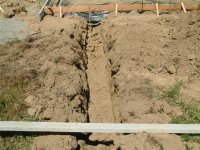
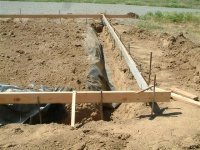
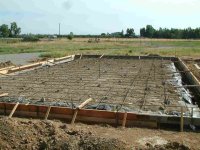
Here's what the site prep looked like when the 24x42 ft slab, 6" thick, 4000 psi concrete, 4" slump was poured for my shop.

This is the trench for the 100 amp 220V service to the shop connecting with the slab footing.

DSCF0037 (Small).JPG

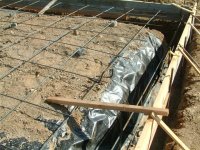
Some images of the site prep work. The footings are nominal 12"W x 12" deep. The black plastic is 6mil Visqueen. The rebar is #4 (1/2") on 24" centers both ways. The rebar under the slab is supported by 3" tall doobies to keep it centered top to bottom in the slab.

DSCF0040 (Small).JPG

DSCF0057 (Small).JPG

DSCF0061-smal.jpg

You'll need a minimum of 3 guys to do the pour (one on the chute and two with shovels). Then you need the equipment to float the surface and put whatever finish you want (trowel, broom, etc). If you've never done this, then get some experienced help because it's easy to screw up the finish on the slab if you're not careful.

Good luck.
P.S. Concrete work is one of my least favorite jobs, after plumbing.
 
   / cement slab #5  
I'd go at least 5" with fibergass..Makes a strong slab as well.
 
   / cement slab
  • Thread Starter
#6  
this a big shed.i will be using it for storeage of my bx24 -lawntractor and screen house .
 
   / cement slab
  • Thread Starter
#9  
so i will up it to 6"x14'x20' add wire role out .could it be one slab or do i need to break it up .im hopeing one slab. vapor barrier then 4"gravel them 6"cement
 
   / cement slab #10  
so i will up it to 6"x14'x20' add wire role out .could it be one slab or do i need to break it up .im hopeing one slab. vapor barrier then 4"gravel them 6"CONCRETE

I would NOT break it up into more than one pour. Don't waste your time with rolled wire mesh. Use 3/8 rebar.
 
   / cement slab #11  
1. Use rebar -- wire mesh is very difficult to keep in the right place in the concrete.

2. Use doobies. Anyone who tells you that he or his crew will pick up the rebar to the center of the slab is a liar.

3. The gravel goes on the ground. The plastic (vapor barrier) goes on top of the gravel. The concrete goes on top of the vapor barrier.

4. Your footings need 4 pieces of # 4 bar run lengthwise.
 
   / cement slab #12  
Ground prep is one of the most important steps. Don't pour on clay. In a perfect world 4/6" of drain rock/ or DG over a compacted, compacted, soil that is damp not wet. You can use wire mesh but I woud attach rebar with bailling wire every 3 to 4 feet both ways to keep the mesh strait. Use the little concrete blocks wired to the under side of the rebar to keep it elevated. Or just order fiber in the load of concrete and forget the steel. If your ground prep is done right 4" of concrete is fine. A little thicker along the edges is good. If you pour at a 3" slump 3,000 psi mud will work. I would order 3,500 psi at a 4 to 4.5 " slump with the right crew of finishers. You can play it on the safe side and order 4,000 psi and go up to a 5.5 " slump easer to work the mud, all depends upon the crew you have. Have at least one person who does finish work for a living there to tell all your buddies what they need to be doing. The more pro finishers the better, to a point. They have the right tools.

Concrete is a perishable product with a short time span to work with, then the results you have a life time to live with. Good luck.
 
   / cement slab #13  
If, at all possible, find a fellow who knows what he is doing with the chute. It will make the job much much easier.:D
 
   / cement slab #15  
That guy comes with the truck here.:cool:

What I was familiar with was a Truck Driver that regulated the rate at which the fellow on the chute wanted the concrete but that was in a different place and many years ago.:D
 
   / cement slab #16  
That guy comes with the truck here.:cool:

Yeah, that guy comes with the truck here too, but will only use two chutes. New company policy, no more four chutes to get where you need.

To the original poster, make sure you have the site prepred for the concrete truck. Be prepared for bad ground with boards. Trucks in my area will make you pay if they get stuck, or they won't go where they think they may get stuck. also have a place where you can let him clean out his chutes when done. Sounds silly, but the last thing you want to do it clean concrete out of your yard.
 
   / cement slab #17  
I have also found that you often have a little extra concrete in the truck at the end of the pour. Just short of enough can be a disaster so a little extra is not a bad thing. I always try to have something small formed up to pour the extra in rather than send it back when I have paid for it.

MarkV
 
   / cement slab #18  
When I did my garage slab, 24' x 30' I hired a couple people to finish it. They guy who delivered the concrete knew the finishers, and he put the concrete exactly where it was needed so there was very little moving it by hand, and the finisher tipped him for it.
I'm in the process of getting prices to put a slab in my barn 30' x 48', prices sure have gone up. I need 30 yds, concrete price is little over $3k, the finisher will prep, lay vapor and rebar and finish for another $3k.
 
   / cement slab #19  
You all know your concrete. This is all true. A good chuteman is as good as a good driver. ;)
 
   / cement slab #20  
All good information. You definitely need some perimeter grade beams to strengthen the edges. Depending on your area, depth of joint will vary with the frost line. I would go with a 12 wide by 16 deep and 45 degree slope the inside edge connecting to the slab. Put in at least 4 ea # 4 rebars allowing minimum of 3" of concrete cover all around. Tie in your grade beams with rebar crossing the grade beam and running into the slab on 12" centers in checkerboard fashion if you can afford it but no more than 24" center to center. Go with 4000 PSI (35MPA) strength. It is not much more in cost and gives you a lot more strength. For any structure where you might be parking tractors or cars on, go with a 6" slab rather than 4". For that size you wont need expansion joint or saw cuts. You never need to put expansion joints or saw cuts closer than 20 feet apart and if you pour low slump of 4" or less you limit the shrinkage cracking. I poured a 30' X 30' x 6" slab for my shop with no joints, saw cuts etc and got no cracks or even spider web surface cracks. If you place your slab when the temps are between 40F and 60F which I did, it helps reduce shrinkage cracking also. Hot weather concreteing cures to fast on the outside which increases the cracking problem. Lastly get plenty of help. If you think 2 guys will be enough, get 4. You will need 2 people with concrete comealongs (like a rake but solid) to move the concrete to close to correct height, then at least 2 more pulling a screed to level it across the forms and someone to bull float it. You will probably need a screed line set in the middle of you slab (7 feet) and finish it out 7x20 and then do the other side, then pull the screed board up, fill in the line and hand finish out to the end unless you can come up with a screed board 16 feet long. If you havent done concrete before, hire some professionals to do this. It will be worth the money because they will have all the equipment and know how and you will get a good finish. Cost wont be much more either if you have to go rent of buy all the tools needed to place, level and finish this slab.
 

Marketplace Items

2021 Deere 331G (A53317)
2021 Deere 331G...
2020 PETERBILT 567 (A58214)
2020 PETERBILT 567...
(160) PIECES OF 1"X6"X6' WHITE PINE TONGUE&GROOVE (A60432)
(160) PIECES OF...
FUTURE 60" PALLET FORK (A60432)
FUTURE 60" PALLET...
2012 Ford F-250 Pickup Truck (A55973)
2012 Ford F-250...
2014 JLG 6036 6,000lb 4x4 Rough Terrain Telehandler (A59228)
2014 JLG 6036...
 
Top