CG differences and handling side grade

/ CG differences and handling side grade #1  

ChesapeakeBoy

Bronze Member
Joined
Jan 25, 2020
Messages
70
Location
NE Iowa
Tractor
2015 Kubota MX4800
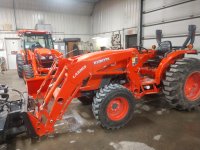
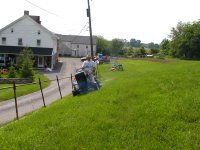
I just purchased a Kubota MX6000 Cab. I replaced my Kubota MX4800 with this. The cab adds about 500#.. I am not sure if the cab model is stiffer, or if the cab makes it stiffer. I bush hogged my pasture the first day. The pasture is NOT flat. I am not sure if it is me or reality... I would think the 6000cab would have a little higher CG, but is it just me, or should both machines be able to handle the same grades? The reason that I am asking is that I mow 50 yards of ditch... I haven't done it yet, but the grass is growing! LOL Both machines have/had fluid in the rear tires... R4. IMG_20200605_154328940.jpg
 
/ CG differences and handling side grade #2  
Yes the CG is some higher. Probably half of that 500 lbs is above where 4800 CG was

I don’t think it will make much difference

Do you have a tire difference?

Andy
 
/ CG differences and handling side grade
  • Thread Starter
#3  
Same tires, width, etc...

It just feels tippy to me... might be just me....
 
/ CG differences and handling side grade #4  
Of course it raises the total c.g of the tractor, by quite a bit actually. Without the cab, the c.g is probably about at the crankshaft centerline. The cab adds a 500# mass to the base tractor weight at a height probably around waist/seat height. So the change is quite large from a mass a foot or more above the cabless tractor's location.

Plus, the cab adds quite a bit of roll inertia to the tractor, so the roll frequency is lower, presuming the same tire pressures are used. The rear tire vertical spring rates determine the roll spring rate.

So, raise the rear tire pressures to stiffen the roll to reduce that quezzy feeling. But, the C.G. is still higher, so stability is reduced. Widen the rear track (move wheels outward) to reduce the chance of a rollover on a sidehill.

You can measure the static rollover point several ways. Tilting table for 1 and some scales under each wheel as a second option. Pull it from the roll bar hoop with a winch and measure the scale load changes and the amount of roll. From this, you can make a plot and predict what the rollover angle would be [where the outside scale weights would be zero.]. That doesn't take into account any dynamic inputs (throttle, brake, driver position, and steering changes that will occur as a rollover develops, but you said you just wanted to compare 1 tractor with another.
 
/ CG differences and handling side grade #5  
All above true. The best thing to do (if you have a way to do it) is to move the rear tires further apart. That will overwhelm all other factors. Friends of mine run a cab style 6040 and they use 6" wheel spacers on each side which made it much better. Said they would not run it on hillsides without the spacers.

I doubt you need to do anything complicated, esp since you have cut the same places before. Just don't hit any low spot or hole on the downhill side. But you know that.
 
/ CG differences and handling side grade #6  
On a smaller scale, I had a b2200 with a cab that felt tippy on a small hill. I removed the cab, a Curtis, and it seemed much less tippy. Maybe it was just me but the cab made me less secure and the cab maybe weighed 100 pounds.
 
/ CG differences and handling side grade
  • Thread Starter
#7  
My rear tires are set at 55" on center... I think I will be adjusting to 57 or 61 1/2"... and obviously... I will not be removing the cab, lol
 
/ CG differences and handling side grade #8  
My rear tires are set at 55" on center... I think I will be adjusting to 57 or 61 1/2"... and obviously... I will not be removing the cab, lol

The spacing needed varies a lot depending on the size and structure of the tractor. I could define a measure of tipping difficulty involving the height of the c.g. above the ground and the width of the rear tire outer edges from the center. Probably an angle which none of us would ever get measured right and none of us could remember. Maybe there ought to be such a spec on tractors??

I'm thinking about 37 degrees (which corresponds to 3ft high --ground to c.g. and 4ft outward -- center to edge of tire) is a pretty stable tractor very resistant to rollover. It's all about margin and tolerance and uneveness of the surface, etc. Gets very subjective of course.

Anyway my MF 2660 low profile weighs about 9000 lbs with loader etc. usually on it and I keep my rear tires 8ft apart at the outer edges. Whatever geometry that is makes it very stable and comfy on steeper ground than I'm going to be on on purpose. The rears will go out a few more inches each side but then it would not fit a trailer for hauling and I don't need it any wider. It's just right for me but I'd be real curious what a Kubota M5 or M6 owner would say.
 
/ CG differences and handling side grade #9  
Set the rear wheeels wider, you will be surprised by the difference.
 
/ CG differences and handling side grade
  • Thread Starter
#10  
So, I think I will set the wheels wider. The problem that I have is that my trailer has side rails... and I barely can get the tractor on it right now. I need a bigger trailer, but that will have to wait.
 
/ CG differences and handling side grade #11  
So, I think I will set the wheels wider. The problem that I have is that my trailer has side rails... and I barely can get the tractor on it right now. I need a bigger trailer, but that will have to wait.

I traded my original fender style trailer for a "deckover" style which allows me to use the full width over top of the tires. That way I can run the outer edge of my rear tires 8ft apart.
 
/ CG differences and handling side grade #12  
This forum is great. 15 years ago I joined a forum for musicians, said something wrong and whamo. Brutal! Musicians can be prima-donnas

The wheel spacer idea is appealing to me, I致e got nothing but rolling hills and every so often I get that feeling. I guess I can å*µoogle it? and I will but, figured I壇 get some real advice first!

I知 waiting till I ask someone what time it痴 is and they say, 電id ya google it?

Thx everyone, summers here!
 
/ CG differences and handling side grade #13  
Franken -- there are many good sources for spacers. Some do not make them very wide. Some use a solid block of aluminum, others used welded steel construction, etc. Brands include Bora (which I bought), Bro-tek, The Tracks Co.,etc.

The Wheel Adapters, Wheel Spacers, Hub Rings for your car! | Motorsport Tech site is related to Bora brand spacers which are made for Kubota up to 6" for sure since I bought them. As I recall Bro-tek does not make them more than 2 or 3 inches wide. The Tractor Wheel Spacers Hub Extensions, Kubota, John Deere, Compact Tractor, Utility Vehicle has a guy named Christian Hansen who does mostly steel, some welded tubing and some steel cylinders. Seems very knowledgeable.

I know of dealers who charge $700 for a pair of spacers installed. I pd. $495 for a pair (6" per side) plus tax., etc. and installed myself. I was very pleased with Bora and they seemed to have every little thing planned and figured out relating to Kubota specifics.
 
/ CG differences and handling side grade #14  
What about extra loading on the axles/bearings due to the new tire position increasing leverage on them? Jon
 
/ CG differences and handling side grade #15  
The L4240 has the wheels set wide. Not sure what the measurement is, but the center of the tire is approx. at the widest edge of the rear fender. It has always felt very stable. I can picture flopping over if it slid down a hill and something "tripped" it the bottom. Can't imagine going on a sidehill where the CG would be outboard of the tire center. Seems like it would slide first.
 

Attachments

  • IMG_4695small.JPG
    IMG_4695small.JPG
    2.5 MB · Views: 117
/ CG differences and handling side grade #16  
What about extra loading on the axles/bearings due to the new tire position increasing leverage on them? Jon

I do not believe there is anything to worry about there. I've used them for years with no problem. Friends have used them day in day out on 2 larger tractors (both Kubota) with no problems. In fact a Kubota dealer installed them on a 6040 for one friend and they were in the Kubota parts inventory. I've never heard of any axle/bearing problem created by using spacers. (That does not mean there couldn't be problems.) In my thinking, tractors are made for a rough and tumble life where heavy loads are likely in all directions, things are unpredictable, there's a wide variety of attachments bound to be hung on them,etc. My view is that a 6 inch longer axle (which is what a 6" spacer amounts to) is surely within the design and strength limits of any sturdy tractor. If not it must be a frail thing, too frail for general use anyway. There are multiple manufacturers making spacers and putting them on probably every brand of tractor. Surely the user community -- these forums -- would have heard of problems if they happen.

I don't know that it proves anything, but many tractors come from the factory with a range of rear wheel wheel spacing far exceeding those of a mid-size Kubota with 6" wheel spacers. My MF 2660 being a good example. I've eyed the market and the specs on mid range (under 100hp) tractors in New Holland, MF, JD & Kubota brands primarily for the last 20 years. Kubota is the outlier in terms of having less wide rear wheel spacing choices. That's why so many of the spacers are sold for Kubotas. My opinion of course.
 
/ CG differences and handling side grade #17  
The math to determine the increased CG height is easy. Just guessing at the plug-in values, but say the weight of the tractor with loader but without cab is 5500 lbs. and the CG is just above the crankshaft centerline as posted above. Next add the 1000 lbs cab. Say the CG of the cab itself is 30 inches above the crankshaft centerline, this creates a moment of 30 X 1000, or 30,000 lb-in. Now you divided that 30,000 lb-in by the total weight of the tractor and cab, in this case 6500 lbs. So... 30,000/6,500 = 4.6 inches. That is it; for my example the CG height increased by 4.6 inches. I guessed at all the values to put into the math, but the math is correct.
 
/ CG differences and handling side grade #18  
The L4240 has the wheels set wide. Not sure what the measurement is, but the center of the tire is approx. at the widest edge of the rear fender. It has always felt very stable. I can picture flopping over if it slid down a hill and something "tripped" it the bottom. Can't imagine going on a sidehill where the CG would be outboard of the tire center. Seems like it would slide first.

Your L4240 has rear tread of 60.2" max and 50.6" min. Those big 17.5x24 industrials add about 17.5" to the 60.2" so your outer edges are roughly 77.7" apart or 6ft 5.7" Half of that is ~ 38.9" How high is your c.g. do you think? If the cg is 36" off the ground then the triangle is 36" hi and 38.9" base so the angle would be 42 degrees. (angle whose tangent is 36/38.9 is 42 deg.) I don't have a way to estimate your cg but that is the idea and the lower the angle the harder it is to roll you over.

As I said in an earlier post there are a LOT of variables and it becomes an individual thing to get at your comfort level on your ground with your machine and the rest of the circumstances. If you are real comfortable with the L4240 on those tires at those widths -- hey good for you and there is a data point.

By the way: If you ever get into a sideways slide due to slope steepness you are in real serious danger and very out of control ! The right action there is to turn your steering wheel into the slide and step on the gas to get some forward motion -- whatever you have to do to get headed straight down the hill.
 
/ CG differences and handling side grade #19  
I have had trouble inserting pictures in TBN and no response yet from the website helpers. I am going to try to post Before and After here of the B2150 -- with and without the 6" spacers on each side.

Before and after.


P1020462 BEFORE spacers.jpg


20160831_152113AFTER Spacers.jpg


Note: Turf tires are on this tractor for extraneous reasons.
 
/ CG differences and handling side grade #20  
........................................................If you ever get into a sideways slide due to slope steepness you are in real serious danger and very out of control ! The right action there is to turn your steering wheel into the slide and step on the gas to get some forward motion -- whatever you have to do to get headed straight down the hill.

Years ago I had a sliding experience. At the time, I had a Kubota B7500 and the old Ford, both with 5' RFM's. My MIL had around 5 acres that my youngest son and I mowed weekly. The Ford stayed at her place and the 'Bota was driven back and forth. This rear portion of the yard has just enough slope to make it a little sketchy. The pole in the picture is pulled cockeyed, so to get an idea of the slope, compare the ground with the buildings. Usually, the Ford would "crab" along and for this slope I always used 4WD.

One time the grass was a little too wet, and the rear really broke loose. I was about half way up the slope. That pipe fence at the bottom is where the ground drops off. I steered uphill and mashed the hydro and got it to dig i a little. #3 Son was pleased to come and pull Dad and Ford up the hill with the Kubota.
 

Attachments

  • P5290903.JPG
    P5290903.JPG
    633.2 KB · Views: 104

Marketplace Items

2005 INGERSOLL-RAND SD-116F TF  ROLLER (A69167)
2005...
2027 . . (A67714)
2027 . . (A67714)
27001CFL (A66736)
27001CFL (A66736)
2019 Ford F-450 Knapheide Service Truck (A66736)
2019 Ford F-450...
2017 Blue Bird 71 PAX School Bus (A66736)
2017 Blue Bird 71...
PORTA POTTY (A67714)
 
Top