Cider press

   / Cider press #1  

patrickg

Veteran Member
Joined
Jun 9, 2001
Messages
1,388
Location
South Central Oklahoma
Tractor
Kubota Grand L4610HSTC
I have a 20 ton hydraulic shop press. And real soon now I will have more pears than I can eat or easily give away (9 really large old, 100 yrs?) pear trees. I like cooked pears, pear butter, pear sauce (if you do it with apples I can do it with my pears as they are crisp and firm fleshed, not soft llike a bartlet) They are very sweet and juicy and should make good juice/cider.

I was thinking of, at least, temporarily replacing the 20 ton hand pumped bottle jack that powers my press with a air powered jack or a ram connected possibly to the remote hydraulics on the Kubota L4610 to lessen the manual labor that would be required to pump the handle about 127.382 kadrilion jilion times to make several galons of juice.

I have a good handle on how to make the fruit press attachment for the press as far as the "platten" and container with holes to let the juice out. Lots of info on cider presses available and I can duplicate for pear squeezing. No recommendations were noted for hydraulic rams or air powered jacks with appropriately long throw. I'm guessing that for conveninece at least a foot of throw would be good (many many pumps for a HD jack's handle).

I guess I'm missing two kinds of info. I don't know how many PSI is required as a minimum which prevents me building the "squeeze box?". Once I know the PSI requirement, and have the force available from the ram/jack whatever, I can compute the max area of the "platten" and get started cutting, grinding, welding, grinding, etc. And I don't know what sort of specs and asvailability there is for for economical rams or air jacks. To not overstress the frame of the press, I don't think I should exceed the 20 tons it was designed for by much if any.

Any suggestions?

Patrick
 
   / Cider press #2  
Take your pears to a juicer /w3tcompact/icons/laugh.gif.

I can't wait to see this one answered. I am constantly amazed at the information that can be gathered on this board. I plan on planting some citrus trees on the land so maybe this thread will prove valuable to me in the future.

Good Luck with the pear wine...I mean juice;

GS
 
   / Cider press #3  
The last cider press I had access to used a 6" diameter ram, and built to 2000psi at full pressure. This pressure was applied to a 24x24" press plate, pushing against 10 sheets of pulp in a PVC lined tub.
If my math is correct, there are about 100 [ounds per square inch of pressure on the apple mush at full pressure.
A few things to bear in mind, the pulp is contained in what looks like a giant shop rag folded back on itself, after being ground to a size about that of a pea. Pressing a rack of cider usually takes about 45 minutes before all the juice is extracted.
The second thing is that hydraulic systems used in food processing should use food grade mineral oil.
 
   / Cider press
  • Thread Starter
#4  
Frantz and GS (Every time I see GS I think Girl Scout but that might not be wrong...)

Anyway, Frantz I wasn't entirely clear about your numbers. I didn't follow the 2000psi to 100psi. If the 2000 was lbs of force not psi pressing on the 6 inch diameter "squeezer" then with that 28.27 sq in squeezer( 6 in dia) and 2000 lbs you'd have about 70.75 psi on the fruit. Let me know if I guessed right at the setup or straighten me out if I got it wrong.

I can size the length of the ram/jack and I know the force I want, about 20 Tons or 40,000 lbs so as not to exceed the design strength of the press BUT I don't know how big I should make the fruit squeezing squeezer's "foot" to get that required/desired psi and this effects the volume I can squeeze per cycle as well.

If 100 psi is enough then 400 sq in would be the max area of the squeezer foot thingy which is a rectangle 20" by 20" or a circle about 11.3" in diameter. If I guessed the math correctly then I could see how 10" ID heavy wall PVC pipe would make a decent cylinder and then I just need to figure out the practical height (length of pipe) that would work.

From some reading I did, I got a great suggestion for preping the pears for squeezing. Take the formica covered cutout from a large sink installation and mount a garbage disposal in it and put legs on it with an arrangement underneath to hold a large plastic bucket. Toss the washed fruit whole through the running disposal and let it collect in a trash bag lined bucket with an unbleached muslin bag (no colors, no decorations, or writing) inside of the plastic bag. This does not crush the seeds and works great with apples. The author suggested that used disposals in good working condition were a great bargain but the aesthetics usually precludes their use even though they could be sterilized. I'll' probably have to buy new to keep piece in the family.

You then drain the muslin bag for a few seconds (squeezing is OK) then place the muslin bag in the press and fold the top over to seal it and lower the boom on it. Supposedly if you press it hard enough the residue is pretty dry and about the consistency of damp cardboard. The residue might be appreciated by cattle. You think?

Anyway, don't hold back, I would rather find out about any misconceptions or dumb notions before building it, not after.

Patrick
 
   / Cider press #5  
You might be over-engineering a bit. I'm sure the presses they sell for home use don't develop near the psi that your hydraulic device would. See <A target="_blank" HREF=http://www.pleasanthillgrain.com/jaffrey_press.html>Jaffrey Cider Press</A>.
 
   / Cider press #6  
OK, went over the figures again, using cheap & dirty math.
A 6" cyl will be 28.26 sq" on the end above the rod, and at 2000# of pressure, that should develope 56,520# of force on the piston. I figured on a 24 x 24" plate, = 576 sq" pushing on the fruit pulp. 576 sq" of plate with 56,520 # of force behind it has 98.12#/sq" of force on the plate, if the math I learned at moma's knee still works.
A garbage disposal would make an excellent fruit grinder, but I gotta ask, just how many bushels are you planning to process? Unless you're doing one heck of a lot, I think you might be better off using an old fashioned meat grinder with a coarse grate. You don't have to pulp the fruit much smaller than a pea to squeeze it.
As to the bag setup, most of the ones I see use a sheet, like a shop rag, that is about 5' square. The sheet is laid out on the base plate, and a pile of pulp that covers about 18" diameter roughly 3" thick is placed in the center. Then the 4 corners are brought in past center to keep the pulp in place. Additional sheets, usually 5 of them, are piled atop the first, and then the pressure is applied. There are no sideplates involved in a large press.
By bringing the pressing plate down slowly, the juice squeezes out thru the cloth nicely. Cider presses do not move quickly, too fast will blow a hole in the cloth bag, and cleaning up that mess won't be fun. I'm also told you get more juice with slow pressing.
As far as feeding the pulp to cattle after pressing, it could go either way. Since most of the sugar will be squeezed out with the juice cattle might not be too interested. If you leave a little sugar in, and let it ferment a bit, you might have very happy cattle. Hard to say till you try it.
 
   / Cider press
  • Thread Starter
#7  
DocHeb,

I read a piece by a guy who uses a hydraulic mechanics press for a cider press. That is where I got the garbage disposal idea. He has done that and reports great success. He recommended mechanics presses from Harbor Freight and said they had a couple good ones for the $ in 12 ton and 20 ton but if space and $ were not prohibitive to go for the 20 ton. I did. Used it a few times as a mechanics press but am standing by to make a cider press accessory for it.

The 20 ton bottle jack takes a lot of strokes to go very far so I thought I would use a air/hydraulic jack or a ram to speed things up and not be so tedious. I can allways use the jack or ram for other things as I will encapsulate it with plastic sheeting rather than use food grade mineral oil and use it for other things as well.

I have 9 100 year old LARGE trees that inundate us in wonderful pears and I would like to not spend an inordinate amount of time sqeezing a small volume of juice. I haven't measured the trees but some are about 2 ft in diameter and a 20 ft extension ladder with me (at 6'2") standing at the top holding on to a branch with one hand and still not able to reach the copious quantities of pears above my reach.

I topped one of the trees drastically to reduce the excessive height and it came back with a vengence with new growth but did not bloom at all. Shocked its system I suppose. Read where trees that haven't been pruned for a while shold be cut back a little each year NOT all at once. Now I know!

Anyway, thanks for the URL. Last year I searched the web pretty good and saw a lot of cider presses. This is a nice one but at $500 I think I will spend another couple hundrred or less on what I have started and do as well if not better.

I'm only stalled for lack of a real good feel for the psi required.

Patrick
 
   / Cider press
  • Thread Starter
#8  
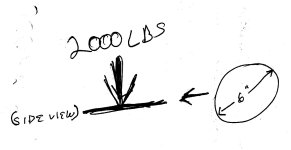
Franz, Thanks for taking the time and trouble to kick this around with me. Your math is impecable, you are a credit to your mom's math teaching skill BUT your physics/engineering analysis is flawed or I need a drawing of what you are thinking about.

My take on this is that there is 2000 lbs of force being DISTRIBUTED over a 6 inch diameter disk. We agree on the area of the disk. 2000lbs. / 28.26 sq in = 70.7lbs per sq in. So we have about 71 psi of pressure on the fruit.

It isn't what I think we were discussing but if you had 2000 psi acting on a piston 6" in diameter the piston would exert a force of 56,520 lbs.

I'm still not sure how many psi are required to sufficiently squeeze pears but when I find out I can then make the largest pressure container the area of which when divided into 20 tons (40,000 lbs) will be equal to that psi requirement. I don't want to drastically undersize the container just to get enough force to exceed any reasonable requirement as for example, quadrupling the psi will make the diameter of the container 1/2 as big. I don't want to arbitrarily reduce my through put out of ignorance so I will try to find out a reasonable figure for psi and build to that.

About my terrifically accurate scale drawing... if 2000 lbs pushing down produced 56,520 pounds of force distributed over the area of 28.26 sq in that would be 56,520 lbs / 28.26 sq in or 2000 psi. Wouldn't that leave a net upward force of 54,520 lbs unapposed and nearly launch the 2000 lb weight into orbit?

Didn't mean this to be a physics/engineering lesson or a sense of humor test but I guess it ended up a bit of both.

Forgive me, attribute it to my advanced age, I'm having a birthday tomorrow!

Patrick
 

Attachments

  • 33-187220-CIDER.jpg
    33-187220-CIDER.jpg
    65.7 KB · Views: 461
   / Cider press #9  
OK Patrick, I think I know where you're getting messed up here. Basicly, " My take on this is that there is 2000 lbs of force being DISTRIBUTED over a 6 inch diameter disk. We agree on the area of the disk. 2000lbs. / 28.26 sq in = 70.7lbs per sq in. So we have about 71 psi of pressure on the fruit." you're dividing when you should be multiplying.
Each square inch of the cylinder piston has 2000# of pressure acting on it, so the piston rod will have a total force of 56,520# of output force, rather than 71# of force.
My physics then calculates the end of the piston pushing against a plate on top of the fruit that is 24" square, totalling 576 square inches. The resulting in a fruit crushing force of 56520# + the weight of the force plate would result in a force of 98.12# per square inch of force on the fruit mush.
The press I'm referring to is structurally equivalent to a mechanic's press with a shower base at the bottom to catch the drippings.
Now, about the age thing, don't let it concern you, I never expected to get this old, and while getting here has been a chalenge on occasion, the journey has left me with one he!! of a Rolodex of accumulated knowledge.
Worst case scenario, I have a buddy in Ok City with the Army, and he can swing by and crush your fruit with a large heavy engineering vehicle.
 
   / Cider press #10  
Patrick:
Have you considered a "lever system " The bottle jack could be placed outside the fruit/juice containment area so no adverse contamination takes place.

If'n your retired there ain't no more birthdays!
Egon
 
   / Cider press
  • Thread Starter
#11  
OK Frantz, Lets see if I can apply the basic principles as you have described them.

Take a guy that weighs 200 lbs whose feet are 10 inches long and 5 inches wide (this is just an example not a custom boot order). With both feet flat on the ground that is 200 lbs "distributed" over 100 sq inches. Following your example that becomes 100 X 200 or 2000 lbs. When this guy stands on something it compresses the something until equilibrium is reached. Lets say he stands on a bathroom scale. Why doesn't the scale register 2000 lbs? Or better yet, since, by your approach, the scale would have to push up at 2000 lbs and he only weighs 200 lbs, why doesn't he get thrown upward with an initial acceleration of something like 10 G's???

I by no means wish to "talk down to you", but my first co-major was physics and math and while your arithmetic remains flawless your analysis is bassakwards. There is just a simple misunderstanding here. It happens to me a lot but this time it didn't.

Now then, if we had a hydraulic cylinder in a static situation (not currently extending or retracting so there are no dynamic losses) then the force on the piston (ram) would be equal to the pressure in the fluid times the area of the piston. A larger piston would "multiply" the force proportionately more, increasing as the square of the diameter. This is sort of a fair "fit" to your contention but this hydraulic cylinder example does NOT model the situation we are discussing.

The cider press doesn't care how the force is applied, by hydraulic cylinder, screw jack, or an inverted pyramid of Lithuanian acrobats with SCUBA weights on their waists. The force applied to the "sqeezing chamber" can come from anywhere, it is an issue of convenience (and my laziness) that I consider a hydraulic ram or air/hydraulic jack.

Whatever linear force is applied to the "crushing piston" is distributed (divided up equally) over the surface of the piston and then since the fruit acts essentially like a liquid (untill nearly finished pressing) the pressure in the fruit (in psi) is the same as on the face of the piston which is the area of the piston divided into the psi.

AHA, a small light came on in what's left of my brain. Something that always helped me learn and teach about solving physics and engineering problems involving lots of units was to include the units in the calculations. For example, if you divide pounds by square inches you get psi. If you expected psi as the answer then you might have worked the problem correctly. If you made a booboo and reversed the numerator and denominator or multiplied instead of divided your answer would be in units of either: square inches per pound or square inch pounds and you would know their was an oops. Getting the units right isn't proof that the numbers are right but not getting the right units is proof that the calculation was set up incorrectly. (There is still a small problem with me and units. I have a lot of left over square radians from years of physics homework and tests. I never needed these for anything and they are apparently useless surplus.)

Put the units in with your good math and see if you accept the results of how the units turn out.

Meanwhile, I still haven't found out a practical pressure for sqeezing pears but am hoping to do so soon.

Patrick
 
   / Cider press #12  
Let me try this again; the pressure gague between the pump and the cylinder is calibrated in pounds per square inch. It reads 2000#/sq" when the pump is running.
The piston in the hydraulic cylinder is 6" in diameter.
We are not deducting for pushrod diameter because the oil is going into the end of the cylinder opposite the push rod.
Pie R squared cake are round = 3.14. The formula for finding square area of the piston is 3.14 x radius squared, radius =3.
3 x 3 x 3.14 = 28.26 square inches of piston area.
Each square inch of piston area has 2000# of hydraulic force pushing on it, because the pump is putting out 2000#/s".
The bathroom scale got thrown out years ago, and I have it hidden in the garage where the wife don't look.
So, each of the 28.26 square inches with 2000# of pressure on it, adds it's 2000# to its neighbor's 2000#, and when they get all done cypherin, the total combined push on the piston is
56,520#.
Now, about the guy weighing 200# with the feet that are 5" x 10", its good to know you know my Army bud over in Ok City.
If gary is standin in his custom army boots with square corners, he's exerting a force on the ground 2# per square inch on the ground. If he's only standin on 1 foot cause he's kickin some private, he's exerting a force of 4#/ sq inch on the ground. Remember the old analogy of a Sherman tank exerting less ground pressure than Gary's Captain in hi heals? Aw lets not go there, the thought of that critter could give me nightmares.
OK, now if we agree, so far, on the 56,520 pounds of total force at the end of the piston rod, we can go on. If not, get out the Grainger book, cause there is a section in the back that explains force the same way I just did.
Now, if you really want to have fun, we can discuss how to use an air compressor and a tank to replace the pump and simplify the system.
Remember, the bathroom scale is hidden, so don't mention it, and do you have a picture of the acrobats wearing scuba equipment, I'd love to see that.
By the way, Gary is putting in his papers end of this year, so he will be available to help press cider, but you're gonna have to feed him, an he don't like MREs.
 
   / Cider press
  • Thread Starter
#13  
Franz, Your post was most amusing and as always your arithmetic was flawless. If you read my previous post you will see that I agree with you on the basics of how hydraulic cylinders work with no need to quote chapter and verse in the King James version of the Grainger catalog. You might also note that there ain't neccessarily a hydraulic cylinder involved in the cider press except as a convenience, MAYBE, so all the analysis so related can be left out so we can cuss and discuss pressin' pears.

What matters is putting force onto the piston that presses on the pears (by whatever means, hydraulic or otherwise, hence acrobat reference) That force is spread evenly and equally, like your army buddies weight on the ground, over the pear crushin' piston (platen?). The larger the piston used to crush pears the less psi on the pears if the applied force on the piston, to do the squeezin', stays the same (and it will because acrobats are most weight conscious).

I sure hope you weren't envisioning a piston with hydraulic fluid on one side and pears on the other cause that ain't happening in my shop. There will be a piston to crush pears that is mechanically pressed on with a great force (up to 20 tons) by my mechanics press. What I need to do is: 1. find out what psi is required to do a good job pressin' pears and divide that into 40,000 lbs to find the max area of the pear crushin' piston in square inches. Then I pick the PVC pipe size that has that cross sectional area or the nearest smaller standard dimension.

My interest in hydraulics is to supply the mechanical force in a more easily used manner than pumping on the 20 ton jack handle a jillion strokes per inch of movement. I thought a couple ways would be either a air/hydraulic jack that uses shop air instead of pumping a handle or a hydraulic ram plugged into the remotes on the back of the 'Bota.

The only reason I went previously into all that other stuff was I thought you didn't understand it and was trying to help. I guess I confused the issues of importance which I believe I have restated above with suficient clarity.

Any help solving the problem would be appreciated. No hydraulics lessons needed. If there actually is some part of what I said previously that you don't understand, ask a specific question and I will explain it. If you don't agree with my analysis, I would be happy to entertain a debate on the physics and or engineering as a separate item not involving pressing pears. If you choose the latter, please post a labeled sketch so we can be sure we are discussing the same thing. Often two persons will be arguing about different items thinking it is only one. A waste of time and frustrating as well. Hopefully I haven't caused that in this instance.

Patrick
 
   / Cider press #14  
Gotcha Patrick, what we was havin there was a failure to communicate.
Now that we have renomenclatured the mush pressing piston as a platten, things get a lot simpler.
The cider press I'm most conversant with cause I got sucked into helping erect it and hook it up, had a platten that was a laminated oak square, 24" x 24" and about 4" thick, backed up by steel that attached it to the piston rod, and kept it from tipping.
Said platten traveled verticly 22" compressing the pile of mush laden cloths from a height of 20" down to a height of 2 or 3".
Now, since the total force the 6" piston pushing the platten down has been discussed adnauseum, and since way back in this thread we determined the total area of the platten was 576 square inches, I divided the total hydraulic piston force available by 576, and came up with a platten pressure of around 98 pounds per square inch asserting itself against a pile of mush.
So, if you have a totral available force of 40,000 pounds, and desire to assert a force on the mush of about 100# per square inch, you could have a platten of around 400 square inches pushing on the mushpile. Reverting to my childhood math, and using my sliderule (still have one) the mush platten would be around 22 1/2 inches in diameter. Now, just what size PVC pipe has that internal diameter I don't have a clue.
Then again, I still don't understand why you feel you need to contain the mush pile laterally inside a PVC pipe.
Given that I see a lot of antique cider presses in this part of the country, mostly screw operated, the 22 1/2" diameter seems about right based on seat of the pants engineering.
Now, comes the fly in the ointment, my bud Gary, the Army Engineer in Oklahoma claims there ain't a pear tree inthe whole windblown state over 15 feet tall cause any tree in Oklahoma more than 15 feet tall, including power poles, gets knocked out by a tornado.
However, I'm not in Oklahoma, and have no direct knowledge of pear tree height in said geography, so I'm going to assume either Gary has had too many beers, or hasn't been to your part of the state.
So, step 2 in seat of the pants engineering, the same course that gave us the system of torquing a bolt to 400 ft# without a torque wrench that went that high by dangling a 100# woman at the end of a 4 foot pipe over the wrench handle, the simplest method of determining if 100#/ sq" is sifficient to squeeze the juice out of mushed pears would be to build a test device. A 1" square peg indexing into a 1" square hole filled with mushed pear, and equipped with a series of small drain holes at the biottom of the hole, equipped with a small platform atop the peg, should provide definitive results when the same 100# woman is talked into standing atop the platform. Locating the 100# woman and convincing her to stand atop said platform is your problem.

Never use a simple explanation when a convoluted one will perform the same function.
 
   / Cider press #15  
<font color=blue>I topped one of the trees drastically to reduce the excessive height and it came back with a vengence with new growth but did not bloom at all. Shocked its system I suppose. Read where trees that haven't been pruned for a while shold be cut back a little each year NOT all at once. Now I know!</font color=blue>

You should also NOT prune them during the growing season. Do it after the leaves have dropped in the fall (or in the winter, before the sap starts to run again). This minimizes the stress on the trees. It also helps to trim back any other trees that are in the area competing for sunshine; most fruit trees like to be out in the open to maximixe the sun exposure (at least that's true of the apple trees up in my area of Vermont).

John Mc
 
   / Cider press #16  
Patrick, I wouldn't advise using PVC anywhere in your press.
Try to stay with fruitwood, but not not Cherry. If you must use plastic Polyethylene is ok. The garbage grinder is ok if it's all stainless. If not, forget it. The amount of pressure and time needed to get the juice out is directly related to the fineness of the grind. Extreme tonnage is not needed, but consistent pressure across the rack is important. Perry is best made if NO metal is contacted.
 
   / Cider press
  • Thread Starter
#17  
Franz, AKA Cool Hand Luke, I'm glad this was so simple to resolve. I have never ever had much trouble getting ladies to do things for me so standing one on a peg should be easy but I may have to enlarge the peg a mite due to shortage of 100 lb ladies in these parts.

Tell Gary that I will wager 10 cases of Colorado Kool Aid against one old fashioned rootbeer float that I have pear trees (plural as in more than one) that he can't reach the top of while standing on a 20 ft extension ladder (base of ladder standing on the ground of course). I realize that this assumes Gary to be less than 8-10 ft tall but I'll take my chances.

Furthermore, published statistics for the probability of serious damage to a house have been calculated for ground zero (geographic center) of tornado alley (next county to the S-E of me). The odds are, one damaging tornadic event to hit a house in about 4000 years. Given the age of my trees, about 100 years, a tree would have a 2.5% chance that one would have been hit by a tornado in its lifetime. They don't look like they have been hit and are so old and decrepid that a good straight wind would break them off. They did lose a serious % of their leaves today in a thundershower but the leaves had been looking real poorly for a while for some reason. Pears are looking mighty good and the windfall I picked up last week was real sweet and juicy but nicely firm, not soft like a bartlet, more likke an apple.

Regarding your last statement. Rest assured, I abhor imprecision and eschew obfuscation.

Patrick
 
   / Cider press #18  
This is a great thread! I have been toying with theidea of a ice cream maker that would run from a belt pulley on my Farmall...
 
   / Cider press
  • Thread Starter
#19  
Cool, Bob. What size drum for the icecream ingredients, one of those food quality 40 gallon jobs?

Why not, I saw a weed eater type pull start motor attached to a blender and advertised, among other places, in TDR (Turbo Diesel Review) as the ultimate Margarita maker when "off-grid." Isn't a tractor, with appropriate implements and attachments, just an adult "transformer toy???)

Patrick
 
   / Cider press #20  
I was thinking to keep it small, as a first expieriment. I thought maybe stick with one of the easily available 5 qt models, and prove the concept on that. I figured that might be a nice place to start, and would be fun to set up at a family reunion.

I am still looking for a belt pulley and gear box. I have a pto, but no pulley gear box. I know a couple places I could get one, but it is low on the priority list right now.

Before pto's came into the forefront, belt pulley's used to drive everything. So, why not an ice cream maker /w3tcompact/icons/grin.gif

I want to finish my trebuchet first anyways... I started cutting the wood for a 3' tall siege engine.

I have seen the gas powered blender at a rental shop of all places, for parties...
 

Tractor & Equipment Auctions

Toyota SR1-BET35 3,500LB Stand-On Electric Forklift (A59228)
Toyota SR1-BET35...
2017 Dodge Charger Sedan (A59231)
2017 Dodge Charger...
Boat (A59231)
Boat (A59231)
UNUSED FUTURE TBS20-20" HYD TELESCOPIC BOOM (A60432)
UNUSED FUTURE...
2018 Toro Sand Pro 5040 Bunker Rake (A59228)
2018 Toro Sand Pro...
2021 New Holland C327 Compact Track Loader (A57024)
2021 New Holland...
 
Top