Clearing Clogged Culvert

   / Clearing Clogged Culvert #1  

3RRL

Super Member
Joined
Oct 20, 2005
Messages
6,931
Location
Foothills of the Giant Sequoia's, California
Tractor
55HP 4WD KAMA 554 and 4 x 4 Jinma 284
One of my culverts clogged up completely. The culvert is 12" diameter, 1-½ years old, plastic and corregated inside. It's about 30' or 40' long. I don't think the road guy set this one on enough slope to accellerate water flow through it so the dirt has settled and plugged it up. I'd like to re-set it but need to clear it first.

I think it's mostly silt & dirt because I was able to poke a hole through the clog with 20' of pvc pipe. (near the top of the culvert). Then attached a wire and finally a chain to it so I pulled through a small piece of steel with the tractor. Made only a tiny hole. Also don't have ANY water at the culvert to try to flush it out. I thought about getting a fire truck up to the property and use their high pressure hose to squirt the debris out the other end, but don't know yet if they'll do that. So I'm asking here first.
How do you clear it?

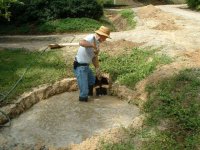
Attached is a picture of how much silt and dirt was washed off the new dirt road, clogging the culvert. You can barely see the edge of it in the lower right hand corner of the photo.
 

Attachments

  • 834153-CLOGGED CULVERT.JPG
    834153-CLOGGED CULVERT.JPG
    90.2 KB · Views: 1,405
   / Clearing Clogged Culvert #2  
All of the normal methods involve a jet of water. I have been able to run a standard pressure washer for 45 minutes from 2-55 gallon barrels of water placed with a little gravity pressure to the pressure washer. I fitted the barrels with hose bib fittings and fed the PW with a garden hose. I would start at the bottom and blast it out. But 40' long is too long.

You know this will happen again if you don't dig it up and reset the culvert. Dig up the pipe, seperate it at the connection, bring it up to your well and blast it out. Then replace it with more slope to it. I like to dig a hole upstream as a place for silt to fall out of the incoming flow before entering the pipe.
 
   / Clearing Clogged Culvert #3  
When installing sewer pipes, they say that you must have a certain degree of slope, not more, not less. When it's too slow the sediment will sink down, when it runs too fast the water will rush out and leave dirt (in case of sewer pipes, poo and toilet paper, in case of culverts, leaves, grass and branches) in the pipe.

Digging a hole before the entrance of the culvert might also help, to make dirt sink down and let only the water flow through. Off course the sink pit would need regular maintenance..
 
   / Clearing Clogged Culvert #4  
Hi Rob,
By lookin at your picture, and reading Beams response, I think he is on the mark. I really dont have much experience with anything like that, but that seems to be the logical route to go. That pipe looks like it is pretty well packed!
You would have to flow alot of water to clear that mess up, and like Beam states, its going to happen all over again.

I do have a pipe similar to that but not as long on my Vt property, and over the years the frost has lifted it up to some degree. Unfortunately by that pipe raising up, that slightly floods my neighbors property only in one small corner. I will have to do like you, and dig it up and remove it and then lower the whole thing. /forums/images/graemlins/frown.gif

scotty
 
   / Clearing Clogged Culvert #5  
I made the same mistake one a culvert not too long ago. Not enough slope and it plugged up on me.

It was 40 feet long and 12 in diameter.

I dug a trench along side of it and a litte deeper. Than I rolled them into the deeper end and tried to pull it out whith my backhoe.

Big mistake. Don't try this with a full culvert. It will tear it apart!!!!

Fortunately I only lost a few feet off the end on that mistake.

But that end was now allot lower than the entrace side. I fillled in the trench at the entrance and built up the area that the water was running over the road. Than I let it sit for a few months and let mother nature flush it out with the rains. About 3/4 of it came out this way.

I left it in the hole, graded the bottom and reset it back in at that new angle. It's all clear now.

Eddie
 
   / Clearing Clogged Culvert #6  
We had that problem in the development I live in.We gave the fire company a $200 donation and they brought out the pumper truck and cleaned out 2 culvert tiles. /forums/images/graemlins/grin.gif /forums/images/graemlins/grin.gif
 
   / Clearing Clogged Culvert #7  
If I or any customers have badly backed up culverts, we call the Fire Dept. give them a donation and they flush it right out with the truck. /forums/images/graemlins/cool.gif

If you are building up sediment like that, you should dig out a good 5'w x 5'l by 1' deep hole right in front of the culvert then fill it with Rip-Rap (which is just a bunch of sub-angular stones, about 5-7" diameter). This slows down the speed of the water and strains out sediment like silt and clay.

For a 12" diam. culvert I would use small rip-rap, about 5" diam. or so. Something like this.
D414%20.jpg

Good Luck!
 
   / Clearing Clogged Culvert
  • Thread Starter
#8  
Thanks for all the advice guys, especially digging a hole in front of the culvert opening, adding rocks and such to slow the water downa dn let the silt settle. I'll have to do that for all8 of them. Although none of the others that diameter have had this problem. I also saw that all the other have slope to them and this one is like level. I'll call the fire dept and donate one of my grandkids to them. /forums/images/graemlins/grin.gif I'll re-set it with more slope after that. Maybe my road guy should do that for nothing? Maybe I should call him? What do you think?

Here's the rest of the story. After I dug out all the dirt with the backhoe, both by the entrance AND exit (which was also plugged) my wife got in there and dug into each end as far as she could with a shovel and a hoe. Crazy woman! She managed to clear about 8' deep on each end that way. Got to give her credit because she worked her butt off!

That was the same weekend I had that episode where I got the tractor to "Diesel Backwards" in that post I made a while back. But before that, I got the chain through by tying the wire to the Blazer and pulled the chain through that way (backing up) then I bolted on this piece of steel and pulled it with the tractor, making a small hole, as I said.

Not being satisfied, and with no other way to clear it, I decided to pull the piece of steel back and forth, kind of "sawing out the clogged part. Tractor on one end and my wife in the Blazer on the other. Well, when she started to pull it through with the Blazer, it must have caught on something. So I'm watching her with all 4 tires spinning and digging huge ruts in the road.

Next thing I tried it...got the same results but all of a sudden, smoke and oil started squiting out of the hood! GEEZ, I thought I'd blown up tha **** Blazer! I shut it down and checked under the hood. The front differential had pivoted enough that the u-joint nicked the oil filter. So there I was at the property, stuck. Well it just so happened that a while ago I brought some extra filters to camp in hopes of one of them fitting my tractor...NOT! One was for my Harley and it fit the Blazer perfect, except it was just shorter. Also happened to have a 5 gallon container of 10/40 synthetic at camp and re-loaded the truck and I was back in business.

Needles to say I was really p*&#@-off at that culvert! That's why I thought you guys might have a better way than that... /forums/images/graemlins/grin.gif
 
   / Clearing Clogged Culvert #9  
The thing about that sediment trap hole is that you'll need to clean it out with the hoe pretty often. For that reason I would not put rock in the hole. You want a big sump with dead storage. Someday, when the site is stabilized with vegetation and such this won't be needed. The mouth of the culvert should always be armored with rock if decent flows are expected.

I have a 98 GM pickup with the oil filter sideways right above the u-joint just like your blazer. The contact shouldn't have happened. The front diff is hard rubber mounted to the frame and the engine is hard rubber mounted to the frame. There's barely even a slip joint in that front driveline. I would look to see what broke to allow that much movement.

That hokey filter mounted sideways has always bugged me. It drains out on the u-joint when you change it so I end up with an aluminum foil hat over the u-joint each time. I've seriously considered a remote mount. But after 142,000 miles I think I'll just let it be.
 
   / Clearing Clogged Culvert
  • Thread Starter
#10  
</font><font color="blue" class="small">( But after 142,000 miles I think I'll just let it be.)</font>

Exactly...I have 165,000 miles on the Blazer now. The real problem was that 10 years ago I had a Rancho 2" lift kit installed and they put in the wrong alignment shims. they were more like for a 6" or 8" lift.
This made the front differential not sit inline with the front driveshaft, but rather a little cocked upwards.(towards the filter) I never changed it because it cleared and kept thinking I was gonna get rid of the Blazer soon any way...well...10 years later I still have it!

Again, thanks for the culvert advice from everyone.
 
   / Clearing Clogged Culvert #11  
</font><font color="blue" class="small">( The thing about that sediment trap hole is that you'll need to clean it out with the hoe pretty often. )</font>

Don't think of it as a "hole" since it will mostly be filled with rock and only about 6"- 1' deep depending on the size rock you use. The sediment will somewhat settle in the rocks but flow of water will clear it out. The rocks just act as a restrictor that will only allow some sediment through at a time. This type of drainage setup will not need to be cleaned out. Especially after a heavy rain.
 
   / Clearing Clogged Culvert #12  
Thank you for your reply. I will always remember your advice.
I don't have the issue right now, but we have plenty, plenty of concrete drainage pipes thoughout the property. I earned something fomr you, hey thanks! /forums/images/graemlins/cool.gif
 
   / Clearing Clogged Culvert #13  
<font color="blue"> I like to dig a hole upstream as a place for silt to fall out of the incoming flow before entering the pipe.

</font>
=====
That's what I do on all my culverts
 
   / Clearing Clogged Culvert #14  
</font><font color="blue" class="small">( One of my culverts clogged up completely. The culvert is 12" diameter, 1-½ years old, plastic and corregated inside. It's about 30' or 40' long. I don't think the road guy set this one on enough slope to accellerate water flow through it so the dirt has settled and plugged it up. I'd like to re-set it but need to clear it first.

I think it's mostly silt & dirt because I was able to poke a hole through the clog with 20' of pvc pipe. (near the top of the culvert). Then attached a wire and finally a chain to it so I pulled through a small piece of steel with the tractor. Made only a tiny hole. Also don't have ANY water at the culvert to try to flush it out. I thought about getting a fire truck up to the property and use their high pressure hose to squirt the debris out the other end, but don't know yet if they'll do that. So I'm asking here first.
How do you clear it?

Attached is a picture of how much silt and dirt was washed off the new dirt road, clogging the culvert. You can barely see the edge of it in the lower right hand corner of the photo.
)</font>
<font color="blue"> The culvert is 12" diameter, 1-½ years old, plastic and corrugated
*the dirt has settled and plugged it up </font>
====
This is also the problem with corrugated steel pipe.
Double wall smooth boar plastic solves that problem.
~~~~~~~~~Several years back I replaced the rusted out 12" corrugated steel driveway culvert.
The state Required I install 15'' Double wall smooth boar plastic culvert.
Told me If it ever plugged up they would use their special machine to clean it out.
That's why they wanted me to use Smooth Bore Plastic because the Machine will tear up the corrugated stuff.
 
   / Clearing Clogged Culvert
  • Thread Starter
#15  
Considering I was able to pull a chain through mine, if it was a smooth bore I could very well have used a 4x4 attached to the chain and pulled the plugged up stuff out. As it was corregated, no chance of that!

That whole day was shot trying to unplug it, and fixing my Blazer /forums/images/graemlins/mad.gif
 
   / Clearing Clogged Culvert #16  
I too have had similar situations, and as the others have pointed out proper fall provides the velocity necessary to keep the pipe clear. In your situation rip-rap on the intake side is necessary, regardless whether the pipe is reset or not. Resetting that length of pipe will take some work, hence you may want to try some alternatives prior to taking that step.

Not knowing the configuration and so forth, the idea is to minimize the sediment entering the pipe, and maintaining the velocity. Assuming that you have a long term perspective on the deal, determine the origin of the sediment, then plant ground cover to reduce the erosion, or divert the flow upstream to some other area. (Rosemary is a fantastic for errosion control, drought tolerant, deer resistant, and cheap). I also assume that a 12" culvert is adequate for the flow.


That said let's think about allowing the sediment to pool and settle upstream (in an area that can easily be cleaned) prior to entering the culvert. Much like the baffle in the septic tank allows the solids to settle and the clear water to flow. If a dam could be made with an overflow discharge pipe then we've accomplished this task. A dry-well setup may also be feasible.

For the swale between the discharge pipe and the culvert, consider using a geotextile fabric, aka weed mat. This is great stuff, the water stays on top of fabric, and protects the soil below it. After overlapping the fabric and stapling it down, use a small rock to protect it and it will NOT reduce the velocity of the water. I use 1 1/2" river rock, its large enough that the water won't move it, smooth enough that the water can easily ride on top of it, and easy to work with. You may need larger rock for the sides of the swale.

It's unfortunate that there isn't any water available. What would it take to bring water there, 1000' of garden hose, a temporary basin, ten drums, a water truck, dam it up now and collect the water, portable pumps - I don't know. While compacting a 1/2 mile long trench I used several 1000' rolls of drip tubing, granted the flow wasn't great, however time was on my side and the tubing was later used in the irrigation system.

Assuming that water is brought to the site, I submit the following observations. For each foot of clogged pipe there is .75 cu. ft. of material. A fire engine carries between 500 -1000 gallons, CDF engines are more like 500. A 1" hose flows 40 gpm, 1.75" 100 to 200 gpm. Injecting water on the discharge side will be an extremely muddy affair, and and only so effective. Think about a garden hose stream pointed into the ground, it doesn't take long until the water that's accumulated in the hole, absorbs the energy from the water entering it. For crude horizontal boring I'll strap the nozzle and hose to a pipe or rebar in order for the nozzle to stay in contact with the soil. CDF doesn't have such a contraption, and overall they might be reluctant to subject their equipment to such abuse. The nozzles are expensive, and purchased with tax payers $ - sensitive topic. Another CDF consideration is the travel distance to refill their tank, what if an alarm comes in and their tank is empty?

Approaching the culvert from the intake side is much cleaner, but with it being so clogged any large flow of water will also make a mess. Consequently a slow flow would be in order.

In conclusion, the water availability will determine the approach. If gravity fed, or low psi, then work from the intake side using a long 2x4 or pipe to assist the water. If high pressure water is available then a garden hose attached to a 3/4" copper pipe with a nozzle might be quicker and more effective.

In any event send a PM, I'm interested to know how things turn out.


It appears that CDF provides your fire protection
 
   / Clearing Clogged Culvert
  • Thread Starter
#17  
Thanks Marks,
Very informative post. It will be 3 weeks before I head back up to the property and see a lot of rain between now and then. I hope it hasn't got worse by then. I'm thinking of running water down there to deal with it. I'll need to do that sooner or later anyway.
 
   / Clearing Clogged Culvert #18  
I have a similar problem with the culverts at the end of my driveways. The county's sand wants to always fill them when we get a hard rain. If I dig out enough of a ditch to let the sand flow it ends up in my woods. Or my neighbor's woods. He doesn't want it, either.
I have to have a sump on the downstream side. If I keep it dug out the culverts stay clear but one hard (2 inches in an afternoon) rain and they're plugged. Even then if I get the hole dug out that day there's enough water in the sand to make it flow. Let it go any longer and, well, I'll show you a picture...
 

Attachments

  • 838950-digging out3small.jpg
    838950-digging out3small.jpg
    95.9 KB · Views: 353
   / Clearing Clogged Culvert #19  
Looks like you need a larger culvert, at a steeper angle and rip-rap the inlet like I explained above.
 

Tractor & Equipment Auctions

UNUSED FUTURE FT90 PLATE COMPACTOR (A52706)
UNUSED FUTURE FT90...
2012 PROCO 130BBL VAC TRAILER (A58214)
2012 PROCO 130BBL...
1987 CATERPILLAR D6H HIGH TRACK CRAWLER DOZER (A59823)
1987 CATERPILLAR...
2013 FORD F-350 FLATBED (A58214)
2013 FORD F-350...
3 Row Twin Row Renaldo Planter (A53317)
3 Row Twin Row...
Kubota RTV X1140 (A60462)
Kubota RTV X1140...
 
Top