concrete slab for barn

   / concrete slab for barn #1  

Blstr88

Silver Member
Joined
Mar 13, 2014
Messages
145
Location
New Hampshire
Tractor
J2023H
Hey guys! My wife and I decided we'll be having a timber frame built next spring so Im going to start getting some quotes to have a slab poured this fall in preparation for the barn next spring. Couple questions...

- What is a real rough idea of price/sq ft I can expect to pay? I realize there are a lot of factors...Im just looking for a ballpark so I know if the quotes I get are reasonable or totally out there.

- I'll store the tractor in the barn, thats probably the heaviest thing...lots of garden tools, wood splitter, small chipper, etc...is a 6" slab necessary or can I get away with a 4"?

- If I have the slab done in the next few weeks but don't build the barn for 6-8 more months, is that ok? Any issue with leaving the slab outside in the elements all winter? Would I be better off waiting to do the slab until right before I plan to have the frame built?

Thanks guys! Really excited about this...we're going to go with a 16x24 timber frame barn, but Im going to have a 9' lean-to on each side. I'm going to close in at least one side so the barn will essentially be 25x24 and possibly leave the other side open to the elements (for stacking firewood under) but Ive considered possibly just closing in both sides so I'd be at 34x24 and then just build another lean-to off the back for the wood
 
   / concrete slab for barn #2  
Prices from $150-225 per yard, for trowel finish, are typical here. I had a hard time finding someone to do a 20x20 (too small for the busy outfits I guess) and paid at the higher end of the range to get a reliable commitment. It was a PITA.

I went 4" fiber reinforced for similar uses. Will hold tractor, equipment, or a car/truck just fine.

I see no issue leaving the slab out in the elements. In fact, it may cure better in the long term, though that only becomes an issue if you go to drill/fasten into the slab. In the short term, you'd want to keep damp and cover with plastic for 5-10 days after it's poured.

For timber frame, are the posts bracket-mounted to the slab? That will require thickening in those areas, and probably re-bar to carry the post loads. Or are there going to be footings? Eddie always makes a good point about pouring a slab in a pole barn negating much of the cost/simplicity benefit, but I am not sure how timber frame compares to pole construction in your neck of the woods.
 
   / concrete slab for barn #4  
If your going to pour this fall do it before real cold air hits, Last fall (2013) I built a 30 x 30 pole barn here in SW Missouri and poured on a 30 degree day. We paid xtra for hot water and a calcium added, and it still took all day for the water to settle, every region is different for pricing, did get a couple of son in laws to help defray labor.
Poured 4'' over rebar and am absolutely very happy with outcome, just don't look to close, no cracks todate, important to get a good finisher and score after it harddens. Would send pictures but not that tech savvy.
 
   / concrete slab for barn #5  
While there shouldn't be any problems with pouring now and waiting, I would still wait until you are ready to build. A funny thing happens over time. The more you think about it, the more ideas you get and then you realize you want to make a few changes. The price of the concrete isn't going to change significantly between now and then, so I would wait and keep working on your plan. I think that you are going too small, but it's yours and you are paying for it. Once you put your tractor inside the building, will there be enough room left over for storage or a workshop? What are you long term goals and will you have more stuff five years from now? My workshop is 24x30 and it's a good size for projects and storing my tools, but it's not big enough for my tractor or implements. My future plan is to build a much, much bigger barn that I can put everything into and have enough room for future stuff. If you wait six months to pour the concrete, will you have more money to make it bigger?

As for pad thickness, 4 inches is plenty for parking a car on or a tractor of similar weight. How big will your tractor be? If you are getting something over 5 or 6 tons, I would go thicker.

Concrete is pretty solid when it cures, but if it can move, it will crack. You really can't stop the cracking, all you can do it minimize how much it moves when it does crack. Rebar is very good at this and what I prefer. Wire is also good, but impossible to keep it in the middle of the concrete while pouring it. They walk on it, pretend to pull it back up, then walk over it again and force it to the bottom of the pad where it's useless. I've seen this 100% of the time. I like wire for sidewalks and small pads where I don't have to walk on the concrete and I can get to it from outside the forms. Fiber has some benefits, but in my opinion does not replace rebar. It's a little something that you can add to it for piece of mind with the knowledge that it will probably decrease the amount and size of the cracks you get.

Be sure your footings are deep enough for your area. When the soil gets wet and freezes, that's when you get the most movement in a building. Just like an ice cube coming out of the tray, that's what a building wants to do when saturated soil freezes. Some soil holds more moisture then others, and those are considered the most expansive and difficult soils to build on. Black Clay here in Texas is really bad about that and the foundation issues are quite extreme. I have red clay and it's not too much of a problem.

If you add any dirt to build up the pad, you must make sure it's compacted. This isn't as simple as it sounds. If that soil settles any after you pour concrete on it, you will have a void under the pad and in time, it will crack no matter what you use or how thick the pad is.

Concrete likes to cure in mild weather. Too hot and too cold means the curing process doesn't happen properly and you have problems. Same thing with moisture. You want as little water in the mix as possible. This makes it harder to spread, but gives you the most strength possible.

Cost varies quite a bit all over the country. You need to start calling around and asking what they charge and what they use. You'll find that some contractors are very organized and others don't have the money to buy the forms. Angies list is a good place to start, but it's still hit or miss because so many reviews on there are false. Look in the local classified ads and see what they are advertising. I've found that those are the guys to be nervous about, but it gives you a starting point on what they charge.

Good luck,
Eddie
 
   / concrete slab for barn #6  
Around here, concrete meant to be indoors is different than concrete that is made to live outside.

Outdoor concrete is air-entrained. But harder to get a smooth finish. If you plan on finishing the barn and adding heat, no air is best, and in that case I would wait.

If you never plan on finishing and heating, it dont matter.

But my question is: how are you building the building? You dont want to just pour a slab and build a building on top of it. You either need post holes or a footer that goes below frost depth. Then the slab INSIDE that. Makes it difficult to do a footer or post holes if you do the slab first.
 
   / concrete slab for barn #7  
Think everyone has already covered the cons of pouring this far in advance so I will just answer your pricing question.

Here a 3000# mix delivered is about $115/ cubic yard. Fiber adds $10/ yard. The local concrete plant won't bring you 3000# concrete if you tell them a vehicle will be parked on it (lawn mowers and atvs are fine though). They will make you go atleast 4000#. Don't have a price on that. These prices are a you pour price.
 
   / concrete slab for barn #8  
While there shouldn't be any problems with pouring now and waiting, I would still wait until you are ready to build. A funny thing happens over time. The more you think about it, the more ideas you get and then you realize you want to make a few changes. The price of the concrete isn't going to change significantly between now and then, so I would wait and keep working on your plan. I think that you are going too small, but it's yours and you are paying for it. Once you put your tractor inside the building, will there be enough room left over for storage or a workshop? What are you long term goals and will you have more stuff five years from now? My workshop is 24x30 and it's a good size for projects and storing my tools, but it's not big enough for my tractor or implements. My future plan is to build a much, much bigger barn that I can put everything into and have enough room for future stuff. If you wait six months to pour the concrete, will you have more money to make it bigger?

As for pad thickness, 4 inches is plenty for parking a car on or a tractor of similar weight. How big will your tractor be? If you are getting something over 5 or 6 tons, I would go thicker.

Concrete is pretty solid when it cures, but if it can move, it will crack. You really can't stop the cracking, all you can do it minimize how much it moves when it does crack. Rebar is very good at this and what I prefer. Wire is also good, but impossible to keep it in the middle of the concrete while pouring it. They walk on it, pretend to pull it back up, then walk over it again and force it to the bottom of the pad where it's useless. I've seen this 100% of the time. I like wire for sidewalks and small pads where I don't have to walk on the concrete and I can get to it from outside the forms. Fiber has some benefits, but in my opinion does not replace rebar. It's a little something that you can add to it for piece of mind with the knowledge that it will probably decrease the amount and size of the cracks you get.

Be sure your footings are deep enough for your area. When the soil gets wet and freezes, that's when you get the most movement in a building. Just like an ice cube coming out of the tray, that's what a building wants to do when saturated soil freezes. Some soil holds more moisture then others, and those are considered the most expansive and difficult soils to build on. Black Clay here in Texas is really bad about that and the foundation issues are quite extreme. I have red clay and it's not too much of a problem.

If you add any dirt to build up the pad, you must make sure it's compacted. This isn't as simple as it sounds. If that soil settles any after you pour concrete on it, you will have a void under the pad and in time, it will crack no matter what you use or how thick the pad is.

Concrete likes to cure in mild weather. Too hot and too cold means the curing process doesn't happen properly and you have problems. Same thing with moisture. You want as little water in the mix as possible. This makes it harder to spread, but gives you the most strength possible.

Cost varies quite a bit all over the country. You need to start calling around and asking what they charge and what they use. You'll find that some contractors are very organized and others don't have the money to buy the forms. Angies list is a good place to start, but it's still hit or miss because so many reviews on there are false. Look in the local classified ads and see what they are advertising. I've found that those are the guys to be nervous about, but it gives you a starting point on what they charge.

Good luck,
Eddie

I'm putting my 2c here as I agree with Eddie on a lot of things.

I had a 30x50 wood framed pole barn professionally built. I came in later and had a 5 1/2" (height of a 2x6) "floating" slab with #3 (3/8) rebar on 18" centers. The crete spec was 5 bag mix (5 bags of Portland cement per cubic yard). I was present when it was poured (fed the crew a BBQ lunch) and insisted the rebar was in the mud, not pressed down under it.....It paid off as mentioned later. I didn't think I would need a beam around and through the middle as the slab was floating and I figured it could follow the ground if.....when it moved, unlike a brick house with all the weight on the slab. Course a tin shell building isn't very heavy but it's in the ground, not on the slab. Turn key on the crete was under $6000 in Jan, 2005. I had the site prepared so it was just concrete materials and labor. Probably at least 1.5 x that cost today as for one thing, this area is growing, new interstate and toll roads going in as fast as you can blink, the sand and gravel trucks from Okla. are everywhere. It's a commodity in demand.

I built the shop on the side of a terrace...will load a pic at the end.....I think. With our changing weather patterns of the last few years the Houston Black Clay soil, well known for it's shrinking and swelling, has shrunk out from under parts of the slab and I am this day in the process of jacking my building back up and looking to a concrete mud pump to pump mud back under the slab to right the broken corners....worst is 5" down at the corner. The rebar has done it's job in keeping the broken pieces intact and not floating off. Knowing what I know now, having a beam poured would have held it and it probably wouldn't have cracked but the building would have still sunk. If you put your building on the slab, like a house, it will all move together but you have to secure your building to something and the higher (mines 12' at the top plate) and wider, the higher the wind load. Burying anchor points in the slab works great on metal framed buildings as you can just bolt up to it. However I have stacked one ton skids of feed and materials on it and that may have helped it's demise plus a 10k# JD tractor and my shop things.

I brought in the same kind of fill that is under large buildings in the area but it matters not when the soil under it shrinks. If I were on sandy loam I wouldn't be having this problem. Can't say about up north where you have freeze/thaw conditions to consider which probably as bad as my clay.

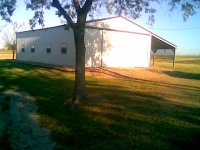
A building is never large enough. Once you get it you dream up all kinds of things to put in it. However, my 30x50' with 15x50' roof extension has served me well in retirement. It serves my farming and other necessities and interests and I haven't outgrown it. I get a lot of use out of the shed part which has a gravel floor. The deere is gone and my current Branson is kept under there with other things. I have a double side door 10x10 that gives me access midway down the building.

Image003.jpg
 
   / concrete slab for barn #9  
I'd grade the site now and let it settle all winter, if you bring in much fill, run the sprinkler on it for a few days every week to really compact it good. I'd echo what everyone else said and build the thing as big as you can possibly afford. I built a 32x36 building 3 years ago, I've already put up 2 temporary enclosures to hold the stuff that won't fit in it. We built a 50'x160' barn/arena for my wife's totally ungrateful horses, a month after it was done she asked how much trouble it would be to add another 100'.
 
   / concrete slab for barn #10  
For this region I think what matters more than the season is excellent drainage and compaction.

If you have a well drained setting, maybe even helped along by some drainage pipes, that reduces the ground moisture which reduces frost movement. That's what I've been told by people around here with the experience to know. I would dig out the soils 18" below and around the slab area and build back up with stone compacting in lifts until the bottom of the slab will sit above the surrounding ground level grade. If it tends toward ground moisture you can put rigid PVC drain pipes (running to daylight) in the bottom of the stone bed as you back fill.

If you do that, plus rebar on a 16" grid, have a good thick apron with more rebar and a 45 degree web to the slab, it should be stable. That's the theory and supposedly best practice.
 
   / concrete slab for barn #11  
I just got a quote to do a 40x40 (6" thick) slab to finish my outbuilding, and they quoted me $4500. That will take roughly 30 yards of concrete, and I recall it was about $110 per yard with fiber mesh added. I think they have some wiggle room in that price, but I'm waiting to see if a neighbor is going to have them do work at the same time...figure if they literally just have to cross the street to go from one job site to the other, it will lower than expenses a bit.
 
   / concrete slab for barn #12  
Site prep is the most important step for your barn and it's floor. As Dave 1949 said, good drainage underneath and good quality stone and gravel, will keep your building from moving. As far as concrete, don't go to thin, if you putting any vehicles or tractors in it, 6" with steel is better.
 
   / concrete slab for barn #13  
Site prep is the most important step ... 6" with steel is better.


You'll be glad for 6" the day you decide you need a lift! Also, central NH can be cold. What about in floor heat? You could maybe run it off solar panels for almost free if the building is sited appropriately.


.
 
   / concrete slab for barn #14  
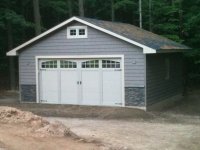
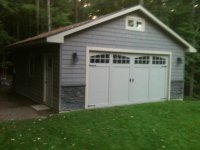
A friend of mine built me a 24 x 24 garage on my property last summer. For me it's just big enough. I almost went 16 x 20 and then 20 x 20 and boy am I glad I went bigger. Block foundation, 2x4 walls, rafters, asphalt shingles, and siding to match the house. I do electrical work so that part I took care of myself, along with insulating the walls and hanging and painting 1/2" plywood last fall. He set up the mason so I don't know what the guy charged but the floor is 4" thick and the only cracks I've seen are within all the control cuts, which is right where they should be. The finish is nice but they didn't cut all the lines as straight as I would have liked. I put Cure and Seal on the concrete within 24 hours of the pour and it took months for all the green to turn light gray. I was really surprised at how long it took to fully cure. That stuff had a real strong odor but it went down like glue in the heat of the summer and I'm glad I did it. There's a bit of a sheen to it now which I wanted but it's not as glossy as pure sealer. Some of you guys have floors like mirrors which I think looks great and would like in my attached garage some day. I also went with the fiberglass in the mix so you can see it at the surface. I figure it gives a little traction when it's wet so that doesn't bother me, especially since this is just an overgrown shed for the tractor, chipper, splitter, mower, tiller, wheelbarrows, snowblower, etc.

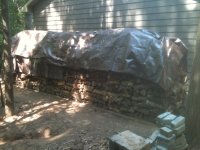
I think you're smart to consider some measure of covering your firewood. In hindsight I would have put a modest overhang off the back wall to cover the woodpile I have back there now. Instead I put down about a foot of gravel and stone dust inside a frame of pressure treated lumber the same width as the garage and six feet deep. I stacked it six feet tall and left about two feet between the pile and the back wall, so there's a ton of wood there but I had to cover it all with tarps. It looks fine but you can't beat an actual roof over it. You gotta check out some of these guys' ideas for storing firewood before you go too far. You might see something you like.

I understand the excitement. I still can't believe how nice it is to have an enclosed storage/shop building near the house with power and shelter from the elements year round. Good luck and post some photos once you get started.

new garage.jpg
 
   / concrete slab for barn #15  
More photos.

Get your firewood under a structural cover if you can. I think it's a better way to go. Live and learn. Maybe I need to build a woodshed now….


New Garage 2.jpgFirewood 2.jpgFirewood 1.jpg
 
   / concrete slab for barn #16  
here in michigan its $98.00 a yard you pour, 4 in slab is fine here for anything the wt. of a car. I am thinking about building my new barn soon then get it weathered in and pour the concrete in early summer i am putting in a 5 to 6 inch slab with at least a 5 in. X16 in deep rat wall around the edges, fiberglass mesh add $ 6.00 per yard some insurance there but as far as the steel mesh its not easy to get in the middle of concrete at all. waste of money it gets pushed down walking on it and when pulling it up it just bends so you have no idea where its at.re-rod edges, cut relief cuts from post to post, that helps then put elasto meric sealer in cuts to make it easy to sweep etc. concrete takes 28 days to fully cure and i rather pour in above freezing temps until cured, we sometimes had to cover the concrete with hay/staw to help keep it from freezing if you must pour in those temps, hope this helps and everyone said alot of great advice
 

Tractor & Equipment Auctions

HAMM H11 PADFOOT ROLLER (A58214)
HAMM H11 PADFOOT...
(2) UNUSED 460/85R30 TRACTOR TIRES / WHEELS (A57192)
(2) UNUSED...
EZ-GO Utility Cart (A55851)
EZ-GO Utility Cart...
1974 Ford F600 Grain Truck (A56438)
1974 Ford F600...
2009 Ford F-550 4x4 Ext. Cab Brush Fire Truck (A59230)
2009 Ford F-550...
UNUSED FUTURE 12" HYD AUGER (A52706)
UNUSED FUTURE 12"...
 
Top