Creating a Lake

/ Creating a Lake #821  
Eddie, I first heard of hydromulching from a friend and neighbor who worked for a company that owned 31 golf courses/country clubs and he said that was what they did around the perimeter of the greens when building new golf courses. Of course this summer will be 30 years since I had that hydromulching done, but I still remember that I could have bought St. Augustine sod for $1.25 a yard (if I provided the labor to put it down) and the hydromulching was just about half that; i.e., $.07 a square foot or $.63 a yard. The friend had told me it usually cost them about a nickel a square foot.

But I agree that the different types of bermuda can get confusing and I don't know anything about them except for the common bermuda and coastal myself.

However, the same can be said for fescue. The neighbor I mentioned who had his lawn done in fescue was, unfortunately, right next door. Now I didn't know, back then, that there are different types of fescue, also, but within a couple of years, I sure did think it should be illegal to plant that stuff. As long as that neighbor lived there, he watered, fertilized, and mowed and had a beautiful lawn, but that stuff spread into my year; clumps of it that grew just a little more than twice as fast as my bermuda.:mad: It also stayed green and needed mowing year round. Then he sold the place and moved and that house became a rental house with tenants who did nothing to the yard, except mow it when the city issued a notice that it had to be mowed. Pretty soon, it was nothing but clumps of tall grass here and there in that yard, while the clumps that had spread into my bermuda stayed nice and green. I spot sprayed with Round-Up to try to keep it under control and out of my yard, but it was just about a losing battle.

It's hard for me to imagine anyone trying to kill out bermuda and keep fescue. If I found any fescue in my yard now, I think I'd spray the whole yard with Round-Up and start over.:D
 
/ Creating a Lake #822  
Hey Eddie, Bird and Jim,
I live on a golf course in Southern California and was head of the greens committee for 5 years. That doesn't qualify me to grow grass though. For years we've had hybrid Bermuda in the fairways and fescue in the rough. The fescue grows well in the shade and cooler months and the Bermuda does not. But the Bermuda grows great when it's hot and the fescue dies off. That was the plan anyway. So each Winter we would overseed the fairways with fescue to have a "green" golf course. Problem with that was during the months that were not hot enough, the fescue would still grow in the Summer. Then when it got really hot the fescue died off and we had bare spots all over. Of course we seeded the bare spots with Bermuda but then fall would come and nothing grew there. Turns out it was easier to grow fescue than Bermuda in our mini-ecosystem.

We finally bit the bullet and cut all the fairways out and replace it with hybrid Bermuda sod in April. Lucky it got hot and with water and fertilizer, our fairways are like carpets now. We NEVER overseed with fescue anymore. We have the dormant base of Bermuda during the Winter and it plays great. The fescue rough does real good even in the Summer but we have to keep it watered quite a bit and pretty tall. So what I'm saying is you need to see what grasses your environment allows to grow whether it be fescue or Bermuda. When you mix them, each plant fights for survival and only one plant can grow in the same spot. The one that likes the environment the most will win out.
 
/ Creating a Lake #823  
I think that's good advice, Rob. The only place I've had any success with mixing them is to let St. Augustine gradually take over from Bermuda, and it will eventually completely displace the Bermuda.
 
/ Creating a Lake #824  
How about some pictures of the lake after the snowfall. If it stuck, that is.
 
/ Creating a Lake
  • Thread Starter
#825  
Scott,

The snow never really happened here. Just some ice and sleet that melted about as soon as it hit. Not enough to measure in my rain guage and no change in the lake level. The forecast is for a storm this weekend that should have some heavy rains, so if that happens, it might fill the lake.


The main grass's that grow here are bermuda, bahia, centepede, zoisa and st augastine. There's probably others, but they are not very common, or just cold season temporary grass. The fiscue and rye varieties do well for a few months, but as soon as it warms up, they die off. It's probably because they need constant watering and that doesn't happen. The bermuda and other grassses do just fine without watering.

Bahia is out because of it's stalks and the way it grows in clumps. Bermuda is the best for ground cover since it spreads out and holds the dirt to together and sheds water when it rains. St. Augustine does the same, but it's better for shade. You have to transplant St. Augustine, no seeding. Centeped is very, very nice, but a very slow grower and dificult to get established. I'm gonna start with some around the edge of the water and reseed it every year. In time, I hope to have the entire lake ringed with Centepede. Zoisa is used in some high end homes, but it's very rare. I've read all the wonders of it, but the one thing I don't like is how quickly it turns brown and goes dormant. I still have a touch of green in some of my bermuda, but mostly it went dormant in November. Zoisa was brown a full month earlier.

Eddie
 
/ Creating a Lake #826  
Bird said:
if you'd had the kind of "soil" I had 60 miles south of Dallas, you'd also have 10 pounds of mud stuck to each shoe.

Bird, I don't recall which "DUKE" movie it was but one of the earlier John Ford/John Wayne flicks was a real hassle for the cast and crew because of your kind of mud. They'd get the camera angles set up and the marks placed but the longer the actors walked around the taller they got forcing closeups to be refigured. The said they wouild literally get about 6 inches taller in the particular mud they were dealing with.

Pat
 
/ Creating a Lake #827  
EddieWalker said:
Pat,

I walked along the side of the dam lookign for any sign of erosion, or squishy spots. It's completely solid and I wouldn't have any problems driving on it.

The other pictures show how much freeboard I have above the water line of the dam.
What do you think? Do I need more dirt?

Thanks,
Eddie

Eddie, I'm not trying to be an alarmist but to offer suggestions that "might" help divert problems. As for walking around and not noticing any squishy spots or driving on the dam. The area of concern would be well under the surface and not detectable by a surface inspection. If the dam were quite saturated by the water on both sides and you drove across the dam you could conceivably find the problem "all at once" but not neccessarily.

My opinion on whether or not you need more dirt is pretty useless. More is better but how much is enough? About 4 years ago I hired a professional engineer (PE who was a soils engineering expert) who brought in a sub contractor with a drilling rig and two operators to take soil samples every 6 inches in depth till we got to bed rock. The total cost to me for the engineer, His laboratory analysis, his report with PE stamp and the drilling rig and crew was less than $1000.

With his information we could act from a position of knowledge to design foundations for two story with basement and have the basement floor and walls super dry even though the ground water gets as high as 7-8 feet above the basement floor and we have no waterproof coating on the walls.

He has E&O insurance to protect both of us and he of course errs on the side of conservatism because if he has a big claim on the E&O they would drop him and he'd be out of business, literally. (E&O is errors and omisions insurance that protects the client in case the PE goofs up and doesn't have deep enough pockets to make it right.) If it were me I'd find someone who knew a whole lot more about gravity dams than any of us here profess to and get an opinion. Is there ever going to be a liability issue regarding the dam bursting? If it let go catastrophically could anyone be harmed and in a positiion to recover damages? It would look good in court if you could show "due dilligence" in the form an expert opinion. Couldn't cost that much to get an expert (with a PE stamp) to review your situation if liability could be an issue.

Pat
 
/ Creating a Lake #828  
Regarding the grass I think you will be happier with Bermuda.
These days there are both hay and turf bermuda that can be seeded. From the research I did there is no economical advantage to seeding. Bermuda is very high to plant or sprig. Giant Bermuda seeds went for $300 per 50# bag last year (8 to 15 lbs per acre for hay, more for turf). Sprigs for coastal hay can run $75 - $100 per acre. (sprigger might try to sell tifton 85 for $125 per acre, it ain't worth it). That bahia might start looking good and $60 for 50 lbs.

Most people sprig around here but the risk is high, you have less that 24 hrs to get it into the ground and must rain within 3 days or its a total loss. Seeds need almost constant moisture until germination. Either way you might want to think about a sprinkler to go with that pump.

Hope to here how the grass turns out, I am just sticking with that @#$&*! Johnson grass for now.

BTW, hogs love to root up the soil for Johnson grass roots.
 
/ Creating a Lake #829  
CharlieTR said:
Regarding the grass I think you will be happier with Bermuda.

I think you're right Charlie.

I've done a lot of fiddling with grass over the years, and learned some hard and expensive lessons! For large expanses of grass in the hot areas of Texas and Louisiana, there's nothing like seed "turf" bermudagrass to start things off. Wal-Mart sells Pennington Sahara, and it works great. No mowing needed in the fields.

You can plant Centipede at the same time, and it will eventually take it over. It's a lot prettier than bermuda, and has a nice, bright green color with (unlike bermuda) almost no fertilizing needed. Centipede is very heat tolerant, and has medium-high drought tolerance.
Zoysia grows too slowly, and burns out here in the hot part of the summer. I'm sure it would burn out even worse in Texas. Zoysia simply won't work near the Gulf. Rainy periods cause a rust disease that stunts it badly. Winter rains also drown it out. That may not be a problem in Eddy's area. Fescue simply doesn't work in extremely hot areas. It battles back in winter, but the sun kills it outright in unshaded areas. St Augustine is just too disease and drought prone, much like Zoysia. It was great in the Gulf coast areas until that crazy decline disease struck.

"More than you needed to know about grass" :)
 
/ Creating a Lake #830  
Eddie,

Have beenvery busy pruing the olive trees so have not stay up to date with this topic. I'm glad I checked ti thogh as last time I looked you were pumping water into it, and now look it is practically full! The lake really looks great eddie, really nice. i am looking forward to seeing it with some grass around it, that is going to look real purty (isn't that how the southerners say pretty?).
 
/ Creating a Lake #831  
Eddie, bet you are getting near full now. My worst drought stricken pond was one of the three in the back yard (several acres) but with snow and ice melt over the last week it is near overflow, much of its fill coming from the catfish pond I made upstream of it which is overflowing.

Pat
 
/ Creating a Lake
  • Thread Starter
#832  
Pat,

There are a few areas on top of the dam that have some ruts in them and are almost perfectly flat that I want to add some dirt to. Over the full length of the dam, I might add another hundred yards to shape the crown better and make it smoother to walk and drive on. I know that's not a significant amount compared to the size of it, but it is more dirt, so that's a good thing.

We received almost half an inch of rain on Saturday, but I can't tell any difference on the yard stick. It's still in the same spot. I don't understand how that's possible, but there is also very little sign of runoff. Those slow soakers just dont provide for very dramatic changes in my water level. hahaha

Charlie,

My neighbor is one of those guys who's spent thousands and thousands of dollars getting his bermuda pastures in. He's disked and treated the soil to get it just perfect, the spriged it and fertalized after the sprigs started to grow. He fertalized it again in the fall.

The following spring, he disked it all in again and spriged it again with a different supplier. He wasn't happy with the results from the previous year.

Then he fertalized again after the sprigs came in. Then over he summer, he overseeded it with a few thousand dollars worth of bermuda seed.

He's probably got about 40 acres in grass overall and I can't even guess how much money he's spent. I have five acres in grass and mine looks just as good as his. He doesn't agree with me and is always suggesting that I do what he's doing. Neither of us are growing hay, or raising livestock, so I'm at a loss as to why I'd want to do anything more than what I am.

Bermuda will come in nicely, but it will take a year or two before it covers everything. I'm not in a rush, so I'll stick with doing it the cheap way. hahaha

Bob,

I've had good results with the Pennington bermuda seed from Walmart, Sams, Lowes and Home Depot. I'm sure it's all the same stuff, but it's a little cheaper at Sams. Recently I've switched to the seed from my farm supply store. His seed is 99.0% pure bermuda seed and when I do the math and compare that to the purity of the Pennington brand, there is a significant difference.

Rox,

Thank you. We're very exited and proud of the lake. If you had any idea of what I imagined it to look like, and how it's turned out, you wouldn't believe me. I never expected the drought or the digging conditions to be what they were. The lake is in the only place I have to put it, but it's still a terrible location to build one. I got very, very lucky with the weather. If the drought hadn't been as severe as it was, and lasted for as long as it did, I would have something that I know think I might have been embarassing.

I got very lucky.

Thanks,
Eddie
 
/ Creating a Lake #833  
Eddy,

Sounds like your neighbor is just as obsessed with grass as we are with ponds. :)

I've had real good luck with Pennington Sahara bermuda. It takes mine one summer to cover solid. I use about 1/3 as much seed as the instructions, because it is was way too much. Of course I'm blessed with a lot more rain and soil moisture than you, so my seed may be surviving better. I never mow my bermuda fields, and it only gets ~8-10" tall. I bush hog my levees as low as I can with good, sharp blades, and they look nearly like a lawn. The centipede is kicking in good now, and starting to take over the bermuda in about 30% of planted areas. With good rain, I think the centipede will be 90% by this fall. It won't ever need mowing either, and chokes out weeds way better than bermuda. I love the way centipede thickly drapes itself over the pond banks, and prevents wave erosion.
 
/ Creating a Lake
  • Thread Starter
#834  
Bob,

Your description of what the Centapede is just what I imagine. I've never seen it do this, or at least, never recognized it for Centapede, and sure would love to see a few pics if you have any???

As soon as it starts to warm up, I'll be planting more seed. I have the option of hulled or un-hulled depending on the conditions. If it's just right, the hulled will come up faster, but if not, it will rot or die on me. Un-hulled is a safer bet and what I'll probably use.

Thanks,
Eddie
 
/ Creating a Lake #835  
I took a look at a sampling of my ponds today and all are overflowing. I get a lot of "helpful suggestions" about doing more bermuda but am not all that motivated. I have pretty good native grass over a lot of my 160 acres and it outperforms bermuda when it is dry. Fertilizer is mostly counter productive on native grasses. Without good rain when you need it fertilizer is money wasted on bermuda. Of course, if you have the water to go with the nitrogen you can grow bermuda like crazy and outperform my native grasses several times over by dumping huge quantities of $ into nitrogen fertilizer. The breakeven point or where additional units of nitrogen cost more than the value of the extra grass they provide comes with production 3-4 times (or more depending on costs) what you get without fertilizer.

I am resistant to getting too dependent on bermuda (fear of drought) and at most may experiment with say 40 acres or less of bermuda and leave the rest in mixed native grasses. Hedging my bets so I don't get skunked in a dry spell but with good water will have a bumper crop of hay from the bermuda.

I do encourage bermuda on the pond dams as it is a good erosion preventer. I want to get better bermuda coverage for some of the overflow swales but may have to get some BIG limestone gravel (riprap) in a few places. I also need to raise the overflow control height of a couple dams as they are too conservative (or have worn down over time.)

Pat
 
/ Creating a Lake #836  
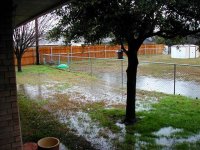
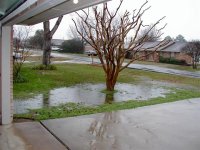
All this talk about ponds and lakes sure makes me jealous of being back out in the country. But I did have puddles Saturday. Of course they're gone now.:D
 

Attachments

  • P1200001 (Small).JPG
    P1200001 (Small).JPG
    87.8 KB · Views: 740
  • P1200005 (Small).JPG
    P1200005 (Small).JPG
    69.5 KB · Views: 568
/ Creating a Lake #837  
One thing I don't see mentioned here in discussing erosion protection is the use of geotextile fabric under your rip rap or other stone armor. Some type of filter fabric will make a tremendous difference in the depth of rock required to prevent undermining of the stone. As an example of the types/usage of material I am talking about here is one manufacturer - Mirafi Products Index, there are many around and most drainage/road construction supply places will stock appropriate weights and sizes for this usage.

It really should be considered manditory to use fabric under stone for erosion protection since it is relatively low cost, easy to install and worth its weight in many tons of stone.
 
/ Creating a Lake #838  
Bird said:
All this talk about ponds and lakes sure makes me jealous of being back out in the country. But I did have puddles Saturday. Of course they're gone now.:D

Bird, you have a nice start there but I believe you need to excavate a little deeper before you stock your pond. :eek:

MarkV
 
/ Creating a Lake
  • Thread Starter
#839  
Pat,

My understanding and experience with bermuda and the drought we just had is very positive. We had a very hot July, August and September with many days over 100 degrees. We didn't get any rain for months at a time and the fire danger was extreme. During all that, my bermuda stayed green and looked nice. It didn't grow very much, and maybe that's the difference.

You must be growing grass for livestock and not to look pretty? And I want grass to cover the ground and look pretty.

I don't fertalize or spend any money on it once it's planted. It just grows and does it's own thing. Mowing is about all I do for it.

My biggest concern, and maybe that's the wrong word, is what to do in the shadey areas. I don't even know if I want grass to grow around all the trees, or is I like the more natural look of leaves and whatever is already there??? At least I still have plenty of time. My thinking is to let it go and see what happens. If the bermuda gets enough sun, it will grow under the trees just fine, if not, then I'll have to come up with Plan B.

Bird,

Your pictures reminded me of my brother. He'd through out a few decoys in a puddle like that in the back yard, or even the neighbors yard after a heavy rain. But I remember puddles like that as being the most fun around when I was a kid. We'd go crazy for something like that!!!!

riprap,

Welcome to TBN!!! Until just now when I read your post, it never occured to me to put down fabric. I should have done that when I put the culverts in.

I can tell you that my thought process was very limited in this area. My goal was, and is, to channel all the runoff water that I can catch and direct it to the lake. Then get it under my shoreline road without causing any damage and to keep as much silt out as I can. I'm guilty of focusing too much on the water getting to the culverts, and almost nothing on what happens when it leaves the culverts.

Laying out fabric and the proper sized rock would have been the best way to go. I'm not sure if it's too late or advantagous to change it now, but will spend some time thinking on it. Thanks.

Mark,

Good point. Maybe Bird can find a friend with a tractor who will dig a hole for him???? hahaha Lots of folks think a fishing pond adds value to there land!!! hahaha

Thanks,
Eddie
 
/ Creating a Lake #840  
patrick_g said:
I have pretty good native grass over a lot of my 160 acres and it outperforms bermuda when it is dry.
Pat

Pat,

The native grasses in my area outperform bermuda by 10:1. That's why I prefer bermuda (and eventually centipede) to the native grasses. :)

In all seriousness, the native grasses here grow way too fast and too tall. My goal is good erosion control, little or no bush hogging, no fertilizer needed, and dominance over weeds. Appearance is way down the list, but centipede looks awesome once it takes over the bermuda. Bermuda needs fertilizer to look nice, but I want the centipede to take it over anyway. Centipede does great without any fertilizer at all.

Eddy,

I'll try to get some pics. My land is a wreck right now from all the equipment, cold weather causing brownout, and ~30" or rain since October.
 
Last edited:

Marketplace Items

2020 JOHN DEERE 770G MOTORGRADER (A63276)
2020 JOHN DEERE...
2018 Ford Explorer AWD SUV (A61574)
2018 Ford Explorer...
1980 Gleaner F2 with heads (A61307)
1980 Gleaner F2...
Arrow Quip 10' Bow Gate (A64047)
Arrow Quip 10' Bow...
2001 International 4000 DT 466E (A60462)
2001 International...
Four (4) R207782 Rear Wheel Weights (A63116)
Four (4) R207782...
 
Top