Creating a Workshop & Home

/ Creating a Workshop & Home #321  
</font><font color="blue" class="small">( Isn't the black clay what they call "caliche?" )</font>

No, caliche is an entirely different chemical composition. I inquired about buying some caliche once and was told (whether right or wrong) that it simply wasn't available in my area. It's supposedly a good road base. The local soil engineer who does most of the perk tests for septic systems called what I had "Wilson Clay Loam"; does not perk well at all. However, it grows crops, grass, etc. quite well with the right amount of moisture and a little fertilizer. It tilled well when the moisture was just right, but if a little too dry, it tilled like 1" to 2" crushed rock, and if a lot too dry, it either tilled like dust or not at all. /forums/images/graemlins/wink.gif And you really didn't like to dig in it when it was too wet (or walk in it) because it stuck to your tools, boots, etc. It was almost black when wet and light gray when dry.
 
/ Creating a Workshop & Home #322  
</font><font color="blue" class="small">( Isn't the black clay what they call "caliche?" If so, it will dry almost as hard as a rock...

)</font>

No. We generally call that black clay all sorts of names, but not caliche. Generally fertile and good for frowing all sorts of things, esp. cotton. Caliche is a layer of hardened or calcified soil that is light in color. Caliche rock is used to build roads and parking lots around here.
 
/ Creating a Workshop & Home
  • Thread Starter
#323  
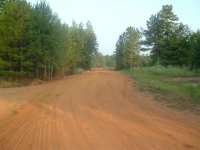
This is the road I'll be using to get in and out on. I've been building it up over the last two years. It's up four feet right down the middle with hundreds and hundreds of yards of clean red clay.

There are red flags going up and down it ten feet apart for the rock driver to lay his trail of material exactly where I want it.
 

Attachments

  • 722599-Workshop 425 (Small).jpg
    722599-Workshop 425 (Small).jpg
    53.8 KB · Views: 508
/ Creating a Workshop & Home
  • Thread Starter
#324  
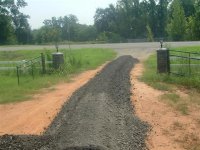
We started right at the bigining with the first load. Each load is in the mid 24 1/2 tons range and good for just over 100 feet long by ten feet wide and four inches thick.

This material is quite a bit darker than what I'm used to, which I expected since it's from a quary that I've never used before. A guy I know told me how to find it and who the owner was. Nice guy, another California transplant!!!
 

Attachments

  • 722601-Workshop 427 (Small).jpg
    722601-Workshop 427 (Small).jpg
    72.2 KB · Views: 484
/ Creating a Workshop & Home
  • Thread Starter
#325  
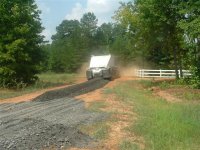
I'm paying $13.75 per ton delivered for this. The other main quarry is in Will Point, which is about midway between Tyler and Dallas. It's also about an hour each way, but that quarry is about a buck a ton cheaper for material, but over $2 more expensive for delivery. Some companies are even more proud of their service than that and want $20 a ton for the same material from the same quary.

These belly dumps really are the way to go for this type of application. After he's gone, it just takes a few minutes to spread it out and make it pretty.
 

Attachments

  • 722604-Workshop 430 (Small).jpg
    722604-Workshop 430 (Small).jpg
    80.5 KB · Views: 465
/ Creating a Workshop & Home #326  
We have seven varieties of clay in North Texas. It runs in colors from deep black to a light yellow. We have a little of that red stuff that discolors all those vehicles who get off road a bit in that state just north of the Red River.

The only stone we have is a limestone. It runs from a chalk soft to a hardness about like sandstone but not as a abrasive. We call it Austin Chalk but if we were in New Mexico, Arizona, California, or Nevada chances are most likely we'd call it caliche. But the caliche I'm familiar with is quite a bit harder than our Austin Chalk.

At my house I've been down ten feet and only found change of color in the clay, black to chocolate brown. A couple of miles from here I'll hit white color that precedes the chalk immediately. A couple of miles west of there the chalk will be from the surface to a couple of feet deep maximum. It'll range from nothing to harder than a bad girl's heart when it comes to hardness.

When we moved here in 85 we got introduced to the black clay we call "gumbo". I remember my dad shaking his head and saying, "your grandpa was from Texas. He used to tell us stories about the clay. How they'd have to use a shovel to scrape it off the wagon wheels so the horses could pull the wagon. We thought he was exaggerating. But now I do believe it's the only time I can recall him understating something."

I have personally have a love-hate relationship with the clay. I love to hate it. One of my sayings is "if my ship ever comes in there won't be a blackland port." /forums/images/graemlins/grin.gif
 
/ Creating a Workshop & Home #327  
A buddy of mine in the aggregrate trucking a long time ago told me that your figure five hundred square feet of coverage for a ten-twelve yard load. That's at four inches. So you're twenty yard belly dumper confirms bud's statement.
 
/ Creating a Workshop & Home #328  
Harvey, the first "power washer" I ever saw was in the service station my Dad bought in Marietta, OK, in '56. We washed cars by hand with a wash mitt. The power washer was strictly for the underside of cars and pickups. The nozzle wasn't like anything you'd see today; it only shot one solid pencil sized stream out, and with enough pressure that you sure didn't want to let it hit you. We put the vehicles up on the lift and washed the underside before greasing them (wonder how many TBN members remember when all vehicles had grease zerks in the u-joints, tie rod ends, ball joints, king pins and bushings, pittman arm, A-frame, etc. /forums/images/graemlins/wink.gif). It wasn't unusual at all to knock over a hundred pounds of dirt and clay off the bottom of a vehicle. And if we hadn't had that machine, it would have been a job to dig out all the grease fittings. And of course that meant I had shovel all that dirt out of the pit into barrels on a trailer and periodically haul it off. /forums/images/graemlins/frown.gif And we got a buck and a half for a wash job and a buck for the grease job. /forums/images/graemlins/laugh.gif
 
/ Creating a Workshop & Home #329  
</font><font color="blue" class="small">( The only stone we have is a limestone. It runs from a chalk soft to a hardness about like sandstone but not as a abrasive. We call it Austin Chalk but if we were in New Mexico, Arizona, California, or Nevada chances are most likely we'd call it caliche. But the caliche I'm familiar with is quite a bit harder than our Austin Chalk.)</font>

Geology lesson for the day: /forums/images/graemlins/cool.gif

Chalk, Limestone, and Caliche are all different physical forms of the same mineral, Calcium Carbonate, CaCO3. Chalk and Limestone were originally deposited under water, usually by the shells or seceretions of small organisms. As you said Harv, Chalk has a very fine texture, and Limestone is more coarse rock.

Caliche is Calcium Carbonate which is precipitated out of hard water in the soil, and forms nodules and sometimes whole layers in the soil. It is extremely hard, and will break in pieces sharp enough to cut truck tires. It is used for road beds and surfaces because it is hard and because it is cheap to mine, since by nature it is close to the surface. It's much more common in west Texas because ground water there is so much more hard than here - water hardness being only a reflection of how much calcium carbonate and calcium sulfate is dissolved in the water.

There is sandstone in north Texas, but you don't often see it because the sandstone formations we have (Principally Paluxy and Woodbine) are soft and friable (crumbles easily) so what you see of it is sandy soil and specific tree types that like sandy soil, for example Post Oaks. The Paluxy Sand is an aquifer in the subsurface that many people out my way have their water wells in.

We now return to the regularly-scheduled discussion of roads, workshops, and tractors. /forums/images/graemlins/laugh.gif

Lookin' good Eddie!
 
/ Creating a Workshop & Home #330  
Question on a use for Caliche. There is a soil product that I have read about that is used to line the bottom of ponds and seal the bottom to prevent water from seeping through, but I do not remember the name. The product comes from Texas. Could this possibly be Caliche?
Farwell
 
/ Creating a Workshop & Home #331  
Farwell, I'm not sure, but I think you're talking about bentonite.
 
/ Creating a Workshop & Home #332  
Bird, you are correct (as always! /forums/images/graemlins/cool.gif); Bentonite is a mineral that when mixed with clay will swell and make an excellent seal. caliche is hard, does not swell, and does not dissolve very well at all, again demonstrating its usefulness for road construction. In oil well drilling, it is common to construct the reserve mud pit with Caliche if it is readily available, but then you must line it with palstic to keep liquid in.
 
/ Creating a Workshop & Home
  • Thread Starter
#333  
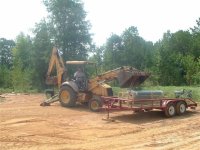
All this dirt talk has me wishing I had some more pics of my gravle coming in, but they never made it back. Truck problems put me on hold for a few days.

Steph and I are concentrating on sealing off the building from the elements, which means putting in the roll up door!!

The first trick was getting it off my trailer.
 

Attachments

  • 722995-Workshop 434 (Small).jpg
    722995-Workshop 434 (Small).jpg
    68.5 KB · Views: 532
/ Creating a Workshop & Home #334  
Thanks guys. The reason I asked is at some point I am planning on cleaning up a half acre low spot that is wet for about six months out of the year, mostly from run off rain and snow melt. When I dig about a shovel depth into my wet area I hit a very dense grey sand and I am not sure what it is called other than grey water sand. My old well had water at a 20 foot depth and this wet area is about 10 to 15 feet below the grade level where the 20 foot starts so I am assuming that I should hit water if I did down another 5 feet. I have been looking for a natural spring but have not found one yet. If I have to seal the pond bottom I really do not want to use a plastic liner and would prefer to use Bentonite if it is available in Michigan. More than likely with all of the lakes in my area I can probably dig a pond and have plenty of water year round or until the water table drops.
Farwell
 
/ Creating a Workshop & Home #335  
Eddie,
If it isn't too much trouble could you let me know the name of your roll up door manufacturer and if they will ship to other states. I have a 10x10 roll up door on my pole barn that was supplied by my builder and I do not have any information on who made it or who the supplier was and am not really too happy with the door anyhow. I want to install roll up door in my lean-too but want a better made door. I have searched the Internet but have not found what I am looking for.
Love the work you are doing. Wish I was young again and had your energy.
Farwell
 
/ Creating a Workshop & Home #338  
Eddie -

After a few months of only logging in here very briefly to post a couple pix, I finally took the time to plow through this thread on your home/shop.

All I can say is: WOW!

Darn it, I thought that I had really accomplished something by putting up my workshop over the Summer with no help other than my wife. But here you go and do the same darned thing and are now ahead of me to boot! /forums/images/graemlins/wink.gif

What you've done is something else. I know what you've been through this Summer, working in the Texas heat, all day, day after day after day. And where you're at has been hotter and much more humid than where I'm at (near Amarillo)! I've noticed on the weather reports that East Texas has had another brutal summer this year!

I can identify with many things you pointed out in your thread like not wanting to work on the roof in the heat of the day for too long. Funny thing for me was that before the roof was on and I had no choice but to work in the sun all day, that's exactly what I did and it didn't seem too unbearable. But as soon as the roof was up and there was shade readily available, the ole sun sure seemed oppressively hot and I got very creative at finding things to do in the shade during the hot afternoons!

The pace of my work will slow dramatically now as I'm going back to work for a while. Good thing too as being off work allowed me to spend a LOT of $$$ in a few short months on materials! It's time to put some back in the bank for a while. /forums/images/graemlins/smile.gif

Again, super job!!!

Mark
 
/ Creating a Workshop & Home
  • Thread Starter
#339  
Farwell,

As Bobby said, I bought the rollup door from Muellers. It's my second one from them and I have no complaints. Price was around $550 plus another $50 for the chain attachement.

The hardest part is getting it into position. The instructions reckomend using a forklift, which I don't have, so I made do with my FEL. After it's on the brackets, it's smooth sailing.

Eddie
 
/ Creating a Workshop & Home
  • Thread Starter
#340  
Mark,

Thanks for the nice words. I figured you were in Texas from the comment you made about the Texas Star in your front door. I've been following your post as well and I'm a big fan of your work. What you've built is just amazing!!!

Temps have been about ten degrees above normal the last week or so, hitting 103 one day. Add the humidity and our heat index goes up to 110! /forums/images/graemlins/frown.gif

As for not wanting to work on the roof due to the heat, what I meant is that I'm terrified of heights, and I hate being up there for any reason. But when it gets to a certain temp., I get dizzy, my legs begin to shake and the heat from the metal is just about unbearable through my sneakers. Boots are too slippery on metal roofs.

Eddie
 

Marketplace Items

2010 Ford F750 Single Axle Dump (A62613)
2010 Ford F750...
2018 ADDCO ROAD SIGN DH1000-ALS (A60736)
2018 ADDCO ROAD...
2018 FORD TRANSIT 350 SERVICE VAN (A59823)
2018 FORD TRANSIT...
2008 MAXX-D FUEL TRAILER (A58214)
2008 MAXX-D FUEL...
2017 Case CX145D (A60462)
2017 Case CX145D...
Land Pride SGCO554 (A60463)
Land Pride SGCO554...
 
Top