Cutting Trees at an Angle

   / Cutting Trees at an Angle #21  
With hung up leaners, be wary of the tree having a lot of stored energy, just waiting to snap when you cut it.
There's scenarios that can turn the tree into a giant compressed leaf spring just waiting to be released by your chainsaw.
Stop and think before cutting
 
   / Cutting Trees at an Angle #22  
With hung up leaners, be wary of the tree having a lot of stored energy, just waiting to snap when you cut it.
There's scenarios that can turn the tree into a giant compressed leaf spring just waiting to be released by your chainsaw.
Stop and think before cutting

And this is why I won't cut on a hung up tree, especially since a so-called expert almost got nailed in that video above (assuming it's the one I saw a couple months ago).

I get a lot of hung up trees where I cut due to the density of the tree and the fact that they are so close together. Now I just plan on it and ensure I have a way to get my tractor in on the butt end. Then I use a chain(s) and the FEL to *slowly* lift and pull the butt end away from where it's hung up. That way I can dissipate any stored energy slowly over time and distance. Plus, if something does go bad, I have the FEL and the front of the tractor to take the brunt, not me. And it's far easier to watch what's happening when looking forward vs. over the shoulder.

Good luck!
 
   / Cutting Trees at an Angle #23  
since a so-called expert almost got nailed in that video above (assuming it's the one I saw
I wouldn't post a video for someone seeking advice where an "expert almost got nailed". That would be highly irresponsible.

Any tree to be taken down requires understanding the forces at work internal & external to the tree as well as the various techniques to safely release those forces. Yes, the release in the video happens very quickly. Proper preparation for the release greatly reduces the risk the tree is going anywhere but where the sawyer expects (and just as important) WHEN he expects it to.

It's not a technique for a chainsaw neophyte (the video says as much in big bold letters). I'm no expert and it scares me every time I have to use it, but it is probably the safest method of controlling a hung up tree all the way to the ground if you can't get heavy equipment to the tree as the OP stated was the case on some of his trees. A 3-4,000 lb tractor is no match for a 2 ton tree with gravity and momentum working on it with stored energy just waiting to be released.
 
   / Cutting Trees at an Angle #24  
When trees get hung on each other perform a hinge cut. Cut from the under side at a slight angle as if the tree were lying over a couple of logs. Cut very slowly until gravity starts to take effect. It is sort of like a felling cut, with out removing a notch. The slower you cut the more control you will have and the more time to get out of the way. Start out on a few small ones to get your technique worked out. Slow is the operative word here.......it takes practice and a good working knowledge of the different type woods your are dealing with. It does work better with hard woods.

Safety first.... T.C.
 
   / Cutting Trees at an Angle #25  
I wouldn't post a video for someone seeking advice where an "expert almost got nailed". That would be highly irresponsible.

Any tree to be taken down requires understanding the forces at work internal & external to the tree as well as the various techniques to safely release those forces. Yes, the release in the video happens very quickly. Proper preparation for the release greatly reduces the risk the tree is going anywhere but where the sawyer expects (and just as important) WHEN he expects it to.

It's not a technique for a chainsaw neophyte (the video says as much in big bold letters). I'm no expert and it scares me every time I have to use it, but it is probably the safest method of controlling a hung up tree all the way to the ground if you can't get heavy equipment to the tree as the OP stated was the case on some of his trees. A 3-4,000 lb tractor is no match for a 2 ton tree with gravity and momentum working on it with stored energy just waiting to be released.

I don't know Square.. I professionally logged for 30 years and have misgivings about this method. "Experts" get killed too. One can get careless if they think they know everything hence him bringing a chainsaw over his head to make his relief cuts. He only felt a need to drop the tree "2 ft". If that were the case, he could have made his cuts at a lower and safer level. This is a profession that err's to the safe side. What helped us immensely was always having a skidder around for pull downs. The wedge method I explained in my earlier post for big tree hang ups I used quite frequently and lI feel a safer method. The biggest reason is that you are no where near the tree during the "fall" period.

Now I know you did not post this to hurt anyone and appreciate the contribution. Although I found it quite interesting, I would prefer a different method. I think being a scaredy cat helped me survive 30 years of logging.
 
Last edited:
   / Cutting Trees at an Angle #26  
Wise thinking, arrow. The scaredy cats rarely get hurt.
 
   / Cutting Trees at an Angle #27  
I wouldn't post a video for someone seeking advice where an "expert almost got nailed". That would be highly irresponsible.

Any tree to be taken down requires understanding the forces at work internal & external to the tree as well as the various techniques to safely release those forces. Yes, the release in the video happens very quickly. Proper preparation for the release greatly reduces the risk the tree is going anywhere but where the sawyer expects (and just as important) WHEN he expects it to.

It's not a technique for a chainsaw neophyte (the video says as much in big bold letters). I'm no expert and it scares me every time I have to use it, but it is probably the safest method of controlling a hung up tree all the way to the ground if you can't get heavy equipment to the tree as the OP stated was the case on some of his trees. A 3-4,000 lb tractor is no match for a 2 ton tree with gravity and momentum working on it with stored energy just waiting to be released.

Right. Its so much more dangerous to be 12-15 feet away with the tractor between you and the tree (and while you're backing away) vs. being within a running chain saw length of a dangerous tree when it finally lets go.

And if you didn't want to post a video of an "expert almost getting nailed" why did you post it not once but twice? In both videos, at around the 5 min mark, the tree lets go, fortunately, straight down at the butt end. If it had moved just two feet in his direction, yep, you guessed it: he would have been nailed.
 
   / Cutting Trees at an Angle #28  
the tree lets go, fortunately, straight down at the butt end.
Exactly where the sawyer's control of the tree intended for it to go.

I repeat from the OP:
I only idea I've come up with is to pull the base out with the tractor and chain, even then there are some spots I just can't get to with the tractor.

Its so much more dangerous to be 12-15 feet away with the tractor between you and the tree (and while you're backing away)
You are actually correct in this statement. When felling a tree if it hangs, next to the base is the safest place to be, moving onto the fall zone increases the risk of being harmed or killed. Go here http://www.forestryforum.com/board/index.php?action=recent and search for "Fall Zone", you'll find plenty to read.

If you've never seen how fast a tree being felled can close a 15 foot (and greater gap) in any direction I understand your false sense of security. Please explain why escape routes are planned at an angle from the base of the tree and NEVER in a straight line with it. You have far less control of a tree chained to a tractor than the guy in the video. But you go right ahead and recommend that technique to someone and then tell me I'm offering a more dangerous solution :rolleyes:

IMPACT FROM TREE DEBRIS AND FELLED TREES

Key Engineering Controls and Work Practices
Limit access/set up controlled access zones
During trimming, keep non-essential response and recovery workers at least 20 feet beyond expected drop zones during trimming
During felling, designate work area so that trees cannot fall into an adjacent occupied work area. Adjacent occupied work areas should be at least two tree lengths from the tree being felled (allow more if it is reasonably foreseeable that the tree might roll or slide)
Always plan a clear path of retreat before cutting
Determine the felling direction and how to deal with forward, back, and/or side lean
Determine the proper hinge size to safely guide the tree in its fall
If tree is broken and under pressure, make sure you know which way the pressure is going. If not sure, make small cuts to release some of the pressure before cutting up the section
Be careful of young trees that other trees have fallen against; they act like spring poles and can propel back
If you have to cut a dead tree, be careful: the top could break off
If possible, avoid felling trees into other trees or objects; branches and objects may get thrown back toward the tree cutter
https://www.osha.gov/SLTC/etools/hurricane/tree-trimming.html
 
   / Cutting Trees at an Angle #29  
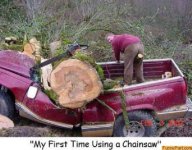
The fall zone is often wider and different than one would expect. That's how these things happen. Things go wrong that you don't think will go wrong.


FunnyPart-com-chainsaw.jpg
 
   / Cutting Trees at an Angle #30  
I also wonder why he did his cuts that high. And would that technique work if the tree still has a root ball attached pulling the tree away from the leaner?
Those are the ones I have a hard time telling which way the forces are.
 
   / Cutting Trees at an Angle #32  
That last method dont work well with larger hardwoods that have alot more branches.
 
   / Cutting Trees at an Angle #33  
That last method dont work well with larger hardwoods that have alot more branches.

There is no "one size fits all" solution to felling trees, leaners, hang-ups, or just plain old straight trees with nothing at all within the fall zone to be concerned with. They're all different and all deserve the utmost respect. The OP was wise in asking for "suggestions".

I only cut (6) years professionally and the training I received helped me unlearn a lot of bad things my dad taught me about cutting trees. Had I continued in the profession without training and not heeded wise advice from those with many years of experience there would have been no chance of me joining Arrow at the(30) year award dinner ;)
 
   / Cutting Trees at an Angle #34  
the 2nd video showing another safe method to control hung up trees to the ground is here: (starts at approximately the 5 minute mark) YouTube Link: http://www.youtube.com/watch?v=o9S7N-QjLGg
I've used this method before, but when you don't have a cant stick to roll the tree, I used a method of doing a small open face cut and taking out a wedge of tree that's 90 degrees to your original face cut at the hinge. Then slowly cutting the hinge, starting from the opposite side like in the video towards the secondary face cut. Having my secondary 90 degree face cut (sometimes) makes the tree roll on its own as the hinge is being released on the opposite side.
But then again, beware of advice on freeing hung up trees; if the person knew what they were doing they wouldn't of hung it up in the first place !
 
   / Cutting Trees at an Angle #35  
if the person knew what they were doing they wouldn't of hung it up in the first place !
:D !
I've chased a tree nearly full circle using the wedge & hinge method you describe :eek: Oops, did I just admit i don't know everything :confused: ;)
 
   / Cutting Trees at an Angle #36  
I also wonder why he did his cuts that high. And would that technique work if the tree still has a root ball attached pulling the tree away from the leaner?
Those are the ones I have a hard time telling which way the forces are.

Good question. Totally up rooted trees from my experience the ball seems to want to mostly fall back into the hole given a flat terrain. Partially uprooted trees like the one in Squares video, will not exert much of a changing force as when they uproot, a lot of the root is still being ground supported. Of course, things change when variables do such as the size of the uproot circumference wise, the size of the tree trunk and angulation of the lean. That's the nature of logging, all aspects and situations seem to have their own set of differentials.
 
   / Cutting Trees at an Angle #37  
if the person knew what they were doing they wouldn't of hung it up in the first place !

Wow, then a lot of times I mustn't knew what I was doing. Selective cutting in dense woods one may have little choice especially if the client is picky about what gets taken down. I've had trees hang up where I thought they would blow right by another canopy (just one of the reasons I hated logging in summer). Sometimes you have to purposely create a hang up to protect a stone wall or fence and then section the tree so it would "jump" the obstacle. Clear cutting say for a shopping mall with skidders with a 12-20 ton winch, I agree you'd have to be Bozo the Clown to afford a hang up. Even that's changed with the feller/buncher machine.
What strikes so sad now a days is that they have machines that chew up 30" oaks rather than save the stems for milling like they used to.
 
   / Cutting Trees at an Angle #38  
square1;4083621 there would have been no chance of me joining Arrow at the(30) year award dinner ;)[/QUOTE said:
You would learn more in those 6 years than in a life time of weekend cutting. Cheez, I never got an award dinner.
 
   / Cutting Trees at an Angle
  • Thread Starter
#40  
Lot of info here, and some pointless arguing. I actually only got in about two hours of work this weekend before the chainsaw decided to quit. Somebody mentioned 2 saws is a good idea, but I've only got one, soooo, I found some alternate projects until the saw gets fixed.

I have cut hanging trees and trees under tension, so I know what released trees can do. That's why I was so wary going into my first time cutting full sized hung trees. most of my short time sawing Saturday was getting a big tree top down on the ground. It had snapped 15 ft up the trunk and the top was on the ground, and the trunk resting on top of the 15 ft stump. I was able to get it down by careful cutting of the top branches. Once the whole mess was on the ground, the saw stopped cutting and so the tree's still down.

As to the video posted, cutting over by head like that isn't going to happen, and that seems a little to dangerous to try. If the trunk slides the wrong way, curtains for the operator. One thing I've learned is that trees can be unpredictable when they fall, or at least very hard to judge correctly.
 

Tractor & Equipment Auctions

2020 CATERPILLAR D1 LGP CRAWLER DOZER (A60429)
2020 CATERPILLAR...
KNOW BEFORE YOU BID - DO YOUR HOMEWORK AND BE HAPPY WITH YOUR PURCHASE (A59823)
KNOW BEFORE YOU...
Deere 331G (A53317)
Deere 331G (A53317)
2014 Freightliner 105' Bucket Truck (A56438)
2014 Freightliner...
2009 Landoll 435A 50ft. 43 Ton T/A Tilt Deck Equipment Trailer (A60460)
2009 Landoll 435A...
Preliminary Listing / Full Catalog Coming Soon! (A53317)
Preliminary...
 
Top