Does gas really go bad?

   / Does gas really go bad? #21  
100LL is responsible for 50% of all air-released lead pollution in the U.S.
No gasoline powered equipment manufacturers recommend it's use.
There's no reason to use it. None.
 
   / Does gas really go bad? #22  
I have to assume that Husky was stored with the carburetor empty. If I leave gas in the carbs of any of my two stroke bikes for more than a week or so, they give me grief. I have to drain the float bowls and let fresh fuel refill them. I put petcocks on all my four-stroke engines, too, and let the fuel run out when I'm done for the day. I dump all the fuel from my chainsaws and run the carbs dry, too. I've cleaned a lot of carbs that sat with fuel in them. I once bought a Kawi KZ1300 six-cylinder bike for half what it was worth because it wouldn't start. I pulled the carbs and cleaned them and rode that bike for years.

If your bikes have trouble starting after just one week with gas in them, you have other problems. It's not the fuel.
 
   / Does gas really go bad? #23  
Well, I've posted this before . . . long, long ago, but I'll do it again. Way back about 1970 I bought a 2 hp Johnson outboard boat motor. Light weight to carry around and used it on a canoe as well as small aluminum boat. It had a one quart gas tank, used a gasoline/oil mix or course and I usually just kept it gassed up, ready to go. And I unexpectedly, and on relatively short notice learned that I was going to the Northwestern University Traffic Institute for the 1971-72 school year; 9 months. While we were up there, I sold our house to a cousin. So when we returned, we had to stay in our RV until a new house was built. So when I did finally get around to using that little boat motor again, it had set with that gas/oil mix for way more than a year. But it started and ran just fine. And then when it ran out of gas and I dumped a fresh quart of gas in it and restarted it, I was surprised at the sound of that little motor. I'll be it gained a couple hundred RPMs or more with fresh gas.:laughing:
 
   / Does gas really go bad? #24  
100LL is responsible for 50% of all air-released lead pollution in the U.S.
No gasoline powered equipment manufacturers recommend it's use.
There's no reason to use it. None.

It is a great fuel, and absolutely NECESSARY for many small aircraft engines.
I recall from before, that YOU don't approve!
Fire departments around here use it in all their small engines,..... because their small engines must start ..... when they really need them!
 
   / Does gas really go bad? #25  
Old gas definitely goes bad. Faster in poly or vented containers. Many inexpensive to expensive 2 stroke oils have stabilizers and can explain the longevity in the original post.

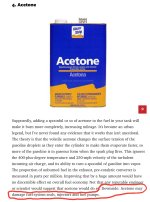
As for acetone additive that's an internet myth. No advantage and a possible big negative issue. Buy a good stabilizer rated for ethanol and use in all low use or stored engines.

From Popular Mechanics magazine:

Screenshot_20201026-143054_Chrome.jpg
 
   / Does gas really go bad? #26  
It is a great fuel, and absolutely NECESSARY for many small aircraft engines.
I recall from before, that YOU don't approve!
Fire departments around here use it in all their small engines,..... because their small engines must start ..... when they really need them!

Having been around airplanes for the first half of my life, and working at the airport FBO for 6, I know why they still use leaded gas for most piston aircraft. It's a necessity. If your lawn mower dies, you can just pull over and park. Airplane, not so much.

As for land based equipment, there's no need to use leaded fuel. Lead is the leading cause of spark plug fouling. Thinking about how many times I've sat in a small aircraft during pre flight run ups and switching the mags back and forth and running the engine up to try figure out which side had the fouled plugs and un-fouled plugs, and having to taxi back in because they're still fouled.... thinking about cars pre-unleaded gas, and how many times I've had to change the plugs VS since unleaded, the plugs tend to outlast the body parts.

If people would just take care of their equipment, follow the manufacturer's recommendations on maintenance and fuel, etc.... they'd not have problems. Most problems are operator induced.

Sure, if you're not going to use a small engine for months and months, you might want to shut off the fuel supply and run the carb out of gas. You might want to use fuel stabilizer. Either one of those options is a heck of a lot better for the environment and your wallet than 100LL needlessly spewing lead into the environment. Add to that, the price of 100LL is averaging about $4.70 a gallon today ( 100LL - Aviation Fuel Prices ) while regular gas is about $2.16. That's more than double the price.

There's a reason leaded fuel was banned for ground use. It's poison. Here's a list of the countries that still allow use of leaded gasoline for ground use:
Algeria, Iraq, Yemen, Myanmar, North Korea, and Afghanistan

That right there should tell you something about leaded fuel.
 
   / Does gas really go bad? #27  
Having been around airplanes for the first half of my life, and working at the airport FBO for 6, I know why they still use leaded gas for most piston aircraft. It's a necessity. If your lawn mower dies, you can just pull over and park. Airplane, not so much.

As for land based equipment, there's no need to use leaded fuel. Lead is the leading cause of spark plug fouling. Thinking about how many times I've sat in a small aircraft during pre flight run ups and switching the mags back and forth and running the engine up to try figure out which side had the fouled plugs and un-fouled plugs, and having to taxi back in because they're still fouled.... thinking about cars pre-unleaded gas, and how many times I've had to change the plugs VS since unleaded, the plugs tend to outlast the body parts.

If people would just take care of their equipment, follow the manufacturer's recommendations on maintenance and fuel, etc.... they'd not have problems. Most problems are operator induced.

Sure, if you're not going to use a small engine for months and months, you might want to shut off the fuel supply and run the carb out of gas. You might want to use fuel stabilizer. Either one of those options is a heck of a lot better for the environment and your wallet than 100LL needlessly spewing lead into the environment. Add to that, the price of 100LL is averaging about $4.70 a gallon today ( 100LL - Aviation Fuel Prices ) while regular gas is about $2.16. That's more than double the price.

There's a reason leaded fuel was banned for ground use. It's poison. Here's a list of the countries that still allow use of leaded gasoline for ground use:
Algeria, Iraq, Yemen, Myanmar, North Korea, and Afghanistan

That right there should tell you something about leaded fuel.

I am quite willing to pay $4.70 per gallon, for the 5-8 gallons of gas I use each year.
 
   / Does gas really go bad? #29  
From here:

Can I run AvGas in my vehicle?

Can I run AvGas in my vehicle?
AvGas is short for Aviation Gasoline. AvGas is of interest to motoring enthusiasts because of its availability, octane rating and low price compared to commercial race fuels. AvGas might seem an obvious choice but closer study raises some doubt.

AvGas LL100 stands for "Low Lead 100 Octane". TEL (Tetra-ethyl-lead) is added to raise the octane. When used in a motor vehicle this fuel will leave a lot of lead deposits in the motor. 100LL has a high lead content (0.5 grams per litre), even higher than leaded race fuels. The deposits left when TEL(lead) is burned are corrosive and damaging to valves, valve guides, valve seats and cylinder heads. Lead deposits will also block oxygen(lambda) sensors and catalytic converters and foul spark plugs even after only a short use. Also, 100LL has a chemical package added to make it perform at high altitude, and that isn't the best thing for motor vehicle performance here on the ground.

AvGas is blended for large-bore, long-stroke, low RPM engines which run at high altitude. While AvGas' higher octane is useful, smaller-bore, shorter-stroke, high RPM engines will perform better on racing fuel or high quality octane boosters. AvGas has lower volatility so when used in proportions higher than about 40%, part-throttle drivability and cold starts may be compromised. AvGas has a lower specific gravity so it will require a change in air-fuel ratio calibration for the engine to perform at its best. LL100 is blended with a high percentage of aromatics causing reduced throttle response which is not an issue with an aircraft engine but certainly an issue in a high-performance automotive engine. These high levels of aromatics will also damage rubber components in automotive fuel systems such as fuel lines, fuel pump seals and injector washers.

The sale and use of AvGas is heavily-regulated. Most aircraft fuel dealers refuse to put AvGas into anything other than an aircraft fuel tank. There is a legal grey area that has some vendors willing to dispense AvGas into "approved" containers if they believe the end use of that AvGas is fueling an aircraft engine. This loop-hole is how some may obtain AvGas for automotive use. Because AvGas has no taxes and duties on it, use on public roads is illegal and if found could result in your vehicle being impounded.

AvGas Tank
The Bottom Line:

Avgas may be suitable for some race cars that don't have catalytic convertors or oxygen sensors and are rebuilt often enough that the TEL(lead) build-up is not an issue. For other applications use an unleaded race fuel or a good quality octane booster.
 
   / Does gas really go bad? #30  
Hmm, I had one chainsaw tuned up about twelve years ago. Till about two weeks ago it has not been used. Started about the fifth pull.
 
   / Does gas really go bad? #31  
.. use Stabil or Seafoam in them all. Seems to help, but maybe not...


It does and that the smartest thing you can do right there. I have used Amsoil quickshot every time I fill up my fuel jugs for the last several years (since they came out with it) and everything starts up fine even after sitting for 3-5 months.

I have also read it's better than running the fuel out because then some O-rings and gaskets will dry up and crack or disintegrate.
 
   / Does gas really go bad? #32  
There are some interesting things found via Google with the query of gas going bad...

What is the (local) consensus of unleaded gas in old and antique engines that were designed to run on leaded gas ?
 
   / Does gas really go bad? #33  
   / Does gas really go bad? #34  
There are some interesting things found via Google with the query of gas going bad...

What is the (local) consensus of unleaded gas in old and antique engines that were designed to run on leaded gas ?

That's a different animal, from what I've been told.
 
   / Does gas really go bad? #36  
I've seen gas go bad, if it's over a year old, it can get gummy, and even get hard.. if you don't expect to use it within a year, it's best to dump the gas in the tank, then run the engine on the gas left in the carburetor until it stops!. I recently worked on a generator that had 2 year old gummy gas, the guy went to use it in a storm, and it wouldn't start, it was gummed up with gummy gas..

My 2 year old honda generator says e gas is ok. A far as draining and running dry, don't forget the bowl.
 
   / Does gas really go bad? #37  
Owning a plane makes avgas available to me. 100 octane, 2% TEL. That stuff NEVER goes bad.

auto fuel is bad juju for anything that doesn't have a catalytic convertor. My Model A and Harley do better with Avgas, even my chainsaw likes it (and smells better too) My old sears tractor the grandkids drive when they visit works great.
There's paperwork available for airplane engines to allow the use of autogas, as long as there's no alcohol. At the airport they called it "Mogas" but as far as I know, it's not available anymore.. I do hear that some marine fuelers have it available.

If auto gas can be get sealed from moisture, it will last longer.

Seems if the container is full and sealed and stored at a constant ambient temp the odds are with you.

I sealef the Model A tank back in 1980 and zero issue until the ethanol blend turned the seller into a goopy mess.
 
   / Does gas really go bad? #38  
I have had gas go bad. One time about a year old, probably with ethanol and it smelled bad. It was in 4hp Briggs and it actually ran but knocked. The other time was a power washer, probably pure gas but sat two years with a near empty fuel tank, that one was my fault. Took the carb apart, cleaned it and put it back together and it ran fine.
 
   / Does gas really go bad? #39  
I got my Dyed and Clear Diesel Delivered last week. Prices are low. Asked driver about Gasoline,( A PetroCan Dealer). I was surprised. His third compartment had "SUPER" no ethanol gasoline on board.
 
   / Does gas really go bad? #40  
I got my Dyed and Clear Diesel Delivered last week. Prices are low. Asked driver about Gasoline,( A PetroCan Dealer). I was surprised. His third compartment had "SUPER" no ethanol gasoline on board.

Send me some!
Here,..... in "The Democratic People's Republic of Taxachusetts"..... it is illegal to "dispense" non ethanol gas.
 

Tractor & Equipment Auctions

2020 DRAGON 150BBL ALUMINUM (A58214)
2020 DRAGON 150BBL...
2014 Lamar Trailer (A55973)
2014 Lamar Trailer...
2004 CATERPILLAR 320C L EXCAVATOR (A60429)
2004 CATERPILLAR...
1985 Ford Ltl9000 Tender Truck (A56438)
1985 Ford Ltl9000...
2019 BOBCAT E45 EXCAVATOR (A59823)
2019 BOBCAT E45...
Westfield Conveyor (A56438)
Westfield Conveyor...
 
Top