You are using an out of date browser. It may not display this or other websites correctly.
You should upgrade or use an alternative browser.
You should upgrade or use an alternative browser.
Drill Press Cross-Feed Table
- Thread starter swines
- Start date
- Views: 12425
More options
Who Replied?
/ Drill Press Cross-Feed Table
#21

Jims1025R
Gold Member
- Joined
- Aug 20, 2021
- Messages
- 284
- Location
- Ontario, Canada
- Tractor
- John Deere 1025R, John Deere 15 Mini ex, Polaris 700 6x6 Ranger & Airplane
I too am negative about milling in a drill press. The morse taper chuck may jump out when you're not expecting it (which will for certain break the end mill, probably damage the work, and could send bits at you. And these compromise devices are really a compromise for any machining in metal. Add to that, most drill presses do not have a hand wheel down feed, nor a lock for the vertical axis.
Try really hard to look for another solution to your needs - like a modest milling machine (even a round column one) which will mill, and drill - even better than the drill press!
There are some tools which are offered for sale, and sound like a good idea, but just are not. The fact that you can buy it does not mean you should!
Try really hard to look for another solution to your needs - like a modest milling machine (even a round column one) which will mill, and drill - even better than the drill press!
There are some tools which are offered for sale, and sound like a good idea, but just are not. The fact that you can buy it does not mean you should!

4570Man
Super Star Member
- Joined
- Apr 7, 2015
- Messages
- 19,033
- Location
- Crossville, TN
- Tractor
- Kubota M59, Kubota L3800, Grasshopper 428D, Topkick dump truck, 3500 dump truck, 10 ton trailer, more lighter trailers.
DISK sander/grinder... not a belt. Belts don't sand flat/straight; disk sanders do. READ.
Or you can goober you're DP and have 2 projects...
A disk sander eats faster on the outside edge though. It could work but you’d have to be careful not to taper the piece.
4570Man
Super Star Member
- Joined
- Apr 7, 2015
- Messages
- 19,033
- Location
- Crossville, TN
- Tractor
- Kubota M59, Kubota L3800, Grasshopper 428D, Topkick dump truck, 3500 dump truck, 10 ton trailer, more lighter trailers.
I don't care what you paid or didn't pay for a milling machine. I don't have room for a milling machine, I don't have three-phase power or a rotary phase converter. Why did you bother to comment if you have no information of any use? Just driving through and thought you drop a snarky comment? Noted...
They make bench top single phase milling machines that would still be a heck of a lot better than a rigged up drill press.

LD1
Epic Contributor
Someone with as much knowledge as him, and a former machine shop owner....makes me wonder why the h3ll he is asking the question in the first place
"Hey, I am a professional machinist and owned several mills and lathes...but can you all advise me on the best way or home-owner, amature hick up my drill press".
And if I don't like what you say....I'll pound my chest about how great of a machinist I am.
Im out.
Good luck. (I don't really mean that)
"Hey, I am a professional machinist and owned several mills and lathes...but can you all advise me on the best way or home-owner, amature hick up my drill press".
And if I don't like what you say....I'll pound my chest about how great of a machinist I am.
Im out.
Good luck. (I don't really mean that)

dadohead
Platinum Member
I served my apprenticeship and worked as a journeyman patternmaker at CAT in the 80's. A disk IS the tool to straighten a metal edge. You don't just shove it up to the disk. The workpiece is started with only several inches on the disk and then lightly slid across... much like feeding wood stock into a jointer. It doesn't take long to learn to straighten stock without cutting a taper.A disk sander eats faster on the outside edge though. It could work but you’d have to be careful not to taper the piece.
Done with this thread... this guy is a tool.
LD1
Epic Contributor
Done with this thread... this guy is a tool.


Tinhack
Elite Member
- Joined
- Jul 3, 2020
- Messages
- 3,517
- Location
- Lytle, TX
- Tractor
- Ford 3910, John Deere 420C, Kubota G32XKS, IH 2606, Bad Boy Maverick-60"
Why are you being so arrogant? And why are you asking on a Tractor Forum?At one point in my life, I owned a machine shop. It had multiple CNC mills, a Bridgeport, a Hardinge toolroom lathe, an EDM, a complete sheet metal fabrication area, and a plastic injection molding machine. The CNC machine tools were high precision and with careful setup and control, parts were regularly made with +0 / -0.0001 inch accuracy. I think I know the difference in how machine tools and drill presses work and why. I'm not trying to make repetitive movements, hold locations, surface milling, or hold precision tolerances. This isn't true machine work.
I can make my metal bandsaw hold tolerances of 0.003 with 12 parts having a miter cut at each end. You'll have to take MY word for the fact that I know what I need to accomplish this task and you don't.

etpm
Veteran Member
- Joined
- Jun 30, 2021
- Messages
- 2,344
- Location
- Whidbey Island, WA
- Tractor
- Yanmar YM2310, Honda H5013, Case 580 CK, Ford 9N
As a current owner of a machine shop, one with several drill presses, I think it doesn't really matter which cross slide table you get. Your real limitation is the drill press. I have a bunch of drill presses. Most are OK and get used for jobs that only require precision in depth control. like installing Heli-Coils using a Procunier tapping head. Even my very nice drill presses with precisely fitted quills I would not consider milling with . This is for several reasons, but the two main reasons are the Morse taper quills and the fact that the cutter, the 1/4 inch endmill, would be held in a drill chuck. Granted, you could be using, for example, a Jacobs ball bearing chuck in very good condition or an Albrecht keyless chuck, also in very good condition. Or drill chucks of similar quality. And I must confess to using Albrecht chucks and small endmills for light milling jobs. In a Bridgeport. It is bad practice. But I did it using my machines and tooling so it was my risk. I would never have tried a stunt like that when I was working for somebody. That said, I think using a drill press for the same job is asking for disaster. You could maybe get away with it, but I think if you try you will, at the least, be breaking cutters. I can imagine the vibration and side load on that Morse taper causing the taper shank to come loose and fall out of the quill. That would be real exciting. I am frankly surprised that anyone who used to own a machine shop would even ask the question. Especially someone who can hold .003" on miter cuts on his metal cutting bandsaw.At one point in my life, I owned a machine shop. It had multiple CNC mills, a Bridgeport, a Hardinge toolroom lathe, an EDM, a complete sheet metal fabrication area, and a plastic injection molding machine. The CNC machine tools were high precision and with careful setup and control, parts were regularly made with +0 / -0.0001 inch accuracy. I think I know the difference in how machine tools and drill presses work and why. I'm not trying to make repetitive movements, hold locations, surface milling, or hold precision tolerances. This isn't true machine work.
I can make my metal bandsaw hold tolerances of 0.003 with 12 parts having a miter cut at each end. You'll have to take MY word for the fact that I know what I need to accomplish this task and you don't.
Eric
3Ts
Elite Member
This has been an interesting thread. I'm interested in metal work, but have a drill press and a welder (period). I was unaware of the issues with side loading Jacobs chucks, nor did it cross my mind about milling machines with round columns. So I appreciated all of you who answered. I learned some more today.
To the OP: Yes, you came across as rather snarky. I realize you asked a question, but the rest of the thread is about education - not just to answer your question, but to educate people like me as well.
To the OP: Yes, you came across as rather snarky. I realize you asked a question, but the rest of the thread is about education - not just to answer your question, but to educate people like me as well.
BukitCase
Elite Member
- Joined
- Feb 17, 2012
- Messages
- 2,756
- Location
- Albany OR
- Tractor
- Case 580B, Long 460, Allis-Chalmers 160
3T's I'm glad SOMEBODY got something positive out of this thread; I know I didn't say WHAT the problem with round column mills is, so if you don't mind, could you share what YOU found? If you're not sure, I (or likely most of the OTHER responders) can elaborate... Steve
Edit - here's a thread from a (sadly, now deceased) fellow Texan that covers a heroic attempt at "changing a sow's ear into a silk purse", aka "fixing" a round column mill the hard way -
Pretty sure you'd need to join in order to see pictures, but it's free (and worth every penny
Edit - here's a thread from a (sadly, now deceased) fellow Texan that covers a heroic attempt at "changing a sow's ear into a silk purse", aka "fixing" a round column mill the hard way -
Rong Fu Mill/Drill head lift guide - Shop Floor Talk
Rong Fu Mill/Drill head lift guide Machining
www.shopfloortalk.com
Pretty sure you'd need to join in order to see pictures, but it's free (and worth every penny
Last edited:

workinonit
Elite Member
I've been looking for a good table myself. I bought a cheapo table that is a POC. It's sitting on the floor. I am NOT a machinist and don't want to use my Baleigh press for that but I would like to be able to mount a piece and drill several holes without having to remove the piece and do it with some measure of accuracy.
BukitCase
Elite Member
- Joined
- Feb 17, 2012
- Messages
- 2,756
- Location
- Albany OR
- Tractor
- Case 580B, Long 460, Allis-Chalmers 160
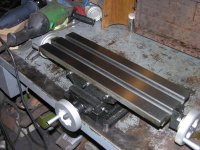
I have this one
Grizzly.com xy table - mine
But I bought mine about 20 years ago; at that time, IIRC it was made in Taiwan. Current ones are Chinese (and about $90 more expensive).
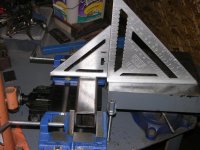
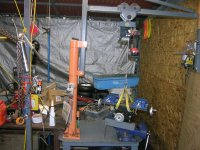
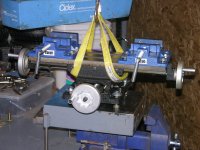
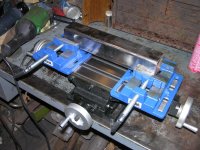
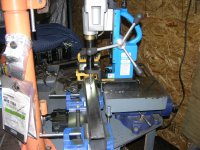
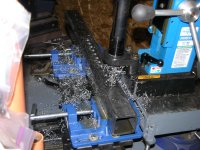
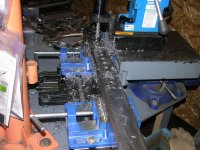
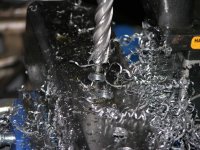
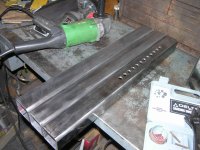
I thought it was too big for my DP, so it sat in its box under a bench for about 12 years, then finally found a home in my "MDVT" project, along with 3 different vises and a "mini" jib crane - "MDVT" stands for "Mag Drill Vise Table" - original, huh?
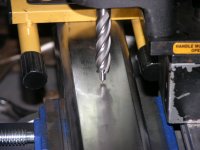
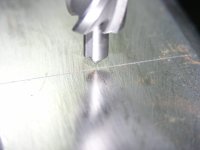
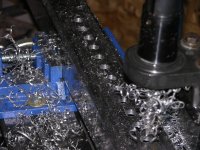
Been awhile since I used the MDVT, but the table's lead screws are ALSO either 8 or 10 TPI, forget which - still very useful for "semi-precision" hole placement - a few pics... Steve
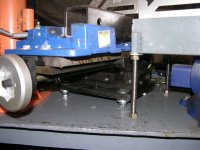
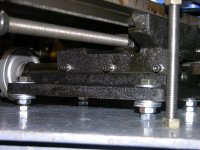
Grizzly.com xy table - mine
But I bought mine about 20 years ago; at that time, IIRC it was made in Taiwan. Current ones are Chinese (and about $90 more expensive).
I thought it was too big for my DP, so it sat in its box under a bench for about 12 years, then finally found a home in my "MDVT" project, along with 3 different vises and a "mini" jib crane - "MDVT" stands for "Mag Drill Vise Table" - original, huh?
Been awhile since I used the MDVT, but the table's lead screws are ALSO either 8 or 10 TPI, forget which - still very useful for "semi-precision" hole placement - a few pics... Steve
Attachments


metalbender
Veteran Member
Have to add my two bits. Troll. Anyone having that much "experience" wouldn't be asking here for basic info.
LD1
Epic Contributor
Kinda like if a lawyer came to a tractor forum and asking for legal advise.....then talking down to everyone who tried to help....while stroking their own ego about how great and smart they are....lol. makes no sense. That's the impression I get. Some people just cannot be helped.Have to add my two bits. Troll. Anyone having that much "experience" wouldn't be asking here for basic info.
3Ts
Elite Member
No-one said what the problem with round column mills was and I have no experience with them, but after reading about the Jacobs chuck damage due to side forces and a mention that round columns are a problem I put 1 and 2 together to figure out that with a round column the side forces are going to cause the cutter head to rotate around the column which means cutting a straight line will be very difficult. It just never crossed my mind until it was mentioned that round was a problem.3T's I'm glad SOMEBODY got something positive out of this thread; I know I didn't say WHAT the problem with round column mills is, so if you don't mind, could you share what YOU found? If you're not sure, I (or likely most of the OTHER responders) can elaborate... Steve
Here are some similar links:


- Replies
- 25
- Views
- 8K
