Educate me a bit on torches

   / Educate me a bit on torches #1  

Richard

Super Member
Joined
Apr 6, 2000
Messages
5,057
Location
Knoxville, TN
Tractor
International 1066 Full sized JCB Loader/Backhoe and a John Deere 430 to mow with
The thread to bend 1" steel got me thinking about this.

Though my project is now done, I went to replace the blades on my flexwing mower. Prior owner said they were original. If true, that means something like 20 years old.

I'm a persistent little cuss..... ultimately getting out the 7" grinder with diamond blade and cut two of them off. I flogged, beat, heated, sprayed, cussed at the other four and they finally came off.

I had a 1 11/16th's 3/4" drive socket. Only had 1/2" breaker.... snapped a 4" Craftsman extension clean in half (when at the time I also worked my 4x torque multiplier into the equation)

Got to thinking that it might be much easier if I had "real" heat, over & above my 'plumbers' MAP gas that I use for soldering.

What kind of tanks & tips (as in ends of the wand for the flame) would you recommend? Also...what issue is there with this likely having to be stored either in the garage or, out in the woods in a clearing where we keep implements? (I'm guessing the wisdom would say keep tanks out there and keep hoses/regulators in garage, which strikes me as logical)

In that other thread, Smokeydog said "Too big a tip can easily draw more acetylene that can come out of acetone solution and media in the tank. Then acetone gets entrained. Causing all kinds of safety issues and damage to your equipment."

Can anyone explain what this means?

(trying to learn some basics before I decide that I want/need to do this....might be smarter/easier to borrow my brother in law every now & then....but I don't like doing that too much)
 
   / Educate me a bit on torches
  • Thread Starter
#2  
I've looked up the definition of entrainment,

"In engineering, entrainment is the entrapment of one substance by another substance. For example: The entrapment of liquid droplets or solid particulates in a flowing gas, as with smoke. The entrapment of gas bubbles or solid particulates in a flowing liquid, as with aeration."


So does this mean that liquid bubbles of acetelyn would be picked up in the vapored acetelyn (I know I'm misspelling that)

Anyway, and now you have the density of the vapor going towards the flame tip mixed with the higher concentrated liquid droplets and when they get to the combustion stage, it's going end with a form of a bang or suddenly large flame?
 
   / Educate me a bit on torches #3  
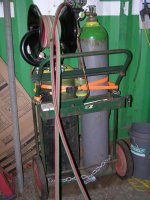
Buy a larger set of bottles. 125 O and 140 fuel. This will let it run larger cutting tips and some limited heating. You definitely should get a real torch, I have an anxity attack if I get farther than about 50 ft from one.
torch cart.JPG
 
   / Educate me a bit on torches #4  
Buy a larger set of bottles. 125 O and 140 fuel. This will let it run larger cutting tips and some limited heating. You definitely should get a real torch, I have an anxity attack if I get farther than about 50 ft from one.View attachment 710814
I've had a set of tanks this size since I was 18, so about 42 years. Sometimes I don't use it for 4-5 years, then I'll use the heck out of it for several months. I don't think I've had the tanks filled more than 4-5 times in that period. I did replace the regulators after about 30 years. It's one of those tools that most folks rarely, if ever, need. However, it sure is handy when you do need it.
 
   / Educate me a bit on torches #5  
Real heat means a "rosebud" torch. BUT you can't just willy nilly go buy a rosebud and stick it on any old acetylene tank. The tank has to be sized to support the rosebud. It is not just a matter of the tank would empty soon because of the small size, it is a matter of how much gas can be safely drawn out of the mixture of things inside of your tank.

Acetylene is a very unstable gas. It cannot just be pumped into a hollow tank like oxygen or some other gas like argon.
Inside the tank there is a filler that looks like mud. It is diatomaceous earth. Yes Diatoms, those tiny shells left over after diatoms die. Then that is flooded with acetone and finally a certain amount of this very unstable gas called Acetylene is pumped into the tank. You never want to run the risk of sucking up acetone by drawing the gas off at too high a rate.

This is why the tank must be sized to run these high flow rate torches. Even a welding tip which doesn't draw near the gas that that a rosebud heating torch does must be sized to the size of tank that will support it. I only have one of the small portable grab it with one hand "refrigeration" sized kits. There is no way I can support a rosebud torch of any size. And can only support the smaller sized welding tips. I think my largest one is a number 3.

All of the information about what can support what is on the internet or your welding supplier can help you select the size of the tanks needed in your welding set to support what sized rosebud you will need to do major heating. Just remember that gas welding/heating/cutting kits are "dangerous". Far more dangerous than electrical welding or plasma cutting or induction heating etc. BUT like everything else that is dangerous, if you know what you are doing and follow the guidelines then you are on top of the danger factors and is no more dangerous than many other activities that humans engage in.

Example I use firearms, and reload ammunition. Both are inherently dangerous, and both can be mastered and used by knowledgeable people. You wouldn't give a person a loading press and a canister of powder and some primers, some cases and bullets and say "go make me some reloads" would you? No, they would kill themselves or you when you went to fire their unsafe ammunition. But if they were given the correct knowledge and they are "hard minded" people, you could expect good safe results.

Of course not everyone in the world is what I call "hard minded". Some people cannot do dangerous tasks because their brains do not function in a way that will allow them to complete these tasks in a safe manner.
 
   / Educate me a bit on torches
  • Thread Starter
#6  
Not sure of the right word, but I've seen how 'explosive' Acetelyn can be when my (machinest) friend had his tanks over to heat the kingpin on my backhoe.

Flame went out or something and the "pop" made it very clear that the stuff ignited "right now" with an explosion verses just an enhanced flame like O2 might have done.

Hard for me to describe but I'm sure that you guys know the 'pop' that I'm talking about. It stuck me as very violent, especially given the size of it.

Never thought about waltzing into a local welding shop. I know they exist here in town but have never been to one.
 
   / Educate me a bit on torches #7  
Not sure of the right word, but I've seen how 'explosive' Acetelyn can be when my (machinest) friend had his tanks over to heat the kingpin on my backhoe.

Flame went out or something and the "pop" made it very clear that the stuff ignited "right now" with an explosion verses just an enhanced flame like O2 might have done.

Hard for me to describe but I'm sure that you guys know the 'pop' that I'm talking about. It stuck me as very violent, especially given the size of it.

Never thought about waltzing into a local welding shop. I know they exist here in town but have never been to one.
Well, if there is a knowledgeable person there, they should be able to get you squared away with a rosebud and the proper sized "kit" to run it safely.
 
   / Educate me a bit on torches
  • Thread Starter
#8  
When my buddy (machinest) came over with his torch, he said it was a rosebud.

It was my first time ever seeing one. My PRESUMPTION is that it would put a flame out that might be....for example, 2-3 inches in diameter at the nozzle.

As it turned out, I guess it was a small rosebud as it was more of a pinpoint flame when blue. The blue part was ...I don't know (and forget) let's just say that the blue part was maybe 1/2" in diameter at the nozzle, perhaps not that large (?)

He DID say that it was a smaller rosebud so maybe there are different sizes.

Can a rosebud 'cut' or is it more for straight heating? Or, does it depend on what you are working on? I guess a small rosebud like I saw could perhaps melt/cut through something thin but not cut through a 2" steel king pin..... however, a larger one might?

I know so little, I don't know what I don't know other than I don't know!

With the big International and JCB, having heat would have been advantageous in times past....so I know it will rear its head again. (some of the pins on backhoe for example)

I'm willing to learn, I'm a stickler for trying to be smart & safe.... what might I first look at?
 
   / Educate me a bit on torches #9  
There are 3 basic kinds of tips. Welding tips, Cutting tips (torch sets) and rosebud. Rosebuds come in different sizes and they are made for heating up metal, but not welding nor cutting. They have pretty big flames, take a lot of gas and will heat up things in a hurry.

Welding tips look more or less like "L's" and have pinpoint flames and are made for welding with a filler rod usually, although you can heat up small things with a welding tip.

Cutting sets take more gas usually than welding tips and a fair sized flame out of several pinholes in the tip and has a extra mixing valve and lever to put more oxygen out of the center hole to oxidize the steel after it has been heated up by the mixture of ace and oxy. You start with just the mixture (neutral flame) adjusted and the workpiece brought up to the proper heat color then you hit the pure oxy lever that starts the oxidation process.

In fact skilled operators can even turn off the heating function of the torch and just let the oxidation process act as the heating source too as this process is exothermic.

Of course if the cut is "lost", then you will have nothing to start that process over again unless you light up and adjust the ace and oxy sources again and start the heating process over again. So most people just let it run even when the cutting process with the pure oxy is being done. Of course these tips come in different sizes and have different thickness's of steel they will cut and require different sized tanks to be safe.

In general if you buy/or rent large sized tanks that are sufficient to run a rosebud heating tip of the size you need, they will be just fine to run smaller cutting and welding tips too. Of course bigger tanks are more expensive either to own, or rent.
 
   / Educate me a bit on torches #11  
kOua has give you good information that should get you on the right track for a good set up. I posted about propane in the 1" bending thread I think might interest you. I also posted about a homemade torch that's capiable of far more than those on 1 pound bottles. From a safty standpoint here are some often overlooked (after the "drawdown" kOua talked about which is #1). There's no need to store tanks outdoors but they should be chained to a cart 100% of time and cart chained to wall any time they are not in use. You need to read up on " flashback arrestors and backflow protective equipment" because they aren't supplied with guages.
 
   / Educate me a bit on torches #12  
For home use I have found the portable torch kit to be adequate. It is easily transported to where you need it if you can't get the job to the shop. For a professional shop environment a full size torch kit is the way to go but overkill for most home owners.

I recommend buying a set without tanks and buy the tanks from where you plan to get gas. OR check with the gas supplier on their tank prices and ask if they will swap out budget bought tanks.

Add a rose bud tip and you are good to go. Note: To get a rose bud tip to light and function set your oxy/acetylene to equal pressures. I usually set both to 10-15 PSI.
 
Last edited:
   / Educate me a bit on torches #13  
The thread to bend 1" steel got me thinking about this.

Though my project is now done, I went to replace the blades on my flexwing mower. Prior owner said they were original. If true, that means something like 20 years old.

I'm a persistent little cuss..... ultimately getting out the 7" grinder with diamond blade and cut two of them off. I flogged, beat, heated, sprayed, cussed at the other four and they finally came off.

I had a 1 11/16th's 3/4" drive socket. Only had 1/2" breaker.... snapped a 4" Craftsman extension clean in half (when at the time I also worked my 4x torque multiplier into the equation)

Got to thinking that it might be much easier if I had "real" heat, over & above my 'plumbers' MAP gas that I use for soldering.

What kind of tanks & tips (as in ends of the wand for the flame) would you recommend? Also...what issue is there with this likely having to be stored either in the garage or, out in the woods in a clearing where we keep implements? (I'm guessing the wisdom would say keep tanks out there and keep hoses/regulators in garage, which strikes me as logical)

In that other thread, Smokeydog said "Too big a tip can easily draw more acetylene that can come out of acetone solution and media in the tank. Then acetone gets entrained. Causing all kinds of safety issues and damage to your equipment."

Can anyone explain what this means?

(trying to learn some basics before I decide that I want/need to do this....might be smarter/easier to borrow my brother in law every now & then....but I don't like doing that too much)
I made my living with an oxy/acetylene torch for years.
Also traveled through central america with the torch and an old truck set up for tinkering and blacksmithing.

Torches are simple devices and pretty much trouble free. Lots of folklore about them.
I'll be glad to answer any questions you have.
rScotty
 
   / Educate me a bit on torches #14  
kOua has give you good information that should get you on the right track for a good set up. I posted about propane in the 1" bending thread I think might interest you. I also posted about a homemade torch that's capiable of far more than those on 1 pound bottles. From a safty standpoint here are some often overlooked (after the "drawdown" kOua talked about which is #1). There's no need to store tanks outdoors but they should be chained to a cart 100% of time and cart chained to wall any time they are not in use. You need to read up on " flashback arrestors and backflow protective equipment" because they aren't supplied with guages.
Yep, on the arrestors and backflow devices. And another thing is many users have found that handheld inductive heating devices are satisfying their heating needs. Might or might not for you. Advantages, no tanks, no fuel, no flame and not much in the way of costs after buying the unit and its coils. Also Plasma cutters are supplanting cutting with fuel for more and more people. And add to that, hardly anyone welds with gas anymore. The various forms of electric welding has pretty well taken over. Gas welding was very popular 100 years ago. And back then that was the prominent form of welding.

People used to heat with their stick welders and a device called a carbon arc torch. However they have complete fallen out of favor. Not the least is the production of some nasty versions of carbon emitted from those old devices including a kind of rare version of carbon called a Buckminster Fullerene. Also known as a "bucky ball". These things are not very good for people.
 
   / Educate me a bit on torches #15  
If you wanna know the "why" (and you SHOULD)

Fuel your safety knowledge - acetylene

I looked into getting a rosebud for my acetylene set about 40 years ago - back then the recommendation was no more than 1/7 of tank volume per hour; if you actually READ the above link, it's now recommended no more than 1/10 of tank volume. Even at the OLD rate, I found that even the SMALLEST available rosebud (at that time) needed the LARGEST acetylene single tank you can typically find -

which is why my tank set has a 330 CF acetylene tank and about 300 CF oxy.

If you
1 - Get "brain pain" trying to figure out all the details of staying "safe", and
2 - Do NOT ever want to actually WELD with a gas torch, and
3 - Haven't already got acetylene torches...

Then I would recommend FORGETTING Acetylene and instead getting a torch setup that uses Oxygen/PROPANE - because -

Use ANY size propane tank, it'll work til it DOESN'T

If you use it a LOT, you can get 25 gallon tanks (AKA 100 pound, propane is about 4 pounds/gallon)

Still need the correct HOSES for propane (grade T hose) - the older hoses that're fine for Acetylene won't last with propane.

There are differences to be aware of, such as which part of the flame is the hottest; it's different between Acetylene and Propane, which is part of the reason there's so much negativity on the web about using propane.


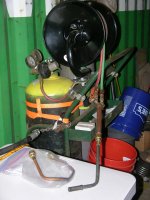
Here's the size tanks I use; again, BARELY big enough for serious heating or cutting -

AcetyReel.jpgAcetyReel2.JPG

A final note ('bout dang time :=) - the only SERIOUS reason for getting Acetylene if you're new at this is actual WELDING - Acetylene is the ONLY known fuel gas that generates it own SHIELD - NONE of the other gases do this, so if you're thinking of "going Retro", either choose Acetylene or FORGET it for gas welding.

Also, the fuel gas isn't the ONLY thing that can get you in trouble; so can Oxygen; the Fabricator link has this covered too.

Bunch of info here I know; but if you CARE about your safety, I recommend reading all the above until you REALLY understand what's involved... Steve
 
   / Educate me a bit on torches #16  
Yep, on the arrestors and backflow devices. And another thing is many users have found that handheld inductive heating devices are satisfying their heating needs. Might or might not for you. Advantages, no tanks, no fuel, no flame and not much in the way of costs after buying the unit and its coils. Also Plasma cutters are supplanting cutting with fuel for more and more people. And add to that, hardly anyone welds with gas anymore. The various forms of electric welding has pretty well taken over. Gas welding was very popular 100 years ago. And back then that was the prominent form of welding.

People used to heat with their stick welders and a device called a carbon arc torch. However they have complete fallen out of favor. Not the least is the production of some nasty versions of carbon emitted from those old devices including a kind of rare version of carbon called a Buckminster Fullerene. Also known as a "bucky ball". These things are not very good for people.
Gouging rigs use carbon rods.
 
   / Educate me a bit on torches #17  
This is worth watching in my opinion. Several things are covered here.

 
   / Educate me a bit on torches #18  
James, I agree; he does a pretty thorough job, including a good intro to fab work. I think he could've been a bit more thorough on the neutral flame; I was taught (about 57 years ago now) that to get a neutral flame, close the oxy just til the "feathers" on the blue cones barely disappear - more feathers = a carburizing flame (used for slight hardening of mild steel) and increasing oxy from neutral gives a reducing flame (usually NOT a good plan)

I REALLY liked his coverage on regulator safety; I barely missed getting KILLED 57 years ago when a "weldor" who had the habit of never backing his regulators off, replaced the oxy bottle, opened the tank valve super fast (I don't think the vid mentioned these can run around 3000 PSI when full), and blew out the regulator - the T handle on the regulator missed my head by about an inch, then it went thru two plywood covered walls and bounced off a car outside the shop. After I cleaned out my shorts, I drove to the nearest LWS and asked about safety pamphlets - after reading that was the LAST time I stayed in the area when the bozo headed for the torch... Steve
 
   / Educate me a bit on torches #19  
Steve you obviously "dodged a bullet" 57 years ago. As you know it is hard to get the fine details from a you tube video, and even harder when you don't have the shade 5 in front of the camera. I saw a video somewhere of a cylinder falling over and knocking the valve off and the cylinder going thru a concrete block wall. Wouldn't want to be standing there or in front of your regulator operated by your bozo co worker as noted above.
 
   / Educate me a bit on torches #20  
James, I sure did "dodge a bullet" - and that experience was a helpful reminder for the rest of my life, especially the last 33 years of "indentured servitude" spent doing instrumentation/control in a couple different rare metals plants - we had forge presses and extrusion presses that developed over 15 thousand TONS of thrust, furnaces that could hold 3 Zirconium ingots 3' diameter and 25' long, rotary forges that could take a solid ingot and make a cannon barrel up to 24" diameter -

Plants like that use chemicals the average person can't even imagine; some of which can dissolve metals like stainless steel in SECONDS - and all that stuff had to be sensed/controlled, many times there was only ONE material an instrument could be made of and survive for more than an hour or two.

Only reason I survived THAT experience is NEVER assuming - in that kind of environment, knowledge isn't just power; it's LIFE... Steve
 

Tractor & Equipment Auctions

Mower deck storage axles
Mower deck storage...
Ford 8210 (A60462)
Ford 8210 (A60462)
2010 Massey Ferguson 2625 (A60462)
2010 Massey...
PALLET OF SCRUBBER PODS (A58214)
PALLET OF SCRUBBER...
2014 International WorkStar 7300 4x4 Altec A55F 55ft. Material Handling Bucket Truck (A60460)
2014 International...
Commercial Lawn Mower 652R (A56859)
Commercial Lawn...
 
Top