Buying Advice Evaluating options for a compact

/ Evaluating options for a compact #21  
No doubt everyone has a "favorite". After looking at a handful of tractors, I ended up creating a spreadsheet where I could list all the specs that were important to me.
I have 20 over hilly acres in TN. Ultimately, I believe a heavier tractor will give you more traction and for hills and snow traction is what you want.
I ended up with a Branson 3725H. There are always compromises and there isn't the side and deep dealer network for Bransons as exist for other brands but they were, to me, superior in enough other aspects that it made my decision easy. You might want to add them to your list.
 
/ Evaluating options for a compact
  • Thread Starter
#22  
Our land is a little over an hour south of the OP, and we have a similar ~35 acres on a hillside, of which I need to maintain about 5-7 acres. I shopped many of the same models the OP was looking at, initially looking at the Mahindra Max26XL, then the 1500s, and was on my way to check out the Kubota L3350 (and to talk to the dealer about the known regen issues) when I accidentally went into a Kioti dealer. I would suggest the OP at least give them a look. There was a dealer in Afton that gave me a very reasonable quote via email, though I ended up with a CK3510se from a closer dealer that's being delivered next week (the Akron dealer may also be the local Yanmar dealer). If you consider the CKs, skip the 2510 (smaller frame) and go to the CK2610 as a minimum (same engine as the 2510 and still rated at 24.5hp, so no regen, but many claim punches above it's weight class and is on the larger CK frame that's around 2800#). With the loader and filled rear tires, it should be >4000#. I had concerns about the DPF as well, but in the end, I wanted a little more HP to run a wood chipper and other as-yet-unknown implements down the road, so I bit the bullet on the DPF. As an FYI - You can get the 35 and 40hp CK models in an 'SE' model, which has a independent PTO and most options from the base CK models as standard.

Depending on how thick the brush is that you want to cut, you may also want to consider a flail mower like the WoodMax FM-62. As long as you don't need to cut anything more than an inch or so thick, it should do the trick while being more maneuverable in the wooded areas, and can also double as a finish mower, especially if you get an extra set of blades (the Y for grass and the heavier duck-foot blades for thicker brush). So, you only buy 1 mower instead of a brush hog and a finish mower, and don't need the mid-pto for a belly mower, saving another $1k or so. I plan on getting one eventually, but for now I plan on maintaining a few short wooded trails and a little brush with the FEL that will I probably put a Piranha tooth bar on and a root rake grapple from EA (I have a nice Simplicity mower for the lawn areas).

BTW, @OP - do me a favor. Stop into Oneonta and have a slice of cold cheese pizza for me. ;) Thanks!

-Lee

Yep, The Kioti dealer in Afton is on my list, not gonna get there tomorrow though. I'm going north to Tully for the Yanmar dealer. I'll have to see if there's another Yanmar dealer around, I wasn't aware of another. It does sound like your land is similar, and I was considering the ck2610, but I think after hearing others' opinions on here, I might want to look at bigger machines. I'm not super concerned about the DPF stuff, other than I knew it added costs once you crossed that HP line. What I really don't want to end up with is a machine that can barely get up the hill with a backhoe on it, or bogs down going up hill with a rotary cutter.
 
/ Evaluating options for a compact #23  
Weight and width matters on slopes and timber. Horsepower, not so much. I have an L 2501 I use on steep slopes and heavily timbered areas. The lifting capacity with a grapple is ample for moving 12 foot logs in those conditions. Slopes and timber requires slow, tedious motions. Speed is not your friend.

If your planning on snowblowing, the 3301 or 3901 would be more applicable. The 2501 frame size is great however it is horsepower shy for some PTO implements.

The grand L's are very nice machines however if your concerned about dings and scratches, why buy the luxury model? See if you can upgrade the seat on a standard L. My 2 cents worth.
 
/ Evaluating options for a compact #24  
In case no one answered this from one of your early posts; the addition of a loader a boxblade will GREATLY improve ride quality. No comparison there.
 
/ Evaluating options for a compact #25  
I'm going to suggest something you may not want to hear at first....

I think the L2501 is the absolutely perfect tractor to start with. It will do most of what you want to do, and when you want to sell it in two or three years you will be able to do so for two or $3,000 less than what you bought it for. I would just about guarantee you that it will hold its value better than any other tractor being sold on the market right now. And no matter what you buy, if you really need a tractor, you will be selling it in 2 to 3 years. (This is the part I know you really don't want to hear).

We see it all the time here on TBN and I was in the same place at one point. The bottom line is that you just don't know enough about tractors and what you need the tractor to do at this point in time to make the right decision. Furthermore, no one here on the internet can know it for you. After a few years of fumbling around and learning by doing and learning on the internet you will know enough to make the right decision to buy the right tractor for the long-term.

Think about this abstractly. You need this to be a do-all utility tractor on a new piece on land with unknown challenges and you don't really know what a CUT is capable of... How can you expect to get it right the first time with any likelyhood?

I bought my B3300su new on 0%, put 500hrs on it over 3years, and sold it in 2days for $3k less than I paid new. Then I bought my MX4800 and customize the heck out of it. I do about what you think your tasks will be. :2cents:

Edit:
I had experience with ag tractors and I still got it wrong with my first CUT.
 
/ Evaluating options for a compact #26  
I recommend new motorcyclists start with a small bike all the time. But unlike tractors, all your motorcycling accessories will work on any size bike.

It's true that an L2501HST would have excellent resale. So would any Kubota HST for that matter. The problem with buying a smaller tractor first and a larger tractor later is that the larger tractor will need all new implements. You can sell the old implements too, and they hold their value as well, but you still have to sell them for enough of a discount to get someone to buy that used implement instead of a new one. That'll increase the cost to upgrade to a larger tractor.
 
/ Evaluating options for a compact #27  
Do you have to have a new tractor? I had less money in my L3240 by a good margin than you’re looking to spend. That tractor is probably 50 percent stronger than the L2501, being a GrandL it was definitely nicer and still had no emissions crap.
 
/ Evaluating options for a compact #28  
I recommend new motorcyclists start with a small bike all the time. But unlike tractors, all your motorcycling accessories will work on any size bike.

It's true that an L2501HST would have excellent resale. So would any Kubota HST for that matter. The problem with buying a smaller tractor first and a larger tractor later is that the larger tractor will need all new implements. You can sell the old implements too, and they hold their value as well, but you still have to sell them for enough of a discount to get someone to buy that used implement instead of a new one. That'll increase the cost to upgrade to a larger tractor.

Not nessicarily in this case. Grapple would likely transfer as would the brush hog, finishmower, landscape rake etc. Dirkworking impliments like boxblade etc probably would not.
Not to mention that I generally buy, and recommend buying, used impliments so depreciation is essentially zero.
Just my 2cents.
 
/ Evaluating options for a compact #29  
You've gotten all kinds of recommendations here already so here are 2 that I haven't seen which I consider very important;
#1 make sure that you have room (clearance) for tire chains
#2 an independent PTO is also very important
Good luck
 
/ Evaluating options for a compact
  • Thread Starter
#30  
Went to the Mahindra dealer today, but didn't make it to Yanmar. Looked briefly at the max26xl, but I think that's pretty much ruled out at this point. Spent most of my time there on a 1526hst. It feels like the right frame size machine to me, but it is under the recommended weight from you guys. I'm worried about 26hp not being enough, based on some of the posts here, but the only other machine he had to look at was a 1538 with a cab. I've decided I definitely do not want a cab. It's nice, but I'd just break stuff in the trees getting firewood. I brought home the pamphlet, I'd probably lean towards the 1533, or the 1538. The 33 might be in the same ballpark price range as the B2650, and it's quite a bit more tractor.

Things I didn't like - The seat, definitely not as nice as the kubota, and no armrests i a big con.
The hst peddle is similar to kubota (treadle type), but I have big feet, and it felt more awkward.
The brakes are on the same side as the hst pedal? Seems strange to me, not sure how you'd brake turn if needed.
Fel was a bit jerkier operation than the kubota, and the joystick felt like it should've been 2 inches closer.

Things I did like - bigger machine
Felt well made, visibly probably 95% as nice as the b2650
I think it was quieter than the kubotas, although vibration was more noticeable at idle.


Dealer said he'd email me a full quote tomorrow, but for the 1533hst with Fel, backhoe, 6' rotary cutter, box blade (don't remember if it was 5' or 6'), and filled rear tires, msrp was close to 40k, but that they could probably get it down in the low 30's with incentives (but pre-tax).

Gonna keep looking, but this is definitely a lot more tractor for not much more money than the kubota. And to answer the question from last night...yes, I'd prefer to buy new. I'm too old and worn out to buy something used that needs something fixed every other weekend, and even if it's a gently used machine, I'll be happier with some kind of warranty, knowing that I'll have at least a few years with less to worry about. I'm hoping this will be the 1 and only tractor I will ever buy, and I think overall I'd just prefer a new one.
 
/ Evaluating options for a compact #31  
I am going to go along with Luke's Screen Name and suggest at least a 40 to 60 hp tractor like his MX. The MX series can be had new in the low 30k range. A box blade and grapple would go nicely to start out. You can always build up implements as you go along. There are also a lot of 40 hp+ tractors that are from the mid 2000's that can be had in the lower and mid 20k that are in good shape.

There is absolutely nothing wrong with the smaller tractors that you are looking at and you will be happy with just having a tractor to help you out on the property. They will also do a lot of work for you. However, once you start using the tractor on your property it will get really small really quickly. I have stated this before, when I bought my tractor I thought it was huge and almost bought a smaller one. Now, looking back I would have bought even bigger than what I have now. You will not regret a bigger tractor.
 
/ Evaluating options for a compact
  • Thread Starter
#32  
I am going to go along with Luke's Screen Name and suggest at least a 40 to 60 hp tractor like his MX. The MX series can be had new in the low 30k range. A box blade and grapple would go nicely to start out. You can always build up implements as you go along. There are also a lot of 40 hp+ tractors that are from the mid 2000's that can be had in the lower and mid 20k that are in good shape.

There is absolutely nothing wrong with the smaller tractors that you are looking at and you will be happy with just having a tractor to help you out on the property. They will also do a lot of work for you. However, once you start using the tractor on your property it will get really small really quickly. I have stated this before, when I bought my tractor I thought it was huge and almost bought a smaller one. Now, looking back I would have bought even bigger than what I have now. You will not regret a bigger tractor.

I'm pretty sure I'm gonna get something bigger than the 25hp I started with. I don't want to be starved for power when it's got a FEL and BH on it, going up a hill, or hauling loads of firewood. The little wagon I have was a manure spreader 50 something years ago. Most of the machinery was removed long ago, so it's not that heavy, but full of firewood it is. My concern with going too big, is I don't want to lose maneuverability in the forest. There used to be a couple trails through there, but they're long since overgrown, but even when I get them cleared, I don't want to be confined to the trails. It's a fairly dense forest, and I don't want something that's too big to weave between trees. Plus, the space I have to park it inside is limited to approx. 12' x 16', with implements likely being stored under a lean-to roof for the time being. Cost isn't really a driving factor per se. I started out wanting to be under 30k with everything, but if I use the Mahindra from today as an example, it'd probably be more like 35k for everything. I'm perfectly fine with that, but at some point I'm gonna have to put a limit on it.

I definitely don't want to get something too small, and regret it later, but the firewood is going to be one of my main tasks in the long term (after getting trails cut, and fixing drainage issues), and something too big to get around would also be a regret. I'm trying to find the sweet spot.
 
/ Evaluating options for a compact #33  
NYCheese

I'm gonna get something bigger than the 25hp I started with. I don't want to be starved for power when it's got a FEL and BH on it, going up a hill, or hauling loads of firewood.

Safe hillside operation demands more tractor weight than level land operation. Tractors optimized for hill work have liquid installed in the rear tires, rather than air. Loaded tires are filled to 75% capacity with liquid, which increases tractor weight low down ~~600 pounds to 800 pounds~~ for two loaded rear tires. Loaded rear tires lower the tractor's center-of-gravity, making the tractor more stable.


My concern with going too big, is I don't want to lose maneuverability in the forest.

Tractors turn much more sharply than road vehicles. Front wheels are unrestricted by bodywork. Tractor front wheels are smaller than rear wheels. Small front wheels can turn tighter to tractor frame.

The tractors you are considering can turn with the steering wheel in NINE feet. Locking one of the two rear wheel brakes, tractors can turn in their own length. Three Point Hitch mounted implements increase tractor/implement combination length, but implements raise hydraulically. Lay newbie maneuverability concern to rest, at least on level ground.

MORE: http://www.tractorbynet.com/forums/owning-operating/379042-why-left-right-brakes.html


I don't want to be confined to the trails.
You need 4-WD for hills.

Safe hillside operation requires four wheel drive (4-WD). Tractors have brakes only on the rear wheels. When descending, tractor weight distribution shifts forward, decreasing rear tire grip. With 4-WD engaged tractor feigns four wheel braking. Without 4-WD engaged, on a steep slope, an uncontrolled descent may occur. Uncontrolled descents have been T-B-N thread subjects.


It's fairly dense forest. I don't want something too wide to pass between trees.

Tractor specs show tractor width with R1/agricultural tires, which you may choose for hillside use. When you have choices narrowed to two or three models, buy a ten foot length of 1-1/2" diameter PVC pipe. Cut it to width of widest wheel spread under consideration. Mark two narrower increments. Check pipe against tree widths, gates, bridge widths, door widths, etc.

I did this pipe test before buying my third tractor. I determined 62" tire spread was going to be much more convenient than 72" tire spread in my woodland.

In terms of indoor storage, tractor height, even with ROPS folded, is invariably the restrictive dimension, not width.


I don't want to get something too small, and regret it later. I'm trying to find the sweet spot.
Buy enough tractor.
 
Last edited:
/ Evaluating options for a compact #34  
I'm pretty sure I'm gonna get something bigger than the 25hp I started with. I don't want to be starved for power when it's got a FEL and BH on it, going up a hill, or hauling loads of firewood. The little wagon I have was a manure spreader 50 something years ago. Most of the machinery was removed long ago, so it's not that heavy, but full of firewood it is. My concern with going too big, is I don't want to lose maneuverability in the forest. There used to be a couple trails through there, but they're long since overgrown, but even when I get them cleared, I don't want to be confined to the trails. It's a fairly dense forest, and I don't want something that's too big to weave between trees. Plus, the space I have to park it inside is limited to approx. 12' x 16', with implements likely being stored under a lean-to roof for the time being. Cost isn't really a driving factor per se. I started out wanting to be under 30k with everything, but if I use the Mahindra from today as an example, it'd probably be more like 35k for everything. I'm perfectly fine with that, but at some point I'm gonna have to put a limit on it.


paragraph
noun
1.
a distinct section of a piece of writing, usually dealing with a single theme and indicated by a new line, indentation, or numbering.
synonyms: section, subdivision, part, subsection, division, portion, segment, passage

verb: paragraph;
1.
arrange (a piece of writing) in paragraphs.
 
/ Evaluating options for a compact #35  
I went down the same path with most of the same requirements as you. And looked at some of the same machines. I ended up with a sub 30k 37 HP, 4 cylinder, 4wd, backhoe, FEL, ag tires, widened rear wheel spacing, brake on opposite side from two hst pedals (not a treadle setup), most comfortable seat i sat on, 4000 lb base weight, 6 year powertrain, 2 year bumper to bumper, etc My choice was a Branson 3725. Have you thought about looking at a Branson? I found it best Mahindra in every category that was important to me.
 
/ Evaluating options for a compact
  • Thread Starter
#36  
I went down the same path with most of the same requirements as you. And looked at some of the same machines. I ended up with a sub 30k 37 HP, 4 cylinder, 4wd, backhoe, FEL, ag tires, widened rear wheel spacing, brake on opposite side from two hst pedals (not a treadle setup), most comfortable seat i sat on, 4000 lb base weight, 6 year powertrain, 2 year bumper to bumper, etc My choice was a Branson 3725. Have you thought about looking at a Branson? I found it best Mahindra in every category that was important to me.

Unfortunately, there's no Branson dealers anywhere even remotely close. I've read good things about their tractors, but I've also read that service and parts can be severely lacking. That combined with the distance to any dealer, would make me very hesitant.
 
/ Evaluating options for a compact
  • Thread Starter
#37  
NYCheese

Safe hillside operation demands more tractor weight than level land operation. Tractors optimized for hill work have liquid installed in the rear tires, rather than air. Loaded tires are filled to 75% capacity with liquid, which increases tractor weight low down ~~600 pounds to 800 pounds~~ for two loaded rear tires. Loaded rear tires lower the tractor's center-of-gravity, making the tractor more stable.

I absolutely plan on having the tires loaded with beet juice. I asked at kubota and mahindra about wheel spacers also, but they both said they might not be compatible with a backhoe.

Tractors turn much more sharply than road vehicles. Front wheels are unrestricted by bodywork. Tractor front wheels are smaller than rear wheels. Small front wheels can turn tighter to tractor frame.

The tractors you are considering can turn with the steering wheel in NINE feet. Locking one of the two rear wheel brakes, tractors can turn in their own length. Three Point Hitch mounted implements increase tractor/implement combination length, but implements raise hydraulically. Lay newbie maneuverability concern to rest, at least on level ground.

MORE: http://www.tractorbynet.com/forums/owning-operating/379042-why-left-right-brakes.html


That's good news. Like I said, one of my concerns with giong too big was getting around between trees. I imagine there's still a point where "too big" would be a factor, but sounds like a much lesser concern than I thought. I really like your idea about using a piece of pipe to visually gauge the width while walking through the trees, I plan on doing that.

You need 4-WD for hills.

Safe hillside operation requires four wheel drive (4-WD). Tractors have brakes only on the rear wheels. When descending, tractor weight distribution shifts forward, decreasing rear tire grip. With 4-WD engaged tractor feigns four wheel braking. Without 4-WD engaged, on a steep slope, an uncontrolled descent may occur. Uncontrolled descents have been T-B-N thread subjects.


4wd is a must. I plan on using this for snow removal also.


Buy enough tractor.

Yeah, I've already eliminated what I originally had in mind. I really did like that B2650, but after reading the posts here, and even talking to the Mahindra dealer yesterday, I think I'd regret buying that machine later on. I'm thinking more in the 35-40hp range now. And making a list of models that are in the 3000lb bare tractor ballpark, which would be over 4000lb with loaded tires and any implements attached.
 
Last edited:
/ Evaluating options for a compact #38  
paragraph
noun
1.
a distinct section of a piece of writing, usually dealing with a single theme and indicated by a new line, indentation, or numbering.
synonyms: section, subdivision, part, subsection, division, portion, segment, passage

verb: paragraph;
1.
arrange (a piece of writing) in paragraphs.
To funny on a tractor forum..
 
/ Evaluating options for a compact #39  
I'm pretty sure I'm gonna get something bigger than the 25hp I started with. I don't want to be starved for power when it's got a FEL and BH on it, going up a hill, or hauling loads of firewood. The little wagon I have was a manure spreader 50 something years ago. Most of the machinery was removed long ago, so it's not that heavy, but full of firewood it is. My concern with going too big, is I don't want to lose maneuverability in the forest. There used to be a couple trails through there, but they're long since overgrown, but even when I get them cleared, I don't want to be confined to the trails. It's a fairly dense forest, and I don't want something that's too big to weave between trees. Plus, the space I have to park it inside is limited to approx. 12' x 16', with implements likely being stored under a lean-to roof for the time being. Cost isn't really a driving factor per se. I started out wanting to be under 30k with everything, but if I use the Mahindra from today as an example, it'd probably be more like 35k for everything. I'm perfectly fine with that, but at some point I'm gonna have to put a limit on it.

I definitely don't want to get something too small, and regret it later, but the firewood is going to be one of my main tasks in the long term (after getting trails cut, and fixing drainage issues), and something too big to get around would also be a regret. I'm trying to find the sweet spot.

Hey NYCheese. I'm in the same place as you are, getting ready to pull the trigger. Also perhaps similar land; pretty steep, often rough, and mostly woods. All of those conditions dictate a larger tractor, but like you, access is tight and often tricky. I've found two good reasons for not just knocking down trees willy nilly (like just to make a wider trail for my tractor): 1. Really want to preserve valuable trees and bushes and habitats, and 2. It's easy to take a tree down, but it's a big job what you do with it afterwards, and the tractor isn't much help with that aside from transport. Not to mention the stumps.

I'm also looking at Mahindra, either the 26XL or the 1526, probably the 15 series. The Mahindras you looked at might have been 2017's. It pays to ask. They made just a few small improvements in 2018 but they might be important. It is hard to nail down this info (I think they don't want to hinder dealers being able to get rid of last year's model) but I believe the 2018 1526 has the improved seat (with red inserts), armrests, and better pedal/control layout. Note the 26XL is the smallest tractor that has the SSQA. (Funny, for some reason the new 20 HP 2018 model, they put the better seat and the SSQA on it! But too small for us.)

Big difference between the 26XL and the 1526 for us hill-folk I think. This pic below shows them side by side (these are 2017 models but it clearly shows the size and more importantly the width difference):
max1526:26XL.jpg

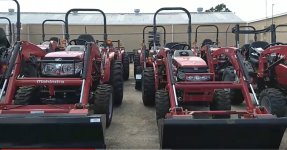
My local dealer has a yard full of slightly faded 2017 shuttles in all sizes. He's bringing in a dozen brand-spanking new 2018's for us to look at. All HST's. Guess the shuttles didn't sell too well around here. Drove a 2018 2538 HST today, with the good seat, armrests, perfect pedal/control layout, and loved it. Just too big for our woods.

Good luck!
 
/ Evaluating options for a compact #40  
..... SNIP.....

My local dealer has a yard full of slightly faded 2017 shuttles in all sizes. He's bringing in a dozen brand-spanking new 2018's for us to look at. All HST's. Guess the shuttles didn't sell too well around here. Drove a 2018 2538 HST today, with the good seat, armrests, perfect pedal/control layout, and loved it. Just too big for our woods.

Good luck!

I can answer that one. I've had both types of transmission - in fact I have both types now (again).

HST is much nicer than a shuttle for hilly country, icy slopes, as well as much better for using the loader. That's because with the HST, when you take your foot off the treadle all tractor driving force stops. Any momentum that the tractor has simply disappears.So reducing the treadle acts like it puts on the brakes as you reduce the drive. Completely off and no drive at all, and it doesn't even want to roll. My Kubota HST also automatically adjusts the throttle to compensate for any motion of the treadle. The throttle can be adjusted separately, but you don't have to.

With a shuttle-shift, the throttle is separate. But more importantly, with a shuttle you are always in gear unless you deliberately shift into neutral. So as you slow down it doesn't want to stop. You are still in gear even if you reduce the throttle. So to come to a complete stop or just inch forward with a shuttle you need to either shift into neutral, tap or stand on the brakes, or shuttle into reverse and go backwards.

Now for use on long straight sections like a huge lawn or a farm field the shuttle is nicer because you can just set the throttle, select a gear, relax, and just continue on without any foot or hand control needed.
rScotty
 

Marketplace Items

2018 Chevy Traverse 3rd Row Seating (A61306)
2018 Chevy...
Wacker Neuson EZ26 (A60462)
Wacker Neuson EZ26...
2005 JOHN DEERE 160C LC EXCAVATOR (A59823)
2005 JOHN DEERE...
2014 Nissan Sentra Sedan (A59231)
2014 Nissan Sentra...
2007 Ford F-250 4x4 Crew Cab 7ft. Flatbed Truck (A59230)
2007 Ford F-250...
2012 HYUNDAI  HL740-9 WHEEL LOADER (A58214)
2012 HYUNDAI...
 
Top