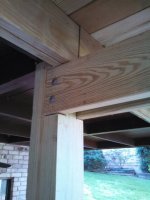
Fasteners per pole barn header, am I thinking about this right?

   / Fasteners per pole barn header, am I thinking about this right? #1  

petebert

Silver Member
Joined
Oct 12, 2011
Messages
223
Location
Outside of Ann Arbor
Tractor
...
Menards 24x50 pole barn. They include a box a 60d 6" nails and don't tell you how many you need to use. I'm wanting to use Spax construction lags instead of the nails.

So here's my thinking, 25lb snow load, 10lb dead weight, add in a buffer, so lets say 40lbs x 24 x 50 = 48000lbs of potential weight on the headers.

There's a north and south wall, so each wall will hold 24,000lbs. One header on each side of the posts, so 12,000 per side and there's a post every 10' so 2400lbs per 10' section. So is this the correct way to think of this, are the fasteners for each 10' section responsible for 2400lbs of weight?

Now I look at the Spax specs, 250lbs/in for the 5/16 screws and they include this note "Withdrawal” design values are to be multiplied by the length of the thread penetration into the side grain of the main member. Length includes tip." So I believe this means if I got a 6" screw, subtract 1.5 for the header thickness, that leaves you with 4.5 x 250 for 1125lbs per screw. So 2 screws per post would give me 4500lbs per 10' section.
 
   / Fasteners per pole barn header, am I thinking about this right? #2  
My head is spinning from the math. But, aren't those screws going to be in shear mode rather than withdrawal mode?

Doug in SW IA
 
   / Fasteners per pole barn header, am I thinking about this right? #3  
...

There's a north and south wall, so each wall will hold 24,000lbs. One header on each side of the posts, so 12,000 per side and there's a post every 10' so 2400lbs per 10' section. So is this the correct way to think of this, are the fasteners for each 10' section responsible for 2400lbs of weight?

...
Are you going to attach the headers to the sides of your posts with a fastener? Either the 6 inch nails that came with the kit, or structural screws that you will buy?

In my experience, you never want the load of a header held in place by a fastener of any kind.

For maximum strength, the ends of the header should be resting on solid wood. In home construction, the header is supported by a Jack Stud. In pole barn's, you can attach blocking to the sides of your posts to create support for your header, or you can notch the top of the post for one of the headers, and block the outside header.

I would use structural screws to hold the header in place once it's supported by lumber under it.
 
   / Fasteners per pole barn header, am I thinking about this right? #4  
Eddie has it right, as usual. The headers should be on notches or plates. Your math may work but you are thinking of it wrong. Bolts, screws, nails don't provide the shear resistance. They hold pieces together tightly so the friction between the pieces provide the shear force.
 
   / Fasteners per pole barn header, am I thinking about this right? #5  
I've been in hundreds of pole barns and never seen one with the poles notched for the headers. Not saying its a bad idea, just unneeded.
 
   / Fasteners per pole barn header, am I thinking about this right? #6  
As a follow-up, look at Morton Building, maybe the largest pole barn builder, whom doesn't notch. RR Buildings on YT, while not technically pole barns, doesn't notch either. It simply is not required or needed.

Same scenario for decks, poles should not be notched.
 
   / Fasteners per pole barn header, am I thinking about this right? #7  
Notching is just one option that is very effective at providing the most strength possible. Morton likes to use laminate posts in their buildings, and they provide more of a Jack Stud when fabricating their posts so the header has solid wood under it.

Another option, which is very common in decks, is to put the header on top of the post. One of the biggest mistake people make with decks is not understanding the difference between a "beam" and a "joist" The next biggest mistake is relying on nails to hold their "beams" in position.

You also have to identify if the lumber is actually supporting a load. If it has a truss resting anywhere in the span, between the posts, then you need a header that is supported by solid wood under it. If the truss is resting on the post, and there isn't anything on the span of the top board, then you have a purlin, and there isn't any need to do anything more for strength.

When building, never rely on what others do, or we've always done it this way, or what somebody got away with. Always build using best known methods.
 
   / Fasteners per pole barn header, am I thinking about this right? #8  
As a timber framer I'd go the extra mile and notch the post on a pole barn.

Every single joist/beam/girt I cut goes into a housed mortise joint. Otherwise the strength of the timber is limited to the strength of the tenon, or in the case of a non notched post in a pole barn, the strength of the fasteners.


1697636067621.png
 
   / Fasteners per pole barn header, am I thinking about this right? #9  
That's really nice. It's pretty fast and simple to notch posts, but I've never done a mortise joint before.

10384848_10204069421238508_775605350227818080_n.jpg
 
  • Good Post
Reactions: JJT
   / Fasteners per pole barn header, am I thinking about this right? #10  
When building, never rely on what others do, or we've always done it this way, or what somebody got away with. Always build using best known methods.
I am not arguing, but Morton buildings are well engineered. If you want to go overboard, go for it, but it is unneeded and a waste of material. "Best known method" is comprised of many things, including the most efficient way to accomplish the goal.

*Morton does use laminated poles, but the laminations are parallel to the trusses. There is nothing under the ledger board unless it is required for siding in which case it is not structural.
 
   / Fasteners per pole barn header, am I thinking about this right? #11  
So you're saying it's cool to slap top band or header or whatever you call it on the side of the post and run some screws in it and then put trusses and a roof on it? You don't recommend at least sitting the truss on top of the post? Who said Morton buildings are well engineered other than Morton and you? I'm just curious. Notching out a post doesn't require any more material, maybe a little more time. I would think the advice given on here would err on the side of caution and conservatism rather than the other way.
 
   / Fasteners per pole barn header, am I thinking about this right? #12  
Notching a post is good insurance, not overkill, I like to bolt my headers to my post rather than a nail or a screw as I think it's a stronger connection and I want it setting in a notch.
 
  • Good Post
Reactions: JJT
   / Fasteners per pole barn header, am I thinking about this right? #13  
I don't think that would pass code around here. I really don't know because I've never seen anyone do it before. Maybe on a shed or something but not a significant structure.
 
   / Fasteners per pole barn header, am I thinking about this right? #14  
I don't think that would pass code around here. I really don't know because I've never seen anyone do it before. Maybe on a shed or something but not a significant structure.
I would have thought it common , it sure is around here, would have never believed that a notched post with a bolted header was unusual for a pole barn.
 
   / Fasteners per pole barn header, am I thinking about this right? #15  
It is common. I didn't make myself clear. I was saying that NOT notching the posts is not common. We agree and were saying the same thing.
 
   / Fasteners per pole barn header, am I thinking about this right? #16  
If you use the lags, I highly recommend pre-drilling the holes full length first. I had a 36" X 96" horse barn, and 36' X 40' a shop built back in 2010 where the contractor used the Spax Power Lags. I didn't know until a month or so after they finished they split every 4 X 6 pole, by not pre-drilling. You have to remember those poles are the center cant of a log and split very easy. I emailed Spax telling them what happened and the Rep that replied asked for pictures and requested my ph.#. I sent pictures and the next day one of their engineering reps called me confirming my thought that they should have been pre-drilled. IIRC, it's even printed in the instructions on the box per the Rep. I'd already cleaned up and burned all packaging in the construction cleanup.

When I contacted the contractor about it, he offered to comeback and patch it. I was so irate, I told him I never wanted him setting foot on this place ever again, I'd fix it myself. I ended up cutting yellow pine 2 X 6's about 3' long and sandwiching that section of pole with Gr. 5, 8" galvanized bolts, then stagger spiked a 30" 2 X 4 jack stud under the headers. It's been 10 years and we've had a few decent 6" - 10"+ snows and it is still holding up well.

I'm thinking the contractor here used 5/16 X 5-1/2" or 6" lags and long enough they nearly met of bypassed each other causing the split. You're pretty much screwing a wedge in there without pre-drilling. And definitely stagger them so they are not running in the same grain of the wood.

I assume you will be using an impact driver to run the lags in. An old carpenters trick my Grandpa used, and was passed down through is to put a dab of Bee's wax on the tip of a screw, or nail for lube, and all will drive easier. A toilet bowl ring is a cheap source for Bee's wax. For screws I take a cheap ladle and bend a 90º at the cup. Cut chunks of wax, then heat with a propane torch. Then pour the wax in a empty pill bottle. I usually carry it in one side of my nail apron. For nails, all of my hammers are the Plumb fiberglass handled hammers, before that back in the early 60's we had wooden hammer handles. Simply drill a 3/8" hole, maybe 2" deep in the end of the hammer handle, and pack with the Bee's wax with your knife, or screwdriver. You may have to stop and refill it a couple times a day, but well worth it. That's a good job for a little, or big helper wanting to "help", yet stay out of the way. I know, that was my job for more than several years helping Dad when he was building something. He always had 2 hammers when building something, and it was my job to "load" the hammers and stay out of his way when not carrying materials.
 

Marketplace Items

2013 CATERPILLAR 336EL EXCAVATOR (A60429)
2013 CATERPILLAR...
TAKEUCHI TL8 SKID STEER (A60429)
TAKEUCHI TL8 SKID...
2015 BMW 328i Sedan (A59231)
2015 BMW 328i...
SANY SY225C9C5KL EXCAVATOR (A59823)
SANY SY225C9C5KL...
2019 ATLAS COPCO QAS 25 T4F NB-3 PHASE GENERATOR (A60429)
2019 ATLAS COPCO...
2023 Kubota M4-061 Deluxe MFWD Utility Tractor with LA1154 Front Loader (A55315)
2023 Kubota M4-061...
 
Top