fill ag tires @ 50% or 75% for lowest Vertical Center of Gravity (VCG)?

/ fill ag tires @ 50% or 75% for lowest Vertical Center of Gravity (VCG)? #41  
Another thing to consider, since this is a discussion of COG. COG is measured vertically and horizontally.

Vertical COG is important in side slope situations. Weight can be added to the tractor chassis to lower the COG or make the tractor more stable.

The tractor chassis, as talked about earlier, is actually sitting on a triangle when on flat ground. The front axle pivot point and each of the two rear tires.

When rear wheel weight is added the horizontal COG moves rear ward. Toward the two point base of the triangle. The farther rearward it moves the more stable the platform becomes in a side slope situation. A tractor with rear wheel weight added is more stable. It's not magic. It's very simple.

Now to the original question. The difference between 75% and 50% fluid filled rear tires is positively measurable. As everything is.

I contend that this small difference isn't worth worrying about. Especially if you are comparing it to a tractor with no rear wheel weight added.
 
/ fill ag tires @ 50% or 75% for lowest Vertical Center of Gravity (VCG)? #42  
I don’t know anyone who would think rear ballast isnt beneficial with loader work.
Even more than beneficial, it is safer and in some cases, life preserving.

Only time I wouldn’t want it is if there was a ground compaction issue or I wanted flotation.
 
/ fill ag tires @ 50% or 75% for lowest Vertical Center of Gravity (VCG)? #43  
Sometimes it just does not make sense to respond. I have been driving tractors for 57 years and using FELs for probably 50 of that starting with a Superior loader on a narrow front Oliver 77. I simply do not care what some of these guys think the fact are. Some of the rest of you here have similar tractor experiences. A battle of wits with the unarmed is not worth your time.
 
/ fill ag tires @ 50% or 75% for lowest Vertical Center of Gravity (VCG)? #44  
Sometimes it just does not make sense to respond. I have been driving tractors for 57 years and using FELs for probably 50 of that starting with a Superior loader on a narrow front Oliver 77. I simply do not care what some of these guys think the fact are. Some of the rest of you here have similar tractor experiences. A battle of wits with the unarmed is not worth your time.

I agree Rick and Hay Dude.

I always think about someone stumbling onto this thread in the future. Sometimes I can't keep my mouth shut. I'll work on that.
 
/ fill ag tires @ 50% or 75% for lowest Vertical Center of Gravity (VCG)? #45  
Not trying to stir a pot but want to talk about person experience in simple terms. At my elementary school (back in the good days of unsafe play grounds, why we had monkey bars even) we have see saws. Two types, the most simple were mounted with two U type clamps in the middle. Meaning the two children needed to be near the same weight for it to work. In case you don't realize it there is wide variance in friends weight often and we had the best see saw as it different mounting system with a few different position it could rest on the pivot pipe allowing a difference in weight to balance each other. So changing the pivot point with same or different weights on each end will affect the balance or lifting of the heavy by a lighter weight. Not sure who the think Greek who said give me a pivot point and he could move the world. Might be little off on his quote.

When I bought my JD with fel I asked about having the wheels filled and the salesman was quick to add we will not sell a tractor with fel without filled tires for safety using the fel. In process of buying a Kubota with fel and the owner there said basically the same thing. Between the two of them bet over a hundred years of experience. Doubt I ever get that much experience but have experience in testing hyd cranes few years back design a lot like logger machine which of course was longer than wider. We would test for tipping over the side and the front, machine weighed did not changed but boy the tip radius did. Anyone who has ever used a excavator with real heavy load while rotating you know the conditions but we were doing a controlled tip to be sure each machine met the specs. Guess what? On machines with different length booms the counter weight (can I use that term?), weight varied a lot.

In my part of the world tires were first filled for pulling traction. But the principal of pivot points is still a valid as on those old see saws. I don't care if the weight is in front or below or behind the rear axle it does not matter. Now in front of or behind the rear axle can affect the AMOUNT of weight needed. My GUESS and yes it is a guess on my part, you fill a rear tire any percentage you want to, there will be as much weight behind the axle as in front of the axle.

Until there is a real test by a major authority proving weight in rear wheels is not the same as weight on rear lift in being a valid counter weight I still want my rear tires filled. As has been posted here sure depending on the load and the machine set up you might not need ANY counter weight. However on most machines made with less metal and lighter weights you not only may need the counter weight you must have counter weight. On a little of a side note, they calculate the operator's weight into some machine's operating weight. My 5 ton excavator does. A 400 pound operator will not need to add as much counter weight as a 100 pound operator will. Just a fact. Even amount of fuel in the machine is taken into consideration in these calculations. Some companies do this for a variety of reasons but read their manual to see if they tell how they calculate the machine weight. If they use think the term is "operating weight" might want to see what they take into consideration.

Smooth operation is much more stable than jerky operation and will not be as touchy machine.
 
/ fill ag tires @ 50% or 75% for lowest Vertical Center of Gravity (VCG)? #46  
I don't care if the weight is in front or below or behind the rear axle it does not matter. Now in front of or behind the rear axle can affect the AMOUNT of weight needed. My GUESS and yes it is a guess on my part, you fill a rear tire any percentage you want to, there will be as much weight behind the axle as in front of the axle.
I can tell you from experience that adding weight behind the rear axle will unload the front axle, we had a tractor with a big plow on the loader and it was overweight on the front axle unless we had 2000# on the 3 point.

Aaron Z
 
/ fill ag tires @ 50% or 75% for lowest Vertical Center of Gravity (VCG)? #47  
I don’t know anyone who would think rear ballast isnt beneficial with loader work.
Even more than beneficial, it is safer and in some cases, life preserving.

Only time I wouldn’t want it is if there was a ground compaction issue or I wanted flotation.

You are basically saying the lever is not advantageous.

Again, weight over the rear wheels only puts weight STRAIGHT DOWN because of how the tractor sits on the ground in relation to its axles. Fluid filled tires does little because the weight is not significant, nor in the proper position, to do any measurable amount of difference. That is why cranes, bucket loaders and cranes all have counterweights...weight further aft so that it acts as a lever.

It has to be past the rear axle of the tractor, and then as it does, the ability to counteract the bucket is cubed by distance shifted.

Incidentally I am a boom mower operator for several towns, and know the pucker factor on an every day basis. Luckily I can use the boom as a crunch to climb up some super-steep hillsides. But that is weight and counterweight left to right.

It is no different front to back with a loader. As I said, we used to fluid-fill tires, and now no longer do. I still load gravel out of the same gravel pit with the same tractor. There is no difference between fluid-filled tires and air filled tires.

In my situation, I most often tow my dump trailer with my tractor so I cannot use counterweight. If I pull my dump trailer with my truck (and thus do not need to hook and unhook from the dump trailer), the difference is staggering. I throw on our 7 foot snowblower and really dig. That is because there is a lot of weight, in the right place.

But leverage IS staggering.

When I was driving pile, sometimes the crane operator would boom out too far, and despite one heavy crane, we would grab the hook and pick the rear tracks off the ground. But that is how leverage works: when you hit the tipping point, it does not matter how much weight is on the machine, it is flippy.

The same dynamic forces are in play with a tractor and loader. And it works the same way with a cable skidder. If the cable is out too far, my skidder just spins, until the winch pulls in the trees enough to get weight over the rear axle, but that is how tractors are designed. On a skidder, 60% of the weight is up front, and 40% on the back, until a load is pulled. Then it transfers to 60% on the back, and 40% on the front. That is how they are sized. If a skidder pulls too much wood, then the front pulls upwards too much, and the tractor losses front tire traction. With a bucket loader it is backwards, the load is up front so loaded, it is 60% up front, and 40% in the back.

Tractors are no different. There has to be a 60% and 40% weight transfer for ideal weight transfer to tractive effort. You cannot get that with fluid-filled tires. There is not enough room in the tires to get enough weight with fluid since it is under the rear axle of the tractor.

Again you are arguing that weight beats the lever, and we all know the opposite is true. A fulcrum and a lever can beat any weight.
 
/ fill ag tires @ 50% or 75% for lowest Vertical Center of Gravity (VCG)? #48  
I just hope no one reads this thread and decides to remove ballast from their rear tires. I’d hate to see someone get hurt.
BTW, I don’t recommend fluid, I prefer a circular cast wheel weight.
I wonder why literally every tractor manufacturer offers wheel weights, usually suggesting them with a loader.
I know for a FACT when I lift heavy hay bales with my FEL, the back tires pop up or lose traction more than they would if I added cast centers and wheel weights.

PS I don’t dispute a 3 point hitch weight block may not be better than wheel weights, I’m saying wheel weights make using a loader safer. I think probably millions of tractor owners agree.
 
/ fill ag tires @ 50% or 75% for lowest Vertical Center of Gravity (VCG)? #49  
You are basically saying the lever is not advantageous.

Again, weight over the rear wheels only puts weight STRAIGHT DOWN because of how the tractor sits on the ground in relation to its axles.

Well, gravity only ever points straight down, so weight will point that way no matter where you put it. That will never change.

In terms of front loader counterweights and ballast, there are several factors at play, and two pivot points to be aware of.

Putting liquid in the rear tires (or using wheel weights) is a very easy way to stabilize a tractor when any implement/weight is installed forward of the front axle. Doesn't matter if it's a front loader or a snowplow or something else, when it's in the air it has leverage about the front axle and will reduce the downforce and traction of the rear wheels. If you want to counter that effect, then liquid in the rear tires is a very simple and easy solution to fix those problems. It doesn't have to be a lot of liquid, because the liquid's lever arm to the front axle is long, generally a lot longer than the lever arm of the front implement to the front axle.

The problem with the above approach is that it doesn't take weight/load off the front axle. But we're just talking about empty implements and doing it with the goal of restoring downforce and traction to the rear wheels to what they were prior to installing the front implement. And we can make a fair assumption that the tractor manufacturer has sized the front axle and wheels to carry the load of those front implements.

Counterweight *behind* the rear axle becomes important when you carry additional load in the front implement, say a load of dirt in the front bucket. It's that scenario where we now need to offset the weight and leverage of the load, and we also want to reduce load on the front axle and tires. The only way to do that is to make the rear axle become the pivot point for the levers. That is why we go with rear ballast boxes or counterweights. Their position behind the rear axle creates a moment (force x distance) that will offset the moment created by the load in the bucket.

All weights on the tractor will always act straight down, and all weights on the tractor can have leverage relative to the pivot points of the front and rear axles. This is important to visualize. Weights over axles will improve downforce and traction of the wheels on that axle but they won't generate moments about that axle. But they will generate moments about the other axle.
 
/ fill ag tires @ 50% or 75% for lowest Vertical Center of Gravity (VCG)? #50  
You have to remember, with fluid-filled tires, half of whatever you add is FORWARD of the rear axle, so that half of the weight is just weight, no counter-balance at all. And the 650 pounds you did add for counterweight (1300 pounds divided by two) is just 650 pounds because it is not past the rear axle any significant length.

If you add 650 lbs of fluid in a tire, you make that tire weigh 650 lbs more than it did before. That weight, when used as ballast, is hanging off the axle as the rear of the tractor is being lifted. There is no front/behind, it hangs off the axle.
 
/ fill ag tires @ 50% or 75% for lowest Vertical Center of Gravity (VCG)? #51  
Well, gravity only ever points straight down, so weight will point that way no matter where you put it. That will never change.

In terms of front loader counterweights and ballast, there are several factors at play, and two pivot points to be aware of.

Putting liquid in the rear tires (or using wheel weights) is a very easy way to stabilize a tractor when any implement/weight is installed forward of the front axle. Doesn't matter if it's a front loader or a snowplow or something else, when it's in the air it has leverage about the front axle and will reduce the downforce and traction of the rear wheels. If you want to counter that effect, then liquid in the rear tires is a very simple and easy solution to fix those problems. It doesn't have to be a lot of liquid, because the liquid's lever arm to the front axle is long, generally a lot longer than the lever arm of the front implement to the front axle.

The problem with the above approach is that it doesn't take weight/load off the front axle. But we're just talking about empty implements and doing it with the goal of restoring downforce and traction to the rear wheels to what they were prior to installing the front implement. And we can make a fair assumption that the tractor manufacturer has sized the front axle and wheels to carry the load of those front implements.

Counterweight *behind* the rear axle becomes important when you carry additional load in the front implement, say a load of dirt in the front bucket. It's that scenario where we now need to offset the weight and leverage of the load, and we also want to reduce load on the front axle and tires. The only way to do that is to make the rear axle become the pivot point for the levers. That is why we go with rear ballast boxes or counterweights. Their position behind the rear axle creates a moment (force x distance) that will offset the moment created by the load in the bucket.

All weights on the tractor will always act straight down, and all weights on the tractor can have leverage relative to the pivot points of the front and rear axles. This is important to visualize. Weights over axles will improve downforce and traction of the wheels on that axle but they won't generate moments about that axle. But they will generate moments about the other axle.

Very well written!!!!

If we remember nothing else out of this, be it this, the fulcrum when using a loader is NOT the rear axle. It's the front axle.

Any weight added rearward of the front axle becomes counter balance. Even the operator.

Any weight added rearward of the rear axle adds counter weight to the rear axle.

Back to the original intent and question of this thread. Rear wheel weight adds stability to the tractor. Effective stability. The weight added to the rear wheel above the axle only becomes a negative when the side slope is very severe. By that time you won't care whether the tire is 75% full or 50% full.
 
/ fill ag tires @ 50% or 75% for lowest Vertical Center of Gravity (VCG)? #52  
If you add 650 lbs of fluid in a tire, you make that tire weigh 650 lbs more than it did before. That weight, when used as ballast, is hanging off the axle as the rear of the tractor is being lifted. There is no front/behind, it hangs off the axle.

Yep. Somehow that is being misunderstood by BrokenTrack.
 
/ fill ag tires @ 50% or 75% for lowest Vertical Center of Gravity (VCG)? #53  
Yep. Somehow that is being misunderstood by BrokenTrack.

I think brokentrack wants to change the fulcrum by moving the location of the weight. Weight on the rear axle helps if only the front axle is the fulcrum. Hanging weight to the rear of the rear axle moves the fulcrum to the rear axle...sort of.
 
/ fill ag tires @ 50% or 75% for lowest Vertical Center of Gravity (VCG)? #54  
I think brokentrack wants to change the fulcrum by moving the location of the weight. Weight on the rear axle helps if only the front axle is the fulcrum. Hanging weight to the rear of the rear axle moves the fulcrum to the rear axle...sort of.

Yep. The "subject" got changed in the midst of defending a position.
 
/ fill ag tires @ 50% or 75% for lowest Vertical Center of Gravity (VCG)?
  • Thread Starter
#55  
I had to get out of this thread. It went waaaay off track. Some posters (BT) actually did not read or understand the original question, then ridiculed me, then contradicted themselves from one post to the next, then posted irrelevant information, then posted incorrect information. How could anyone have thousands of posts and still not have correct information?? Can you imagine a new person reading this information? I am not an expert but I just want be safer and I paid attention in math class.

I am sorry for the confusion. I just wanted to know if 50 or 75% fill was preferred for better VCG, while static on a slope, no load in the bucket. i went back a year or two and did not find any info with this specific topic. yes, tractor moving on a slope adds many additional factors and I did not wish to get that complicated. Fortunately, posters such as OVRSZD, ACZLAN, S219, RD & HP were able to keep it on track and give me good information about my question. OVRSZD understands what I am asking and I am going to read his posts multiple times. Basically if I get into a sketchy slope situation by the time the effect of a lower VCG by using 50% fill (vs 75% fill of which 25% may be above the VCG) comes into play its going to be too late anyway. TY all.

I use my post hole digger to plant my chestnuts on rocky, gravely slopes. most times I drill with the tractor perpendicular but sometimes I have go semi parallel to a slope to drill. The tractor is NOT moving, STATIC! And I still had other posters who chose not to listen and tell me 'all theoretical discussions are moot without the tractor moving', lol.

yes, the PH digger can place unusual moment arms of torque on the 3ph at any given time and these are all unknowns. So I have done as much as I can to attempt to prevent an unknown from potentially causing a rollover. I have spacers, wheel weights + filled rears and I drill slow. Be safe out there.
 
Last edited:
/ fill ag tires @ 50% or 75% for lowest Vertical Center of Gravity (VCG)? #56  
I had to get out of this thread. It went waaaay off track. Some posters (BT) actually did not read or understand the original question, then ridiculed me, then contradicted themselves from one post to the next, then posted irrelevant information, then posted incorrect information. How could anyone have thousands of posts and still not have correct information?? Can you imagine a new person reading this information? I am not an expert but I just want be safer and I paid attention in math class.

I am sorry for the confusion. I just wanted to know if 50 or 75% fill was preferred for better VCG, while static on a slope, no load in the bucket. i went back a year or two and did not find any info with this specific topic. yes, tractor moving on a slope adds many additional factors and I did not wish to get that complicated. Fortunately, posters such as OVRSZD, ACZLAN, S219, RD & HP were able to keep it on track and give me good information about my question. OVRSZD understands what I am asking and I am going to read his posts multiple times. Basically if I get into a sketchy slope situation by the time the effect of a lower VCG by using 50% fill (vs 75% fill of which 25% may be above the VCG) comes into play its going to be too late anyway. TY all.

I use my post hole digger to plant my chestnuts on rocky, gravely slopes. most times I drill with the tractor perpendicular but sometimes I have go semi parallel to a slope to drill. The tractor is NOT moving, STATIC! And I still had other posters who chose not to listen and tell me 'all theoretical discussions are moot without the tractor moving', lol.

yes, the PH digger can place unusual moment arms of torque on the 3ph at any given time and these are all unknowns. So I have done as much as I can to attempt to prevent an unknown from potentially causing a rollover. I have spacers, wheel weights + filled rears and I drill slow. Be safe out there.

Thank you for the update. Hopefully you will benefit from information given here.

Threads often "drift". Just have to wade thru it to find information that helps you.

Sorry for any confusion in this one. :)
 
/ fill ag tires @ 50% or 75% for lowest Vertical Center of Gravity (VCG)? #57  
I only fill to 50%.

1) IThe ride is so much better with some air to compress inside the tire. This also reduces the chance of a blowout and the fluid from being compressed into the carcass.

2) The tractor cg is usually pretty close to the crankshaft centerline. That's pretty much the same as the rear axle centerline. So Any fluid above the axle shaft hurst ; any below helps.

3) It's easier on the clutch, transmission and rear gears because it doesn't contribute as much to the rotational inertia.

4) Its easier to dismount or change the track width with a lighter tire than a heavier one. And if its too heavy, it can be drained out and refilled. With iron weights, it takes another tractor with a loader of a heavy jib crane to mount them on the axle.
 
/ fill ag tires @ 50% or 75% for lowest Vertical Center of Gravity (VCG)? #58  
A perspective that I visualize, that I haven't seen mentioned. This would be one element of a theoretical analysis:

A loaded tire is exerting (some) anti-rollover force until you are tipped sideways so steep that the weight of the tire is now downhill of the tractor's CG.


(After thinking about this a lot I bought a $700 ROPS for the Yanmar as soon as they became available).
 
/ fill ag tires @ 50% or 75% for lowest Vertical Center of Gravity (VCG)? #59  
I only fill to 50%.

1) IThe ride is so much better with some air to compress inside the tire. This also reduces the chance of a blowout and the fluid from being compressed into the carcass.

2) The tractor cg is usually pretty close to the crankshaft centerline. That's pretty much the same as the rear axle centerline. So Any fluid above the axle shaft hurst ; any below helps.

3) It's easier on the clutch, transmission and rear gears because it doesn't contribute as much to the rotational inertia.

4) Its easier to dismount or change the track width with a lighter tire than a heavier one. And if its too heavy, it can be drained out and refilled. With iron weights, it takes another tractor with a loader of a heavy jib crane to mount them on the axle.

Agree with everything but #4.
I can put 100lb wheel weights on without a crane. If they’re over 100, 2 guys can do it in a few minutes with an impact wench. Also, it’s not necessary to remove cast weights if the tires need to be replaced. If fluid filled, the fluid needs to be removed & replaced. More time consuming.
 
/ fill ag tires @ 50% or 75% for lowest Vertical Center of Gravity (VCG)? #60  
Agree with everything but #4.
I can put 100lb wheel weights on without a crane. If they豎*e over 100, 2 guys can do it in a few minutes with an impact wench. Also, it逞エ not necessary to remove cast weights if the tires need to be replaced. If fluid filled, the fluid needs to be removed & replaced. More time consuming.

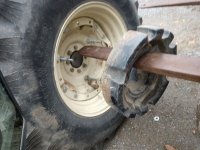
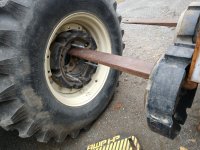
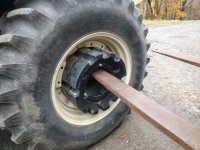
My weights are 300# each, a bit much to manhandle;
removing weights 4.jpgremoving weights 3.jpgremoving weights 2.jpgremoving weights 1.jpg

That said, yes non liquid filled tires are much easier to dismount and repair.

Also I am fairly certain that Titan Tire in their tire book recommends only a 40% fill when tires are liquid filled.
 

Marketplace Items

iDrive TDS-2010H ProJack M2 Electric Trailer Dolly (A59230)
iDrive TDS-2010H...
2016 Freightliner M2 106 Ambulance (A59230)
2016 Freightliner...
ST205/75R15 Trailer Tires (A55788)
ST205/75R15...
2017 CATERPILLAR 926M WHEEL LOADER (A60429)
2017 CATERPILLAR...
POWER MATE (12) SHANK CHISEL PLOW 3PT (A60430)
POWER MATE (12)...
2016 DRAGON SAND CONVEYOR (A58214)
2016 DRAGON SAND...
 
Top