Grading Finish Blade test - the blades

   / Finish Blade test - the blades #1  

Charlie_Iliff

Veteran Member
Joined
Jun 13, 2001
Messages
1,890
Location
Arnold, MD
Tractor
Power Trac PT1845, John Deere 2240, John Deere 950, John Deere 755, Jacobsen Turf Cat II
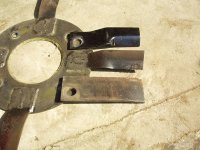
Attached is a picture of the blade I cobbled up, compared to the stock PT rough cut blade for the 1845's 72" rough cut mower. The purpose of the exercise was intended to be development of finish blades which will do lawn quality cuts, but not self-destruct when encountering a little hump in the soil. (See broken mower blade thread.)
The plan was to put four on each stump jumper, 12 in all, instead of the two per spindle on the rough cut system. The PT finish blades are four per spindle, but rigidly welded to a ring, not free swinging. I'll attach a pic of that to the next post.
 

Attachments

  • 54-174478-P7170003.JPG
    54-174478-P7170003.JPG
    84.1 KB · Views: 232
   / Finish Blade test - the blades
  • Thread Starter
#2  
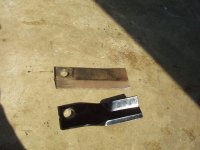
For further comparison, here is one of my blades and a rough cut blade lying on the factory finish blade ring. The factory finish blades are 1/8" thick, my blade is 1/4" thick, and the rough-cut blades are 3/8".
I selected a Gravely blade that would have about the same drop from the plane of the disk as the stock finish blades. In the photo, the ring is upside down. The blades are offset downward from the stump jumper something over an inch. The Gravely blades have a little less offset, but more "lift" - more bend upward of the trailing edge.
 

Attachments

  • 54-174483-P7170010.JPG
    54-174483-P7170010.JPG
    88.8 KB · Views: 206
   / Finish Blade test - the blades
  • Thread Starter
#3  
Re: Finish Blade test - failure # 1

So I mounted the 12 blades and attacked a horse pasture, where grass growth has been slow, some areas are grazed to dirt, and some weeds have grown a foot. One single-stem weed, particularly, was up a foot or so, thinly scattered over the field. To my dismay, more often than not I ran over the tall stem and it popped back up in my wake as if I hadn't been there. The cut was rough throughout. I did not have much fairfly smooth grass to try, but it seemed better cutting tall fescue back from 8" to 5" than it did on taller weeds, etc. I had the mower set high. Clearly, the very high lift blades were creating pressure distributions under the deck which flattened a lot of stuff below the blades, rather that picking it up for even cut. I learned something, I guess, but I'm not sure yet what.
 
   / Finish Blade test - the blades
  • Thread Starter
#4  
Re: Finish Blade test - Failure # 2

The temperature when I started mowing was 94. With the rough cut blades, I have been able to mow with that temperature, but the machine running hot. With the factory finish blades, I had one genuine overheating incident. With my special super high lift swiveling set, The needle started up in 15 minutes, and would have gone all the way to engine meltdown if I hadn't stopped at 1/2 hour, 240 degrees, and the anemic alarm sounding, but inaudible even with Pro-Ears until I shut down the mower.
With this experience I did learn something. The higher the lift on the blades, the more the dust and grass fragments are blown out from under the mower, and the faster the oil cooler plugs up.
My first overheat incident was with the factory finish blades and the deck fairly low. A lot of stuff was blown out the front in that configuration. This test was with the deck high, and most was blown out the back, underneath the machine.
As testing progresses, if I don't lose interest and let the weeds grow, I'll try the deck tilted forward and back to see if it makes a major difference.
So, after the overheat, I drove it a mile, blew out the oil cooler, removed half the blades, and went back to mowing. [Continued next Post]
 
   / Finish Blade test - the blades
  • Thread Starter
#5  
Re: Finish Blade test - qualified success

After removal of half of the new blades, so I had just two per spindle as the rough-cut blades are mounted, the deck cut much better, and in fact was a bit smoother cutting at reduced throttle than at full chat. More importantly, the temperature stabilized at 220 and stayed there for an hour. Outside temp was still over 90. The amout of debris blowing out the back was reduced enough that accumulation on the oil cooler was significantly less than with 12 blades. So, I now have 2 sets of super high lift swiveling finish blades.
I'll have to wait for the fall growth spurt to try the blades on the lawn. My suspicion is that PT 4xx owners and Scag, Exmark, etc operators will not be switching to PT 1845's with Iliff custom blades for smooth lawn work. It may be, however, that if I am actually cutting only a small bit off the top of already smooth grass, these blades will do better than the rough cut blades. For horse pastures, I have to declare my experiment a failure, and remount the 3/8" thick rough cut blades. They have minimal lift, and the engine will run a lot longer without overheating.
 
   / Finish Blade test - the blades #6  
Re: Finish Blade test - qualified success

Charlie, that's an interesting experiment. Kinda makes you wonder whether more blades are better or worse; sounds like worse. It reminds me of the instructions with my DR trimmer/mower. It uses two strings, but you could just as easily put 4, or more, strings on it, but I haven't tried it with 4 because the manual says "Please note that installing more than two cords at a time does not improve trimming performance - in fact it can lessen it."
 
   / Finish Blade test - the blades #7  
Re: Finish Blade test - qualified success

<font color=blue> I have to declare my experiment a failure </font color=blue>

At least you (and we) now know more than before.....that makes the experiment quasi-successful in my book. Thanks for reporting it in detail.....thought provoking!
 
   / Finish Blade test - the blades #8  
Re: Finish Blade test - qualified success

I'd think that even with two blades, as you increased the pitch of the blade to gain lift, the wind resistance would increase, thus loading the engine down more and increasing your temperature. Add two more blades and you are doubling the amount of air that the blades have to push, etc...

The same thing would happen with a string trimmer. More strings = more wind resistance = more load on the engine.

Am I thinking correctly here?
 
   / Finish Blade test - the blades
  • Thread Starter
#9  
Re: Finish Blade test - qualified success

Bird:
Certainly more blades was not as good in this particular application. Over on Lawnsite, I see a lot of claims by those using "doubles", often with two blades of different lift characteristics. Most claim better finish cuts. With my deck, with no contouring for air flow, and a lot of volume taken up by stumpjumpers, my working theory is that the "lifted" air came back down where it pushed the grass out of the way of the blades. I also have a DR string trimmer. I think more strings slows it down too much. I don't think I have that problem with the mower spindles, but at some point I might put some kind of tach on the deck.
Now, if I can just figure out what it is I'm learning so the next step is an improvement .../w3tcompact/icons/smile.gif
 
   / Finish Blade test - the blades
  • Thread Starter
#10  
Re: Finish Blade test - qualified success

David:
You're certainly right that more blades result in more drag, and more pitch (lift) results in more drag. The highest drag system I tried was with the factory finish blades with the deck low - at a height for a showoff lawn, that Bubenberg tells students never to do because it hurts the grass. Certainly that caused the most heat, until my 12-blade run yesterday. The stuff I was cutting with the stock blades was a lot thicker than yesterday, however, and I think would have been signiicant drag even with the rough cut system. Yesterday, I overheated it even at part throttle, where I have been able to cut heavy stuff wide open with no problem if the oil cooler was clear. I think that load is certainly a factor, but less of one than even a 20% blockage of the cooling air flow.
 
   / Finish Blade test - the blades #11  
Re: Finish Blade test - qualified success

I think the load is a much bigger factor than the hydraulic cooler. While the blocked oil cooler is a significant cause of heat, I'll bet that if you clean it out and run it on a concrete driveway for a while, with and without the multiple blades, and the deck at the same height for each test, the heat will be much higher with multiple blades. The only experience that I have to back this up is an excercise bike with a big fan in it instead of a wheel. The faster you turn the fan the harder it is to pedal. And there was a significant difference in horse(David) power required to get even one more mph out of that thing.

I still think that if you double the number of blades, you are doubling the required power to push them through the air, or at least very close to doubling it.

However you have more experience in this area than me, with the boats and planes and such. Is my thinking correct or is the hydraulic cooler more important?
 
   / Finish Blade test - the blades #12  
Re: Finish Blade test - qualified success

Perhaps I am only (again) exposing my newbie naiveté, but, assuming this application (or another) had turned out workable, but tended to run the heat up, why not simply add another oil cooler and fan in series?

Presumably, the oil is returning to the main tank after cooling, so (unlike a filter prior to the pump, which may slow flow and thereby reduce power), I can’t think of why this would create a problem. (well, maybe where to mount it…/w3tcompact/icons/hmm.gif)
 
   / Finish Blade test - the blades
  • Thread Starter
#13  
Re: Finish Blade test - qualified success

David:
I have no doubt that you are right about the multiple blades contributing significantly to the heat. The oil cooler I'm having a problem with, however, isn't the hydraulic system cooler, although it also caked up pretty thoroughly. My heating problem is the engine oil cooler, which is the only cooling system on the Deutz. It is small to my eye, and I think my experience has shown that there is little reserve cooling capability. On a hot day, running on the road at full throttle takes the temperature to a bit over 200. Cutting fairly heavy grass on in the same ambient temperature runs the engine temp gauge to a bit over 220, where it stabilizes. When the oil cooler starts to cake up with dust, however, the temperature starts to climb. That happens even if I reduce the throttle, which suggests to me that the heating is more air flow related than load related, although I have no doubt that you are right that the twelve blades are a lot more drag than six.
The bottom line certainly is that the machine won't work with 12 high lift blades, since I not only got a bad cut, but also overheated the engine due to the combination of increased drag and blocked cooler from the cloud of grass and dust thrown out under the machine. But, help is on the way. I talked to Terry and he is going to send a pre-screen for the intake air. I can then continue to experiment, perhaps with a longer interval between trips to the compressor. My growing suspicion, however, is that my best configuration is going to turn out to be sharpened rough-cut blades, and a different machine for lawn grooming - or at least a different deck.
 
   / Finish Blade test - the blades
  • Thread Starter
#14  
Re: Finish Blade test - qualified success

Doug:
As I note in a response to MossRoad, I obviously wan't clear about which oil cooler was a problem. The overheating was the engine, since dust plugged its oil cooler. Since it is only oil cooled, with neither a water radiator nor air-cooling fins, that is a problem.
As I am sure you've seen on yours, there is a side plate held by two bolts that exposes the under side of the engine oil cooler. Blowing air down from the top removes dust that is caked on the bottom, restricting flow. There hasn't been any problem at all except mowing with high lift blades in dry grass (weeds). When the deck spews a lot of dust, however, it doesn't take a very high percentage of the cooler to be blocked before the temp needle climbs.
It would be possible, of course, to plumb in another cooler and fan, but it would be a more complex project than putting one in the hydraulic system. For now, I'm going to try the pre-screen that Terry is sending, and use only two blades per spindle. I might actually hit a good combination so my money won't have been completely wasted.
Got to admit, despite the disappointment, I enjoy the experiment more than just going out and cutting the furshlugginer grass.
 
   / Finish Blade test - the blades #15  
Re: Finish Blade test - qualified success

<font color=red>As I am sure you've seen on yours, there is a side plate held by two bolts that exposes the under side of the engine oil cooler. Blowing air down from the top removes dust that is caked on the bottom, restricting flow. </font color=red>

When I overheated mine and got the alarm (For a while there I thought I must be dreaming, but now I see Charlie has one too) I took off the cover and blew it out - it was nearly clean. Then I checked the manual which calls for a cleaning every 250 hours. I wonder if the roughcut mower is just too much for this engine, keeping it at full HP output in heavy going. It would seem to me that this is an industrial engine and should be designed and rated for continuous full load operation. But maybe not.

My spacer stock arrived today from Aircraft Spruce so the plan is to make some spacers and try 12 roughcut blades this weekend, though it would appear from Charlie's experience that I'll be wasting my time. My problem has been the uncut stripe to the left of the right blade, which I think might be the point of maximum grass loading under the deck. Where the grass from the center blades and the grass from the right blades collide. And just jamb the works at that point. With the rubber deflector on the rear discharge there really is no effective discharge area. I wonder what happens if the rubber is removed? Aside from the obvious safety issues, it might relieve the grass loading. And might make Charlie's high lift blades work too. If I can figure a way to keep from getting konked I may try taking the thing off.
 
   / Finish Blade test - the blades
  • Thread Starter
#16  
Re: Finish Blade test - qualified success

John:
I'm not sure that four rough cut blades will be bad. I'm reasonably convinced that it was the high air flow that caused my problem. The rough cut blades have little lift.
Tonight, I left the rear wheels at the highest setting, but dropped the front wheels by two spacers - an inch. I mowed a field, still with two high-lift offset blades per spindle. It did the best job of any combination of settings I've used. So little right side stripe that I can call it nonexistent. /w3tcompact/icons/smile.gif
The ambient temp was 90, decreasing to 88 over the 1 1/2 hours of mowing. I didn't pull the panel to look at the oil cooler. The highest the temp got was 230. Mine has never gone over 230 unless the oil cooler was at least 20 percent blocked. I'll look forward to seeing the performance with a coarse screen on the cooling air.
Re the alarm. Either it didn't go off the first time I overheated it, or I just didn't hear it over the mower noise. Terry still tells me there isn't one.
 
   / Finish Blade test - the blades #17  
Re: Finish Blade test - qualified success

Charlie: <font color=red>Tonight, I left the rear wheels at the highest setting, but dropped the front wheels by two spacers - an inch. I mowed a field, still with two high-lift offset blades per spindle. It did the best job of any combination of settings I've used. So little right side stripe that I can call it nonexistent.</font color=red>

I've read that lower in the front takes less power but that seems like a dramatic improvement. I'll see if I can get the four 12 blades on this weekend and see what happens.

My new high zoot 18v Milwaukee impact driver came yesterday too. For all these many years I've resisted buying one for the few times it would have been handy but I must say changing those blades without one tipped the balance right off the scale! There just ain't no way to stop them spindles turnin' on ya.

<font color=red>The highest the temp got was 230. Mine has never gone over 230 unless the oil cooler was at least 20 percent blocked.</font color=red>

Mine runs normally in the 230 range until I put on the mower, then it runs at 235-240 at 80 degrees ambient and goes up a degree for each degree above 80 degrees ambient. Roughly. The alarm is so faint with the engine at full scream it's essentially useless.
 
   / Finish Blade test - the blades #18  
Re: Finish Blade test - qualified success

Air resistance vs speed is a squared function. ie if at 1000 blade rpm the air resistance requires 3hp to keep them spining then at 2000 rpm you need 9hp (3 to the second power or 3x3)

It's likely 4 blades doubled the resistance, but it may have required the engine to produce 95% of its available power all the time, causing it to overheat. If we use the above example and double the power at 1000 rpm you would require 6hp then at 2000 rpm you would be using 36hp! (my example numbers are just pulled out of the air but they illistrate how much power can get sucked up quickly)

Another thought to ponder is a woodworking example. A 24 tooth blade will cut faster than a 40 tooth blade, and a 40 tooth blade will cut faster than an 80 tooth blade. But more teeth give a better finish because each is taking a smaller cut. Maybe the feed rate (in this case ground speed) was just too fast for the 4 blade system.
 
   / Finish Blade test - the blades #19  
Re: Finish Blade test - qualified success

Well, just hold me down and slap me silly until I listen to what you are saying. /w3tcompact/icons/tongue.gif I completely forgot that it is an air cooled engine. Sorry for the confusion on my part.
 
   / Finish Blade test - the blades #20  
Re: Finish Blade test - qualified success

Math to the rescue! Thanks. I wondered why it seemed so hard to get the last MPH out of that excercise bike /w3tcompact/icons/tongue.gif
 

Tractor & Equipment Auctions

45ft. T/A Flatbed Trailer (A59230)
45ft. T/A Flatbed...
(2) UNUSED 31" X 8 MM EXCAVATOR TRACKS W/ PINS (A60432)
(2) UNUSED 31" X 8...
Cushman Hauler 1200X Golf Cart (A57148)
Cushman Hauler...
2006 Keystone Laredo 29RL 31ft. T/A 5th Wheel Travel Trailer (A55853)
2006 Keystone...
UNUSED RAYTREE RMSC78-78" HYD SOIL CONDITIONER (A60432)
UNUSED RAYTREE...
2008 JCB 190 ROBOT SKID STEER (A60429)
2008 JCB 190 ROBOT...
 
Top