Fluorescent Bulbs

   / Fluorescent Bulbs #61  
hockeypuck said:
At first look CFL's seem to be a no brainer, but after further review I will have to put it into the same category as the Prius and ethanol. You buy them and they make you fell good, but they are not very echo friendly after all. CFL's do have alot of mercury in them. Proper disposal will be difficult to manage. I read on one web site that they actually recommend cutting up the piece of carpet that it broke on. The prius has too many byproducts from its battery production and disposal to really make it worth while buying and ethanol takes more energy to produce, than it actually produces. It also is driving up the cost of my cereal. Using food to make fuel, there is something just plain wrong with that.

So in short, use halogen lights, drive a Hummer, and drill in Anwar.

Actually they have very little mercury in them but then this has already been discussed.
 
   / Fluorescent Bulbs #62  
What I want to see is somebody do a set of curves that relate initial bulb cost, operational cost and longevity... to a filament bulb initial cost and operational cost and longevity.... That is, how long does a bulb have to live before it pays for itself compared to a filament bulb. Let's not use the touted life of a CFL, but do a 1 week, 1 month, 6 month, etc life time for the CFL.

We have many testamonials to both short and long cfl ife...

my own experience tends toward the short life.... so the economic question is interesting.... assuming one ignores initial energy to manufacture both bulbs and disposal cost...
 
   / Fluorescent Bulbs #63  
texasjohn said:
What I want to see is somebody do a set of curves that relate initial bulb cost, operational cost and longevity... to a filament bulb initial cost and operational cost and longevity.... That is, how long does a bulb have to live before it pays for itself compared to a filament bulb. Let's not use the touted life of a CFL, but do a 1 week, 1 month, 6 month, etc life time for the CFL.

We have many testamonials to both short and long cfl ife...

my own experience tends toward the short life.... so the economic question is interesting.... assuming one ignores initial energy to manufacture both bulbs and disposal cost...

I have had CFL's last for just a few months and I have some in my lamps that were given to me free by the utility company that are still going. That was back in 1991. Fluorescent bulbs can have life spans as high as 20,000 hours. There is a descrpancy in what is listed and sometimes what you get with a CFL in terms of life span. Maybe its quality control or perhaps a particular brand. The same is true of incandescent bulbs. I have had them last as short as 1/100th of a second from brand new as a result of not being sealed, I have seen some go for thousands of hours. The one thing without question is the lumens per watt advantage of fluorescent over incandescent. You simply cannot dispute that. On my outside lamp posts are cfl's. They are 15 watt cfl's, have been going for 3 years now every night automatically. The incandescents would last about 4-6 months and need replacing. They were 60 watt bulbs compared to the 15 watt cfl, they were indeed much dimmer. I also got these cfls for free from the hardware store. I can still easily choose to go incandescent but much prefer the greater light and lower power consumption of CFL. I do agree, I like having the choice.
 
   / Fluorescent Bulbs #64  
I'll take all the free bulbs I can get... CFL or incandescent.... It's when a CFL costs $3.00 plus that their buy in cost begins to be noticeable. Wish ANY of the CFL's I have had would last even over a year.... none have so far... I've tried probably 25 or so so far.... most don't make it 6 months.
 
   / Fluorescent Bulbs #65  
texasjohn said:
I'll take all the free bulbs I can get... CFL or incandescent.... It's when a CFL costs $3.00 plus that their buy in cost begins to be noticeable. Wish ANY of the CFL's I have had would last even over a year.... none have so far... I've tried probably 25 or so so far.... most don't make it 6 months.


Wow, that sounds like a pretty dismal experience on your part. I have used various manufacture CFL's(free ones from the PUD and what's on sale at Cosco, wallmart ECT) and measure their longevity in years, not months.

I wonder what you electrical power looks like? How old is your home and wiring? Issues with power quality could be causing the shorter lifespan.

If my math is correct, a 15 watt CFL uses 1/4 the power of a 60W light bulb for about the same ammount of lighting. That is 45 Watt hours less per hour of use. 1KW divided by 45W = 22, so every 22 hours you are saving nearly 1KW of electricity over a 60W incandescent. At an average price per KW/HR of around .11(http://www.eia.doe.gov/cneaf/electricity/epm/table5_6_a.html), that bulb needs to run about 600 hours to recoup a $3 cost in saved electrical bills. At say 4 hours a day, 7 days a week, that is roughly 150 days to recover the cost.

This of course dosn't subtract the cost of an incandescent bulb that you didn't buy from the equation, which would make the payoff point less than $3.

Also if you pay more than 11 cents per KW/HR for electricity(linked website showed Texas at 12.2 cents per KW/HR for residential power in Nov 07) then the payback will be shorter(540 hours at 12.2C per KW/HR)...
 
Last edited:
   / Fluorescent Bulbs #66  
I just bought a 4 pack a couple weeks ago and the package says 4 bulbs will equal 28 years worth of lighting... time will tell!

mark
 
   / Fluorescent Bulbs #67  
being semi literate, I read the package re bulb life
Being naieve, I believed
I do not believe any of my bulbs... bought from HF and HD and Wally world lasted the 4 or so months to reach payback point.

There are two houses... one in the center of Georgetown
The other at the end of the Pedernales electric line in the country.

I noticed at the Mexican restaurant we frequent that they had put CFL's in their lights... the kind that have 4 or 5 bulbs in one fixture... about half of their CFL'S are burned out. I assume that they put them all in at once, but don't know... just observations....

I suggest you put your in-service date on your CFL's ... and hope your experience surpasses mine!
 
   / Fluorescent Bulbs #68  
I took my Dad to a low vision specialist and learned that the fluorescents (bulb replacement type and long type) have different kinds of brightness that is measured in degrees Kelvin. The specialist said that Walmart/Homedepot do not have the brighter replacement bulb type for the brightness needed for my Dad. Special light places have the brighter bulbs. I brought one of the bulbs and the colors are closer to real than the yellowish lower kelvin temp ones.

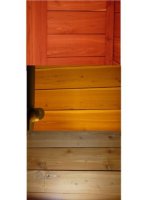
Attached is a regular incandescent light bulb top, and a Walmart florescent bulb middle, and the special higher degree kelvin florescent bulb bottom.

The cedar is exactly the same color but at night with the lamps it looks like I have three different stains. The bottom is the color closest to the sunlight color and is the easiest light for my Dad to read by.

There is a brighter degrees Kelvin bulb but it is too harsh on the eyes like bright sunlight. I'm sorry I don't have the degrees numbers for you right now but I hope this helps with a goggle search.
 

Attachments

  • light test 1.jpg
    light test 1.jpg
    14.7 KB · Views: 121
   / Fluorescent Bulbs #69  
txdon said:
I took my Dad to a low vision specialist and learned that the fluorescents (bulb replacement type and long type) have different kinds of brightness that is measured in degrees Kelvin. The specialist said that Walmart/Homedepot do not have the brighter replacement bulb type for the brightness needed for my Dad. Special light places have the brighter bulbs. I brought one of the bulbs and the colors are closer to real than the yellowish lower kelvin temp ones.

Attached is a regular incandescent light bulb top, and a Walmart florescent bulb middle, and the special higher degree kelvin florescent bulb bottom.

The cedar is exactly the same color but at night with the lamps it looks like I have three different stains. The bottom is the color closest to the sunlight color and is the easiest light for my Dad to read by.

There is a brighter degrees Kelvin bulb but it is too harsh on the eyes like bright sunlight. I'm sorry I don't have the degrees numbers for you right now but I hope this helps with a goggle search.

Don, what you are describing is the "color" of the light measured in a index called kelvin. The warm white or yellowish hue is 2700K. The cool white bulbs that were so common in 4' fluorescent were frequently 4000K also known as "cool white" I believe that 2700K is about as low a temp as they go but on the higher bluish end they go well above 4000K. There is a color rendering index that indicates how accurate the color is. Stores use different temps based on the product they sell. Myself, I prefer the more yellow light of 2700K. Sometimes the lumen (brightness) is slightly less per watt, but still quite efficient.
 
   / Fluorescent Bulbs #70  
RaT, I just looked at the base of the floresent bulb (the bottom picture), it says 6400K. That is the K best for contrasting colors for reading for people with macular degeneration.
 
   / Fluorescent Bulbs #71  
The first CFL bulb that I ever bought is still in service. It is in a fixture that stays on 24/7, and has been for at least 5 years.
 
   / Fluorescent Bulbs #72  
When researching C5 flourescent lights, I discovered the kelvin difference... and purchased 6500Kelvin lights for the workshop.... doing this allowed me to reduce the number of fixtures and I am SUPERBLY HAPPY with the resulting visibility in the shop.

Yes... for higher visibility... higher Kelvin is better... but women don't like it because it makes them look ghostly...
 
   / Fluorescent Bulbs #74  
I have a flouriscent bulb that is a circle that is about 8" round, it screws into a regular light bulb fixture. I got it several years ago I beleive when they first came out. It has burned several hours a day and is still burning. I also got one of the cfl bulbs like was shown in the test article when they first came out in our area. That bulb has burned 10 to 12 hours a day and is still burning today. I would buy either type of these bulbs again for these particular light areas, I feel I have gotten good service from them. I tried to use the cfl bulbs in a more air tight light fixture and they didn't last much more than a day or two. In my opinion and from my experience I like them but I would only use them where they can get air around them[ I guess they get too hot in an enclosed fixture]. When buying them I like the larger wattage ones, they seem to have a better light. I didn't know that they had mercury in them when I bought them, only found out about that when I saw a news article telling people how to dispose of them when they burned out and if they broke. The health risk if they break has got me considering the ones that I am using in my garrage, some kind of wire enclosure to keep them from being accidentally hit and broke would be a good thing to do. I have some 4ft flouriscent shop light fixtures in my garrage and in my basement that when one bulb blows don't seem like I have any luck in replacing the bulbs. After one bulb blows and I replace it don't seem like I can ever get but one bulb to burn then. maybe I am doing something wrong or something that I don't know about is keeping them form burning, and I know that I am getting the bulbs in right. The fixtures that I am talking about are newer fixtures, the older shop fixtures that I have I don't have that problem. Any suggestions about this would be appreciated, otherwise I will be phasing out these shop lights for the cfl lights.
 

Marketplace Items

500 BBL FRAC TANK (A58214)
500 BBL FRAC TANK...
2024 CATERPILLAR 255 SKID STEER (A52707)
2024 CATERPILLAR...
LayMor Sweepmaster 300 8HC (A55314)
LayMor Sweepmaster...
RAKE ATTACHMENT FOR MINI EXCAVATOR (A58214)
RAKE ATTACHMENT...
1995 Jeep Wrangler 4x4 SUV (A59231)
1995 Jeep Wrangler...
2007 JCB 3CX BACKHOE (A60429)
2007 JCB 3CX...
 
Top