From plow to subsoiler

   / From plow to subsoiler #1  

City Farmer

Platinum Member
Joined
Jan 3, 2013
Messages
528
Location
Chesterfield, Mi
Tractor
Ford 3000, 4400 & 4500TLB Case 830 Case 350 dozer
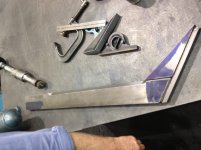
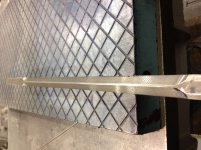
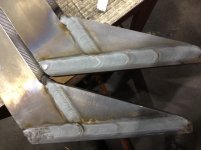
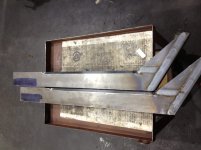
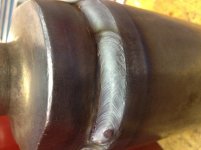
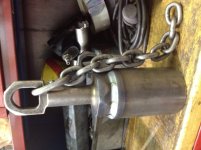
I removed the (2) plows from the frame and made a couple of subsoilers. I still have to drill and tap a few holes for an attachable pipe to install water lines, wire and a mole. What do you think, can anyone come up with some ideas/improvements to it before I paint it all up? I'm thinking its plenty strong, its 1"x3"x33-1/2" and the plow frame has a shear bolt for safety. The subsoilers will go 24" in the ground before hitting the frame of the plow.
 

Attachments

  • image.jpg
    image.jpg
    1 MB · Views: 864
  • image.jpg
    image.jpg
    553.6 KB · Views: 721
  • image.jpg
    image.jpg
    572.4 KB · Views: 550
  • image.jpg
    image.jpg
    530.1 KB · Views: 702
  • image.jpg
    image.jpg
    527.8 KB · Views: 720
   / From plow to subsoiler #2  
Those are some nice welds!!

Cheers

Roger
 
   / From plow to subsoiler #3  
I don't think you really have questions. You just wanted to show off the beautiful work you did and I don't blame you. ;) GREAT JOB!
 
   / From plow to subsoiler #5  
I think you will need to put a wear point on the sub-soiler and maybe some hard surfacing rod along the cutting edge as a minimum expecially if you have sandy soils. You could likely use a replaceable point like is used on back hoe or FEL teeth.
Nice welds by the way.
 
   / From plow to subsoiler #6  
I love these projects posts. Great looking work and exceptional welds. Can't wait to see your report on how it works!

Joe
 
   / From plow to subsoiler #7  
Great project hope you are working on it and will post updates as i am currently planning a subsoiler and have assembled some materials. I also have a two button plough.
 
   / From plow to subsoiler #8  
Nice work. Do you think there is any chance 3/4 x3 would stand up to use as a sub soiler in clay soil?
 
   / From plow to subsoiler
  • Thread Starter
#9  
Thanks for the kind words everyone. That's a good idea about putting a bucket tooth over the point, I didn't think of that. I was going to hit it with some hard weld and grind it back in if it wears to much. When everything dries up around here I'll report back let everyone know how it works, good or bad. I can't take credit for all the welding, I started welding it up and my buddy told me "let me clean those up" and finished them for me. I'll never argue with a guy who can run a bead like that. He's probably one of the best I've ever seen, even better with aluminum. I got the idea of using the plow frame from TBN so I guess the only thing I've done was cut/machine some steel to make them. I hope the old 3000 has enough HP to pull them. It pulls the (2) bottom plow really easy so we shall see.
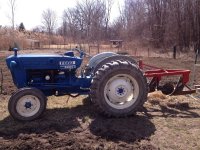
@ Mac, that's a really nice set up you have. I tried looking at tractor data for your Pacer Hp but I couldn't find any info. It looks like its a big tractor. Does it struggle to pull the three shank subsoiler?

Rio Grande, I would think 3/4 would be thick enough as long as you have some trips. Just in case you hit something. I used 1" because that's what my entire plow frame is made of and that's the thickness where the plows get bolted to.

Here's the mole I'm gonna try to pull with it. I still have to grind an angle on it and short'n up the chain some but here it is. It was used to lift big parallels at work, someone busted the chain on the other side so they threw them away. I went to the welder and had him attach a plug on the end of it. Sorry, I tried to shrink the pictures and rotate them but I don't know how to do that. I can barely make this thing work sometimes.
 

Attachments

  • image.jpg
    image.jpg
    673.6 KB · Views: 441
  • image.jpg
    image.jpg
    669.4 KB · Views: 547
   / From plow to subsoiler #10  
It's amazing how much HP it takes to pull subsoilers. We have a lot of clay around here, which makes it even tougher to pull subsoilers through. I've been running mine at about 16" depth since these fields were never deep tilled. They're very hard and compacted. If I put then down the whole way (24") it'll make that 113 HP Detroit snort.


Mac
 
   / From plow to subsoiler #11  
Spectacular welds. Great job.


Someone asked about 3/4" wide rippers in clay and that might be too narrow. One inch is the narrowest I have seen and 1 1/4" is common..
 
   / From plow to subsoiler #12  
It's amazing how much HP it takes to pull subsoilers. We have a lot of clay around here, which makes it even tougher to pull subsoilers through. I've been running mine at about 16" depth since these fields were never deep tilled. They're very hard and compacted. If I put then down the whole way (24") it'll make that 113 HP Detroit snort.


Mac

You're right about that. My neighbor just put in an English walnut orchard (about 8 acres). He used a double shank ripper (sub soiler) and a D9 Cat to rip down to about 30 inches depth to break up the hardpan. Subsoilers will act like very effective anchors if you let them dive too deeply into the soil and don't have enough drawbar hp to get them moving. That's why you see parabolic shaped subsoiler/rippers--less drag in the soil than the simpler L-shape designs.
 
   / From plow to subsoiler
  • Thread Starter
#13  
I thought about parabolic rippers when I was making mine. In stead of being straight, I set the pivet point back on my rippers to give it a longer cutting angle. They will engage the ground at a 60* angle and the foot will be parallel to the ground. That will give me an extra 4" of cutting edge in 24"s of depth. I've only looked at pictures and never measured the central angle on a parabolic ripper. So I'm not sure how much more length of cutting edge there is. I'm hoping that the longer cutting edge and the 45* down the length of the ripper will help it pull a lot eaiser thru the ground.
 
   / From plow to subsoiler #14  
Thanks for the reply.


By the way farmer I know it was mentioned but those welds are amazing. I have been welding for 25 years, non professionally and it is rare for me to lay that nice of a weld. I never break a weld, but I would sure be prouder if they looked like yours!

I may toss a riper together with the 3/4 I have. We have been working our ground for over 20 years with a rear tine tiller and it takes forever compared to other farms to dry out.
 
   / From plow to subsoiler #15  
I think you'll be Ok with 3/4" just don't make any turns that might bend things sideways. I think that's the bigger risk.
 
   / From plow to subsoiler #16  
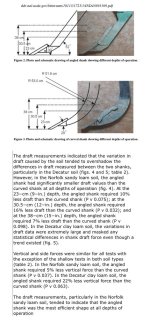
Subsoiler shank style comparison test:

subsoilerTest.jpg

Bruce
 
   / From plow to subsoiler
  • Thread Starter
#17  
Subsoiler shank style comparison test:

View attachment 314109

Bruce

Thanks Bruce, I'm happy to see its easier to pull an angled ripper than a parabolic. The plow frame I have has an angle of about 54*(could be 52*). To make things easier to cut/fit I set everything up on 60*-30*.

I tried it today and it didn't go very good. It's still pretty wet so the tractor had a hard time hooking up after 10"s. With both rippers it went in the ground nice and even but was to much so I removed one ripper. There's no way I'll be able to pull a single ripper with the set up I have now, I only have a chain connecting the lift arms. I need a turn-buckle on the left side of the tractor because when the ripper starts to enter the ground the other side of the plow frame goes up causing the ripper to tilt while its in the ground. I'll give it another shot in a few days after things dry up. I'll grab a turn buckle from tractor supply too. Worst case I'll make a new mount for the single ripper to keep it centered behind the tractor.
 
   / From plow to subsoiler #18  
City Farmer, I wish you all the best with your subsoiler project.

Here's a link to the United States Dept of Agriculture that explains subsoiling very well and also discusses the different types of rippers used as well as the amount of moisture in the soil for proper fracturing.

It normally requires 25-50 HP per shank depending on soil type and depth. As depth is doubled HP required quadruples. If wings are added required HP increases. Parabolic shanks require the least amount of HP to pull.

http://www.fs.fed.us/t-d/pubs/pdfpubs/pdf08342828/pdf08342828dpi72.pdf

Good luck and I'm sure you'll get your subsoiler working the way you want it.


Mac
 
   / From plow to subsoiler #19  
City Farmer, I wish you all the best with your subsoiler project.

Here's a link to the United States Dept of Agriculture that explains subsoiling very well and also discusses the different types of rippers used as well as the amount of moisture in the soil for proper fracturing.

It normally requires 25-50 HP per shank depending on soil type and depth. As depth is doubled HP required quadruples. If wings are added required HP increases. Parabolic shanks require the least amount of HP to pull.

http://www.fs.fed.us/t-d/pubs/pdfpubs/pdf08342828/pdf08342828dpi72.pdf

Good luck and I'm sure you'll get your subsoiler working the way you want it.


Mac
Ooh... Great link for those of us new to the subject. Thanks for posting. :thumbsup:

Joe
 
   / From plow to subsoiler
  • Thread Starter
#20  
Thanks Mac, I have to wait until it dries up around here before I try again, its been raining almost everyday. I had (2) nice Pike swimming in the drainage creek behind my house, they were splashing so much I thought it was a duck. I got 2 of them on video, maybe if I have the time I'll post it.
It seems we have some conflicting information. The artical Bruce posted showed that an angled ripper was easier to pull in different soil conditions. In the URL it looks to have come from the USDA.
 

Tractor & Equipment Auctions

2001 Workhorse Custom Chassis P42 Delivery Truck (A59230)
2001 Workhorse...
2021 Club Car Carryall 500 Electric Utility Cart (A59228)
2021 Club Car...
2024 New Holland T8.410 MFWD Tractor (A55314)
2024 New Holland...
1981 LINK BELT HSP 8028 (A58214)
1981 LINK BELT HSP...
Bobcat A770 (A60462)
2008 Ford F-350 4x4 Ext. Cab Knapheide Service Truck (A59230)
2008 Ford F-350...
 
Top