Tires Front tire angles

/ Front tire angles #1  

scottgze

New member
Joined
Jan 8, 2019
Messages
7
Tractor
Ferguson
Hi people
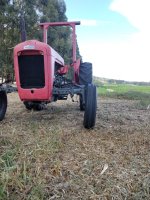
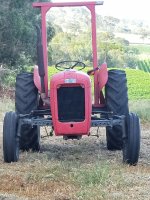
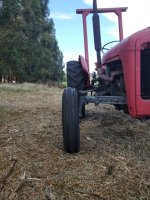
I've recently aquired an FE35, the serial number indicates it's a 1959. Over all, I like it. However, I've noticed that the front wheels seem to be at odd angles, as per the attached photos.
Since these tractors don't have camber adjustment, what could be the cause? I have noticed that it also seems to have toe out, could this be a contributing factor?

TIA

TIA IMG20190110181056.jpgIMG20190110181013.jpgIMG20190110180943.jpg
 
/ Front tire angles #2  
You need to get an Op Manual and see what is recommended for your specific unit. Pictures can be very deceiving. Somebody will probably post here with the data you need. Just hang in there.

By the way - - Welcome to TBN, Scott.
 
/ Front tire angles #3  
To me the right tire looks like it's taller than the left one. Are they both the same size? Check to see that the spindles aren't bent and that the wheel bearings aren't loose. I'm also thinking that the right front wheel is up on a bump for the picture which would also distort things. How does it look on a level surface?
 
/ Front tire angles
  • Thread Starter
#4  
Cheers oosik. I have all four manuals, and I can't find any reference to wheel camber. While the pictures can deceive, my eyes don't, The LH front wheel has a definate outward lean (positive camber). I'm wondering if the stub axle is a bit bent?
I've been lurking here for about a week, pretty impressed by the level of knowledge I've seen so far :)
 
/ Front tire angles
  • Thread Starter
#5  
Thanks pmsmechanic. How would I go about checking if a spindle is bent?
 
/ Front tire angles #6  
Thanks pmsmechanic. How would I go about checking if a spindle is bent?

I would do something like taking the tires off and putting a straight edge on the flange that the tires bolt onto. You might have to tighten the wheel bearing so that there is minimal play in the bearings. Then measure the distance from the straight edge to the top of the spindle. Take the measurement from something that will be the same on both sides, like the machining hole in the center of the nut that holds the steering arm on. The distance should be the same on both sides. If it isn't then I would take the hubs off and eye ball both the spindles to see which one is bent. If you have trouble eye balling stuff like this then use a small square and place it against the flange that the seal rides on. If you compare the flat of the square to the axle you should be able to see right away if something is bent.

Before I get into something like this though check all of the simple stuff first as mentioned in my first post.

Edited to add that you could also place the square against the "knee" that the spindle slides into. That might show a bend better than the flange that the seal rides on.
 
/ Front tire angles #7  
That is not unusual!!! That is the way they were made! you can go from brand to brand and you will find the same thing!
 
/ Front tire angles
  • Thread Starter
#8  
Thanks for everyone's help! Being new to tractors, this website has been invaluable.
 
/ Front tire angles #9  
The purpose of camber on the wheels is to reduce the scrub radius. This is the intersection of the wheel plane at the kingpin axis on the ground. This greatly reduces the overall steering effort, especially on dirt or in a furrow. Obviously it makes manual steering manageable. Ideally, the steered wheels just twist instead of twisting, scrubbing and rolling.
 
/ Front tire angles #10  
The only thing I can tell by those photos is you have it parked on unlevel ground. The only way you will be able to measure camber and toe accurately is to park it on level ground or better yet concrete.

You should probably start by jacking it up and checking wheel bearing play.

For doing home alignments I cut a piece of pipe that fits inside the rim beads and hold a digital level or angle gauge against it. Add or subtract from 90 degrees to figure out the camber.
 
/ Front tire angles #11  
I agree with JD. Park it on a level concrete slab before you jump to any conclusions about the camber being out of whack.

A few things to look at if it is out of camber: Make sure the tires match in height from side to side on both front and rear. Different brand of tires can mismatch in height even if they are the same size. Make sure the tire's air pressure matches from side to side too.

Maybe you should measure the wheelbase from side to side and see if they match. That could be a major clue to something being wrong. In addition to checking wheel bearings for play, check the pivot bushings for the front axle assembly (the one on the center line of the tractor that allows the front axle to pivot up and down) as they do wear out and can cause the front end to become all kitty-whampus in unpredictable ways. I had to replace my Ferguson's pivot bushing when it developed all kinds of slop. Also, check to see if one of the radius rods is bent. That can also cause your front end to become kitty-whampus, particularly if your pivot bushing is worn. In fact a worn pivot bushing can cause a radius rod to bend. Toe in and out is easy to adjust and could contribute to camber problems, not on its own, but if stacked upon some of these other problems. You should check to see if an axle is bent, but I would guess it would snap completely in two before it will bend (I've had them snap. It is fairly common, particularly if you have a loader installed.) My first guess would be the pivot bushing though. Seems like most old tractors have worn pivot bushings to various degrees.

Let us know what you find.
 
/ Front tire angles #12  
Personally, I wouldn't bother with checking the camber since there is no way to correct it and I doubt that it has a bent axle since those old tractors were build pretty robust. I would check the wheel bearings and correct any that are too loose.
Check your toe in from front to back of the tire. There should be about an inch (or more-check your OEM manual to see if it specifies) narrower in the front of the tire compared to the back. You can adjust this by tightening or loosening the tie rod on each side. You have to work each tire separately so you will need to establish a centerline on the tractor to measure to.
Normally the tie rods should show about equal number of threads on both sides. I would start by looking at that and determine if someone has screwed one of the tie rods out/or in by a bunch.
 
/ Front tire angles #13  
Check your toe in from front to back of the tire. There should be about an inch (or more-check your OEM manual to see if it specifies) narrower in the front of the tire compared to the back.

:eek: When have you ever seen anything that specifies an inch or more of toe in?

You should be pretty safe with zero to an 1/8". The tractor will never be traveling fast enough for toe in to affect the steering effort.

In road racing we set the front steering angle to have a little toe out to make a car turn in better. But we also have unusual camber and caster settings.

All of the check points suggested by Cougsfan are valid.

I would work it in this order.
Park on level surface.
Check tire pressures.
Check tire diameters.
Check wheel bearings.
Check king pins.
Check toe.
Check camber if it concerns you but Like was mentioned I don't know how you could fix it unless something is bent or worn.
 
Last edited:
/ Front tire angles #14  
Here is a link to a Massey Ferguson 35 Workshop Manual.

The manual is all images so it isn't text searchable as is. If you have a full version of Abobe Acrobat you can fix it so it IS text searchable which will be very handy.

Right click on the link and save link as. Open the document in Adobe Acrobat, (not reader), click on the document tab and go down to the recognize text using OCR, move over to the recognize text in OCR and click on that. It will take a while to process but this will convert all the recognized text to searchable text and straighten all the page images. Make sure and save it after it finishes processing.
 
/ Front tire angles #15  
Personally, I wouldn't bother with checking the camber since there is no way to correct it and I doubt that it has a bent axle since those old tractors were build pretty robust. I would check the wheel bearings and correct any that are too loose.
Check your toe in from front to back of the tire. There should be about an inch (or more-check your OEM manual to see if it specifies) narrower in the front of the tire compared to the back. You can adjust this by tightening or loosening the tie rod on each side. You have to work each tire separately so you will need to establish a centerline on the tractor to measure to.
Normally the tie rods should show about equal number of threads on both sides. I would start by looking at that and determine if someone has screwed one of the tie rods out/or in by a bunch.
I have never seen that much toe-in required on the front of a tractor! Try for a 1/8th to 1/4" max!
 
/ Front tire angles #16  
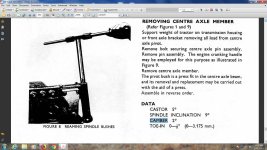
After downloading the manual and converting to text I found the toe instructions on page 348.

ADJUSTING FRONT WHEEL TOE-IN
Front wheel toe-in should be 1/8 in. (3.18 mm.)
To adjust toe-in proceed as follows:-
locate tractor on firm level ground.
Place front wheels in straight ahead position.
Using a suitable track gauge. check toe-in.
If adjustment Is required the pinch bolts clamping
the drag link ends to the drag links should be slackened
off and the drag links rotated clockwise or
anti-clockwise to increase or decrease toe-in as
reqUired. Adjustment should be made equal ly to
both drag links. This may be checked by noting the
relationship of the rear drag link ends to the footrests.
When the front wheels are in the straight
ahead position the distance between the rear end of
each drag link and the adjacent footrest should be
equal. Tighten drag link pinch bolts when adjustment has
been completed.
Remove track gauge.
Move tractor until front wheels have rotated 180°.
Re-check toe-in.

I also found the full front end specs.

MF-FE-Specs.jpg
 

Attachments

  • MF-FE-Specs.jpg
    MF-FE-Specs.jpg
    464.1 KB · Views: 158
/ Front tire angles #17  
If you find your center pivot bushing is worn out (if the bushing is worn, usually the pin will be worn out too); I was advised by an old, very knowledgeable tractor mechanic to install two bushings instead of one. The original one goes in from the the rear of axle, and a second one can be installed from the front of the axle. They come standard with only the one in the rear. (My memory says the original was the rear, rather than the front, anyhow) The dual bushings will cause the affair to wear less, last longer and develop less slop over time. These bushings and pins are readily available still and not overly expensive.
To check the center pivot bushing for wear, simply jack the tractor up from anywhere but the front axle, and watch to see if the axle drops down some before lifting with the rest of the tractor. A worn bushing may also allow the axle to rock back and forth, changing the castor as it does.
 
/ Front tire angles #18  
Looks fine to me. Check toe-in and use it.

There's not a man in this discussion born in 1959 or earlier that doesn't have a bit of camber issue. :)
 
/ Front tire angles
  • Thread Starter
#19  
All good suggestions, thank you. The right hand bearing was a bit loose, I've tightened that, and it's slightly better. i suspect I have a learning curve ahead of me.
 
/ Front tire angles #20  
Nice find on a good old tractor.

Welcome to TBN.
 
 
Top