Gas Fireplace Question

   / Gas Fireplace Question #1  

Dougryan

Bronze Member
Joined
Apr 6, 2000
Messages
96
Location
Webster, NY
Tractor
Cub Cadet 3206
Hi,
I'm going to have a gas fireplace installed soon. I'm doing the framing for the install (inside corner of the family room) and a pro will do the actual unit install with gas and electric hook ups.
To prep for the install, all I need to do is build the platform that the unit will sit on. The installer needs the space to put in the gas, electric, and vent through the wall. Once that is done, I will frame up the enclosure, have it all inspected, then do the finish work.

Even though this is a 'zero clearance' unit, there is still plenty of clearance required. Especially above the unit where the coaxial vent pipe comes out and does the 90 degree bend to the exterior wall. I expect a lot of dead space where no combustible materials may be used. This is probably because the vent pipe and space above the firebox will get hot.

So here's my question... Can I take advantage of that heat be leaving an opening at the top of my enclosure (and possible a small vent at the bottom to allow a convection)?

Seems like two good outcomes. 1 - A bit of extra heat in the room. 2 - Lets the heat escape the enclosed cavity.

Thoughts?
Thanks,
Doug
 
   / Gas Fireplace Question #2  
What type of enclosure? is this for a fireplace insert, or a free standing unit. We have a Jotuel gas stove, replaced a wood unit.
 
   / Gas Fireplace Question #3  
My two new inserts already have vents/venting at the top and bottom of the unit to take advantage of the convection. Check with your supplier and see if you can find a unit that includes venting.

SimS
 
   / Gas Fireplace Question #4  
Most gas fireplaces (and wood units too) have an open cavity around the main inner firebox, with vents open to the room on top and bottom. Room Air will go in the bottom and come out the top heated up.

The outer shell doesn't get very hot, so there wouldn't be much heat there in your framed cavity, plus without an air path to help it flow, I don't think there would be a huge benefit. And I bet some part of fire code requires it to be sealed/isolated from the outer room so that possible stray flames can't get into the framing. At least with wood units, many of the clearance and material specs are about protecting the home's framing from flames in the main fire box that could possibly escape the main front opening. Gas is a different beast of course, but often the codes are the same.
 
   / Gas Fireplace Question
  • Thread Starter
#5  
Hi,
To be specific, it is the Enviro Q1 gas fireplace (not the model that would be inserted into an existing masonry fireplace). The model I am buying will get built into a stick framed 'bump in' structure in the corner of a room. Here is a link to the product page Enviro | Products | Gas | Q1 Gas Fireplace

Thanks,
Doug
 
   / Gas Fireplace Question #6  
I looked at the PDF for specs/dimensions, and it has the same types of external clearances as a wood-burner, so my guess is that fire code won't allow you to have openings into the wall framing above the fireplace. Again, this has more to do with flames escaping out the front of the unit than it does the clearance around the fireplace inside the wall. Fire code is real conservative when it comes to openings in framed structures within 4-5 feet of a fireplace, wood or gas.
 
   / Gas Fireplace Question
  • Thread Starter
#7  
Hi,
From the Napoleon website...
--------- ----------
Direct vent is a term used to describe a specifically designed fireplace that performs differently from the traditionally vented fireplace which use a chimney. This type of fireplace has a completely sealed combustion chamber which allows it to vent directly out a side wall of the home. One of the benefits of this type of design is that it must draw air necessary for combustion from the outside since the sealed combustion chamber does not allow air to be drawn in from around the fireplace. The co-axial vent system has the exhaust pipe within the air intake pipe which protects any surrounding combustible material from the high temperature of the flue gases as well as preheating the outside air prior to it being introduced to the combustion process.
----- ----------

So there should be no issue with flames escaping the fire box.

Doug
 
   / Gas Fireplace Question #8  
Doug, I know all that, but it doesn't have anything to do with fire code, clearances, etc. The gas fireplace at our last house still had code requirements for non-combustable materials on the face around the fireplace for a certain distance from the opening. As far as fire code is concerned, it's still a "flame" inside the walls/framework of a home, and they don't really differentiate whether it's direct vent or not -- that's more about airflow and gasses.

If you look at the drawings for your fireplace at that link you gave, it has face clearance requirements just like any other gas or wood fireplace. I suspect if you look at building/fire code for your location, it's going to forbid openings into the wall framing within a certain radius of the fireplace (it's normally in the 5-10' range, but I don't know the exact numbers for your situation). There are similar requirements that prevent stoves and fireplaces from being located near HVAC ducting and other types of "chases" within a home. Anything that provides a possible path into the guts of the framing is not allowed.
 
   / Gas Fireplace Question
  • Thread Starter
#9  
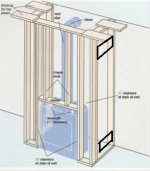
Here is a picture of a 'bump in' framed with a fireplace installed. I drew a couple of parallelograms where I was thinking about putting my vents... Just an example showing how warm air could get out of the cavity above the fireplace by letting cool air in at the bottom.

Doug
 

Attachments

  • Cavity Vents.jpg
    Cavity Vents.jpg
    25.7 KB · Views: 95
   / Gas Fireplace Question #11  
Doug, I know all that, but it doesn't have anything to do with fire code, clearances, etc. The gas fireplace at our last house still had code requirements for non-combustable materials on the face around the fireplace for a certain distance from the opening. As far as fire code is concerned, it's still a "flame" inside the walls/framework of a home, and they don't really differentiate whether it's direct vent or not -- that's more about airflow and gasses.

If you look at the drawings for your fireplace at that link you gave, it has face clearance requirements just like any other gas or wood fireplace. I suspect if you look at building/fire code for your location, it's going to forbid openings into the wall framing within a certain radius of the fireplace (it's normally in the 5-10' range, but I don't know the exact numbers for your situation). There are similar requirements that prevent stoves and fireplaces from being located near HVAC ducting and other types of "chases" within a home. Anything that provides a possible path into the guts of the framing is not allowed.
Been awhile since I installed mine but as I recall the "clearances" all involved the unit and the interior framing that enclosed it (with one further caveat for any mantle). None of them amounted to much because the unit itself is totally enclosed and is insulated (not unlike your kitchen oven). I was thinking about trying to add vents on the chimney chase to recapture any heat going up and out and was told I could. Not so sure what I would gain though...double wall pipe with exhaust on the inner tube, intake air on the outer tube. I'm not so sure how hot that pipe gets and whether it would be worth it.
 
   / Gas Fireplace Question #12  
There are internal clearances between the unit and the wall/chimney framing and external "face" clearances to combustable wall/flooring materials, mantels, etc. All of that varies depending on the type of unit.

For pre-fab units, gas or wood, the internal clearances are often a lot less restrictive than the face clearances. For instance, the fireplace surround in our new house is 2x4 framing with drywall over it, then metal lathe and stone veneer on the outer surface (room walls). There were lots of restrictions about distance from the fireplace opening face to flooring and wall materials, and the 16" above the opening was required to be a masonry material. But inside the wall, it was absolutely fine to have exposed 2x4 framing and the paper backside of the drywall within 6" of the fireplace box. As you note, they are heavily insulated and should not get warm enough to be a problem. The majority of the heat should stay inside the inner firebox or go into the home or up the chimney.

At our old house we had a nice gas fireplace that really belted out heat into the room. That was required to have 12" of masonry surround around the entire face (we used slate). It also had very minimal clearance requirements for the backside of the wall. That particular home had a TV cutout built into the wall above the fireplace (which we installed shelving into and used for books/etc), and I never noticed any heat in that area. At least for that fireplace, there didn't seem to be any heat going up into the cavity around the fireplace.
 
   / Gas Fireplace Question #13  
My gas fireplace was installed during the original construction, before I bought the home, so I don't know everything they did.

The airspace you are referring to, leaks cold air into my house when the fireplace is not being used. Since I only use my fireplace on special occasions, I would not want to give that air an easier path inside.

The interior walls of the bump out were not originally insulated, just the exterior ones. That led to the interior walls being ice cold all winter.

I removed the exterior siding, and sheathing, and insulated the interior walls as best I could. And, I sealed up any places I found air coming in, in the winter.

The fireplace still causes a loss of heat in the winter, when it's windy.
 
   / Gas Fireplace Question #14  
If it is direct vent there will not be much residual heat due to the nested design of the pipe.
 
   / Gas Fireplace Question
  • Thread Starter
#15  
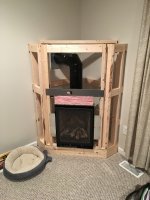
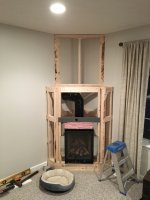
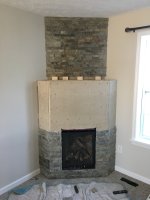
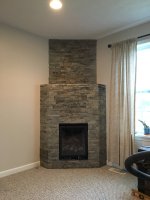
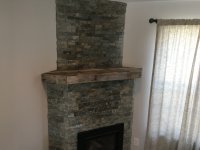
Done!!! Did a corner mount portrait style unit and built a ledger stone front with a recycled pallet mantel.
 

Attachments

  • IMG_1370.JPG
    IMG_1370.JPG
    2.1 MB · Views: 76
  • IMG_1372.JPG
    IMG_1372.JPG
    1.9 MB · Views: 80
  • IMG_1396.JPG
    IMG_1396.JPG
    1.8 MB · Views: 75
  • IMG_1409.JPG
    IMG_1409.JPG
    2 MB · Views: 77
  • IMG_1423.JPG
    IMG_1423.JPG
    2.3 MB · Views: 81
   / Gas Fireplace Question #16  
Your installer should know the code rules "if" he provides a permitted and inspected installation. Some rural/country areas are lacking in enforcement and a lot of non-code compliant installations occur by marginal installers. BEWARE

Code issues are becoming easier for the novice to find in today's digital age and even small contractors have become more aware of the issues because of the complexities of continuing updates every 3 years.

SIDE ISSUE ON CODES:

Even when I know the codes involved in issues presented here on TBN I am reluctant to quote or provide copies of the code sections as there are many who are adamant that codes are a waste of time and money and produce a lot of negative comment on those type posts. Everyone to there own philosophies to preserve our freedom. "ALL" LIVES ARE IMPORTANT

I recently retired from being a construction quality control specialist and had a shelf and computer full of code, design, and compliance references. In QC we go way beyond what your normal city/county/state inspectors know and/or do. We find many code violations in construction design documents. That is why designers always always use the term "per local code requirements".

Ron
 
Last edited:

Tractor & Equipment Auctions

2024 DEVELON DL250-7 WHEEL LOADER (A59823)
2024 DEVELON...
Hydraulic Liftgate (A59230)
Hydraulic Liftgate...
2015 Ford Focus Hatchback (A59231)
2015 Ford Focus...
2007 FREIGHTLINER M2 26FT CDL REQUIRED BOX TRUCK (A59905)
2007 FREIGHTLINER...
TANK MANIFOLD (A55745)
2014 Dodge Charger Sedan (A59231)
2014 Dodge Charger...
 
Top