Generator inlet plug install-need advice on wire size/type, etc...

   / Generator inlet plug install-need advice on wire size/type, etc... #1  

IHDiesel73L

Silver Member
Joined
May 13, 2010
Messages
167
We just got power back after four days out in Northwest NJ due to the early snowfall on trees that still have most if not all of their leaves. My town looks like a bomb hit it with the amount of splintered trees, broken poles, downed wires, etc... I have a generator and it allowed me to save the food in our refrigerator and chest freezer (a whole season worth of venison), keep the blower on my wood furnace running, and drain our sumps every few hours to keep the basement from flooding, but I was doing that with extension cords run through a window and all over the house. Far from ideal. It seems like we're getting these days long outages due to downed trees from storms at least once a year now, so it's time to install an inlet plug/interlock switch so that I can safely feed power to the panel and use breakers to route it wherever I need it. If I upgrade my generator I can also run my electric HWH as well-we were nice and warm but the cold showers were a little rough.

Right now I have a very basic generator-it's a Craftsman/Generac 4500W/7.8HP unit that's really intended for use on a jobsite. I got it free because it was not running-all it needed was a good carb cleaning. In addition to the 120V/15A household receptacles it has a 240V/30A receptacle as well. So given that I could simply buy a 30A inlet plug, wire to handle 30A, and a 30A breaker for the panel and be done with it. However, I notice that there are also 50A plugs. Since I plan to upgrade my generator anyway, would it be wise to install a 50A setup right off the bat? Based on my needs I think the biggest unit I would probably go with would be between 8 and 10kW. If I do go that route, I know what I need in terms of a plug and breaker, but what size/type of wire do I need? 6 gauge? Solid or braided?
 
   / Generator inlet plug install-need advice on wire size/type, etc... #2  
If you're going to do something like this, you should really bring a qualified electrician in to either do the job, or provide advice that would meet any codes your area may have as well as add the switch to ensure the power you generate doesn't bleed in to the outside powerlines.
Also, there's a good thread on the dangers of Carbon Monoxide (CO) stemming from using generators...definitely worth the read!

Good luck and be safe!!
 
   / Generator inlet plug install-need advice on wire size/type, etc... #3  
We just got power back after four days out in Northwest NJ due to the early snowfall on trees that still have most if not all of their leaves. My town looks like a bomb hit it with the amount of splintered trees, broken poles, downed wires, etc... I have a generator and it allowed me to save the food in our refrigerator and chest freezer (a whole season worth of venison), keep the blower on my wood furnace running, and drain our sumps every few hours to keep the basement from flooding, but I was doing that with extension cords run through a window and all over the house. Far from ideal. It seems like we're getting these days long outages due to downed trees from storms at least once a year now, so it's time to install an inlet plug/interlock switch so that I can safely feed power to the panel and use breakers to route it wherever I need it. If I upgrade my generator I can also run my electric HWH as well-we were nice and warm but the cold showers were a little rough.

Right now I have a very basic generator-it's a Craftsman/Generac 4500W/7.8HP unit that's really intended for use on a jobsite. I got it free because it was not running-all it needed was a good carb cleaning. In addition to the 120V/15A household receptacles it has a 240V/30A receptacle as well. So given that I could simply buy a 30A inlet plug, wire to handle 30A, and a 30A breaker for the panel and be done with it. However, I notice that there are also 50A plugs. Since I plan to upgrade my generator anyway, would it be wise to install a 50A setup right off the bat?Depending on your needs 50 A would still not operate all that you stated you wanted to run, and to run your HWH. Most HWH electric that is, have upper and lower cal rods, they can be 3,500 to 4,500 watts for a 40 gal HWH. See why you wouldn't have enough generator? It all depends on how much $$ you want to spend and what you need to operate . Transfer switch is the way to go if your not sure about pulling mains.Based on my needs I think the biggest unit I would probably go with would be between 8 and 10kW. If I do go that route, I know what I need in terms of a plug and breaker, but what size/type of wire do I need? 6 gauge? Solid or braided?
DevilDog
 
   / Generator inlet plug install-need advice on wire size/type, etc...
  • Thread Starter
#4  
If you're going to do something like this, you should really bring a qualified electrician in to either do the job, or provide advice that would meet any codes your area may have as well as add the switch to ensure the power you generate doesn't bleed in to the outside powerlines.

I will be seeking advice from an electrician but will do the work myself.

Also, there's a good thread on the dangers of Carbon Monoxide (CO) stemming from using generators...definitely worth the read!

I will check it out. Part of the reason I want to install the inlet plug is so that I don't have to worry so much about voltage drop. Using the regular 15A receptacles with extension cords I had to be conscious of how long my cords were. With the inlet plug and the 240V/30A connection I'll be able to build a shelter for the generator well away from the house-especially the outside air intake for my wood furnace.

Depending on your needs 50 A would still not operate all that you stated you wanted to run, and to run your HWH. Most HWH electric that is, have upper and lower cal rods, they can be 3,500 to 4,500 watts for a 40 gal HWH.

I should have been more clear. I would not expect to be able to run the HWH heater at the same time as any other appliance. I would just cycle it manually by turning off all other breakers and letting it heat it up by itself for an hour or two maybe first thing in the morning or overnight. It's an 80 gallon and very well insulated. We lost power at 3:00 p.m. on Saturday and I was still able to take a very warm, but not hot shower at 6:00 p.m. on Sunday. I'm not sure of the wattage of my HWH elements, but it's only served by a 30A breaker.

It all depends on how much $$ you want to spend and what you need to operate . Transfer switch is the way to go if your not sure about pulling mains.

I'm going to be using a simple interlock switch:

Generator InterLock Kit

It's very simple-you just mount a breaker for the generator in the slots right below the main breaker and the sliding switch ensures that the main cannot be switched on if the generator breaker is switched on and vice versa.
 
   / Generator inlet plug install-need advice on wire size/type, etc... #5  
I have a transfer switch for my system and I also installed one for my brother. I would recommend one for your application. They are far more versatile than the interlock you are looking at.
You can control the circuits that require more watts of power by just flipping a switch or two.
You would buy a large enough transfer switch to accommodate the larger generator that you plan on buying in the future. It can be used with the smaller generator that you have now, you just won't be able to use all of the circuits at one time.
Generac has an installation video that comes with their transfer switchs that is easy to follow.
 
   / Generator inlet plug install-need advice on wire size/type, etc...
  • Thread Starter
#6  
I have a transfer switch for my system and I also installed one for my brother. I would recommend one for your application. They are far more versatile than the interlock you are looking at.
You can control the circuits that require more watts of power by just flipping a switch or two.

Maybe I'm not understanding this correctly, but the way I see it, the advantage of the panel interlock is that I can power anything on my main panel rather than having to install a separate panel and having to choose what to power from that. For example, I have a very small, two bedroom one bath ranch. One day I hope to add a second floor, which of course will necessitate adding circuits to my main panel (I have a 200A service and plenty of space so this is not a problem), so with the interlock, anything I add is automatically able to be powered by the generator if need be, assuming I have enough capacity. If I am wrong on this someone please explain-I have a good working understanding of these things but am by no means an expert.
 
   / Generator inlet plug install-need advice on wire size/type, etc... #7  
Maybe I'm not understanding this correctly, but the way I see it, the advantage of the panel interlock is that I can power anything on my main panel rather than having to install a separate panel and having to choose what to power from that. For example, I have a very small, two bedroom one bath ranch. One day I hope to add a second floor, which of course will necessitate adding circuits to my main panel (I have a 200A service and plenty of space so this is not a problem), so with the interlock, anything I add is automatically able to be powered by the generator if need be, assuming I have enough capacity. If I am wrong on this someone please explain-I have a good working understanding of these things but am by no means an expert.

I have the interlock bracket and it works fine. I like it for the reasons you stated.
I would definitely go with the 50 amp breaker. The hot water heater is probably 4500 watts, but I am not sure of that. Your generator will just run that. One of the advantages of the smaller generator is lower fuel consumption. Sometimes getting fuel can be difficult. Trees may block the road, the gas station may not have power, and the ones that do run out of fuel quickly. Most of the time you will only be using a small percentage of the capacity. If you get a bigger one, keep the smaller one.
 
   / Generator inlet plug install-need advice on wire size/type, etc... #8  
Install a manual "On-Off-On" transfer switch rated for your grid supply. One of the "On" sides goes to the grid, the off disconnects your house from everything and the other "On" connection goes to your generator connection. This is what is required to completely isolate your generator from the grid. No other subpanels needed. Just flip the breakers in your existing panel to power the circuits you wish to power from the generator. You'll need an electrician to install this between your main panel and the grid entrance.
 
   / Generator inlet plug install-need advice on wire size/type, etc... #9  
they really don't make an interlock switch for an existing 200 amp main breaker panel. The problem is you have to remember to manually shut off the 200 amp breaker and since this isn't done at the same time automatically that the interlock would be thrown, its against the NEC codes.

What most generator manufacturers are doing with the larger permanent mount gen sets are providing 100 and 200 amp automatic transfer switches.

These simply install right next to your existing panel and wire between the existing panel and the generator.

HOWEVER you first have to do a load calc. I have installed these in houses which have a small 50 amp actual load while all major appliances are turned on, as gas heat, gas water heater and gas range were in use.

In an all electric house, i have seen actual registered loads (amp meter) of 150 amps while all the above are running.

The generator needs to be sized correctly.
A 4500 watt generator will only provide 18.75 amps at 240 volts
a 10,000 watt will provide 41.6 amps at 204
a 20kw generator will provide 83.3 amps at 240 volts.

some people will argue that they can simply turn off the larger circuits, but unless the generator you have can automatically shed these larger loads, most electrical inspectors wont allow their install by a qualified electrician.

When i come onto jobs that want to use a 50 amp generator on an existing 200 amp service, i generally have to add a generator panel right next to and interconnected with the main panel. Then i physically move the circuits that i want the generator to power up (up to 50 amps max continuous load). This panel will have a simple manual interconnect switch that will simultaneously disconnect the generator and the utility power so both cannot ever run at the same time. I then run a #6 copper line to an outdoor generator ready receptacle. The owner only needs to move the generator over to this outlet and plug it in. Then switch over the panel manually.

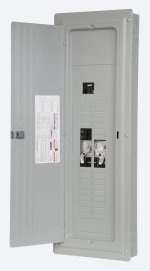
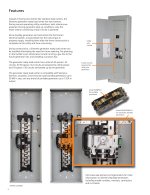
They also make replacement main panels that have provisions for either an automatic or a manual transfer switch. These panels have a split bus and are 100% legal for generator. I have used alot of these for retrofits for houses with undersized generators, especially where there is no room for another panel. I LOVE them. few hours work and its up and running.
I use the Siemens panel. It has a provision to be easily changed to a fully automatic system in the future if the owner upgrades his generator.
 

Attachments

  • GenReadyLC_Siemens4.jpg
    GenReadyLC_Siemens4.jpg
    116.7 KB · Views: 574
  • Main%20breaker%20and%20transfer%20switch_large.jpg
    Main%20breaker%20and%20transfer%20switch_large.jpg
    64 KB · Views: 413
  • SIE_SA_GenReady0609_low res-2.jpg
    SIE_SA_GenReady0609_low res-2.jpg
    502.8 KB · Views: 840
   / Generator inlet plug install-need advice on wire size/type, etc... #10  
Maybe I'm not understanding this correctly, but the way I see it, the advantage of the panel interlock is that I can power anything on my main panel rather than having to install a separate panel and having to choose what to power from that.

You understand it correctly.

Also, search for your panel and see if your panel manufacturer has an Interlock kit available. I know Square D and others have them. They seem to be cheaper from the panel manufacturer.

Also, see my thread, on same.
 
   / Generator inlet plug install-need advice on wire size/type, etc...
  • Thread Starter
#11  
they really don't make an interlock switch for an existing 200 amp panel. The problem is you have to remember to manually shut off the 200 amp breaker and since this isn't done at the same time automatically that the interlock would be thrown, its against the NEC codes.

Take a look at the link I posted above:

Generator InterLock Kit

The switching is not simultaneous, but it does require that the main be off before the generator breaker can be switched on and that the generator breaker be off before the main can be switched on, so there is no possibility of forgetting to do one or the other-its impossible.

HOWEVER you first have to do a load calc. I have installed these in houses which have a small 50 amp actual load while all major appliances are turned on, as gas heat, gas water heater and gas range were in use.

I am not trying to power my entire home. I actually did pretty well for four days powering my wood furnace blower, sump pumps, fridge, freezer, and TV with my 4500W unit, its just that I want to be able to do it without having to wrestle with extension cords. Also, it would be nice to have a large enough generator to power the electric HWH, but only by itself with no other loads. We can cook everything we need on the gas grill or with a dutch oven in the woodstove so no need to power the electric stove or microwave, etc...

some people will argue that they can simply turn off the larger circuits, but unless the generator you have can automatically shed these larger loads, most electrical inspectors wont allow their install by a qualified electrician.

I'll have to consult my local construction official. If I just send him the website and he looks it over I'm sure he can give me a yes or no.

I have the interlock bracket and it works fine. I like it for the reasons you stated. I would definitely go with the 50 amp breaker. The hot water heater is probably 4500 watts, but I am not sure of that. Your generator will just run that. One of the advantages of the smaller generator is lower fuel consumption. Sometimes getting fuel can be difficult. Trees may block the road, the gas station may not have power, and the ones that do run out of fuel quickly. Most of the time you will only be using a small percentage of the capacity. If you get a bigger one, keep the smaller one.

Good point on the larger generator. I was actually amazed at the runtime on a near full load with my 4500W unit. Theoretically I could install a 50A plug end (it's the same number of conductors, just a different style plug) on the end of the 30A generator cord so it would work with the 50A inlet receptacle. That way I could have both generators side by side and use each one as needed. I do try to keep at least 20 gallons of gas on hand at all times, stocking up 10 or 15 more gallons if I know a storm is coming. I always add Seafoam and if it sits long enough it just goes into one of the cars (God knows it gets used up fast that way :laughing:), the tractor, the saws, etc...
 
   / Generator inlet plug install-need advice on wire size/type, etc... #12  
You understand it correctly.

Also, search for your panel and see if your panel manufacturer has an Interlock kit available. I know Square D and others have them. They seem to be cheaper from the panel manufacturer.

Also, see my thread, on same.

I have never seen an interlock thatcan switch a 200 amp main breaker and a 5o amp generator, cause the 200 amp breaker is generally at the center top or center bottom of the panel. How can yo possible interlock this with a panel mounted 50 amp breaker

I use these interlocks all the time on subpanels without a main 200 amp breaker, but that is not what the OP is trying to do


yeiks... i stand corrected. I looked into your link and was amazed. I have never seen this on any panel or at my supply house. Then again, i rarely use CH style panels so maybe thats the reason.

This would be legal for a manual transfer generator, but like you said you would have to manually shut off the larger breakers.

My main issue with my ever installing this would be i usually put gen sets in older peoples homes... ones that cant remember or know how to reset the clocks on their microwave ovens. I am cirtanally not going to assume that they will remember to switch off the larger breakers. HAHA
 
   / Generator inlet plug install-need advice on wire size/type, etc...
  • Thread Starter
#13  
You understand it correctly.

Also, search for your panel and see if your panel manufacturer has an Interlock kit available. I know Square D and others have them. They seem to be cheaper from the panel manufacturer.

Also, see my thread, on same.

Thanks! That's exactly what I'm looking to do. I have a Square D box and didn't know that they made the interlocks as well-I'll check them out.

I have never seen an interlock thatcan switch a 200 amp main breaker and a 5o amp generator, cause the 200 amp breaker is generally at the center top or center bottom of the panel. How can yo possible interlock this with a panel mounted 50 amp breaker.

If you look at the website the interlock kits are composed of sliding plates which serve as lockouts for each breaker. The 50A generator breaker must be mounted the top two slots on either the right or left side of the panel depending on the style. If you look at the graphic on the website its easier to understand-I'm probably not explaining it that well. I also called the company just now to verify that they have a kit that will fit my box and they do. I just wanted to make sure that I wasn't talking out of my rear end :D
 
   / Generator inlet plug install-need advice on wire size/type, etc... #14  
1) A UL-listed interlock for your current breaker panel is a good solution for this application. It is inexpensive, allows for load flexibility, and is trivial to install. Note that not all breaker panels accept interlocks, so it is not always possible to go this route.

2) A 50A-capable feed from the generator to the panel will require #6 AWG wire. Generally the least expensive way to do this, depending on the length of the span, is to run 4 conductors of type THHN/THWN wire inside non-metallic conduit (typically gray schedule 40 PVC electrical conduit). This type of wire and conduit are both available at HD or Lowes. The conduit should be routed from the breaker panel through the structure wall or foundation. Externally, if there is a buried span, it must be at a depth of 18" below finished grade. If it will be mounted to the side of the structure, it should be at least 24" above finished grade. All buried bends should be long sweep type, and all above ground bends should have pull access.

3) You will need qty 2 #6 AWG Black conductors, qty 1 #6 AWG White conductor, and qty 1 #10 AWG Green conductor. Per the NEC, you can run #10 AWG ground for circuits up to 50A. Put red "phasing tape" around the ends of one of the lengths of black conductors, to denote it as the second leg.

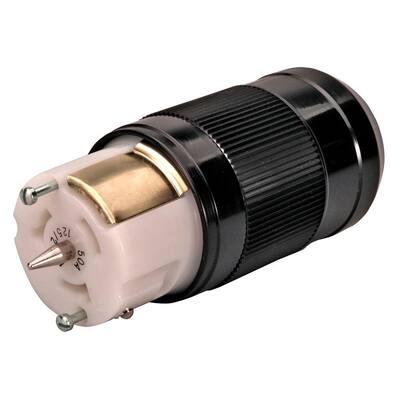
4) The 50A inlet for the generator is best served by a Reliance PB50 50A receptacle, type CS6375. A mating plug (CS6364) is available for your generator cordset. The cordset cable from the generator to the inlet should be minimum 300V rated, #6AWG type SOOW flexible rubber cord. The plug on the generator end will match your current 30A plug (4 wire: L1/L2/N/G), and can eventually be upgraded to a 50A plug should you get a larger generator set.

Wrooster

41IASx1DNpL.jpg


c67a5075-b2ba-4059-8612-d521d97d3b14_400.jpg
 
   / Generator inlet plug install-need advice on wire size/type, etc... #15  
Hmmm, i called my SqD supply house and asked the counterman about this....he didnt have the slightest idea what i was talking about.

Do you have a part number for this interlock. I di work on alot of QO and homeline panels..

Most of my work is with Siemens panels though. Hardly ever use cutler hammer stuff.


SEE even us crusty old sparkies can learn something new from a tractor forum :laughing: :laughing: :laughing:. I would really love to know a part # for the GE stuff..... ill also see if i can google it.
 
   / Generator inlet plug install-need advice on wire size/type, etc...
  • Thread Starter
#16  
1) A UL-listed interlock for your current breaker panel is a good solution for this application. It is inexpensive, allows for load flexibility, and is trivial to install. Note that not all breaker panels accept interlocks, so it is not always possible to go this route.

2) A 50A-capable feed from the generator to the panel will require #6 AWG wire. Generally the least expensive way to do this, depending on the length of the span, is to run 4 conductors of type THHN/THWN wire inside non-metallic conduit (typically gray schedule 40 PVC electrical conduit). This type of wire and conduit are both available at HD or Lowes. The conduit should be routed from the breaker panel through the structure wall or foundation. Externally, if there is a buried span, it must be at a depth of 18" below finished grade. If it will be mounted to the side of the structure, it should be at least 24" above finished grade. All buried bends should be long sweep type, and all above ground bends should have pull access.

3) You will need qty 2 #6 AWG Black conductors, qty 1 #6 AWG White conductor, and qty 1 #10 AWG Green conductor. Per the NEC, you can run #10 AWG ground for circuits up to 50A. Put red "phasing tape" around the ends of one of the lengths of black conductors, to denote it as the second leg.

4) The 50A inlet for the generator is best served by a Reliance PB50 50A receptacle, type CS6375. A mating plug (CS6364) is available for your generator cordset. The cordset cable from the generator to the inlet should be minimum 300V rated, #6AWG type SOOW flexible rubber cord. The plug on the generator end will match your current 30A plug (4 wire: L1/L2/N/G), and can eventually be upgraded to a 50A plug should you get a larger generator set.

Wrooster

:thumbsup: Thanks! This is exactly the info I needed. I figured I needed #6 but wanted to verify. It will be pretty straightforward-the box will be mounted on the foundation wall about 20' away from the panel-no underground span, etc... I have a length of #6 rubber cord that was used for a portable welding outfit which should work for the generator to box connection (it's definitely #6 and I think rated for 600V) but I will verify that is correct first.
 
   / Generator inlet plug install-need advice on wire size/type, etc...
  • Thread Starter
#17  
Hmmm, i called my SqD supply house and asked the counterman about this....he didnt have the slightest idea what i was talking about.

Do you have a part number for this interlock. I di work on alot of QO and homeline panels..

Most of my work is with Siemens panels though. Hardly ever use cutler hammer stuff.

I don't have a Square D number-tmajor would have that-I am only familiar with the Interlock brand kits from the website. If I can get one from Square D for less than $150.00 that would be nice. Especially since the #6 wire is going to be :shocked: just for 25'!
 
   / Generator inlet plug install-need advice on wire size/type, etc... #18  
Hmmm, i called my SqD supply house and asked the counterman about this....he didnt have the slightest idea what i was talking about.

Do you have a part number for this interlock. I di work on alot of QO and homeline panels..

Most of my work is with Siemens panels though. Hardly ever use cutler hammer stuff.


SEE even us crusty old sparkies can learn something new from a tractor forum :laughing: :laughing: :laughing:. I would really love to know a part # for the GE stuff..... ill also see if i can google it.

I'm surprised at you, since you contributed to my other thread.

From my other thread:
They are available on different sites, however they are available at Lowe's and I believe, Home Depot. They may not be available in store, but they can be special ordered. The Square D plates/kits are available in two configurations, for the QO panels ... one for the M1 main breaker (QOCRBGK1) and one for the M2 main breaker (QOCGK2). The M1 main (70 to 125 amps) is about the size of the D/P branch breakers, while the M2 is a much larger main (150 to 225 amps). Both about $55.00, made by Square D. Also, there are different plates or part numbers for the HomeLine series load centers. They all are probably available through most electrical supply stores, as well.
 
   / Generator inlet plug install-need advice on wire size/type, etc... #19  
I'm surprised at you, since you contributed to my other thread.

From my other thread:
They are available on different sites, however they are available at Lowe's and I believe, Home Depot. They may not be available in store, but they can be special ordered. The Square D plates/kits are available in two configurations, for the QO panels ... one for the M1 main breaker (QOCRBGK1) and one for the M2 main breaker (QOCGK2). The M1 main (70 to 125 amps) is about the size of the D/P branch breakers, while the M2 is a much larger main (150 to 225 amps). Both about $55.00, made by Square D. Also, there are different plates or part numbers for the HomeLine series load centers. They all are probably available through most electrical supply stores, as well.


now that i have those numbers, ill check back with my supplier. And no, i have never seen these before. Most electricl suppliers are starting to come out with split panel systems like siemens has so the owners dont have to flip breakers, so i guess this has never come up.

Actually here in Idaho, the inspectors really WANT to see a separate gen panel so a homeowner wont have any issues. Not that they wouldnt pass it as long as its a manual flip gen panel, but they dont like to see it.
 
   / Generator inlet plug install-need advice on wire size/type, etc... #20  
dang... i just went to lowes and homedepot site, and cant locate them.

I called my supply house again, got the same dummy. Has no idea what im talking about. I guess ill go in there myself and try to find it . First ill have to do some google searches.

Thanks for the info though. this might help with the smaller gen set installs i get.

But for now, i better got outside and clean the horse stalls before it freezes to the ground. see youall later
 

Tractor & Equipment Auctions

2023 Bobcat E60 (A53317)
2023 Bobcat E60...
UNUSED FUTURE ML32 - 32" MINI HYD MULCHER (A52706)
UNUSED FUTURE ML32...
2019 FREIGHTLINER CASCADIA TANDEM AXLE SLEEPER (A59904)
2019 FREIGHTLINER...
2014 SKYTRAK 10054 TELEHANDLER (A58214)
2014 SKYTRAK 10054...
2019 GALYEAN EQUIPMENT CO. 150BBL STEEL (A58214)
2019 GALYEAN...
2023 John Deere 333G for Parts (A56438)
2023 John Deere...
 
Top