Grapple project OPEN SOURCE

   / Grapple project OPEN SOURCE
  • Thread Starter
#61  
Why do you need pump flow for any calculations?

Nothing too important. Just to see the time it takes to close with different cylinder rod lengths and bore diameters

So, I am playing around with the diagrams. I now got all the force calculations, got the class 3 lever, and all that. My understanding is that all the parametres are like dancing... (yes i am a romantic guy with a tractor!:) :) hahaha)

There is no magic way to increse power of course. You have to give something. Either distance, or time. So I am trying to figure out an average point, and understand what most people need from a grapple. (Me personally I need only brush since I have the log winch at the back.)
I mean, I could easily increase the clamping force at the end point by just restricting the angle from full close to where it opens. But is that do important? If I am getting brush i need the more opening that I can get. If I am moving logs, then maybe I need not that much opening but more biting force. Same with rocks. And I say maybe, because the heavy stuff will just sit on the tines, right? Do i really need more than a 1000lbs on the closed position? I think not.

The other thing I will try to balance is at what point I need to maximize the force. I believe that it is not at the very opened state, but neither at the closed one, I think it should be just about after the halfway.


I really thank you all for pointing me to what to research!
Oh, and the other lesson learned is that... man, dont CAD every bit of detail until you finalize the geometry! hahaha

I will make a quick video to sum these up if someone else wants to start playing with the CAD. Its really very easy. A lot easier than cardboards!!!!!! :) :)
 
   / Grapple project OPEN SOURCE #62  
Calculated times are not going to be realistic. 1/4" hoses, and going through multiple fittings and couplers. Most people want to slow it down, not worried about speed
 
   / Grapple project OPEN SOURCE #63  
I think 1000# of bite force at the tines is gonna be a weak grapple.
 
   / Grapple project OPEN SOURCE #64  
Calculated times are not going to be realistic. 1/4" hoses, and going through multiple fittings and couplers. Most people want to slow it down, not worried about speed

I added restrictors to slow mine down when opening, so it didn't "slam" open so hard. I'm still getting used to them. I like fast speed so I'm not waiting on the claw movement at all. :)
 
   / Grapple project OPEN SOURCE #65  
Nothing too important. Just to see the time it takes to close with different cylinder rod lengths and bore diameters

So, I am playing around with the diagrams. I now got all the force calculations, got the class 3 lever, and all that. My understanding is that all the parametres are like dancing... (yes i am a romantic guy with a tractor!:) :) hahaha)

There is no magic way to increse power of course. You have to give something. Either distance, or time. So I am trying to figure out an average point, and understand what most people need from a grapple. (Me personally I need only brush since I have the log winch at the back.)
I mean, I could easily increase the clamping force at the end point by just restricting the angle from full close to where it opens. But is that do important? If I am getting brush i need the more opening that I can get. If I am moving logs, then maybe I need not that much opening but more biting force. Same with rocks. And I say maybe, because the heavy stuff will just sit on the tines, right? Do i really need more than a 1000lbs on the closed position? I think not.

The other thing I will try to balance is at what point I need to maximize the force. I believe that it is not at the very opened state, but neither at the closed one, I think it should be just about after the halfway.


I really thank you all for pointing me to what to research!
Oh, and the other lesson learned is that... man, dont CAD every bit of detail until you finalize the geometry! hahaha

I will make a quick video to sum these up if someone else wants to start playing with the CAD. Its really very easy. A lot easier than cardboards!!!!!! :) :)
Curious why you are "reinventing the wheel" so to speak...? why not examine a half a dozen commercial products similar to what you are wanting and then design something where the parameters are similar...?

Heck even us coders hardly ever write anything entirely from scratch any more...way too many libraries of open code available...and way too many scripts that write classes etc...
 
   / Grapple project OPEN SOURCE #66  
I think 1000# of bite force at the tines is gonna be a weak grapple.

I've never tried to calculate my bite force. I'm sure it's high. I recently picked up an 8'x12'x1/4" steel plate by standing it on it's edge, rolling the grapple forward over the top edge and biting it. I want my most force at closed and I want my claws to clamp tightly so I can handle thin objects.
 
   / Grapple project OPEN SOURCE
  • Thread Starter
#67  
I sure did my research! I saw more than 100 pictures. Best resource was the EA grapples btw, these guys explained a lot on their video. Also the Titan ones, and a few others. There are tiny differences at the geometry. Mine was also similar, but the guys before said it was not ok so I spent some time learning these stuff. It will sure be helpful down the road anyway. I need a firewood processor and a well rig (I did my own well manually but its not enough, I have to go 5-10ft deeper as it runs dry in Aug-Oct.).
 
   / Grapple project OPEN SOURCE #68  
I sure did my research! I saw more than 100 pictures. Best resource was the EA grapples btw, these guys explained a lot on their video. Also the Titan ones, and a few others. There are tiny differences at the geometry. Mine was also similar, but the guys before said it was not ok so I spent some time learning these stuff. It will sure be helpful down the road anyway. I need a firewood processor and a well rig (I did my own well manually but its not enough, I have to go 5-10ft deeper as it runs dry in Aug-Oct.).

I'll see if I can get some dimensional specs off my tomahawk grapple. Which is one of the cheaper grapples out there.

But equally as important as hydraulics, is make sure the tines are well gusseted or you will just bent them over. 3/8" steel tines....unsupported for 6" or so....a tractor has no issues bending that over
 
   / Grapple project OPEN SOURCE #69  
I'll see if I can get some dimensional specs off my tomahawk grapple. Which is one of the cheaper grapples out there.

But equally as important as hydraulics, is make sure the tines are well gusseted or you will just bent them over. 3/8" steel tines....unsupported for 6" or so....a tractor has no issues bending that over

Yep. I used 1/2" trussed and still have bent them.

If all a guy ever did was pick up a smooth, uniform, circular object you wouldn't have any problems. :)
 
   / Grapple project OPEN SOURCE #70  
Time for some geometry / trig / hydraulics 101. This is gonna be a long post.....but worth the read if you want an understanding of grapple forces, especially movement about a circular motion.

For starters.....grapple all the way open....and grapple at max close are both the weaker extremes of its range of motion.

Those with a kubota, reference your manual and look at the chart illustrating bucket curl. Either extreme range of motion is the least powerful, because you are rotating the bucket. Same with the grapple. Just look at the triangle and the design of the lid. The more the lid opens....the more the 3 points of the triangle become in alignment....same way with closing.....if it were allowed to close further....there would be a point where the rod end of the cylinder would drop below the line the other two points form. Think about how over-center type latches work (like a chain binder). Same principal.

So for starters.....get familiar with the law of cosines.

Law of Cosines -- from Wolfram MathWorld

I dont have any good side shots of my grapple, but I'll use the drawings but MY dimensions off my tomahawk.

Here is the triangle we are dealing with. Solve for the angle C using law of cosines above....
View attachment 526505

I get 11.8 degrees. A little less than I thought it would be....but more on that later.

So sin(11.8*) = 0.204
So 7850# of force from my 2" bore cylinder multiplied by 0.204 and we get 1601# of force trying to close the lid.

Can do the same thing with the grapple lid open. Dimension C and B stay the same. Dimension A gets 8" smaller (cylinder retracted 8")

View attachment 526508

Get about 10.25 degree angle.

So thats about 1400# of force trying to close the lid.

Now thats at the two extremes. Like I said....its more mid stroke.
Do the same formula....but dimension A (the cylinder).....make it 22.25" to simulate mid stroke of the cylinder and the lid half closed.

That gives you a 15 degree angle....and sin(15*) is 0.259
0.259 x 7850 = ~2000# of closing force.

So, what does all of this translate to in terms of bite force at the teeth.....this is where we get into simple class 3 lever.

The length of my grapple from pivot to tines is 26.25". And we already know the pivot to the point where the force applied is 23"

View attachment 526509

So if at full closed my cylinder being on the 11.8* angle can impart 1600# of force to close the lid, and does so 23" away from the pivot of the lid (fulcrum), how much force can it exert at the tips of the teeth that are 26.25" away from the fulcrum.

Answer = ~1400# of force.

At mid stroke where the 15* cylinder angle allowed for 2000# of force to close the lid, that would be about 1735# of force at the teeth.

I can say that I would not want a grapple with any LESS force at all. So design with that in mind. More force within reason certainly isnt gonna hurt a thing.

And remember, I used YOUR drawings, BUT MY dimensions. So things may not look right, or may not look to "scale" and thats why. I'd be shooting for ~1500-2000# of clamp force.

If anyone has a different brand grapple and would like me to calculate the bite force.....All I need is 4 measurements. Close your grapple lid and give be the 3 dimensions that form the triangle (A,B,and C in my drawings), and then the dimension from the lid hinge to the teeth. And I can calculate assuming a 2" cylinder and 2500psi. See how the geometry of some other grapples compare:laughing:
 
   / Grapple project OPEN SOURCE
  • Thread Starter
#71  
I agree with everything but I think you have an error on the the last picture.

But yes, summarizing, I use this simplified formula. Fin = sin(A) * F * L1/ (L1 +L2)
Fin= the final force
A= the angle
F=the Cylinder force
L1- the distance between the pivot and the end of the cylinder
L2 the distance between the end of the cylinder and the point where the force is acting.

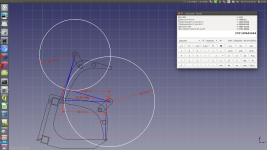
I think you are wrong where you sketched that the 26.25"
It should be like this one correct? (My apologiesm I have removed the outlines of the cylinder base. But is where the red dot is
Screenshot from 2017-10-28 16-37-17.png

So in my last picture I get a force of 7850×sin(7.9)×16.24÷(16.24+3.94) = 868lbs
 
Last edited:
   / Grapple project OPEN SOURCE #72  
Do the method I showed and what do you get for clamp force?

Or give the 4 dimensions and I'll figure it.

I think you are over complicating it. The grapple doesn't care if the lid is curved or how much it's curved. You are already taking it into account when you figure the angle of the cylinder.

If the lid had straight tines going from it's hinge to it's tips, the force would be the same as if they were curved as they are
 
   / Grapple project OPEN SOURCE #73  
LD1, do me, do me!!!!!!

A = 26.5"
B = 24"
C = 4"
D = 30"

Using a 2" x 8" cylinder if that matters.

Thanks!!!!!
 
   / Grapple project OPEN SOURCE
  • Thread Starter
#74  
Do the method I showed and what do you get for clamp force?

Or give the 4 dimensions and I'll figure it.

I think you are over complicating it. The grapple doesn't care if the lid is curved or how much it's curved. You are already taking it into account when you figure the angle of the cylinder.

If the lid had straight tines going from it's hinge to it's tips, the force would be the same as if they were curved as they are

No, I think there is a misunderstanding here. The 26.25" that you draw is not the distance between the point that the tines apply the force and the grapple pivot point. In vectors, your 26.25 should be a point on the extension of the line between the grapple pivot point and the cylinder rod point. See my last sketch. Your 26.25 should be where the L2 measurement ends. Not at the hypotenuse.
The shape or the lenght of the teeth should not affect the calculation you are right
 
Last edited:
   / Grapple project OPEN SOURCE #75  
LD1, do me, do me!!!!!!

A = 26.5"
B = 24"
C = 4"
D = 30"

Using a 2" x 8" cylinder if that matters.

Thanks!!!!!

Not good.

Your "c" dimension is pathetic.

Puts your cylinder on a 7.1* angle at full close. Giving 970# cylinder force.

24/30th of that is 776# bite force.
 
   / Grapple project OPEN SOURCE #76  
No, I think there is a misunderstanding here. The 26.25" that you draw is not the distance between the point the tines apply the force and the grapple pivot point. In vectors, your 26.25 should be a point on the extension of the line between the grapple pivot point and the cylinder rod point. See my last sketch. Your 26.25 should be where the L2 measurement ends. Not at the hypotenuse.
The shape or the lenght of the teeth should not affect the calculation you are right

Yes. But reality vs practical.

I am giving two known fixed points to measure. = EASY

Trying to extend a vector line beyond, and some imaginary point the lines cross, and get a measurement...= Hard.

And in reality....the numbers are close enough to suffice.

In other words, there are other things that are gonna make a large difference in the calculations. Like being 1/2" off on a measurement one way or another. Or 2400 Psi system pressure vs 2600.

Just trying to keep things as simple and easy as possible and still get a pretty accurate real world number
 
   / Grapple project OPEN SOURCE
  • Thread Starter
#77  
1957lbs , made it class 2 lever, so end up 2100lbs on the teeth! Wtf that stuff are so fun!
And since you say the 2" cylinder is too quick, replace it with a 2.5" and we have 3280lbs...:cool2:

Thats the proof!Screenshot from 2017-10-28 20-02-10.png
 
   / Grapple project OPEN SOURCE #78  
Ain't math fun :D

It's amazing what just a few inches here and there make in overall performance? It's a good thing you are designing and asking questions first rather than just flying by the seat of your pants. Even if in the end I think you will have spent more trying to build.....at least you have a good understanding.

And FYI....these same mathematic principals apply to things like dump trailer design, loader and backhoe lift specs, etc.
 
   / Grapple project OPEN SOURCE #79  
Just realized I was in too big of a hurry when I posted that last post. You are still using a 4" cylinder.

And to do that and achieve the force you did.....look at your angles when the lid is open.

(Hint: your grapple will never close)
 
   / Grapple project OPEN SOURCE
  • Thread Starter
#80  
Just realized I was in too big of a hurry when I posted that last post. You are still using a 4" cylinder.

And to do that and achieve the force you did.....look at your angles when the lid is open.

(Hint: your grapple will never close)

hahaha! You are right! Its going towards the opposite direction! hahaha.

I will fix that, and I will redesing it, I think I have to change the shape of the teeth a litte, make the radius more tight and increase the capacity of material that fit in there. I am leaning towards a 2.5" also for reasons:
a) you mentioned that its too fast anyway, so the loss of the speed is a good thing. And the increase in force is a better thing!
b) having that much of a bite force, gives me room to sacrifice a little more force in exchange of some wider angle and more opening. Teeth to teeth in opening (measured from inside) is 29" now. If I can make it to 35" or so it would be perfect.


And yes, I like learning stuff!! Forums, google, videos are my friends! :) :)

Anyway, there is a lot work more to be done. BoM, links, cost, figuring out these annoying pins....
 

Tractor & Equipment Auctions

INGERSOLL RAND G25 GENERATOR (A58214)
INGERSOLL RAND G25...
2020 MACK GR64FT (A58214)
2020 MACK GR64FT...
Roll of 2-inch Vacuum Hose (A57454)
Roll of 2-inch...
2010 Deere 318D (A60462)
2010 Deere 318D...
Case 1020 25ft Draper Head (A56438)
Case 1020 25ft...
1982 LeeBoy Motor Grader (A55302)
1982 LeeBoy Motor...
 
Top