Grapple project OPEN SOURCE

   / Grapple project OPEN SOURCE
  • Thread Starter
#101  
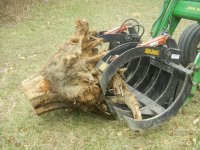
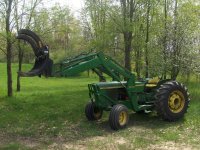
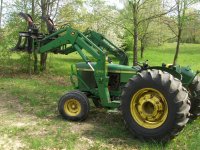
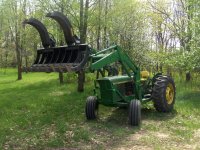
I built a double claw grapple onto a Bobcat LoPro bucket. It works very well and has hundreds of hours of hard use under it's belt.

As I've stated earlier, I'm totally a practical application guy. Your approach is over my comprehension level. So I design by the desired end result. In my case I wanted a large opening. That created the position of my cylinders. I had no idea how much bite force I was going to have until I put it into action. I don't need more force. I'm just a bit disappointed that my design doesn't score any higher.

I struggled a lot with position of the cylinder tabs. Tack welded, cut loose, moved, tack welded, many times to get where I ended up. When fully open and rolled back my claws parallel my FEL frame and curl cylinders so I couldn't open any wider. This "big mouth" design gives me the ability to push loose brush up in a pile, then roll the grapple forward until the claws span most of the pile. Clamp, compress and pick up a huge pile of brush. In the other side I have ability to clamp onto thin material such as plate steel, steel fence posts, or whatever.

Still, just disappointed in my force numbers..... :ashamed:
If that works for you then your "numbers" are ok. I need the numbers because I do not know what works and trying to design one that works right away. Make the mistakes on the CAD instead. And hopefully -if I CNC cut the steel- the tabs will be mounted in such a way that I will not have to measure anything.

That's what I should have done. Made my frame mount tab taller and more forward, then used a shorter stouter cylinder. Famous last words!!!

Do you know what the stroke length is on that cylinder?

Edit: Never mind, I checked out your link. They say 10". My pea size brain can't figure out how to make that work on mine. My claws and apron must be shorter than theirs. I'll have to take some more measurements of mine.
I cannot see how they fit a 10" cylinder on that size. But I am kind of tired changing the cad. I think I will stick to the 6" for now

Not sure why you are still so adamant on wanting to use a 4" or 6" stroke cylinder....when all the mfgs that spend thousands on designing and engineering all use 8" or 10" stroke cylinders.

Why re-invent the wheel.

But you have designing software ability. So whatever works for you.

I'd go no less than 3/8". That's pretty much standard on light and medium grapples.
No obsession on 4" or 6". It is just I cannot fit any longer cylinder on that design. The wicked grapple from EA uses 5" and still have great reviews. And I think my desing is closer to the wicked one. I can try to add the 8". Lets see. If it will give me more opening why not?

I'm following this thread and I really have enjoyed the mathematical approach. I wish one of my high school math teachers had used a real world example approach to show how math can be used after you pass the test... I think it would have really held the interest of many students. I did fine in math, but I remember thinking how I would never use that in real life!
Now I haven't checked the math for accuracy... Nor have I confirmed that the formulas are proper... But I like the approach!
Its not anything difficult. Google is your friend. Espesially now that the elders:thumbsup: mentioned what to research. I would say the most difficult part is the CAD. But still, I have 11 months CAD experience and I am self taught.

Just remember that bigger diameter cylinders are heavier. And every pound you have at the end of the loader is one less pound you can pick up with the grapple. I would use a flow control valve with a smaller diameter cylinder, if the force at the end of the jaws is still enough to get the job done.
Ok, let the numbers talk :) What would you prefer on 6" lenght? 2" with 1510lbs or 2.5" with 2360lbs at the closed position? For an average compact tractor with 30-40hp.
 
   / Grapple project OPEN SOURCE #102  
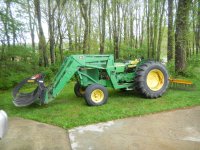
That thing is very well built!!!! Are your cylinders 2x8?? Anxious to see your "C" measurement. Also would like to see a pic with the claws open if you have one. Thanks!!!!
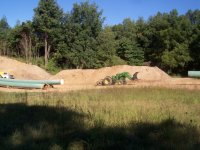
It is well built and heavy! I'll check cylinder size when I get measurements. I don't have many open (I always close when not in use) these are the only ones I could find, plus a few more, I was able to lift and drop stump on my burn pile.
 

Attachments

  • burn4daytwo 001.JPG
    burn4daytwo 001.JPG
    204.7 KB · Views: 167
  • farm 3-23 005.JPG
    farm 3-23 005.JPG
    196.1 KB · Views: 241
  • piilinglogs 001.JPG
    piilinglogs 001.JPG
    829.7 KB · Views: 174
  • tractor 004.JPG
    tractor 004.JPG
    771.3 KB · Views: 207
  • tractor 006.JPG
    tractor 006.JPG
    765.7 KB · Views: 175
  • tractor 005.JPG
    tractor 005.JPG
    759 KB · Views: 228
   / Grapple project OPEN SOURCE #103  
LD1,

I have a request. Is there some way that you can write a "paper" on figuring the bite force?

For example, maybe have a drawing at the beginning giving a visual of the four measurements you need, A, B, C, D. Then a written description of what each is. Then the mathematical formula used to calculate bite force. Then,,,,, in layman's terms,,,, that same formula in steps. Maybe in pdf or something easy to save. Attach it to a post here. Then anyone that wants to save it can easily for future projects.

This would be useful on more than just a Grapple. For example, a tree puller.

I would greatly appreciate this if you are willing to take the time. This gets talked about a lot on TBN, especially as Winter sinks in.

I'd use it now for example, I measured my "C" and it's actually 5". Then I took measurements of my homemade tree puller. So would like to try to understand and calculate this on my own.

Thank you for whatever you come up with!!!! :)
 
   / Grapple project OPEN SOURCE #104  
It is well built and heavy! I'll check cylinder size when I get measurements. I don't have many open (I always close when not in use) these are the only ones I could find, plus a few more, I was able to lift and drop stump on my burn pile.

I really like that. Strongly built!!! Measure the open distance if you get a chance. Looks very impressive!!!
 
   / Grapple project OPEN SOURCE #105  
LD1,

I have a request. Is there some way that you can write a "paper" on figuring the bite force?

For example, maybe have a drawing at the beginning giving a visual of the four measurements you need, A, B, C, D. Then a written description of what each is. Then the mathematical formula used to calculate bite force. Then,,,,, in layman's terms,,,, that same formula in steps. Maybe in pdf or something easy to save. Attach it to a post here. Then anyone that wants to save it can easily for future projects.

This would be useful on more than just a Grapple. For example, a tree puller.

I would greatly appreciate this if you are willing to take the time. This gets talked about a lot on TBN, especially as Winter sinks in.

I'd use it now for example, I measured my "C" and it's actually 5". Then I took measurements of my homemade tree puller. So would like to try to understand and calculate this on my own.

Thank you for whatever you come up with!!!! :)

A, B, and C are relative depending on what you are working on.

No need in reinventing the formulas.

Look up law of cosines......and see if you can understand that......because if you can....you are 90% there.

If you cannot, there is no point in me writing out the formula....because law of cosines is basically it.

All law of cosines is doing is allowing you to find the effective angle of the cylinder.

It seems you understand that there are 3 points. Base of the cylinder, rod of the cylinder, and the pivot point of whatever the cylinder is moving. In this thread it happens to be the pivot of the grapple lid.

Since the grapple lid is moving, the line drawn between its pivot and the rod end is the line you want to find the angle of the cylinder in relationship to.

Law of cosines formula allows you to find that angle when the only "known" measurements is the lengths of the 3 points.

Once you know the angle.....it gets simple. Formula for a cylinders force on an angle is the force times the sin of that angle. I "think" you understand that.

Now it simply becomes about leverage. Because that force that was just calculated using the sin of the angle....that force is rarely applied where the work is happening. Like on a loader....who cares how much lift force there is where the cylinder is attached. Same with grapple. Dont care about where the cylinder is connected, rather out at the teeth.

But you can eliminate the law of cosines if you are in physical possession of whatever you are wanting to figure, as well as a $4 angle finder and a straight edge. Something I dont have the luxury of when helping someone online, thus I ask for those three measurements and I can figure the angle pretty simply.

If you want, send me a pic of the tree spade and some measurements, but dont be afraid to try to solve it yourself. If you get stuck, just ask.
 
   / Grapple project OPEN SOURCE #106  
A, B, and C are relative depending on what you are working on.

No need in reinventing the formulas.

Look up law of cosines......and see if you can understand that......because if you can....you are 90% there.

If you cannot, there is no point in me writing out the formula....because law of cosines is basically it.

All law of cosines is doing is allowing you to find the effective angle of the cylinder.

It seems you understand that there are 3 points. Base of the cylinder, rod of the cylinder, and the pivot point of whatever the cylinder is moving. In this thread it happens to be the pivot of the grapple lid.

Since the grapple lid is moving, the line drawn between its pivot and the rod end is the line you want to find the angle of the cylinder in relationship to.

Law of cosines formula allows you to find that angle when the only "known" measurements is the lengths of the 3 points.

Once you know the angle.....it gets simple. Formula for a cylinders force on an angle is the force times the sin of that angle. I "think" you understand that.

Now it simply becomes about leverage. Because that force that was just calculated using the sin of the angle....that force is rarely applied where the work is happening. Like on a loader....who cares how much lift force there is where the cylinder is attached. Same with grapple. Dont care about where the cylinder is connected, rather out at the teeth.

But you can eliminate the law of cosines if you are in physical possession of whatever you are wanting to figure, as well as a $4 angle finder and a straight edge. Something I dont have the luxury of when helping someone online, thus I ask for those three measurements and I can figure the angle pretty simply.

If you want, send me a pic of the tree spade and some measurements, but dont be afraid to try to solve it yourself. If you get stuck, just ask.

Working, working, working.......
 
   / Grapple project OPEN SOURCE
  • Thread Starter
#107  
There is another way. I can give you easy instructions in a video how to do it in Freecad. Its really very easy, no need to learn the whole program, just how to draw a few lines in 2D. Then it will show you the angles, and the distances. It looks easy for me anyway!! hahah
 
   / Grapple project OPEN SOURCE #108  
Just found this interesting thread. My first thought was: "Where is IslandTractor?" (He has put a lot of good thought into grapple design)

On your early question about whether to make the tips touch, if you design them to get close, you can tweak their position later with the threaded connection between the rod and the rod's clevis.

And just to muddy the issue about geometry/clamping force:

It can be argued that clamping force in this style of grapple mostly applies to something compressible, like a wad of brush. Otherwise, with the lower tines supporting the load, the jaws just need to touch the load and resist upward forces that would let the load escape- like when bouncing down a rough trail. Now here is the rub: an unfavorable triangle that doesn't provide much clamping force is less likely to unclamp under those bouncing loads. Think about it- as the three corners of the triangle move into being colinear, (bad for clamping force) the jaw approaches self locking.
 
   / Grapple project OPEN SOURCE
  • Thread Starter
#109  
Just found this interesting thread. My first thought was: "Where is IslandTractor?" (He has put a lot of good thought into grapple design)
Can we find these threads?

On your early question about whether to make the tips touch, if you design them to get close, you can tweak their position later with the threaded connection between the rod and the rod's clevis.
Nice idea. Maybe I will leave a little rod travel extra so I can extend it below the tips if need it
It can be argued that clamping force in this style of grapple mostly applies to something compressible, like a wad of brush. Otherwise, with the lower tines supporting the load, the jaws just need to touch the load and resist upward forces that would let the load escape- like when bouncing down a rough trail. Now here is the rub: an unfavorable triangle that doesn't provide much clamping force is less likely to unclamp under those bouncing loads. Think about it- as the three corners of the triangle move into being colinear, (bad for clamping force) the jaw approaches self locking.
[/QUOTE]
Exactly what I was thinking when I said that I would like the max force right after the mid travel. But anyway, my early designs really sucked. Now that I have a better understanding of the geometry those arguments are not a issue anymore. I even thinking of going back to 2" rod since I can get 1500lbs which will suffice. 2.5" can give me 2500lbs at the closed position. Maybe too much that as others commented, will stress the whole structure.

Now my only "problem" is what exactly is the purpose of the grapple. I figured out how to make it 40" tall, how to add 8" cylinder, etc. Easy stuff. Now I have so many options, and no restrictions. So I have to decide my mind. What most people want? Should I go to 36 long one? Are most people need it for brush? Then more volume inside the tines is desired. Need for moving heavy logs? Then smaller, lighter design that will not limit the lifting capacity of the front will match better.
Or decisions on whether design it simple with flat bars? CNC will add to the cost a lot. Even plasma cutter, is not accessible by anyone (it should if one is serious in fabricating tools anyway). Maybe make simple tines from flat bar? But that will definitely affect the strength of the grapple.

I understand that there is not one recipe for all. At least now I have some higher ability to fit ones needs.
 
   / Grapple project OPEN SOURCE #110  
   / Grapple project OPEN SOURCE #111  
Now my only "problem" is what exactly is the purpose of the grapple. I figured out how to make it 40" tall, how to add 8" cylinder, etc. Easy stuff. Now I have so many options, and no restrictions. So I have to decide my mind. What most people want? Should I go to 36 long one? Are most people need it for brush? Then more volume inside the tines is desired. Need for moving heavy logs? Then smaller, lighter design that will not limit the lifting capacity of the front will match better.
Or decisions on whether design it simple with flat bars? CNC will add to the cost a lot. Even plasma cutter, is not accessible by anyone (it should if one is serious in fabricating tools anyway). Maybe make simple tines from flat bar? But that will definitely affect the strength of the grapple.

I understand that there is not one recipe for all. At least now I have some higher ability to fit ones needs.

My main use of my grapple is hauling and piling brush to burn. I also haul stumps (most were previously dug with a backhoe, hired out), move and pile logs, move large rocks, in that order.
 
   / Grapple project OPEN SOURCE #112  
My main use of my grapple is hauling and piling brush to burn. I also haul stumps (most were previously dug with a backhoe, hired out), move and pile logs, move large rocks, in that order.

Yep, that's my list!!!! Additionally my Grapple is built on a Bobcat bucket so it also serves to get one heck of a load of dirt to stay in the bucket. :)
 
   / Grapple project OPEN SOURCE #113  
many times manufactures literature, will have line drawings, and will give one a good set of plans, with out the dimensions, but once one knows the width of one part the rest can be guess-a-estimated with some close accuracy,

and I do many times use the cardboard design method, one can work it through the paces and see what is happening and what could bind or hit,

my two cents,
 
   / Grapple project OPEN SOURCE #114  
Not trying to jump over LD1.

Measurements with claws closed.
A = distance from barrel end of cylinder pin to ram end of cylinder pin
B = distance from hinge pin of claw to ram end cylinder pin
C = distance from hinge pin of claw to barrel end of cylinder pin
D = distance from hinge pin of claw to tip of claw

Here are the measurements for my RakeMaster grapple

A = 28.25'
B = 23.50
C = 6.25"
D = 31.75"
Cylinder is 2 1/2" x 8"
Tractor has 2250psi

Thanks for bite pressure calculation!
 
   / Grapple project OPEN SOURCE #115  
Approx. 1300# bite force zebra.

Cylinder is on a 9 degree angle. But since you start off with a 2.5" cylinder...that starts you will 11000# of cylinder power instead of 7800 with a 2".
 
   / Grapple project OPEN SOURCE #116  
Approx. 1300# bite force zebra.

Cylinder is on a 9 degree angle. But since you start off with a 2.5" cylinder...that starts you will 11000# of cylinder power instead of 7800 with a 2".

Thanks for calculating, interesting to know
 
   / Grapple project OPEN SOURCE
  • Thread Starter
#117  
I think the force of the 2.5" cylinder is 12600lbs if the initial pressure is 2500psi.

The project is on hold until the end of the week due to the storm that hit Maine. 3 days without power, they said we will be on grid again by Sunday :(

I had uploaded an better version on the Dropbox, but I do not recall if it the final one. Which will have a 2" think cylinder 8". I will use 3/8" thick metal. All the files will be in Freecad format, but I can export them in .STEP if you want to use them in different CAD. But by keeping them in freecad you can alter them very very easy!
Anyway see you next week guys going back to my primitive living in the dark :(
 
   / Grapple project OPEN SOURCE #118  
I think the force of the 2.5" cylinder is 12600lbs if the initial pressure is 2500psi.

The project is on hold until the end of the week due to the storm that hit Maine. 3 days without power, they said we will be on grid again by Sunday :(

I had uploaded an better version on the Dropbox, but I do not recall if it the final one. Which will have a 2" think cylinder 8". I will use 3/8" thick metal. All the files will be in Freecad format, but I can export them in .STEP if you want to use them in different CAD. But by keeping them in freecad you can alter them very very easy!
Anyway see you next week guys going back to my primitive living in the dark :(

My tractor is rated 2250psi, which I stated when asking for bite force calculations. I know we have been using 2500psi for a base line.
 
   / Grapple project OPEN SOURCE
  • Thread Starter
#119  
My tractor is rated 2250psi, which I stated when asking for bite force calculations. I know we have been using 2500psi for a base line.

Oh ok, this is formula I think: Force = Initial pressure * (3.14 * diameter of cylinder^2)/4
So yes almost 11000 with 2.5", 7065 with 2"


Ok, I am back so many days without electricity. Too excusted to do anything, so many things to catch up. But I will finish that thing, it will be sooo useful. I have so much brush everywhere.
I need a little help. Can someone put a link of the pivot pin One that can take grease? I think I am slow, I cannot find it. Or else I will use just plain bolts. :(
 
   / Grapple project OPEN SOURCE #120  
The basic formula is true when pushing out.

When pulling back, you have less force (because of the area of the rod). On a grapple the opening force is usually not a problem (unless you are doing something weird like using the lids as a jack on a tree trunk or something), but I thought I'd mention it anyway.
 

Tractor & Equipment Auctions

2017 Ford Fusion Sedan (A59231)
2017 Ford Fusion...
2011 MAGNUM PRODUCTS LIGHT PLANT/TANK TRAILER (A58214)
2011 MAGNUM...
Kubota BX25D (A53317)
2006 KOMATSU PC228USLC-3 EXCAVATOR (A60429)
2006 KOMATSU...
2012 VOLVO VNL (A55745)
2012 VOLVO VNL...
1980 Gleaner F2 with heads (A56438)
1980 Gleaner F2...
 
Top