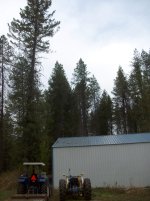
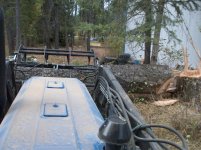
Grappling fun - A Picture Thread....

   / Grappling fun - A Picture Thread.... #421  
I have to disagree. A 6ft 1/2" ID hose connected to 2ft of 1/4" will have a higher flow rate than 8ft of 1/4" hose (assuming the same head pressure). At least that's what the laminar flow physics says.
How does your theory fit with the fact that flow restrictors are typically only the thickness of a washer? I'm not a physicist but it seems pretty clear that the vast majority of the difference will be because there is even one inch of 1/4" tube.
 
   / Grappling fun - A Picture Thread.... #422  
I have to disagree. A 6ft 1/2" ID hose connected to 2ft of 1/4" will have a higher flow rate than 8ft of 1/4" hose (assuming the same head pressure). At least that's what the laminar flow physics says.

Slightly. But the real drag is in the 1/4" lines and the smaller fittings. If he was going more than 12' total, then yes, you could measure the loss. In this case, the 1/4" line is a restrictor and there would be a pressure drop because of it (the velocity of the fluid would also change).

http://www.lifcohydraulics.com/catalog/pdf/Hedland-(Flow-vs.-Pressure-Drop)-In-line-Flow-Meters.pdf
 
   / Grappling fun - A Picture Thread.... #423  
How does your theory fit with the fact that flow restrictors are typically only the thickness of a washer? I'm not a physicist but it seems pretty clear that the vast majority of the difference will be because there is even one inch of 1/4" tube.

I think if you go back and re-read you'll see that this is missing to point slightly.
My comment was also missing the point to some extent because diameter has a much greater effect on pressure drop than length (but length does nevertheless matter). What this means is that even very short reductions in diameter can cause a large pressure drop (as in your washer example). However, I would still prefer to have a 1/2" line cnvert to 1/4" at the end rather than it be 1/4" for the entire distance.

But back to the pictures! Giant grabber arms for the kid in all of us are awesome.
 
   / Grappling fun - A Picture Thread.... #424  
--------------

But back to the pictures! Giant grabber arms for the kid in all of us are awesome.
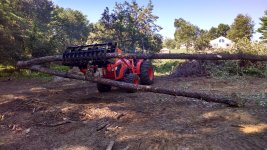
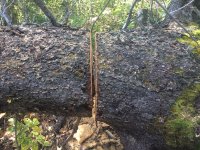
Here ya go. :thumbsup:

P4080004.JPG


P4140015.JPG


P4140018.JPG


P4200006.JPG
 
   / Grappling fun - A Picture Thread.... #425  
You're giant grabber arm is bigger than my giant grabber arm... Just don't tell my 3yr old!


ForumRunner_20151010_063845.png
 
   / Grappling fun - A Picture Thread.... #426  
I think if you go back and re-read you'll see that this is missing to point slightly.
My comment was also missing the point to some extent because diameter has a much greater effect on pressure drop than length (but length does nevertheless matter). What this means is that even very short reductions in diameter can cause a large pressure drop (as in your washer example). However, I would still prefer to have a 1/2" line cnvert to 1/4" at the end rather than it be 1/4" for the entire distance.

But back to the pictures! Giant grabber arms for the kid in all of us are awesome.

I am a little confused by this. I can see that you get pressure drop from any restriction while there is hydraulic fluid flow but doesn't the pressure drop or loss become zero or negligible as the cylinder slows at the end of its travel because there is no longer any flow. So there is no reduction in force holding or grabbing the load due to restrictions. Is this correct ????
 
   / Grappling fun - A Picture Thread.... #427  
I am a little confused by this. I can see that you get pressure drop from any restriction while there is hydraulic fluid flow but doesn't the pressure drop or loss become zero or negligible as the cylinder slows at the end of its travel because there is no longer any flow. So there is no reduction in force holding or grabbing the load due to restrictions. Is this correct ????

I think so. Here try this experiment. On you garden hose turn the water flow down to just a drip by nearly closing the water valve. Now lest say the water pressure on your system is 60 lbs. Now just a drip ever few seconds is coming from the hose. Put your thumb over the end of the hose, wait several seconds and you will start to feel the pressure building under your thumb. After some time the full 60 lbs per square inch will build up under your thumb. The flow rate of the flow is very very low, just a drip, but it will still develop the full 60 lbs per square inch under your thumb, it just takes a long time to do it. If a small amount of water leaks past your thumb, it will take some time to develop the 60 lbs again, but it will happen.

So the "flow restrictor" of the water valve nearly shut slowed the flow rate down to nearly nothing, but it still delivers 60 lbs per square inch of pressure over a long time period, at nearly zero flow rate.
 
   / Grappling fun - A Picture Thread.... #428  
I am a little confused by this. I can see that you get pressure drop from any restriction while there is hydraulic fluid flow but doesn't the pressure drop or loss become zero or negligible as the cylinder slows at the end of its travel because there is no longer any flow. So there is no reduction in force holding or grabbing the load due to restrictions. Is this correct ????
That is correct, but I am also confused by the term "pressure drop". From my experience, in an open center system, pressure increases with resistance to flow. Instead of "pressure drop", it is "flow rate decrease"

When the grapple lid stops moving, pressure will increase until the relief valve opens. That is maximum clamping force.
 
Last edited:
   / Grappling fun - A Picture Thread.... #431  
I think so. Here try this experiment. On you garden hose turn the water flow down to just a drip by nearly closing the water valve. Now lest say the water pressure on your system is 60 lbs. Now just a drip ever few seconds is coming from the hose. Put your thumb over the end of the hose, wait several seconds and you will start to feel the pressure building under your thumb. After some time the full 60 lbs per square inch will build up under your thumb. The flow rate of the flow is very very low, just a drip, but it will still develop the full 60 lbs per square inch under your thumb, it just takes a long time to do it. If a small amount of water leaks past your thumb, it will take some time to develop the 60 lbs again, but it will happen.

So the "flow restrictor" of the water valve nearly shut slowed the flow rate down to nearly nothing, but it still delivers 60 lbs per square inch of pressure over a long time period, at nearly zero flow rate.

Nicely explained, James! Your experiment would make Bill Nye The Science Guy proud! :thumbsup:
 
   / Grappling fun - A Picture Thread.... #432  
That is correct, but I am also confused by the term "pressure drop". From my experience, in an open center system, pressure increases with resistance to flow. Instead of "pressure drop", it is "flow rate decrease"

When the grapple lid stops moving, pressure will increase until the relief valve opens. That is maximum clamping force.

Seems like the confusion in terminology is just over where we are measuring when we talk about an increase or drop in pressure. Restricting the flow causes the applied pressure to rise at the point of restriction, but results in a corresponding drop of applied pressure measured at the cylinder downstream, until the volume of fluid passing the restriction catches up to the original flow rate. James' experiment with the garden hose illustrates that.
 
   / Grappling fun - A Picture Thread.... #433  
Thanks K0ua. Easy to understand that.

gg
 
   / Grappling fun - A Picture Thread.... #434  
Bottom line, the output from a 1/4" line is perfectly adequate to operate a grapple cylinder. I use 3/8" because it is tougher than 1/4" and more flexible than 1/2". The last 18" or so are 1/4".
 
   / Grappling fun - A Picture Thread.... #435  
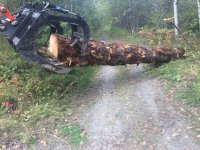
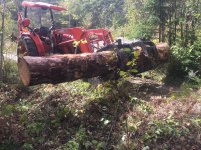
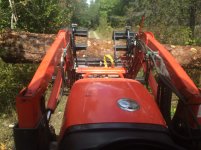
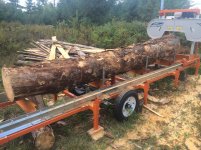
From the bush to the mill....white spruce dead-fall.....grapples are great!!
IMG_0400.jpg
IMG_0402.jpg
13 foot log going down an 8 foot wide bush road makes things interesting:
IMG_0403.jpgIMG_0404.jpg
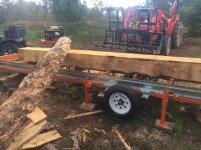
....and finally on the mill:
IMG_0405.jpgIMG_0406.jpg
 
   / Grappling fun - A Picture Thread.... #436  
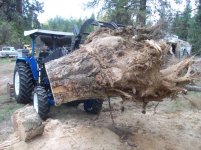
Knocking the dirt out of the newest stump by lifting and dropping it and then grapple holding it to square cut the top-

This one was heavier than most

garage tree stump 002.jpg grapples are the best:)
here is a pic of the tree- the stump was attached to before i dropped itGarage tree drop 001.jpg
 
Last edited:
   / Grappling fun - A Picture Thread.... #437  
Hi sd455dan- I assume you missed your shop? :)
 
   / Grappling fun - A Picture Thread.... #438  
Yeah-:D it's still intact,
I thought about having it done professionally but we had already removed several other shorter/smaller trees using the same method. So just went for it, gotta say i didn't need any coffee during or after:laughing:

I posted about it over on the tractors and wood thread- using a long heavy duty cable/ rope setup hooked to the JD dozer and then wedge /hinge cutting the tree and pulling it over.

Here is the grapple picking up the base of the tree where it landedGarage tree drop 024.jpg

Wife did video it on her phone -but not sure how to post it without linking to her facebook page..??.
 
Last edited:
   / Grappling fun - A Picture Thread.... #439  
I had to take it off because it caused too much damage.

Tractor lifts 011 (Large).jpg
Tractor lifts 009 (Large).jpg

Steve

Neat scale. I am guessing that is a half ton. Have you ever weighed it?

My 3/4 ton GMC weighs 7300 pounds, front axle 4100, rear axle 3200.

2015-01-02 10_01_45-725 kg equals pounds - Google Search.png
seems kinda light for the back half of the truck.


By picking up the backend he is transferring some of the weight to the front axle.

I think it is somewhere around 4500lbs. 05 Silverado Z71. Roger is correct, I would not be able to lift the front end at all.

----------------------

Steve

I'll have to try it with my truck and see how it compares to the weight on the axle.
I had the crane scale on and remembered these posts from last year. My truck has been weighed at the Co-op, front axle, 4100 pounds. Rear axle 3200 pounds.

PA060023.JPG


2344 pounds lifting from the receiver hitch, a lot less than I expected. Bullitt is right. :thumbsup:
PA060029.JPG


PA060030.JPG
 
   / Grappling fun - A Picture Thread.... #440  
some from today, cleaning up fence lines


Tractor & Equipment Auctions

UNUSED RAYTREE RMBD50-50" HYD DRUM MULCHER (A60432)
UNUSED RAYTREE...
13042tx (A55973)
13042tx (A55973)
2003 Big Tex 10PI 16ft. T/A Pipe Top Utility Trailer (A55973)
2003 Big Tex 10PI...
Alamo SHD96 Flail Mower
Alamo SHD96 Flail...
Kubota U55-4 (A57148)
Informational Lot - Financing (A56438)
Informational Lot...
 
Top