Grease Testing

/ Grease Testing #1  

dlauffenburger

Silver Member
Joined
Apr 23, 2011
Messages
112
Location
Warren PA
Tractor
JD 5425 w/542 Loader
Okay, i know this subject can cause a lot of arguments so i tried doing a search for previous posts but the last post i found was from 2007/2008 so it is probably out dated.

We just recently purchased a new tractor w/loader and i am looking for one GP grease to use on the tractor and loader. The Car Quest Lithium grease my father had bought in the past seems really thin and tends to breakdown with little heat and pressure.

During my web search i saw a few posts stating that a Aluminum base grease is better than lithium for GP use and will stay put in the Loader pivot pins better. Most grease sites you visit will tell you that their grease is the best and show you a chart comparing their products to everyone else with their own test results.

Is there an independent agency that test greases and post results on the web to review or are we stuck just trying seveal greases ourself and picking what we think is the best.

Any recommendations/comments are apprecieated.

Dave
 
/ Grease Testing #2  
I feel that any grease used on equipment like a loader or backhoe is pretty much going to be the same. The reason for that is dirt and water can get into the joints very easily. Grit and dust will do the majority or wear to the pins and bushings. Therefore regular "flushings" of grease will prevent nearly all of the wear.

With that said, I'm lazy and would rather have only one type of grease on hand. So I pick whats best for the sealed joints in my trucks, and stick to that. In that case, I like a good moly grease with a Timken load test of at least 80 lbs, but better would be 100 lbs. The soap base doesn't bother me much as its job is to hold the lubricant, but I try to stick with one type to avoid incompatibility.

But no matter the testing, miracle greases, ect, there is no subtitute for regular greasing and removal of contaminants by greasing.

I guess my point is this: Just like oils, try not to over-think it. Just use a quality product and perform the maintenance at least to the minimum requirements. Over-greasing (unless a sealed joint!!!!!) is not harmful. Lack of grease is the reason for loose pins and bushings, not necessarily the type use.
 
/ Grease Testing #3  
I agree. I keep two greases on hand for about 100 pieces of equipment. The basic grease is Super Tech grease in the blue tube sold at WalMart for around $1.50 per tube. I buy it by the case and use it for general lube points. I like to pump it over full and clean the old grease the pushes out.

The other grease I use is Pennzoil Marine grease sold at auto parts stores and Menards for $3.00 per tube. I buy it 6 or so at a time for marine applications and high speed spindle bearings and trailer bearings.

Chris
 
/ Grease Testing #4  
I buy Caterpillar Brand 5% Moly grease from the local Cat dealer, by the case of 12 tubes, NGLI #2. It is not much more expensive than the other brands (nonbrands?). About the only things it might not be suitable for are high speed, tight clearance, ball and roller bearings, in electric motors, for example.

I think the John Deere brand 3% moly is probably just as good, and it is available at the John Deer dealer by the tube.

Both Caterpillar and John Deere are usually quite competitive on pricing for items that, in theory at least, have aftermarket substitutes. Although their brand is no guarantee of quality, considering that most of their sales are to purchasers of their expensive equipment, many of whom keep careful maintenance records, it seems unlikely they would sell a defective product.
 
/ Grease Testing #5  
................................................................................................................ there is no subtitute for regular greasing and removal of contaminants by greasing.
............................................................................................................................ Lack of grease is the reason for loose pins and bushings, not necessarily the type use.

X2 Well said! :thumbsup:
 
/ Grease Testing
  • Thread Starter
#6  
Gentlemen,

Thank You for your input. I will probably just try some of the moly greases and see what works.

The Car Quest grease we currently have just seems to soft and does not seem to stay where you put it.

Thanks again,
Dave
 
/ Grease Testing #7  
Rather than varying back and forth, I just got a case of Deere's Multi-Purpose SD Polyurea Grease. Seeing how they rate the skid steer for 50 hours between greasing the pins, it must stick pretty well and their application chart looks pretty good:

キ Ideal in rolling-contact applications

キ -15 to 350ーF (-26 to 177ーC)

キ For high-temperature, extreme-pressure conditions

Used for initial lubrication at the factory in U-joints and axle bearings

キ For excellent protection in corrosive and wet conditions

Compatible with most other types of grease

Excellent for all-purpose applications, especially those requiring a severe-duty grease

キ Our best multi-purpose grease

Deere's webpage
https://jdparts.deere.com/partsmkt/document/english/pmac/8180_fb_GreaseSpecialMultiPurpose.htm#_Special-purpose_HD_moly compares their different offerings, which I find useful.

Ken
 
/ Grease Testing
  • Thread Starter
#8  
Ken,

thanks for the response and link. I initially was think about using the JD Polyurea but i read on the net that Polyurea grease were not compatible with other greases and mixing them would cause the two greases to harden.

It is interesting that the JD site says that their Polyurea is compatable with most greases.

Thanks again,
Dave
 
/ Grease Testing #9  
As far as recommendation of a good all purpose grease, I'd have to say Texas Refinery Corporation 880 Crown and Chassis grease. It's a VERY good grease and surpasses most others on the market. I use their grease, oil and fuel treatment...all very high quality.

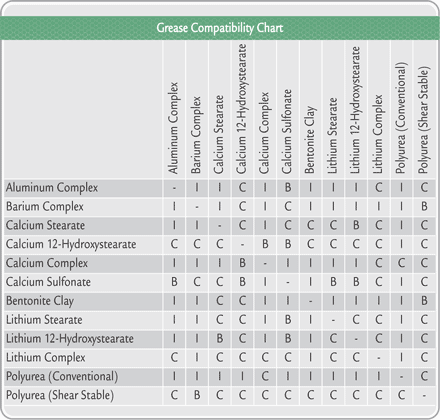
Compatability chart from The Skinny on Grease Compatibility
Articles_200902_grease-compatibility-chart.gif
 
/ Grease Testing
  • Thread Starter
#10  
Mace,

Thanks for the info and link. Great chart!
 
/ Grease Testing #11  
Thanks for the chart and the url reference. If I am reading the chart correctly, I guess that explains why polyurea sometimes has a bad rep for compatibility yet Deere rates their Multi-Purpose SD Polyurea as generally compatible: there are two types of polyurea and presumeably Deere is using the shear stable compatible type.

Two thoughts:

-- Of course grease of any sort is better than no grease

-- Sticking with one broad use grease is probably better than jumping around from one tube to the next and wondering what you have and how compatible it may be.


How many of us have different grease guns with different types of grease for different applications? Is there any real value in that?

Ken
 
/ Grease Testing #12  
How many of us have different grease guns with different types of grease for different applications? Is there any real value in that?

As a general rule moly grease is not good for rolling element bearings, so you probably should have two different grease guns if you want to use a moly grease in certain places.
 
/ Grease Testing #13  
As a general rule moly grease is not good for rolling element bearings, so you probably should have two different grease guns if you want to use a moly grease in certain places.

Mace...How do you figure? Under heat and pressure Moly adheres to metal components creating a protective barrier, reducing friction and increasing the life of the bearing.

What is there about Moly that would be bad to use in a rolling element bearing?
 
/ Grease Testing #14  
I've heard the moly can build up and reduce the clearances in a rolling element bearing to a negative number. When that happens, the bearing self destructs. It doesn't happen every time but it does happen and when it does, it's the last thing anybody ever suspects for the cause of the failure. I've heard that it is related to the particle size of the moly used but I can't find anything definitive on it at this time. Caterpillar did have this to say about their own moly grease...from http://www.biodiesel.org/pdf_files/OEM Statements/2005_OEM_CatVersion9.pdf page 17/78
In addition, the Moly in Cat Ultra 5Moly Grease is a special grade that has a median particle size of 3 microns in order to meet the special requirements of some rolling element bearings.
From Moly??? - Bob Is The Oil Guy
Molakule, I have 6 inches of scar tissue on my derriere from having once recommended a 3% moly grease for all applications for a coal company. Within a few months the company began having u-joint failures galore! On inspection of the U-Joints we found that the moly had centrifuged to the outer portions of the needle bearings, preventing new grease and replenishment oil from reaching the outer portions. In fact the outer portions of the needles had been eroded away from the pure moly! Thus the failures. I then switched them from one universal to two specialized. i.e. Moly additized for the plain bearings and non moly for the non friction bearings. Problem gone.. That was 10 years ago.... I still have the failed U joints in our warehouse as a reminder.
and
I have 5 product data sheets for 3% moly greases from 5 different grease manufacturers that state "for use on heavily loaded sliding surfaces only. Do not use this moly additized grease in non-friction type bearings as the moly will cause premature bearing failures" or some variation of those words.

Also from Engine Bearing Grease
The reason moly is NOT reccomended for ball bearings is because the moly can build up on the race surfaces and reduce the bearing clearances enough to cause bearing failure. Some years back the Model A Ford club reccomended a moly grease for the rear axle ball bearings. There was a rash of axle bearing failures traced to this moly build up on the races. It is in fact an irregular build up of the moly and forms patches on the races and it had the same effect as dirt in the bearing.

And from lithium grease - Page 2 - PeachParts Mercedes ShopForum

Here are a couple of quotes from Exxon regarding their Moly EP type greases (emphasis added):

RONEX EXTRA DUTY MOLY 2 is recommended for high load applications at slow-to-moderate speeds, including applications in the paper, construction, and mining industries, as well as off-highway vehicles operating at 35 mph or less. RONEX MP, with its much lower base oil viscosity of 767 SUS, is designed to meet a wider range of high-speed industrial and automotive bearing applications, including wheel bearings in on-highway use.

Beacon EP 2 Moly is suitable for plain bearings and gears. It also can be used in rolling contact bearings, but is not generally recommended for high-precision rolling contact bearings because of the possibility of molybdenum disulfide building up in the clearances.
(Bold added by me).
I think one should error on the side of caution and not use a moly grease in a rolling element bearing...just in case.
Moly grease can be great for plain bearings (bushings) though.

Did you know...molybdenum disulphide in the presence of water can cause electrolytic corrosion.
 
/ Grease Testing #15  
Virtually everyone of those references are from old technology from Industrial grade Moly at 7 microns. The largest percentage of lubricants fortified with Moly in todays industry uses the 3 micron Moly. Schaeffer's grease uses a Technical grade Moly at .7 microns. At that grade, the protective layer that is built is a micro-fraction of a human hair. It is not mechanically possible for this Moly to throw tolerances off in these bearings or result in corrosion. The "disulfide" aspect of Moly prevents this. Sulfur is an anti-oxident. The corrosion you refer to occurred from raw molybdenum in low quality products trying to compete by offering low cost "Moly" greases.

Old stories about lubricants linger for decades. Technologies change and improve. I still get statements about how you can't switch synthetic and petroleum oils. It doesn't help that a great majority of lubricant sales people have very little technical knowledge of their own products so they make up a bunch stuff when challenged by old ideas.
 
/ Grease Testing #17  
With that said, I'm lazy and would rather have only one type of grease on hand. So I pick whats best for the sealed joints in my trucks, and stick to that. In that case, I like a good moly grease with a Timken load test of at least 80 lbs, but better would be 100 lbs. The soap base doesn't bother me much as its job is to hold the lubricant, but I try to stick with one type to avoid incompatibility.


I know a little about greases, but quite frankly I don't know of a grease with an 80, or 100 pound Timkin Rating. I sell a 70 pound rated grease, and quite a few at around 50, but may I ask who has a 100 pounder?, just curious?
 
/ Grease Testing #18  
Texas Refinery Corporation's #2 grade 880 Crown & Chassis grease has a 100 lb Timken OK load rating. Their #00, #0 and #1 grades of 880 have an 80 lb Ok rating as does their Moly 880 C&C #1 and #2 grades. Their Paragon 3000 has 80lbs for their #1 grade and 100 lbs for their #2 grade.
 
/ Grease Testing #19  
Texas Refinery Corporation's #2 grade 880 Crown & Chassis grease has a 100 lb Timken OK load rating. Their #00, #0 and #1 grades of 880 have an 80 lb Ok rating as does their Moly 880 C&C #1 and #2 grades. Their Paragon 3000 has 80lbs for their #1 grade and 100 lbs for their #2 grade.

Thanks for that info, yes--I know of TRC C&C, a very nice looking tacky red grease that is **** for tough. I did not know the Timkin on it though.
 
/ Grease Testing #20  
As a general rule moly grease is not good for rolling element bearings, so you probably should have two different grease guns if you want to use a moly grease in certain places.

Thats pretty much what I have always heard.

I personally use a good moly (black) for things like pins and bushing on the loaders and backhoes, bushhog tailwheels, etc.
And I use a good (usually synthetic) NON -moly grease for the roller/ball bearings. Currently am using SHC460, but have also used XHP222 (blue) and sta-lube sta-plex EP (red) in the past
 
 
Top