Grid-tied solar

/ Grid-tied solar #101  
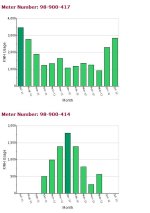
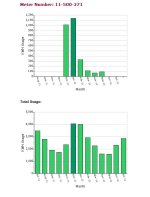
In fact I can supply exact numbers. Meters 1.jpgMeters 2.jpg
The left image shows our consumption at 11 c/kWh rate and the geo consumption at 4.2 cents. The right image shows air/air heat pump installed in the guest room also at rate 4.2 c/kWh and total consumption of the house. The basic load of the house excluding the heat or AC is about 1000 kWh/month. The 4.2 c/kWh is used only in the heating season. AC is charged at normal rate.
Our geo system was expensive due to fact that we have floor heating and AC as well. Forced air system is significantly cheaper. The geo uses waste heat to heat all hot water during AC season.
 
/ Grid-tied solar #102  
Glad to hear your system is doing well. I didn't opt for any PC or Web interface, your display is nice though.

I would recommend you acquire one. We discovered that one of our inverters was going offline for substantial periods and NOT storing error codes on the display. Our wireless monitoring system more than paid for itself, and we have it sitting in the kitchen where everyone can see it.
 
/ Grid-tied solar #103  
Photovoltaics in the northeast is a feel good hobby at best, if you already have public powerlines to your place. I don't care how many people put up forcasted projections. The great technological breakthrough the makers were hoping for back in the 80's never happened. The efficiency still sucks <20%. Then you have all your losse converting storing DC to AC . PR press can't wait up for tech breakthroughs, so everyone in the business has been/ still is still talking it up, even though it can't compete cost wise or convience. If you are in a dry area somewhat close to the equator,solar becomes feasable, but in down-east Maine... sorry. You have to cook the books to make it look cheaper than the grid. Never mind no power during a snow storm, don't forget to go out and clean them off afterwards. Efficiency loss over time? Yup you bet. Look at your cars paint job, or the headlght covers. Look in your rain gutters. Personally, just the thought of mothering a flock of batteries at my house would be a deal breaker by itself. Dealing with a room full of batteries sucks.What's wrong with this one- oh- bad cell, Hey what's that smell, ohh- over charging- just venting.
If you don't have grid power available, then that's a different story.
 
Last edited:
/ Grid-tied solar #104  
wow, i never explored geothermal, but, i'm going to!
after some quick web research, i want to explore the options.
if i were to just convert to geothermal i would save a ton of
heating costs, and then to convert that over to solar would
be a piece of cake. sounds like an awesome combination!
but, how much will all of it cost? that is the magic question.
my existing water well is approx 300ft, so can that be used?
hmmmmmmmmmm
 
/ Grid-tied solar #105  
Geothermal is a much more sound science for your area of the country than solar.
 
/ Grid-tied solar
  • Thread Starter
#106  
I would recommend you acquire one. We discovered that one of our inverters was going offline for substantial periods and NOT storing error codes on the display. Our wireless monitoring system more than paid for itself, and we have it sitting in the kitchen where everyone can see it.

I only have one inverter, so that would be pretty obvious if it quit. It's in a location I walk by several times a day and I watch the display cycle through it's various messages now and then. The inverter does not display the output of the two pv strings independently. I can't compare them to see if they are essentially identical, which they should be. I have been assuming the strings are both functional based upon the total output shown, but I agree that is a "blind" assumption.

Beyond that, if the "In" and "Out" utility meter readings seem to make sense compared with the inverter's display, I assume it is working okay. Lot of "assumings" there but would a more complete interface tell me that much more?

I am not too worried about recalling history, the inverter displays total kWh's and total operation hours since installed, current day's total kWh's and operation hours, and current sampled kWh's for the AC and DC sides. I record some of those readings on paper occasionally. :eek:

Of the missing info, the independent string readings are what I would find most useful -- I think. Does that make sense?
 
/ Grid-tied solar
  • Thread Starter
#107  
wow, i never explored geothermal, but, i'm going to!
after some quick web research, i want to explore the options.
if i were to just convert to geothermal i would save a ton of
heating costs, and then to convert that over to solar would
be a piece of cake. sounds like an awesome combination!
but, how much will all of it cost? that is the magic question.
my existing water well is approx 300ft, so can that be used?
hmmmmmmmmmm

I don't think any solution would be cheaper upfront than adding a wood or coal furnace to your existing hot-air system if you have your own wood-lot. Your fuel price is extremely low, aside from your labor and property taxes. I just couldn't burn coal although I have in the past in Fisher Papa Bear with coal grates :)

Wood does have the continuing labor drawback to it, but seasoned well and burned well in a modern stove, it's also pretty green. In UpState NY you would be relying on a very local resource. If you purchase wood, you are supporting the local economy rather than sending your energy dollars away. And, you will be warm.
 
/ Grid-tied solar #108  
I have been assuming the strings are both functional based upon the total output shown, but I agree that is a "blind" assumption.

On my system, I assumed the production output per day was different from one inverter to the other because of shading. Once I got the data logger I realised what was really happening. I guess in my case it's a little different because I'm selling to the grid, so I'm geeking on maximum output.
 
/ Grid-tied solar #110  
The depth of the well is not as important as the flow it could supply. I think you would be better off with closed loop system. Open system requires heat exchanger maintenance especially if the water is hard. The guy who installed my outside loops has directional drill with which they can install underground loops with only minimal ground disturbance. The drill's shaft doesn't rotate, only the drilling head powered by hydraulic motor supplied by drilling polymer through the hollow shaft. The polymer fills the bore providing lubrication and thermal contact for the pipe they pull underground when they retract the drill shaft back to the machine. They can install loops under trees or a house. One thing about geo to remember is to select system optimized for you climate to get the best efficiency.

If you have ducts already in place the geo "furnace" will fit in with only small modifications.
We paid extra for the floor heating (about 5k more that forced air only). In other words we spent about 13k more than propane burning forced air system. I estimate that we would burn about $2000 in propane/season so the system paid for itself in about 7-8 years.
 
/ Grid-tied solar #111  
Photovoltaics in the northeast is a feel good hobby at best, if you already have public powerlines to your place. I don't care how many people put up forcasted projections. The great technological breakthrough the makers were hoping for back in the 80's never happened. The efficiency still sucks <20%. Then you have all your losse converting storing DC to AC . PR press can't wait up for tech breakthroughs, so everyone in the business has been/ still is still talking it up, even though it can't compete cost wise or convience. If you are in a dry area somewhat close to the equator,solar becomes feasable, but in down-east Maine... sorry. You have to cook the books to make it look cheaper than the grid. Never mind no power during a snow storm, don't forget to go out and clean them off afterwards. Efficiency loss over time? Yup you bet. Look at your cars paint job, or the headlght covers. Look in your rain gutters. Personally, just the thought of mothering a flock of batteries at my house would be a deal breaker by itself. Dealing with a room full of batteries sucks.What's wrong with this one- oh- bad cell, Hey what's that smell, ohh- over charging- just venting.
If you don't have grid power available, then that's a different story.

I've dealt with batteries and solar panels for 30 years and have not had a battery fail early. The panels are vertical for the winter so snow accumulation is not a problem but darkness is. What's your experience? I haven't had to deal with power company for 30 years. Its obvious that the payback will be quicker in an area with more unobstructed sun or areas with high electricity costs.

A true comparison to other energy sources would be a very complex challenge that would include all internal and external present and future costs.

Looks like nearly all states and the Fed offer incentives. It must not be so obvious to them.
http://www.solar-estimate.org/index...solar-incentives&subpage=&external_estimator=

Loren
 
/ Grid-tied solar #112  
As the thread title states, we are talking about "Grid Tied Systems." Batteries should not be part of the discussion. As a PV system owner where electricity costs on average $0.18Kwh (and rising) I believe it makes sense! I can invest my $'s many places elsewhere with less return. I expect my system will still be producing nicely 25+ years from now. What do think a Kwh will cost then?
 
/ Grid-tied solar #113  
As the thread title states, we are talking about "Grid Tied Systems." Batteries should not be part of the discussion. As a PV system owner where electricity costs on average $0.18Kwh (and rising) I believe it makes sense! I can invest my $'s many places elsewhere with less return. I expect my system will still be producing nicely 25+ years from now. What do think a Kwh will cost then?

if typical yearly increase of the rate is 3% 0.18 25 years later will be 0.38.
 
/ Grid-tied solar #114  
I just got a quote for a hardware DIY for a system that would produce about 55000 kWh/ year. $96000 pre-incentive.
180 ea 250W mono panels.
20 kW inverter or add $10000 for 180 micro inverters.
Support structure
disconnect etc.
If their calculation are correct (I doubt they are wrong) the pay back period, assuming constant rate 0.11c/kWh, would be about 11 years.
I think I buy 45 panels and see how it will go.
 
/ Grid-tied solar
  • Thread Starter
#115  
I just got a quote for a hardware DIY for a system that would produce about 55000 kWh/ year. $96000 pre-incentive.
180 ea 250W mono panels.
20 kW inverter or add $10000 for 180 micro inverters.
Support structure
disconnect etc.
If their calculation are correct (I doubt they are wrong) the pay back period, assuming constant rate 0.11c/kWh, would be about 11 years.
I think I buy 45 panels and see how it will go.

Wow. You don't mess around :laughing: Look forward to hearing about your project if you go ahead with it.
You would need to adjust their payback calculation by the fact your are paying less for your heating/cooling usage, whatever percentage that is of your total use.

I looked at micro-inverters. I guess the pros are that they isolate any panel in a sub-array or string from affecting the other panels in that section. The cons seem to be more potential points of failure and cost. FWIW, the people at Revision Energy didn't think they are worth the risks, although they do install some.
 
/ Grid-tied solar #116  
We have 100% electric house. So heating cost is already factored in. Microinverters increase the cost by about 10% but I think they are way to go. Especially for DIY projects.
They provide redundancy, optimize each panel especially if some shading is involved and marginally increase performance of the system. There are few more advantages:
The software that comes with it monitors every single panel/inverter so troubleshooting is relatively easy.
Adding panels is straightforward by just plugging them in.
When you work with panels you deal only with small voltages from single panel. You can turn off the output but not the panel when illuminated. When you work with interconnected panels you work with large life threatening voltages. You have to cover them before working on connections.
 
/ Grid-tied solar #117  
I am reluctant to state this but photovoltaic panels degrade rather quickly over time producung less and less power. To those that want to get off the grid...more power to you. I pay around .06/kW for electricity in my location. I wish they made coal fired home generators.
 
/ Grid-tied solar
  • Thread Starter
#118  
Ladia,

The left image shows our consumption at 11 c/kWh rate and the geo consumption at 4.2 cents

You lost me on the 100% electric home. From your post with the graphs of geo and non-geo use, you aren't paying the same rate for all of your power. I look at that as meaning you need to account for that in calculating payback time as they will differ at 11 cents versus 4.2 cents. If you net-meter only the non-geo 11 cent rate consumption with solar pv, replacing your most expensive electricity, then I see your point.

Will your local utility give you the geo heating 4.2 cent rate and net-metering combined?
 
/ Grid-tied solar #119  
Source of that data? When we were looking, degradation even after 20 years appeared to be minor. Of course, this was sales stuff from multiple companies.

I am reluctant to state this but photovoltaic panels degrade rather quickly over time producung less and less power. To those that want to get off the grid...more power to you. I pay around .06/kW for electricity in my location. I wish they made coal fired home generators.
 
/ Grid-tied solar #120  
Ladia,

The left image shows our consumption at 11 c/kWh rate and the geo consumption at 4.2 cents

You lost me on the 100% electric home. From your post with the graphs of geo and non-geo use, you aren't paying the same rate for all of your power. I look at that as meaning you need to account for that in calculating payback time as they will differ at 11 cents versus 4.2 cents. If you net-meter only the non-geo 11 cent rate consumption with solar pv, replacing your most expensive electricity, then I see your point.

Will your local utility give you the geo heating 4.2 cent rate and net-metering combined?

My electric installation has three meters. One is total power. One is for geo in the house and one for heat pump in the shop building. The power consumed by geo and the heat pump is subtracted from the total and charged at lower rate during the heating season. If I understand interconnection agreement correctly the coop will install another meter measuring power delivered to the grid. The meters are read once a month. If there is excess compared to total power delivered from the grid it is applied as credit for next month etc. If there is still excess at the end of a year it will be converted to cash at rate 3.5 cent or whatever the wholesale rate is at that time. In other words the solar system should be sized to just cover the consumption for the best ROI.
 

Marketplace Items

2015 Ford F-350 4x4 Ext. Cab Liberator 3,200LB 1.5 Ton Crane Mechanics Truck (A55973)
2015 Ford F-350...
2019 KUBOTA KX033-4 EXCAVATOR (A60429)
2019 KUBOTA...
TOPCAT HCRC 72" HYD BRUSH CUTTER (A52706)
TOPCAT HCRC 72"...
2019 LGMG SS1932E ELECTRIC SCISSOR LIFT (A60429)
2019 LGMG SS1932E...
2026 Quality steel dump truck (A56859)
2026 Quality steel...
2014 KOMATSU HM400-3 OFF ROAD DUMP TRUCK (A60429)
2014 KOMATSU...
 
Top