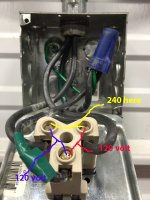
Help! Learning to weld

/ Help! Learning to weld #21  
Have you used this outlet before?
 
/ Help! Learning to weld #22  
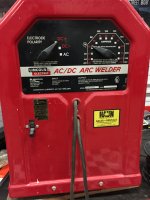
I looked at the welder manual, but learned nothing. It does however, have a fan. Not sure if it has a thermostat.

Have you tried playing with the heat range selector switch?
 
/ Help! Learning to weld #23  
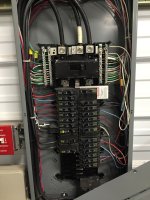
you know it might just be the quality of the picture it looks like both hot legs on one yr but maybe there are actually two wires. I just can't tell by the picture. if indeed there are 2 incoming hots and one ground wire and it hookrd to a 240 breaker, and that breaker is testing 240 against both poles, then I'm not sure what your problem is. if you're sure you're getting to 40 across both hot legs then the issue is something else. I've seen people wire 240 outlet up to both the same phase length in a panel and they get 120 against ground on both but they don't get 240 across both hot. can you take a picture inside the panel what I could see where the wires are landing
 
/ Help! Learning to weld
  • Thread Starter
#24  
I have never used this outlet before, I believe the people that owned the garage before me used it for their welder. I attached some images of the electrical panel, the welder is the bottom breaker on the left side.

Thanks for all of your suggestions
 

Attachments

  • image-3856436470.jpg
    image-3856436470.jpg
    514.6 KB · Views: 218
  • image-2795531506.jpg
    image-2795531506.jpg
    511.3 KB · Views: 254
  • image-1602442578.jpg
    image-1602442578.jpg
    508.3 KB · Views: 252
/ Help! Learning to weld #25  
i got to my main computer and rechecked the pictures. The panel is correctly done and on further look, the outlet is correct. What looked like both wires under a wirenut was actually the wires leaving conduit. The picture over my cell phone looks WAY DIFFERENT THAN BLOWING IT UP ON DESKTOP.

So, if both positive legs show 240 with tester between legs, then the issue is not with the outlet. Next test would to be removal of welder case , then plug in welder and test if theres power to either side of switch. You need to test both incoming power before switch and power after switch.

I had an old lincoln tombstone and if i recall the leads are visable behind a bakelite cover.


image-3568146155 copy.jpg
 
/ Help! Learning to weld #26  
Nicely wired panel!

Did you try to weld on the AC setting? I know the shop gave the welder the OK, but who knows at this point. Maybe the rectifier is gone. Maybe the AC/DC switch is defective. With the welder power turned off, on the AC setting do you get any resistance reading between your welding ground and a hot welding lead? We can't assume that just because you can't hear anything, that the primary supply is at fault, although usually you can hear an unloaded transformer idling and the cabinet resonating slightly. An amprobe would be usefull at this stage, to see if you are getting any idling current going into your transformer (welder).
 
/ Help! Learning to weld #27  
I agree with the electrician (imagine that):) Yes time to carefully take the cover off, and start checking for voltages inside.. Remember your 245 volts will fry you nice and crispy. But that is what I would do. This will tell you if there is a connection problem in the plug or cord with and intermittent connection perhaps. Just be careful, keep one hand in your pocket and think through each step. Unplug from the wall if you need to disassemble further or re-position your leads to measure. Also not a bad idea to have another responsible adult nearby, no kids no pets in the area.

I know, I know I am being a nanny here, but if you are not used to working with high voltage/high current circuits, better safe than sorry.

By the way the fan in those is fairly loud, You are darn sure going to hear it when you switch it on.
 
/ Help! Learning to weld #28  
I agree with the electrician (imagine that):) Yes time to carefully take the cover off, and start checking for voltages inside.. Remember your 245 volts will fry you nice and crispy. But that is what I would do. This will tell you if there is a connection problem in the plug or cord with and intermittent connection perhaps. Just be careful, keep one hand in your pocket and think through each step. Unplug from the wall if you need to disassemble further or re-position your leads to measure. Also not a bad idea to have another responsible adult nearby, no kids no pets in the area.

I know, I know I am being a nanny here, but if you are not used to working with high voltage/high current circuits, better safe than sorry.

By the way the fan in those is fairly loud, You are darn sure going to hear it when you switch it on.

my old tombstone was REAL loud. my new unit just hums.

always do all the cover removals and expose wires while unit is unplugged. if you feel comfidant using a tester, only after all wires are exposed and no open wire can bump against another open wire is it ok to plug it in.

i dont know of any other reliable way to tell of switch is issue. ive gotten resistance showing on bad switches in the past.

then again,,,, 30 years working with open circuits is nothing for me. if your unsure of yourself, this is a DANGEROUS power setting.
 
/ Help! Learning to weld
  • Thread Starter
#29  
I've tried welding on DC+/- and AC with no luck.. I'm going to call the shop tomorrow and see what they say, I will also try to test it at a friends place to see if there is something weird with my supply.
 
/ Help! Learning to weld #30  
learning to weld may be the easier part :)

and keep an eye out for auto darkening helmet. its amazing how much weld quality increases in relation to good helmet
 
/ Help! Learning to weld #31  
well I see both hot wires from the outlet connecting to a single incoming wire. In other words there's two outlets connected on with one incoming wire so is three wires under one wire nut. There's no way in the world you can have 240 that way I'm not sure how you're reading it.
I see three black wires entering the box. One is a ground and goes to a wire nut, allong with a bare copper wire that goes to the box screw, and another short black wire that goes to the outlet ground connection.

The other two black wires go to the remaining outlet connections, as they should.

I would try turning the breaker off and on a few times. Or check the connections at the outlet and circuit breaker. A lose connection can pass enough current to get a voltmeter reading, but not enough to feed your welder.
 
/ Help! Learning to weld #32  
I've tried welding on DC+/- and AC with no luck.. I'm going to call the shop tomorrow and see what they say, I will also try to test it at a friends place to see if there is something weird with my supply.

This would be extremely unlikely, BUT, if you had a very high resistance in your supply lead/leads then you could measure the voltage just fine but when you turned the welder on and attempt to draw an amount of current the voltage would drop to a very low value and not be able to power up the welder.

Again by measuring inside the welder for supply voltage with it turned on would also diagnose this possible, but very unlikely situation.
 
/ Help! Learning to weld #33  
learning to weld may be the easier part :)

and keep an eye out for auto darkening helmet. its amazing how much weld quality increases in relation to good helmet

I felt my welding competency increased about 100% when I bought an auto-darkening helmet.
 
/ Help! Learning to weld #34  
Why not call the repair shop back and ask THEM again what could be wrong or get them to show you it works, maybe offer to pay for a half hour lesson?

/edit - and OP - DO not talk to the welding shop about "dual phase" UNLESS your in the center of Philadelphia and supplied by PECO. The REST of the US is on either single or three phase power. Two-phase electric power - Wikipedia, the free encyclopedia
 
/ Help! Learning to weld #35  
can you put the put the plug partway into the outlet, and reach the prongs with your meters probes?

If you can, see if you get 240v with the welder turned on, and off.
 
/ Help! Learning to weld
  • Thread Starter
#36  
I originally tried doing this, I hooked each probe one to each hot and plugged the cord in as far as I could, I only read 60V across them, the switch was on if I remember. I just assumed this was because they prongs were not making a good enough connection, could this be an issue?
 
/ Help! Learning to weld #37  
I originally tried doing this, I hooked each probe one to each hot and plugged the cord in as far as I could, I only read 60V across them, the switch was on if I remember. I just assumed this was because they prongs were not making a good enough connection, could this be an issue?

I would definately take the cover off, and measure the supply leads with the welder fully plugged in and the welders power switch turned on. This is your next step.
 
/ Help! Learning to weld #38  
I originally tried doing this, I hooked each probe one to each hot and plugged the cord in as far as I could, I only read 60V across them, the switch was on if I remember. I just assumed this was because they prongs were not making a good enough connection, could this be an issue?

Ah Ha!

Check the tightness of all screw connections. At the outlet, at the plug, at the breaker, and any other connections.

Does the plug feel firm in the outlet?
 
/ Help! Learning to weld #39  
I never asked if you were using a Digital or Analogue meter. Sometimes you can get erroneous readings with a digital meter. I was working in a factory last summer doing my security stuff when their in house electrician was getting all flustered. He kept getting voltage on a line that he was sure he turned off. I noticed immediately that another circuit occupied the same conduit. I told him to shut that one off as well and as I expected, his readings went away! He seemed so dumbfounded by it all (the induced voltages that is) and I couldn't believe he had been an industrial electrician for decades!

As for your issue. I would be trying to put another load on that receptacle, or at least take an old (edison) light bulb and put the leads into or onto the receptacle live to ground, each side, not accross both or your bulb will POP.
 
/ Help! Learning to weld #40  
I never asked if you were using a Digital or Analogue meter. Sometimes you can get erroneous readings with a digital meter. I was working in a factory last summer doing my security stuff when their in house electrician was getting all flustered. He kept getting voltage on a line that he was sure he turned off. I noticed immediately that another circuit occupied the same conduit. I told him to shut that one off as well and as I expected, his readings went away! He seemed so dumbfounded by it all (the induced voltages that is) and I couldn't believe he had been an industrial electrician for decades!

As for your issue. I would be trying to put another load on that receptacle, or at least take an old (edison) light bulb and put the leads into or onto the receptacle live to ground, each side, not accross both or your bulb will POP.

That is not a bad idea.. and would help to answer the high resistance supply lead remote possibility too, since the bulb would draw some current.
 

Marketplace Items

2017 JOHN DEERE 333G (A60736)
2017 JOHN DEERE...
2020 Peterbilt 567 Quint Dump (A62613)
2020 Peterbilt 567...
2008 HINO 268 4X2 26FT NON CDL BOX TRUCK (A59906)
2008 HINO 268 4X2...
40' 6 Door Shipping Container (A60352)
40' 6 Door...
RING 2 STARTS HERE @ 9:15 AM (A62130)
RING 2 STARTS HERE...
2002 Bobcat 863 High Flow Compact Wheel Loader Skid Steer (A59228)
2002 Bobcat 863...
 
Top