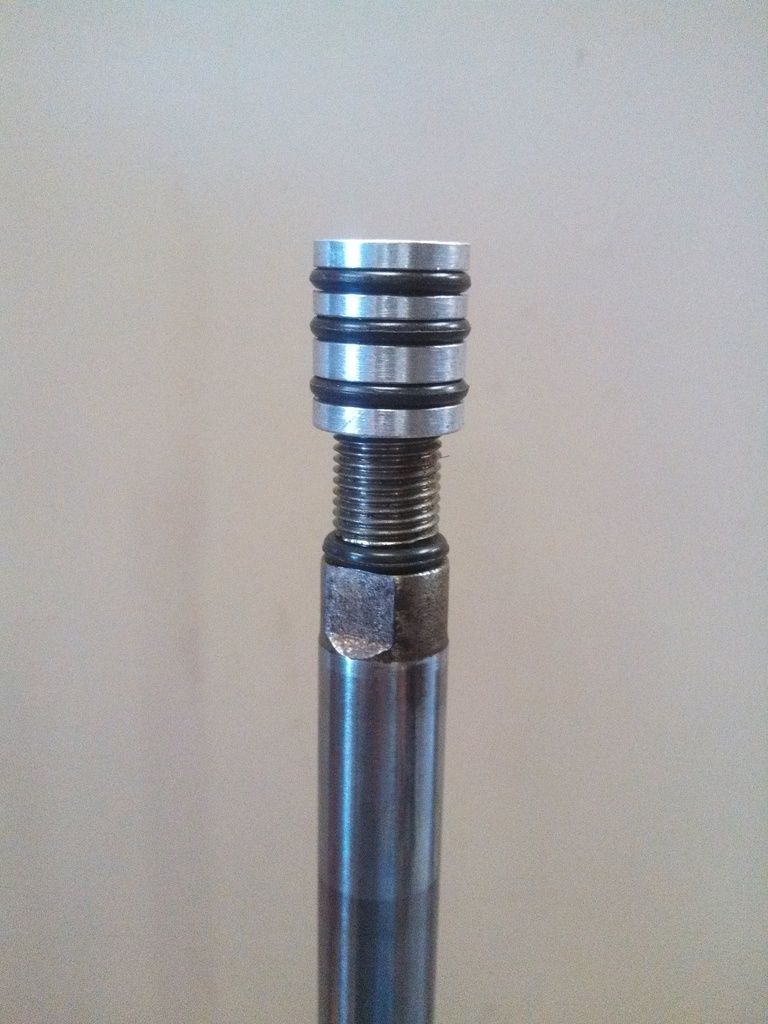
High pressure "boost" pump

   / High pressure "boost" pump #1  

jwmorris

Veteran Member
Joined
Oct 3, 2007
Messages
1,135
I have been interested in PCP air rifles since my daughter was born but didn't like the way folks have to fill them.

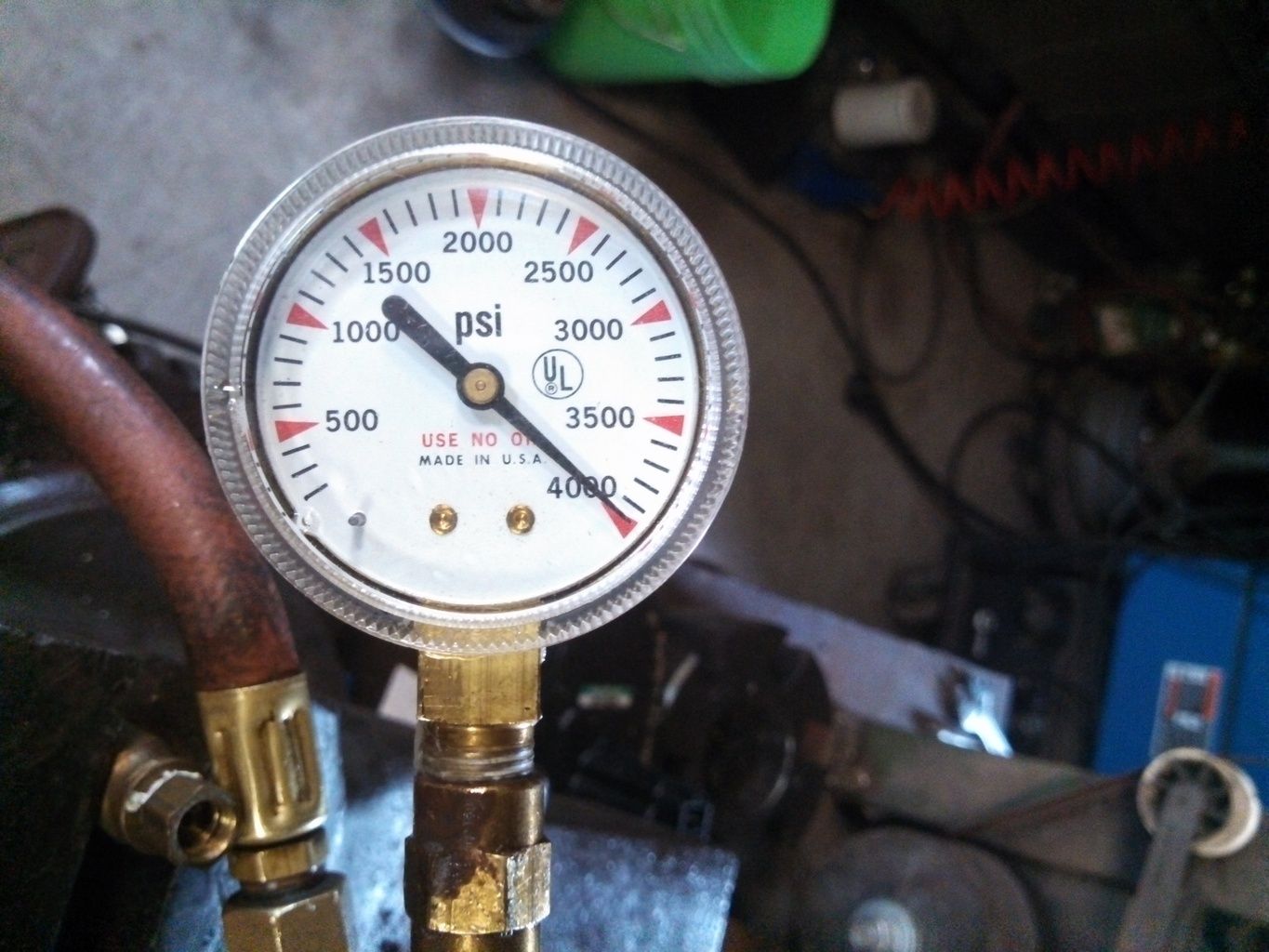
Built a pretty simple booster pump that uses 90 psi "shop" air and boosts my weld tank gasses up from 1500 psi up to the pressures they work at. 2400 psi so far, have to wait on the check valves and 4500 psi tank to get here for further testing.
 
   / High pressure "boost" pump #2  
Looks good. Just be carefull with such high presssures.

Oh, and please turn your phone when taking video that is to go on youtube.
 
   / High pressure "boost" pump #3  
keep us updated, and post more details when done,

Thanks you for the post,
 
   / High pressure "boost" pump
  • Thread Starter
#4  
Check valves just came in.

IMG_20150530_145310_365_zpss4p9j6zw.jpg
 
   / High pressure "boost" pump #5  
That's pretty nifty. What did you use for a seal on the high pressure piston?
 
   / High pressure "boost" pump #6  
Check valves just came in.

Wow. 4kpsi is a lot. Must be some good fittings to handle that kind of force. Did you have any leaks? What kind of tank are you filling, and does it fill fast enough to get hot? My LWS puts a fan on my argon tank when he fills it to 2kpsi. But it only takes a few minutes.
If it was slower, it might not get too hot.
 
   / High pressure "boost" pump
  • Thread Starter
#7  
Alli had on hand the right size were cheap harbor freight o-rings, I really didn't expect them to hold up to 4k psi.

I figured I would at least need a quad seal if not a cup seal, guess if the o-rings don't hold up I'll swap them out.

IMG_20150529_122252_865_zpszn5g2myu.jpg


IMG_20150527_165315_153_zpssxto0l6z.jpg


Brake line fittings so far, the tank is not here yet but it is a carbon fiber 4500 psi 68 cu tank.
 
   / High pressure "boost" pump #8  
Not one to push for safety police however those pressures of "gasses" are very dangerous. Fluids are nothing there as no expansion under a rupture but testing your welds and fittings with gasses is not a good plan. I have run fluids at excess of 60K PSI when working titanium lines & can say even an air bubble can cause explosive results.

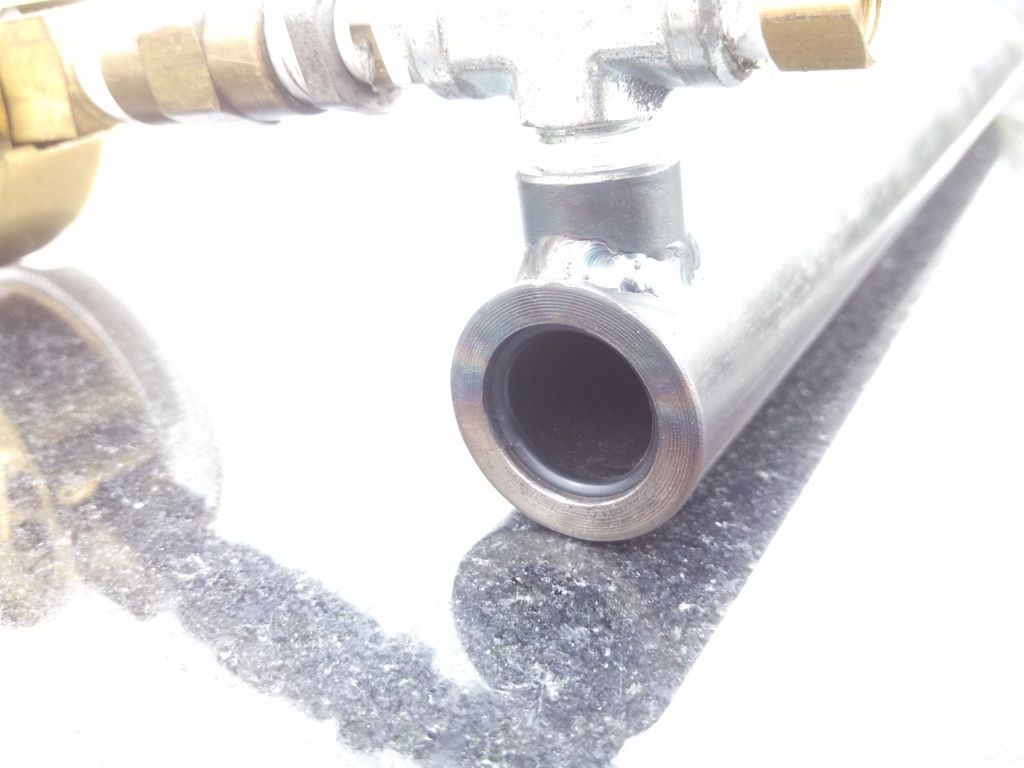
at those working pressures single pas tig welds can/do fail & one on the chamber fitting looks somewhat suspect. Brass fittings also are not good in those pressure ranges under many standards and something picked up at local plumbing supply is not rated anywhere near those pressures. Specifically that brass coupling under the gauge appears to be a standard plumbing part w pipe threads most likely rated under 1200 psi.
 
   / High pressure "boost" pump #9  
Not one to push for safety police however those pressures of "gasses" are very dangerous. Fluids are nothing there as no expansion under a rupture but testing your welds and fittings with gasses is not a good plan. I have run fluids at excess of 60K PSI when working titanium lines & can say even an air bubble can cause explosive results.

Gasses are fluids. I think you mean liquids.
 
   / High pressure "boost" pump
  • Thread Starter
#10  
Yes, testing hydraulically is always safer and good to go over operating pressures by a substantial amount for safety.

In any case the results are what they are.

Just for information and or ideas, attempt at your own risk, etc...
 
   / High pressure "boost" pump #11  
Gasses are fluids. I think you mean liquids.

No, Gasses are (air nitrogen etc in gaseous state) Liquids such as hydraulic fluid or water dont compress for all intensive purpose.

Air compresses and when something lets go it is like a bomb it can really explode with shrapnel.

Fluid does not compress so when something starts to leak pressures drop fast, and no explosion.

M
 
   / High pressure "boost" pump #12  
In physics, a fluid is a substance that continually deforms (flows) under an applied shear stress. Fluids are a subset of the phases of matter and include liquids, gases, plasmas and, to some extent, plastic solids.

that's a copy and paste.

Gasses are fluids, but gasses are not liquids.

IIRC from "high school", Liquids assume the shape of the vessel holding them to the level of fill.

Gasses FILL the vessel that contains them.

Both are fluids.

With that, a pinhole leak can send out a knife of a stream of liquid that will penetrate skin as easily as a razor.

Be careful, use hydraulic fittings and common sense. Typical automotive brake line systems run around 1000 psi. Not a good match for a 4ksi application, but better than plumbing fittings.

Oh! I hand pump my PCPs, it's good exercise and keeps me mindful of where and when I pull the trigger. ;-)
 
   / High pressure "boost" pump #13  
No, Gasses are (air nitrogen etc in gaseous state) Liquids such as hydraulic fluid or water dont compress for all intensive purpose.

Air compresses and when something lets go it is like a bomb it can really explode with shrapnel.

Fluid does not compress so when something starts to leak pressures drop fast, and no explosion.

M

Yah. Got that part.
Gasses store energy when compressed. Liquids don't compress so they pose less of a hazzard.

I guess I wasn't clear.
I was saying that gasses and liquids are both fluids.

You were using the word fluid, where (I think) you should have used the word liquid.

Liquid - Wikipedia, the free encyclopedia

..... On the other hand, as liquids and gases share the ability to flow, they are both called fluids......
 
   / High pressure "boost" pump #14  
So you are using the 2.5" air cylinder to compress the high pressure while it is retracting right?

How are you holding the small tube to the cylinder?
 
   / High pressure "boost" pump #15  
In physics, a fluid is a substance that continually deforms (flows) under an applied shear stress. Fluids are a subset of the phases of matter and include liquids, gases, plasmas and, to some extent, plastic solids.

that's a copy and paste.

Gasses are fluids, but gasses are not liquids.

IIRC from "high school", Liquids assume the shape of the vessel holding them to the level of fill.

Gasses FILL the vessel that contains them.

Both are fluids.

With that, a pinhole leak can send out a knife of a stream of liquid that will penetrate skin as easily as a razor.

Be careful, use hydraulic fittings and common sense. Typical automotive brake line systems run around 1000 psi. Not a good match for a 4ksi application, but better than plumbing fittings.

Oh! I hand pump my PCPs, it's good exercise and keeps me mindful of where and when I pull the trigger. ;-)

yes:

Fluid is ONE of the 4 standard observable states of matter State of matter - Wikipedia, the free encyclopedia others are listed above include Gasses, Solids and Plasmas. The reason I use FLUID is because the "term" most people equates as a "hydraulic fluid or Transmission Fluid." However liquid would be a technically correct term & most people think water when term "Liquid" is used. We are on a tractor site so use of "Fluid" for someone working in a garage making a high pressure pump is in my opinion adequate to get the point across. As for high pressure streams of fluid cutting YES they can and do cut thru steel all day long however again in the instance here he has very low volume of flow vs the pressure & ability to move the flow. To cut/damage the system need high pressure AND high flow to maintain the pressure. Cutting using High Heat and energized-pressurized gas (Plasma Cutting) is very popular as well.

Additional Physics info, GAS can be cooled and compressed to the point it condenses into its "fluid state" (such as propane) or they can precipitate out into it's fluid state (rain water from air/clouds.) A Solid material (1st state) can be heated until it changes into its 2nd state Fluid. It can be heated more to become Gas (3rd state) & continued heating with a charge it can become a PLASMA it's 4th common state. PLASMA is not a state that is easy to attain for most material and most Matter transforms into the 3 other states depending on pressure/temperature. Some will sublimate (transform from solid to gas) & bypass the liquid state such as Dry Ice changes from solid to CO2 gas bypassing the liquid state almost entirely.

M
 
   / High pressure "boost" pump
  • Thread Starter
#16  
So you are using the 2.5" air cylinder to compress the high pressure while it is retracting right?

How are you holding the small tube to the cylinder?

The o-rings on the piston and at the bottom of the tube locate it OD/ID, pressure on the piston from the argon tank drives the HP piston up and the tube down. A "floating"system, it really is as simple as it looks.

That is also how it can get away with just air to the top of the LP cylinder.
 

Tractor & Equipment Auctions

2023 KRT ST650 STAND-ON SKID STEER (A60429)
2023 KRT ST650...
TORO GREENS MOWER (A56857)
TORO GREENS MOWER...
2019 FORD F-150 XLT CREW CAB TRUCK (A59823)
2019 FORD F-150...
2015 JOHN DEERE 1050K WH CRAWLER DOZER (A52707)
2015 JOHN DEERE...
Caterpillar D5G LGP (A53317)
Caterpillar D5G...
NEW Woods 6ft Finish Mower (A56438)
NEW Woods 6ft...
 
Top