How do I stop blowing oil seals?

   / How do I stop blowing oil seals? #1  

ns_in_tex

Platinum Member
Joined
Mar 24, 2002
Messages
924
Location
East Texas
Tractor
Kubota L4610 HSTC, International 2400, Hesston 1280,
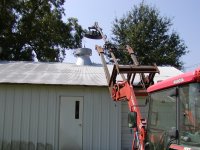
We built a 30" mower for our FEL so we could trim trees up high, ETC.
It is powered by a hydraulic motor. Belt drive. 6" v-belt pulley on motor & 5" v-belt pulley on mower.
We are running 5 to 6 GPM & tractor bypass is set at 2500 psi.
After blowing first seal, we put an adjustable bypass adjacent to the motor & set it at 1800 psi.
Next seal, we backed off on adjustable bypass a little more, but did not set with a gauge.
It does a great job, & may cut things we don't expect it to, for a good while, then it will blow the seal on something, we wouldn't expect it to.
Where am I going wrong. We really don't want to give the mower up.
Motor Specs:
Concentric/ Haldex Barnes 4F657A, Product# G2368956,
Hydraulic Gear Pump/Motor, Birotational.
Displacement: 0.517 Cu In.
Max contiuous PSI 2500
Max intermittent PSI 2750

Do you think we need to set adjustable bypass down more or do we need some kind of heavy duty motor?
Thanks in advance
 

Attachments

  • P9030013.JPG
    P9030013.JPG
    470 KB · Views: 471
  • P9030018.JPG
    P9030018.JPG
    427.3 KB · Views: 457
   / How do I stop blowing oil seals? #2  
Don't most hydraulic motors need a case drain? I would make sure there is a case drain with zero restriction on it.
 
   / How do I stop blowing oil seals? #3  
   / How do I stop blowing oil seals? #4  
Like Ishiboo stated, what type of seals does your motor have?
Do you have any "run down" protection for when you are stopping the motor?

Since the shaft seal is usually connected to the return flow side of a motor I would suspect that you either have to much back pressure in the return line or no run down protection in your circuit.

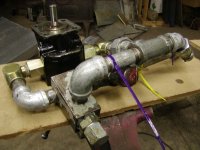
As JJ states: Get rid of the pipe fittings especially the galvanized ones. Oil flowing past the galvanizing will cause the galvanizing to flake off destroying everything in your system.
 
   / How do I stop blowing oil seals? #5  
maybe getting too much back pressure on your return line.....those connections and qc's need to be larger than the inlet side to reduce pressure drop at high flow/rpm

do you have a motor spool in the control valve (free spin when disengaging)

you may need a piston motor w/case drain which can withstand higher pressure/flow and speed
 
   / How do I stop blowing oil seals? #6  
You should have a motor spool valve in the hyd circuit so the motor can wind down.

I can see why you blew the seals if you suddenly stopped the motor.

Use a motor spool valve like this.

Surplus Center - 1 SPOOL 8 GPM PRINCE MB11C5C1 MOTOR SPOOL VALVE

I would think your blade would be turning at about 800 to 1000 rpm, and about 1/2 in thick

At 6 GPM, you are turning that blade at 2681 rpm. I would also be wary about using thin blades above your head, and the bits and parts of tree limbs going everywhere.

How about a picture of the cutter?
 
   / How do I stop blowing oil seals? #7  
Hey J_J , are those little pumps strong enough to handle belt drive? Seems like alot of stress on that little shaft and bearing? Always thought you had to use a Love-Joy on those??
 
   / How do I stop blowing oil seals?
  • Thread Starter
#9  
I can see I have lots to learn about hydraulics.
Many of your replys, we do not know enough to answer intelligently.
1. We are running it off one of our rear Kubota remote valves. We don't know what kind of valve this is, and have no idea if it may be case drain.
2. I think I remember, some times it free wheels down & some times it loads down. We normally try to engage slowly & do same on disengage. Many times it will stall instantly when hits dirt or other solid material.
I will admit to cutting 3" cedar tree on purpose, and steel fence post accidently, but it did not blow at this time.
3. Seal is just normal low pressure oil seal.
4. Spike pressure. Would setting my bypass to maybe 1000 psi lower the spike pressure?
5. Our deck is 1/4" steel, open on front side & protecting tractor side.
6. Blade is 1/2x3 with swing ends, some kind of hard steel we had on hand, but holds cutting edge well.
7. It has always blown seal when it strikes something, not when turning on or off.

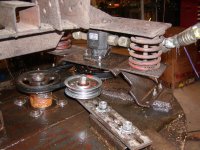
Picture attached with motor & shields removed.
 

Attachments

  • P9030020.JPG
    P9030020.JPG
    460.9 KB · Views: 423
   / How do I stop blowing oil seals?
  • Thread Starter
#10  
We cut with blade rotating counter clockwise, viewing from top.
Deck skirt is also 1/4" steel.
 
   / How do I stop blowing oil seals?
  • Thread Starter
#11  
Another picture with belt guards removed.
 

Attachments

  • P9030010.JPG
    P9030010.JPG
    451.1 KB · Views: 168
   / How do I stop blowing oil seals? #12  
There is no case drain on that motor.

A hyd spike could be a great deal higher than the relief setting, and much faster than the relief can operate.
 
   / How do I stop blowing oil seals?
  • Thread Starter
#13  
There is no case drain on that motor.

A hyd spike could be a great deal higher than the relief setting, and much faster than the relief can operate.

OK, can I increase my chances by slowing tractor rpm's down to get less gpm & try setting relief at 1000 psi?
I think our tractor has a 9 gpm pump, but we normally run the engine while using this about 1300 rpm. If we ran at 1000/1100 rpm, I think we might get 3.5 to 4 gpm output.
 
   / How do I stop blowing oil seals? #14  
Any flow will produce pressure when something is doing work.

Even at 3 GPM, you can develop a spike.

It might even be the side load that is causing the seals to blow.

When you hit something hard, the pressure goes way up.

You might want to consider maybe a 2 to 3 cu in hyd motor with a larger shaft. You will have more torque, and the weight of the blades does most of the work.

Keep them spinning as fast as you can, your flow will determine the rpm, and watch the temp of the fluid.

Again, I would replace the water pipe fittings.
 
   / How do I stop blowing oil seals? #15  
Inlet pressure spikes will rarely blow shaft seals on gear motors. Inlet spikes will crack the gear housings or blow the seals between the gear housing and end plates.

Return line pressure WILL blow the low pressure shaft seal you have in that motor. I suspect it is rated for 10 - 20 PSI max running with possibly 40 -50 PSI momentary spikes in the tank line. Most of these small gear gear motors have bi-rotational checks built in which vents the shaft seal to the low pressure side. If the low pressure (tank or return) pressure gets to high for a given period of time the seal blows.

Excessive plumbing, quick disconnects, etc. all add to this pressure in the return line.

Does this motor have plain bearings with an outboard roller bearing for side load? If yes it was designed for side load use.

If it just has plain bearings or needle bearings it has limited side load capabilities.

Side loading could cause the seal to leak but unless the loading causes excessive internal leakage it should not cause the seal to blow out.
 
   / How do I stop blowing oil seals?
  • Thread Starter
#16  
There is no case drain on that motor.
Does no case drain mean that my return line is operating under pressure?
If so, is there an easy way to get rid of the return line pressure?
 
   / How do I stop blowing oil seals?
  • Thread Starter
#17  
Inlet pressure spikes will rarely blow shaft seals on gear motors. Inlet spikes will crack the gear housings or blow the seals between the gear housing and end plates.

Return line pressure WILL blow the low pressure shaft seal you have in that motor. I suspect it is rated for 10 - 20 PSI max running with possibly 40 -50 PSI momentary spikes in the tank line. Most of these small gear gear motors have bi-rotational checks built in which vents the shaft seal to the low pressure side. If the low pressure (tank or return) pressure gets to high for a given period of time the seal blows.

Excessive plumbing, quick disconnects, etc. all add to this pressure in the return line.

Does this motor have plain bearings with an outboard roller bearing for side load? If yes it was designed for side load use.

If it just has plain bearings or needle bearings it has limited side load capabilities.

Side loading could cause the seal to leak but unless the loading causes excessive internal leakage it should not cause the seal to blow out.
The Grainger catalog says it has outboard bearing, but we do not find what kind of bearing.
I don't think the seal has ever shown signs of leaking until it blows completely out.
What are my options to lower return line pressure, other than larger hoses & fittings.
What size would be recommended for 5 or 6 gpm flow?
We are using 3/8 hose, but it is running from the rear remote disconnects. We also are going through 3 sets of disconnects.

Is there a brand of disconnect which has better flow?
 
   / How do I stop blowing oil seals? #18  
Just make sure there is an open line to tank with no restrictions from the motor out to tank.

QD's will decrease flow unless you go one size up on the QD.
 
   / How do I stop blowing oil seals? #19  
I think JJ and Oldnslow identified the problem: excess pressure in the return circuit. 6 gpm through 3/8" hose has a pressure loss of 2psi/ft; your hose seems to be at least 20 ft long, so that is 40 psi pressure at the motor exhaust. If your quick disconnects are 3/8" also, they are causing pressure drops of 15-20 psi each; three disconnects equals 45-60 psi. That's 85-100 psi pressure at the motor exhaust; then add the mitered elbows, remote valve, FEL valve if the remote is served by power beyond from it, and other fittings, each of which adds 1-2-3 or more psi of pressure. You did not say whether your hydraulic system has a return filter, but if it does that could easily add another 15-20 psi.

I suspect the exhaust pressure at the motor is very close to the manufacturer's limit if not over it.

The only thing that does not fit is your statement that he seals only blow out when the motor stalls. I understand that the momentum of the fluid in the inlet line will cause a pressure spike at the motor inlet, but I am not certain how that pressure spike also seems to appear in the motor case. With the reversing check valves the motor case is connected to the exhaust line through a check valve, so any sudden leakeage past the ends of the gears into the motor case should be handled through the exhaust check valve. Perhaps the motor case is normally at nor slightly over seal design pressure and even a sligght spurt of fluid past the gears into the motor case causes enough additional pressure to blow the seal.

I think your best solution, if you want to keep the 6 gpm rate of flow through the motor, will be a 1/2" return line as short as you can make it, with 1/2" or one size up quick disconnects (and perhaps fewer than 3 disconnects), and a minimum of elbows (which should also be sweep elbows rather than mitered ones).

Please let us know how it works out.
 
   / How do I stop blowing oil seals?
  • Thread Starter
#20  
Thanks to all for the good info & thanks to JJ & others for the heads up on galv piping. We knew that was not according to hoyle, but, we had that and **** I am sure I am the only one that has cut corners. The picture of the hand drives the point home.

Made me think of something else we learned the other day. Cutting steel plate with water. They tell me it looks like it had been drilled or machined. Much better than plazma cutter.

When we get a new seal, will look into what we will try next, from all your suggestions.

Does anyone know the best way to get line direct into the tank? and surely it would not be bypassing the filter?
 

Marketplace Items

2013 PETERBILT 367 DAYCAB (A58214)
2013 PETERBILT 367...
New/Unused Quick Attach Bale Spear (A57454)
New/Unused Quick...
Unused 2025 CFG Industrial QK16R Mini Excavator (A59228)
Unused 2025 CFG...
2019 GALYEAN EQUIPMENT CO. 150BBL STEEL (A58214)
2019 GALYEAN...
DEUTZ MARATHON 60KW GENERATOR (A55745)
DEUTZ MARATHON...
Unused 2025 CFG Industrial MH12RX Mini Excavator (A59228)
Unused 2025 CFG...
 
Top