stuckmotor
Super Member
- Joined
- Sep 23, 2009
- Messages
- 7,652
- Location
- Lower Up State S.C.
- Tractor
- AC WD 34 hp/3500 lbs MF 261 60 hp/5380 lbs
Thanks Shield Arc. I guess I was wrong.

You are welcome!Thanks Shield Arc. I guess I was wrong.

Well I'm no pro, but that's how I've been doing it for years.
Shield Arc,
Would you do it with an AC welder? That's all I have.

lol, I think our terminology is getting confused, caps don't fill holes ( as in a zero volt reference and up ) they smooth out " ripples"/"noise" of a specific voltage and are also used as storage cells. .
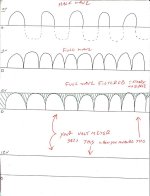
lol, I think our terminology is getting confused, caps don't fill holes ( as in a zero volt reference and up ) they smooth out " ripples"/"noise" of a specific voltage and are also used as storage cells. .
View attachment 456660
here, this might help. and for the other EE's out there, this drawing is OBVIOUSLY not scaled.. freq, etc, waveform errors, etc. it's just a pictogram.
Skyhook... the first line shows half wave dc, an ac wave form ran thru a diode and it chops one half off as the diode oposes current flow in one direction.
the next line shows full wave dc, either a transformer and 2 diodes, or 4 diodes aranges so that the lower waveform is tossed 'up top'.. this makes for a riple-dc.
Now, if you take a capacitor and put across the ground reference and the positive test point. the capacitor will 'fill in' the space between those waveforms. ( of course you must have a large enough cap to filter with... loaded or unloaded circuit will effect that, yada yada..
the third line shows the full wave dc with a steady state line over it and a green hash shaded area.. that's what the cap is doing, the green shaded area.
to your vom, the 4 line is what gets reported... steady state dc.
I considered doing this drawing, but I was lazy. I am glad you posted it.
I realize it's hard for those that are not engineers or tech's to visualize some of these concepts, and how cap's and inductors interact with circuits voltage and current, etc.
hopefully the drawing will help. it's a bad drawing, but i think it will work. the signal 'generator' ( my hand ) needs to be calibrated.

So, if I may ask: What's a good entry level DC welder? Something that's usable for typical farm equipment. I already have a Lincoln SP-175 Plus MIG, but I need something with a little more oomph for 3/8" and up material.
I looked at the old Lincoln AC/DC buzz box, but DC amps are only 125. Doesn't sound like enough.
Thanks,

The 125 amps DC would be fine, but I wouldn't spend "new" price for the AC/DC; think they are around $385-400 and there's plenty of options when you get in that range. I quick Google search returned $400-550; so I wouldn't pay that for one.So, if I may ask: What's a good entry level DC welder? Something that's usable for typical farm equipment. I already have a Lincoln SP-175 Plus MIG, but I need something with a little more oomph for 3/8" and up material.
I looked at the old Lincoln AC/DC buzz box, but DC amps are only 125. Doesn't sound like enough.
Thanks,

So, if I may ask: What's a good entry level DC welder? Something that's usable for typical farm equipment. I already have a Lincoln SP-175 Plus MIG, but I need something with a little more oomph for 3/8" and up material.
I looked at the old Lincoln AC/DC buzz box, but DC amps are only 125. Doesn't sound like enough.
Thanks,
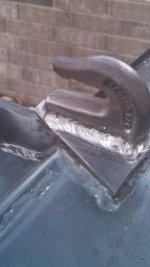
Sure! But with good welding gloves on. Back when I was working I welded a lot with just White Ox cotton gloves. Used those gloves mostly for rigging, but they worked OK for a few quick welds.Shield Arc,
Would you do it with an AC welder? That's all I have.
Looking at the specs as we speak, thanks!!!
:beer:
The PowerArc 200ST really likes ESAB's 10P-Plus 6010.Looking at the specs as we speak, thanks!!!