Ballast How much ballast is too much ballast?

   / How much ballast is too much ballast? #1  

Mike_Kanzer

Gold Member
Joined
Jul 14, 2005
Messages
337
Location
Chester county, PA
Tractor
Kubota L3830 HST, JD Gator 855D
I normally put my bushhog on the back of my L3830 Kubota to use as ballast whem I am doing loader work. It weighs in around 500lbs. I have seen folks on TBN building concerete 3pt ballasts weighing in well over 1000lbs. It seems to me that there must be a point where the ballast works against the tractor. Clearly the ballast plus the load in the loader combine and limit what the tractor is capable of carrying. How would you figure out how much ballast to use so that it isn't working against you? I know it differs based on the size and weight of your tractor, but I would like to know what people think about it.
 
   / How much ballast is too much ballast? #2  
Your Bushog is cantilevered behind the rear axle fulcrum so it acts as more effective balance than its 500 pound weight.

Dedicated Ballast Boxes are used when operators want compact ballast which will only slightly increase the length of their tractor + ballast length-overall. Cultipackers are also often mounted as compact/short/heavy ballast.

Your L3830 Operator's Manual will have a page with suggested ballast loads.

Very generally speaking ballast should be 60% of your FEL lift capacity, assuming your rear tires are not loaded.
 
   / How much ballast is too much ballast? #3  
I normally put my bushhog on the back of my L3830 Kubota to use as ballast whem I am doing loader work. It weighs in around 500lbs. I have seen folks on TBN building concerete 3pt ballasts weighing in well over 1000lbs. It seems to me that there must be a point where the ballast works against the tractor. Clearly the ballast plus the load in the loader combine and limit what the tractor is capable of carrying. How would you figure out how much ballast to use so that it isn't working against you? I know it differs based on the size and weight of your tractor, but I would like to know what people think about it.

I use around 2K pounds on my Mahindra. Seems about right for heavy loader work. I think the maximum lift is somewhere around 3K, so I'm at 2/3 capacity on the 3 point. I know my chipper is around 1K, and the tractor will lift the rear end with the chipper on it, which is why I made a larger weight.

I've never noticed the tractor being limited by overall weight.

The rear is much stronger than the front on a tractor, from tires to axles to frame. The primary reason i use a large weight as opposed to loaded tires and a smaller weight is that the weight behind the rear axle actually removes weight from the front axle. Since my rear axle is incredibly strong, I'd much prefer to load that axle heavy compared to the front.
 
   / How much ballast is too much ballast? #4  
Rear counterweight on the 3 pH should be calculated to work with the fel loading. The tractor ballast should not exceed the weight needed for optimum wheel
slip.

Tractors with excessive weight have to work harder using up available horse power, more fuel wasted. There is a limit to what is reasonable, some people over do it . Some people don't have enough ballast and suffer excessive wheel slip
, besides not having traction needed they also wear down their tread prematurely.
 
   / How much ballast is too much ballast? #5  
There is a limit on the weight the front or rear axle is designed to take--but it is amazing given the weights of the machines; rear ballast loads the rear and lightens the front.

I hear you though-loaded tires plus steel weights, plus some 1/2 ton concrete thingy--some folks must need higher psi for ground engagement or heavy loader work.

I have too much soft ground to go heavy--I like a little flotation in a couple spots!

I don't like when my wheels slip--but I'm glad slippage remains an option. Otherwise something else has to give!
 
   / How much ballast is too much ballast? #6  
Your Bushog is cantilevered behind the rear axle fulcrum so it acts as more effective balance than its 500 pound weight.

Dedicated Ballast Boxes are used when operators want compact ballast which will only slightly increase the length of their tractor + ballast length-overall. Cultipackers are also often mounted as compact/short/heavy ballast.

Your L3830 Operator's Manual will have a page with suggested ballast loads.

Very generally speaking ballast should be 60% of your FEL lift capacity, assuming your rear tires are not loaded.

I dont agree with 60%. I'd say closer to 100%. But depends on where you measure the FEL capacity at, and how far back the counterweight is placed.

My FEL is rated for 1150 @ pins, 1000 @ bucket center, And 850 @ bucket edge.

My 700lb blade is sufficient for most work. It hangs back about 3' to its COG. But when doing max loader work, I still get light. My 1100# bushhog ensures I cannot ever lift the rear. And My barrel ballast is 1000# and is pretty centered on the lift pins. Acts similar to the blade. And all of this with loaded tires.

If you are doing alot of loader work, IMO the limit is what the rear can lift. The more you have back there, the less on the front axle. And the front axle is ALOT smaller than the rear. For a 3830 kubota, I'd say a 500# bushhog is no where near enough. I would want at least a 1000-1200# implement that sticks pretty far back for serious work. But theres a difference between hard FEL work (digging, heavy pallets, etc) and moving a bucket load of gravel and mulch.

If you cannot back up a slight grade on wet grass in 2wd without wheels slipping, then you need more weight.
 
   / How much ballast is too much ballast? #7  
I run 1400lbs on the back of mine when working on the hills and using the grapple. The weight really helps a lot with stability and allows me to safely use the grapple to its full potential. The biggest thing (as mentioned) is getting the correct amount weight for your specific machine for the task at hand.
 
   / How much ballast is too much ballast? #8  
I don't know what you guys are doing for loader work but the front ends on most of these compacts can't handle the weight of a loader with not enough ballast. I have seen and worked on ag tractors from 30hp up to and over 100 hp, with major front end problems because of loader work and not enough ballast. My rule of thumb is with empty bucket front end should have very little weight on it. Old tractors used to have ballast numbers as public knowledge, an old JD 1010 had an operating weight around 4000 lbs, and ballasted weight of 5750lbs so 1750 lbs of ballast for a 35hp tractor. I had a **** of a time getting straight numbers out of my dealer for my JD 790 for ballast. My JD 790 has a backhoe that weighs 800 lbs+-, plus loaded rears, that seams about right for that size. Maybe mine gets used hard, I don't know, it is a farm tractor and works for a living. Just wanted to say I think too much weight is way better than not enough. I have several thousand dollars in that lesson.
 
   / How much ballast is too much ballast? #9  
Depends on what I'm doing:

- moving loose dirt, or gravel in standard bucket - 1000 pounds of rear tire fill plus the ~200 pound brush cage seems to be plenty.
- moving medium size stumps (<2000 pounds) I'll start thinking about putting the rear blade on (extra 500 pounds and sticks way behind the eyes)
- moving things near the loaders limit - I wish I had an extra 1000 pounds. So no, I don't think it's crazy to have a 1700 pound weight on the 3 point with filled tires and wheel weights. Sometimes, that's exactly what you should have! (I will probably put a bar on the rear blade to add weight way back when needed)

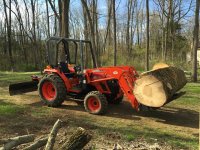
In the picture I'm moving a ~3000 pound log. It was a bit unnerving. 1700 pounds of ballast and I would have greatly appreciated a lot more weight on the rear! If you look at the tires you can see how much weight is on the front axle and almost none on the rear. A previous post was right on that you want a lot of weight in the back and as far behind the rear axle as possible to take weight off of the smaller front axle. Adding weight to the back does not decrease your hydraulic lifting capacity in the front in any way. In fact, it actually increases it because it allows you to actually use the capacity of your loader without tipping.

Tractor with log.jpg
 
   / How much ballast is too much ballast? #10  
You guys have much larger rigs than I, but the same principles apply. In my case, my loader has an 850lbs capacity, and my usual ballast is my box blade with some suitcase weights clipped on it for a total of 680lbs. That gives me 80% of my FEL capacity hanging behind the rear axle. This just feels right for almost every conceivable lifting/scooping job I may come across.

It's a world of difference from the light back blade I started out with in my feeble attempts at ballast. That was downright scary!

Sent from my XT907 using TractorByNet
 
   / How much ballast is too much ballast? #11  
I use my backhoe and loaded tires for ballets. Together they weigh over 3k. My loader only lifts about 2000.
 
   / How much ballast is too much ballast? #12  
When i had a 500# chipper on my tractor, i could only lift aprox 1,500# without lifting the rear end. My tractor specs show 2,700 capacity. With my new 1,000 concrete balkast and filled rears, i have easily lifted 2,200 pound pallet of concrete. 2,200 concrete plus 425# listed weight of forks = pretty dang close to spec for lift.... And the rears didnt even lift
 
   / How much ballast is too much ballast? #13  
I have a smaller tractor (B2910) - the FEL is an LA 402 - the 402 number is the capacity (in kilos) to the bucket center ... in other words 885 lbs more or less. To the pivot pin, it's 1060 lbs.

Until I built my ballast block I used to use my box blade which is around 514 lbs or so. It was really too light (IMO)

(Additional note: My rear tires are unloaded, as I use the tractor as our primary mower and don't want to be rutting up and compacting the lawn)

I suspected that the PRV on my loader was set low and when I checked it I found that it was low by 200 psi. So I shimmed it and bumped it to 200 psi over the factory spec. Don't really know what my loader's lift capacity is now, but when I built the ballast block I wanted something beefy to take the weight off the front axle - especially having read of multiple instances of the front stub axles breaking on this series tractor.

The 3PH has a rated lift capacity of 1655 lbs I believe at the pins, and 1300 lbs 24" behind the pins.

When I built the ballast block I used enough concrete - 7.6 cu ft - to give the block a weight of 1140 lbs. In reality, it probably weighs closer to 1200 lbs, due to the amount of steel used in it's construction.

When I initially tried to pick it up with the 3PH it wouldn't lift it ... at least not without pulling the top link in all the way, to tip the block forward. And even then it would just barely pick it up.

Did some more checking and found the PRV for the 3PH was also set 200 psi below the factory spec. I added one 0.4 mm shim to the 3PH PRV and that allowed the 3PH pick up the ballast block easily with about 2000 psi (factory spec on this tractor is 1992 psi)

When I pick up the ballast block on the 3PH you can feel the tractor really squat down ... very noticeably ... probably from the tires squashing down a bit. I don't believe I'd ever noticed that with anything else on the 3PH.

It feels solid and really well planted on the ground now ...

I take it pretty easy when I have the ballast block on and don't go tearing around at speed over rough terrain.

I haven't used the tweaked up loader or the ballast block all that much yet ... but I know I can pick up the ballast block now with the loader using the pallet forks. Assuming my calcs on the weight are correct, it appears that the loader is capable of picking up more than it's rated capacity.

I also know I've picked up some logs with the pallet forks that I probably could not have before I added the ballast block and did the mods to the PRV's.

Having had the experience of almost flipping the tractor several times while doing loader work in my early experiences with it, I really like the idea of a little more ballast rather than a little less ballast. And the fact that the front axle is seeing less stress, as a consequence of being unloaded far more than it ever was with just my box blade is somewhat reassuring as well.

IMG_2085.JPG

IMG_2077.JPG
 
Last edited:
   / How much ballast is too much ballast? #14  
1417445525032.jpg

1700lb roughly counterweight and I don't think its quite enough with loaded rears and steel weights. I sure wish I could get cast rims! 3200lbs roughly at 24" on the 3pt, so I could have definitely went higher. I believe the 563 loader specs around 4,000lbs or so.
 
   / How much ballast is too much ballast? #15  
View attachment 423050

1700lb roughly counterweight and I don't think its quite enough with loaded rears and steel weights. I sure wish I could get cast rims! 3200lbs roughly at 24" on the 3pt, so I could have definitely went higher. I believe the 563 loader specs around 4,000lbs or so.

Now that's a counter weight!!!
 
   / How much ballast is too much ballast? #16  
View attachment 423050

1700lb roughly counterweight and I don't think its quite enough with loaded rears and steel weights. I sure wish I could get cast rims! 3200lbs roughly at 24" on the 3pt, so I could have definitely went higher. I believe the 563 loader specs around 4,000lbs or so.

Now that's a counter weight!!!
 
   / How much ballast is too much ballast? #17  
Now that's a counter weight!!!

:thumbsup: yeah it is! I broke the pins on the drawbar that went through it. Cat 1 was not heavy enough with bushings! SO, I'm going to get some grade 8 bolts and weld them on!
 
   / How much ballast is too much ballast? #18  
I think the overall length of the tractor makes a big difference as well. The tractors with a shorter wheel base, (compacts) will need more ballast the ones with a longer wheel base, (row crop).

I have an Oliver 1655 row crop 70 hp tractor with a Dual 3100 loader, 3" lift cylinders. The loader is rated for up to a 150 hp tractor. I have 18.4-34 tires with calcium water. This works fine without additional weight/ballast for dirt work.

However, when I am using the grapple/forks for lifting whole trees up to 24" diameter, I have to have my boom on the back with the winch for ballast. (Approximately 500 lbs.)
 
   / How much ballast is too much ballast?
  • Thread Starter
#19  
I had forgotten that my rear tires are loaded which obviouly markedly increases the rear ballast weight. My L3830 will lift 1400 lbs at 50 cm on the front end loader (LA723) and is rated to lift 2760lbs at 2ft for the 3pt. I guess with the mower and rear filled tires I am ballasting about 1400-1500lbs. It seems to be stable when I am hauling manure or turning the compost pile. Thanks for the info guys - very helpful. Mike
 

Marketplace Items

UNUSED FUTURE SB45 EXCAVATOR HYD SILENT BREAKER (A60432)
UNUSED FUTURE SB45...
Pat's QH and hydraulic top-link.
Pat's QH and...
2022 Schulte 2500 Giant Rock Picker (A56436)
2022 Schulte 2500...
Volvo L306 (A57148)
Volvo L306 (A57148)
2004 Pierce Tilt Crew Cab Enforcer Fire Truck (A59230)
2004 Pierce Tilt...
FUTURE 60" PALLET FORK (A60432)
FUTURE 60" PALLET...
 
Top