How to do engineering calculations?

   / How to do engineering calculations? #21  
I thought he was asking about building a simple ramp... I'll re-read his post as I must have missed where he asked about getting an engineering job designing aircraft fuselages.

I think reading a book about welding would get you started in welding a few simple projects, like maybe a ramp or something to begin with.
 
   / How to do engineering calculations? #22  
Why read a book when you have the internet and youtube? All you would ever need to know...

Seriously, they are many things you can learn and do on your own with the help of the internet. Building a skyscraper is not one of them however :)

Or what he said...
 
   / How to do engineering calculations? #23  
The title of the OP asks "How to do engineering calculations?"

...To me this means that the OP would like to learn a little about the theory behind a task for a project...not just mimic something arbitrarily...
 
   / How to do engineering calculations?
  • Thread Starter
#24  
Thanks to everyone for the replies. I'm going to have to read and reread the thread to get an understanding of the options presented and decide which way to go. Not much time to go through it right now.
I will try to get the trailer laid out and get pics of the bowing so you can get an idea of where the problem lies, with different angles of pics and such.
I am not trying to get an engineering degree from the internet. I still wish that was the field I had chosen young in life, but there was no money for the schooling at that time. I ended up being a SQL Server DBA, which I like, as long as I can partake in my one of my favorite activities, things involving large machinery and a welder.
The big thing here is I would like to know how to be a bit more scientific about designing and building things so that in cases where size, or weight matters, I can make the right decisions. No, there are no space shuttles or sky scrapers in my future, but some small time engineering so I can build cool things like I see in these forums.
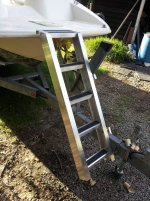
Here's a pic of the boat trailer ladder I designed and built from aluminum this summer. I experimented with that by cutting up an old step ladder and clamping it onto the trailer. After I saw how badly it would twist when a little weight was added, I decided to make it out of 1/8" x 1.5" x 3" channel. It turned out really nice, and clamped in two places on the trailer, is solid as a rock.

20130705_185826.jpg

Thanks again,
Chris
 
   / How to do engineering calculations? #25  
TORQUIN,
Just recognize that some of the projects you will see are over built simply to add weight to the implement. For your ramp I would guess that that 1.5x3.0 rectangular box tubing with .125 wall thickness would work for you and still be light enough to lift easily.
 
   / How to do engineering calculations? #26  
As has been suggested check out trailers with ramps and copy.:thumbsup:
 
   / How to do engineering calculations? #27  
I'm with you Egon,
I wouldn't mess about trying to redesign that tailgate for 3000#.
Just make some ramps.
Fini
 
   / How to do engineering calculations? #28  
The equations do take a while to get used to. I suggest getting an fe exam practice book as your first reference then buying more books on what specific topic you are interested in. The guys that say you can't learn it on your own are wrong. You just need to do lots of practice problems to get a feel for it. Statics for dummies would be another good starting point.
 
   / How to do engineering calculations? #29  
Machinery's Handbook has detailed information about engineering calculations for about any shape beam you can think of. I think you can download it free online.
 
   / How to do engineering calculations? #30  
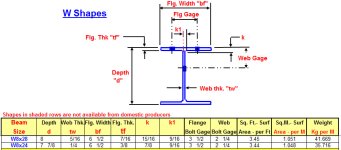
The problems with the angle is that it doesn't put enough material far enough away from the centerline. W flange beams are the stronest for a clean loading situation, but they are hard to connect. Pipe is OK, but the amount of material parallel to the centerline is minimal. Square tube has the max material parallel to the centerline so it's strong and the square shape is easy to work with. For your application, some channel would work nicely. Flat face is easy to weld and it still has significant material parallel to the centerline. The disadvantage to a channel is that it's not symetrical around the Y axis so it will be prone to buckling. That said, it'll still work for your application. Don't forget to make the lap connection long enough to restrain the rotation at the conneciton points.
 
   / How to do engineering calculations? #31  

Attachments

  • SNAG-0003 11-26-2013 3.55.25 PM.jpg
    SNAG-0003 11-26-2013 3.55.25 PM.jpg
    646 bytes · Views: 243
   / How to do engineering calculations? #32  
Beams deflect first, then fail. The main reason you see H shapes is to avoid deflection.

A good old welder ounce showed us a trick. He showed us that if you could stop a piece of paper from deflecting it would support a huge amount of wieght. Just think about making a header, two 2 by 10's. Now put a layer of tin between them, huge strength increase

My point is, it's the deflection that leads to failure. Looking at the original posters picture, I would add a couple mid field 1-1/2 angle braces welded to the top and bottom rails. This would spread the load, and stop the expanded metal from deflecting and pulling on the perimeter.
 
   / How to do engineering calculations? #33  
Beams deflect first, then fail. The main reason you see H shapes is to avoid deflection.

A good old welder ounce showed us a trick. He showed us that if you could stop a piece of paper from deflecting it would support a huge amount of wieght. Just think about making a header, two 2 by 10's. Now put a layer of tin between them, huge strength increase

My point is, it's the deflection that leads to failure. Looking at the original posters picture, I would add a couple mid field 1-1/2 angle braces welded to the top and bottom rails. This would spread the load, and stop the expanded metal from deflecting and pulling on the perimeter.


I'm reaching back in my memory banks but IIRC Deflection is not a failure mode unless the beam is unrestrained and slides off of the supports. Deflection is a controlling characteristic because a beam sagging under a load is very unnerving to the average person even though its safely carrying a load. Many of the design projects that I did were controlled by deflection if the connection points held through their failure analysis.


Torsional buckling, shear, crushing and a few others are failure modes.
 
   / How to do engineering calculations? #34  
Deflection is OK as long as it's within the elastic limits of the material and acceptable for the design/situation. Beams deflect and come back to normal all the time.

Now, buckling, which I think is the real point of AK's post, is a problem. That's when the beam/member goes off in another direction from the applied load, and all **** breaks loose. Column buckling is a prime example, which is why columns are often a lot larger radially than they need to be for a pure compression load. They need the extra beef to resist buckling from asymmetric loads.
 
   / How to do engineering calculations? #35  
I agree, deflection is not failure, sorry to get that mixed up.

I do hope that after all this the OP can find a simple fix to meet his needs
 
   / How to do engineering calculations? #36  
Quote Originally Posted by Shield Arc View Post
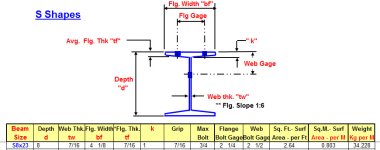
So why does the same height W-shape take more weight than the same height S-shape?

Because it places more material from the center line.
 
   / How to do engineering calculations? #38  
I like one of the earlier responses, by s219, that encouraged you to look at other, successful designs and to copy them, making improvements where needed.
To quote Tom Lehrer:
...let no one else's work evade your eyes. Remember why the good Lord made your eyes, so don't shade your eyes, but plagiarize, plagiarize, plagiarize! Only be sure always to call it, please, "research".
This is fine so long as you are doing this for your own use and not for profit.
If for profit, you will need to copy much more carefully.

Or you can execute your own design.
How to do engineering calculations?
Rule #1: Assume that you are wrong and review all of your assumptions.
Rule #2: When you have convinced yourself that you are no longer wrong, have someone else (who's judgment you deeply respect) review your work.
Rule #3: After you have fixed the dumb mistakes that your checker has pointed out, it's time to build a prototype and do some testing in the sandbox, before you commit time and materiel to a finished product. The prototype should be unpainted and easy to alter once you determine that you were wrong, again.
Rule #4: Test the prototype. Murder cycle - test it to failure and see how much margin (safety factor) you have designed into it. Ask yourself if this is enough margin to trust your best friends' life on.
Rule #5: Make appropriate changes, weld, then paint. Enjoy.

Engineering calculations are only as good as the assumptions that guide their use.
A gun is only as dangerous as the person holding it.
Either be humble in design or prepare to be humbled by your design.

This is not for everybody, but if you can live with the occasional ego crushing failure and take precautions to isolate the risk to a tolerable level, it can be a very satisfying thing when your product begins to work as you had intended.
 
   / How to do engineering calculations? #39  
I like one of the earlier responses, by s219, that encouraged you to look at other, successful designs and to copy them, making improvements where needed.
To quote Tom Lehrer:
...let no one else's work evade your eyes. Remember why the good Lord made your eyes, so don't shade your eyes, but plagiarize, plagiarize, plagiarize! Only be sure always to call it, please, "research".
This is fine so long as you are doing this for your own use and not for profit.
If for profit, you will need to copy much more carefully.

Or you can execute your own design.
How to do engineering calculations?
Rule #1: Assume that you are wrong and review all of your assumptions.
Rule #2: When you have convinced yourself that you are no longer wrong, have someone else (who's judgment you deeply respect) review your work.
Rule #3: After you have fixed the dumb mistakes that your checker has pointed out, it's time to build a prototype and do some testing in the sandbox, before you commit time and materiel to a finished product. The prototype should be unpainted and easy to alter once you determine that you were wrong, again.
Rule #4: Test the prototype. Murder cycle - test it to failure and see how much margin (safety factor) you have designed into it. Ask yourself if this is enough margin to trust your best friends' life on.
Rule #5: Make appropriate changes, weld, then paint. Enjoy.

Engineering calculations are only as good as the assumptions that guide their use.
A gun is only as dangerous as the person holding it.
Either be humble in design or prepare to be humbled by your design.

This is not for everybody, but if you can live with the occasional ego crushing failure and take precautions to isolate the risk to a tolerable level, it can be a very satisfying thing when your product begins to work as you had intended.

That is some of the best engineering advice I think I have ever seen given on this forum. BabyGrand thank you for that excellent post. I have only one thing to add from my engineering degree.
K.I.S.S.
Keep It Simple Stupid The fanceir your make something, the more ways it is possible for it to fail.
 
   / How to do engineering calculations? #40  
That is some of the best engineering advice I think I have ever seen given on this forum. BabyGrand thank you for that excellent post. I have only one thing to add from my engineering degree.
K.I.S.S.
Keep It Simple Stupid The fanceir your make something, the more ways it is possible for it to fail.

Thanks, Red!
And good you remembered to mention K.I.S.S. (I knew I was forgetting something) - that makes things so much easier.
 

Tractor & Equipment Auctions

2007 Ford F550 Superduty. 6.0 Powerstroke - 90k Miles (A56438)
2007 Ford F550...
2021 CATERPILLAR 299D3 SKID STEER (A60429)
2021 CATERPILLAR...
2011 Chevrolet Silverado 2500 Pickup Truck, 127808 Miles, Utility Rack - GREAT WORK TRUCK (A56438)
2011 Chevrolet...
2012 Husqvarna LTH18538 38" Riding Mower (A59231)
2012 Husqvarna...
2020 Bobcat MT85 (A53317)
2020 Bobcat MT85...
2007 MACK GRANITE CV713 DUMP TRUCK (A60430)
2007 MACK GRANITE...
 
Top